The K2 Bottleneck vs Everest's Khumbu Icefall: Altitude, Deaths & Which Is More Dangerous
By Blake Penson · February 22, 2022
Category: route-comparisons
6 min read
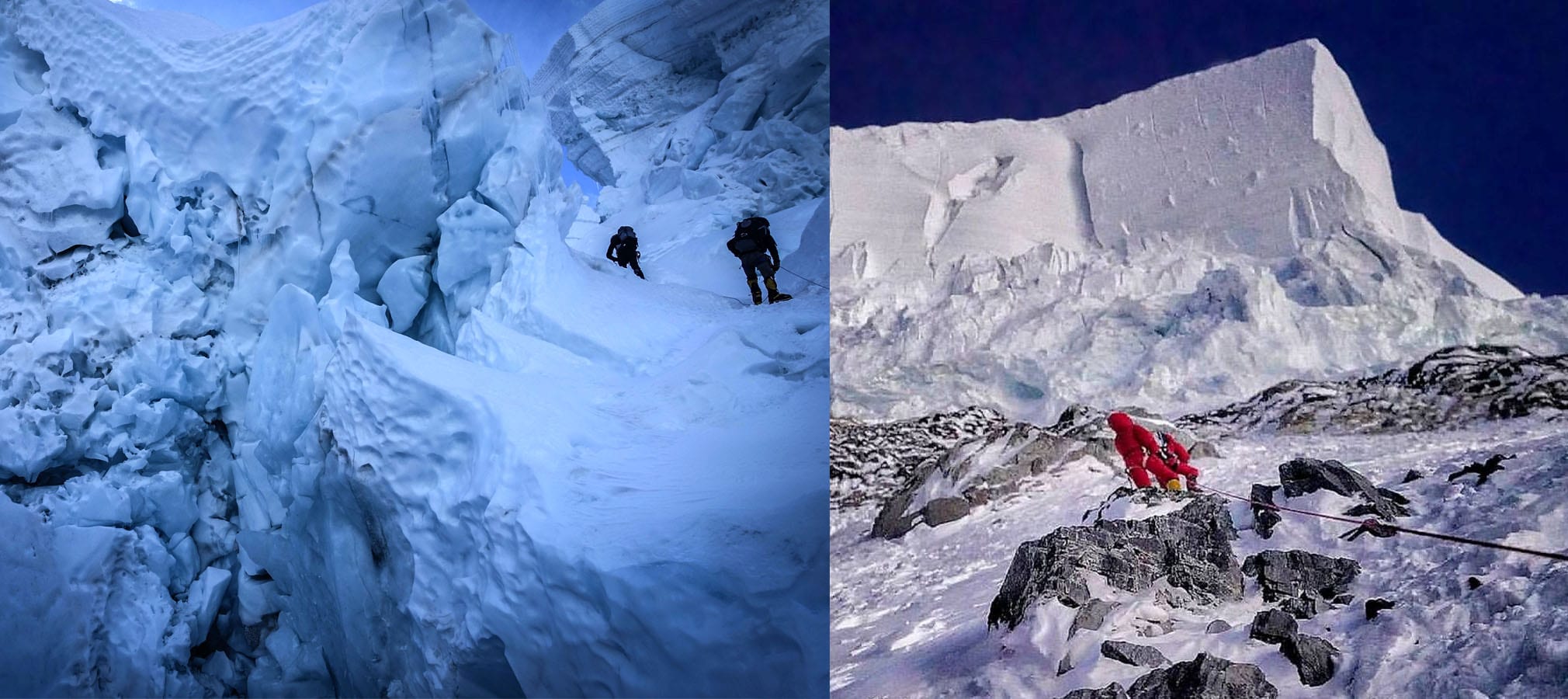
The Bottleneck on K2 is a narrow, steep snow-and-ice gully at about 8,200–8,300 metres (26,900–27,200 ft), directly beneath a huge overhanging ice cliff (a serac). Climbers must go up it, then traverse left under the serac, on summit day. It is the most dangerous section of K2's standard routes. The Khumbu Icefall on Everest is a constantly moving maze of crevasses and ice towers between roughly 5,400 m and 6,000 m (17,700–19,700 ft), just above Everest Base Camp. It is the most dangerous section of Everest's South Col route. The Bottleneck is more technical and sits deep in the death zone, where a single mistake or serac collapse can be fatal and rescue is almost impossible. The Icefall is lower and less steep, but climbers cross it many more times, and it has killed more people overall, mostly Sherpa workers. Most experienced high-altitude guides, including Lukas Furtenbach, who has led expeditions on both mountains, rate the Bottleneck as the more dangerous feature for any single climber.
This guide explains what each feature is, where it sits, its history and death toll, how climbers cross it today, and how the two compare on height, steepness, exposure, time spent and risk. It also covers what else people call a "bottleneck" on Everest.
| K2 Bottleneck | Everest Khumbu Icefall | |
|---|---|---|
| Altitude | ~8,200–8,300 m (26,900–27,200 ft) | ~5,400–6,000 m (17,700–19,700 ft) |
| Type of hazard | Steep couloir under a hanging serac | Moving icefall with crevasses and seracs |
| Steepness | ~40–50°+ | Mostly 20–40°, with vertical walls crossed by ladders |
| In the death zone? | Yes | No |
| Crossings per climber | Usually 2 (up and down on summit day) | Often 6–10 per expedition; Sherpas 20+ |
| Worst disaster | 2008: 11 deaths on K2, many tied to serac fall in and above the Bottleneck | 2014: 16 Nepali climbers killed by an ice avalanche |
What is the Bottleneck on K2?
K2 (8,611 m / 28,251 ft) rises on the border between Pakistan and China in the Karakoram. It is the world's second-highest mountain and the highest point in the Karakoram range. Most climbers use the Abruzzi Spur on the south-east ridge, first climbed by an Italian expedition in 1954, or the nearby Cesen route (south-south-east spur). The two routes meet below the shoulder of K2 at about 7,600–7,900 m. From there everyone heads to the same place: the Bottleneck.
The Bottleneck is a narrow couloir (gully) of snow and ice that cuts through the rock band above the shoulder, at roughly 8,200 m. It is about 100 m long and steepens to around 40–50 degrees, with patches of hard ice and rock. Directly above it hangs a massive serac, an unstable cliff of glacial ice often described as being more than 100 m high, that caps K2's summit pyramid. At the top of the gully, climbers make a long, exposed traverse to the left beneath the serac before climbing snow slopes to the summit, about 400 m higher.
Where exactly is the Bottleneck?
| Point on K2 (Abruzzi Spur / Cesen route) | Approx. altitude |
|---|---|
| K2 Base Camp (Godwin-Austen Glacier) | 5,000–5,150 m (16,400–16,900 ft) |
| Camp 1 | ~6,050 m (19,850 ft) |
| Camp 2 (above House's Chimney on the Abruzzi) | ~6,700 m (22,000 ft) |
| Camp 3 (below the Black Pyramid's top) | ~7,200–7,350 m (23,600–24,100 ft) |
| Camp 4 (the Shoulder) | ~7,600–7,900 m (24,900–25,900 ft) |
| Bottleneck couloir | ~8,200–8,300 m (26,900–27,200 ft) |
| Traverse under the serac | ~8,300–8,400 m (27,200–27,560 ft) |
| Summit | 8,611 m (28,251 ft) |
Camp heights vary from year to year with snow conditions and team choices.
Why is the K2 Bottleneck so dangerous?
The Bottleneck combines nearly every serious mountain hazard in one short stretch:
- Falling ice. The serac above the Bottleneck calves without warning. Chunks of ice from refrigerator-size up to house-size can sweep the gully and the traverse.
- Steepness and exposure. A slip in the gully or on the traverse can mean a fall of thousands of metres down the south face.
- Altitude. At 8,200 m+, climbers are deep in the death zone, hypoxic, exhausted and slow. Many climb it without supplemental oxygen.
- Timing. Climbers usually reach the Bottleneck in the dark, between about 2 am and 6 am, and come back down it in the afternoon, often in failing light and while exhausted.
- Crowding. In busy years dozens of climbers queue on a single fixed line. Delays mean more time under the serac and more time in the death zone.
- No escape and almost no rescue. There is no alternative route through the rock band. Helicopters cannot work at this height on K2, and carrying an injured climber down is extremely difficult.
The 2008 K2 disaster and other Bottleneck tragedies
The Bottleneck's reputation was sealed on 1–2 August 2008, when 11 climbers died on K2 in the mountain's worst single accident. Delays in fixing ropes slowed a large group of climbers through the Bottleneck and many summited late in the day. During the descent, serac collapses from above the traverse swept away climbers and cut fixed ropes, stranding others above the Bottleneck in the dark. Some climbers fell, some died of exposure and some went missing. Several Sherpa and Pakistani climbers died trying to rescue others.
Other notable incidents in or near the Bottleneck:
| Year | Event |
|---|---|
| 1986 | "Black Summer": 13 deaths on K2 over the season, several high on the mountain after storms |
| 1995 | A storm near the summit killed seven climbers, including Britain's Alison Hargreaves |
| 2008 | 11 deaths, many linked to serac fall above the Bottleneck traverse |
| 2021 (winter) | First winter summit on 16 January by a Nepali team; several climbers died that season, including Ali Sadpara, John Snorri and Juan Pablo Mohr, last seen high on the mountain |
| 2023 | Pakistani high-altitude porter Muhammad Hassan fell and died at the Bottleneck on 27 July as dozens of climbers passed |
How many people have died on K2?
| K2 statistic | Figure | Note |
|---|---|---|
| First ascent | 31 July 1954 (Achille Compagnoni, Lino Lacedelli) | Italian expedition, Abruzzi Spur |
| Total summits (all time) | 964 | To end of 2025 (Broad Peak Adventures compilation) |
| Total deaths (all time) | roughly 90+ | Estimate to end of 2025; sources vary |
| Record season | ~200 summits (2022) | Press reports |
| 2024 season | ~65 summits | Alan Arnette |
| 2025 season | 42 summits, 2 deaths (rockfall lower on the route) | Alan Arnette |
Historically, K2 has had far more deaths per summit than Everest. Before 2000, roughly one climber died for every four who reached the top. The ratio has improved sharply with commercial fixed ropes, better forecasting and bottled oxygen, but K2 is still one of the deadliest 8,000 m peaks. A large share of its deaths happen on the upper mountain, many in or near the Bottleneck and its traverse, often on the descent.
What is the Khumbu Icefall?
The Khumbu Icefall is the steep, broken section of the Khumbu Glacier where it pours out of the Western Cwm (the valley between Everest, Lhotse and Nuptse) and drops toward Everest Base Camp. It is the first major obstacle on the South Col route and starts almost straight out of Everest Base Camp.
| Khumbu Icefall fact | Figure |
|---|---|
| Lower end (top of base camp) | ~5,400 m (17,700 ft) |
| Upper end (Camp 1, entrance to the Western Cwm) | ~6,000–6,100 m (19,700–20,000 ft) |
| Vertical gain | ~600 m |
| Approximate length of route | ~2.5–4 km (varies each season) |
| Glacier movement | Roughly 1 m (3–4 ft) per day in places |
| Typical crossing time | 6–12 hours for clients on the first crossing; 3–5 hours later in the season; Sherpas often faster |
| Route maintained by | The "Icefall Doctors", a specialist Sherpa team managed by the Sagarmatha Pollution Control Committee |
Why is the Khumbu Icefall so dangerous?
Glacial ice flows downhill like a very slow river. Where the Khumbu Glacier drops over a step in the bedrock, it cracks into deep crevasses and tall, unstable seracs (ice towers), some as big as buildings. Because the glacier moves continuously, crevasses open and seracs fall with little warning, at any time of day or night. On top of that, the icefall sits under the hanging glaciers of Everest's west shoulder and Nuptse, which can drop avalanches straight across the route.
To cross it, climbers use a route of fixed ropes and aluminium ladders, some lashed together end to end, to cross crevasses and climb ice walls. They clip into the ropes and walk across the ladders in crampons. Every season the Icefall Doctors find the line, install and maintain the route, and re-route it when sections collapse.
Khumbu Icefall disasters
| Date | Event | Deaths |
|---|---|---|
| 18 April 2014 | Ice avalanche from Everest's west shoulder hit the route near the "Popcorn Field" | 16 Nepali climbers and workers |
| 25 April 2015 | Earthquake-triggered avalanche hit Everest Base Camp (just below the icefall) | 22 at base camp |
| 12 April 2023 | Serac collapse in the icefall | 3 Sherpas |
| 10 May 2026 | Nepali worker died between base camp and Camp 1 | 1 (cause not officially stated) |
The 2014 disaster led to strikes, the cancellation of most of that season, and lasting debate about the pay, insurance and risks faced by Sherpa workers. Hired climbers cross the icefall many more times than clients because they carry tents, food, ropes and oxygen to the upper camps. That is why their death rate in the icefall is so much higher.
Drones in the Khumbu Icefall
Since a trial in 2025, heavy-lift drones have been used to ferry oxygen bottles, ropes and supplies from base camp to Camp 1, and to bring rubbish back down. DJI reported one-way flights of about 8 minutes, against 6–8 hours for a load carry on foot. In 2026 drones were used more widely, which could reduce the number of dangerous load carries Sherpas make through the icefall. Read more in our Everest 2026 season review.
How climbers cross the K2 Bottleneck today
On a modern commercial K2 expedition, the Bottleneck is crossed only on summit day, and the whole schedule is built around it.
- Rope fixing. A combined team of Nepali and Pakistani high-altitude climbers fixes ropes from base camp to the shoulder, then pushes through the Bottleneck and the traverse, usually a day or two before the main summit wave. In years when rope fixing stalls, as in 2008, the delays cascade into late summits and night descents.
- Leaving Camp 4. Climbers usually leave the shoulder at about 7,800 m between 10 pm and midnight, so they reach the base of the Bottleneck in the small hours.
- Climbing the gully. On fixed ropes with jumars (mechanical ascenders) and crampons, climbers move up the couloir as fast as altitude allows, ideally without stopping beneath the serac.
- The traverse. At the top of the gully, climbers clip into a horizontal line and traverse left beneath the ice cliff. Guides try to keep spacing tight and move people through it without delay.
- Turnaround. Most teams set a strict turnaround time, often around noon to 2 pm, so the descent through the Bottleneck happens in daylight.
- The descent. Going down the Bottleneck is often the most dangerous moment. Climbers are exhausted, may be out of oxygen, and are abseiling or arm-wrapping down steep ice on worn fixed lines.
Bottled oxygen, a strong summit Sherpa or high-altitude porter, and a conservative turnaround policy are the biggest factors a client can influence. They are also among the main reasons K2 prices vary so much between operators.
How climbers cross the Khumbu Icefall today
On Everest the icefall is part of daily life for the first month of the expedition.
- Training at base camp. Before their first crossing, clients practise ladder crossings, jumaring and abseiling on the glacier near base camp.
- Early starts. Teams usually leave base camp between 2 am and 4 am, when the ice is coldest and most stable, and aim to be through the icefall before the sun warms it.
- Rotations. A typical client crosses the icefall on two or three acclimatisation rotations (to Camp 1, Camp 2 and sometimes Camp 3) and then on the summit push. Counting the descents, that is often six to ten crossings in all.
- Moving fast through hazard zones. Guides tell climbers not to stop under seracs or in avalanche paths such as the "Popcorn Field" and the "Football Field". Rest stops are taken only in safer areas.
- Fewer crossings. Some operators now use helicopter-supported logistics, pre-acclimatisation in hypoxic tents at home, or acclimatisation on nearby peaks such as Lobuche East to cut the number of icefall crossings. Drones are starting to reduce load carries too.
Training and gear for both
| K2 Bottleneck | Khumbu Icefall | |
|---|---|---|
| Key skills | Steep snow/ice on fixed lines, efficient jumaring, abseiling, moving fast at 8,000 m+ | Ladder crossings in crampons, clipping and re-clipping, glacier awareness |
| Essential gear | 12-point crampons, ice axe, harness, jumar, figure-8/ATC, 8,000 m down suit, oxygen system | Crampons, harness, jumar, ATC, helmet, glacier glasses |
| Typical prior experience | At least one 8,000 m peak (often Everest or Manaslu) plus technical alpine climbing | 6,000–7,000 m peaks with fixed-rope experience; operators increasingly ask for a prior 7,000 m or 8,000 m climb |
See our explainers on crampons and how the body copes above 8,000 metres.
K2 Bottleneck vs Khumbu Icefall: head-to-head
| Factor | K2 Bottleneck | Khumbu Icefall | Edge (more dangerous) |
|---|---|---|---|
| Altitude | ~8,200–8,300 m, in the death zone | ~5,400–6,000 m, below the death zone | Bottleneck |
| Technical difficulty | Steep snow/ice 40–50°+, exposed traverse | Ladders and ropes; short vertical sections | Bottleneck |
| Main hazard | Serac fall, falls, exhaustion, crowding | Serac fall, crevasses, avalanches | Similar types |
| Time exposed per crossing | ~1–3 hours under the serac each way | ~3–12 hours | Icefall |
| Number of crossings | Usually 2 (summit day) | Often 6–10 for clients; 20–30+ for Sherpas | Icefall |
| Rescue options | Practically none | Rescue teams and helicopters can reach Camp 1 and base camp | Bottleneck |
| Historical deaths | Fewer total, but a high proportion of K2's deaths | Dozens, mostly hired climbers | Icefall (total) |
| Psychological load | Short but extreme | Repeated, cumulative | Depends on climber |
So which is more dangerous?
It depends on how you measure it.
- Per crossing, for an individual climber: the K2 Bottleneck is more dangerous. It is steeper and higher, deep in the death zone, and offers almost no rescue. One mistake, or one serac collapse, can be fatal.
- Over a whole expedition, especially for support climbers: the Khumbu Icefall has claimed more lives. That is because so many people cross it so many times, and because it sits in the path of avalanches.
Lukas Furtenbach of Furtenbach Adventures, who has guided on both mountains, told ExpedReview he considers the Bottleneck the more dangerous of the two. Its exposure, altitude and the serac above leave far less margin for error than the icefall.
Is K2 harder to climb than Everest?
Yes. By almost every measure K2 is harder and more dangerous than Everest, even though it is about 238 m lower.
| K2 | Everest | |
|---|---|---|
| Height | 8,611 m (28,251 ft) | 8,849 m (29,032 ft) |
| First ascent | 1954 | 1953 |
| Standard route | Abruzzi Spur / Cesen route | South Col (Nepal) / North Ridge (Tibet) |
| Technical difficulty | Sustained steep rock and ice (House's Chimney, Black Pyramid, Bottleneck) | Mostly snow slopes with fixed ropes; short rock sections near the summit |
| Total summits | 964 (to end of 2025) | 13,737 (to end of 2025) |
| Total deaths | roughly 90+ (estimate) | 339 (to end of 2025) |
| Approach | ~1 week trek up the Baltoro Glacier from Askole | ~8–10 day trek from Lukla, or drive to base camp in Tibet |
| Guided price | Quote-based; varies by operator | Around US$80,000 at full-service Western operators (see our Everest cost guide) |
| Expedition length | 7–9 weeks | 6–9 weeks |
Everest is higher, but its standard routes are less steep, less exposed and better supported, with more camps, more fixed ropes and more rescue options. K2's weather is also more severe and less predictable, and the mountain's sheer steepness leaves fewer safe places to rest or wait out bad weather.
Does Everest have a bottleneck?
Everest does not have a feature officially called "the Bottleneck", but it has several places where queues build up, and climbers often call these bottlenecks:
- The Hillary Step (~8,790 m): a short rock and snow step just below the summit. Since the 2015 earthquake it has been more of a snow ramp, but traffic still slows here.
- The summit ridge and South Summit (~8,750 m): a narrow, exposed ridge with one main fixed line, where photos of long queues in 2019 went around the world.
- The Lhotse Face (~6,800–7,900 m): a long, steep ice slope where crowded fixed ropes slow climbers on the way to Camp 3 and Camp 4.
- The Second Step (~8,600 m) on the North Ridge: a rock step climbed with a ladder fixed by a Chinese expedition in 1975.
On busy summit days, such as the record 274 summits on 20 May 2026 on the Nepal side, these narrow points can hold climbers up for hours in the death zone. That is one reason guides keep strict turnaround times.
Can you avoid the Bottleneck or the Icefall?
- K2: The Bottleneck is on the line of both standard south-side routes. The K2 North Ridge from China avoids it completely. It is a much more remote, technical and rarely climbed route, with its own hazards, including a long approach by camel and steep ground high up.
- Everest: The North Ridge from Tibet avoids the Khumbu Icefall. It has its own challenges: more time at high altitude, colder and windier conditions, and the steps on the summit ridge. The Tibet side was closed to foreign climbers in 2026. Our guide to the South Col vs North Ridge compares them in detail.
Top-rated operators on ExpedReview
These ratings come only from verified ExpedReview client reviews (data as of 22 October 2026).
| Route | Operator | ER average rating | Verified reviews |
|---|---|---|---|
| Everest – South Col | Climbing The Seven Summits | 5.0 / 5 | 14 |
| Everest – South Col | Dream Himalaya Adventures | 5.0 / 5 | 5 |
| Everest – South Col | Adventure Consultants | 5.0 / 5 | 3 |
| Everest – North Ridge | Furtenbach Adventures | 4.8 / 5 | 12 |
| K2 | Furtenbach Adventures | 5.0 / 5 | 1 |
| K2 | Summitclimb | 4.8 / 5 | 1 |
K2 ratings are based on a single review each, so treat them with caution. Compare all operators on the K2 page and the Everest South Col page, or read how to choose an Everest operator.
Frequently asked questions
What is the bottleneck on K2?
The Bottleneck is a narrow, steep couloir at about 8,200 m on K2's standard south-side routes. It runs beneath a huge hanging serac. Climbers go up it and then traverse left under the ice cliff on summit day. It is the most dangerous section of the climb.
What altitude is the K2 Bottleneck?
Roughly 8,200–8,300 m (26,900–27,200 ft). The traverse beneath the serac above it reaches about 8,400 m, roughly 200–400 m below the 8,611 m summit.
Why is the K2 Bottleneck so dangerous?
It combines a steep, exposed gully with a serac that can collapse without warning, sits deep in the death zone, is usually climbed in the dark, often has queues, and offers almost no rescue options.
How many people have died at the K2 Bottleneck?
There is no official count for the Bottleneck alone. Many of K2's 92 recorded deaths (to end of 2025) happened on the upper mountain in or near it, including several of the 11 deaths in the 2008 disaster and the 2023 death of porter Muhammad Hassan.
What happened at the K2 Bottleneck in 2008?
On 1–2 August 2008, serac collapses above the Bottleneck traverse swept away climbers and cut fixed ropes, stranding others high on the mountain. Eleven climbers died in K2's deadliest single accident.
What is the ice wall on K2?
The "ice wall" or "ice shelf" on K2 is the massive serac, a cliff of glacial ice often described as more than 100 m high, that hangs above the Bottleneck and the traverse. It is the main source of danger on that section.
Does K2 have crevasses and sheer ice cliffs?
Yes. K2's glaciers and lower slopes have crevasses, and its upper mountain is capped by a large serac, a sheer ice cliff, above the Bottleneck. The approach glaciers around base camp are also heavily crevassed.
What is the most dangerous part of K2?
The Bottleneck and the traverse beneath the serac at about 8,200–8,400 m. House's Chimney and the Black Pyramid lower down are technically demanding, and rockfall between base camp and Camp 2 has also caused deaths in recent seasons.
Is K2 harder to climb than Everest?
Yes. K2 is steeper, more technical and more exposed, has worse weather, and has historically had a much higher death rate per summit. Everest is higher, but its standard routes are easier and better supported.
Is K2 deadlier than Everest?
Per summit, yes. Everest has more total deaths (339 to end of 2025), but it has had over 13,700 summits. K2 had 964 summits and 92 deaths to the end of 2025, roughly one death for every ten summits.
What is the Khumbu Icefall?
The Khumbu Icefall is a steep, broken section of the Khumbu Glacier between about 5,400 m and 6,000 m on Everest's South Col route, directly above base camp. Crevasses and seracs make it constantly hazardous, and climbers cross it using fixed ropes and ladders.
How dangerous is the Khumbu Icefall?
It is the most dangerous part of the South Col route for most climbers, especially Sherpa workers who cross it many times. The 2014 ice avalanche there killed 16 Nepali climbers.
How long does it take to cross the Khumbu Icefall?
Usually 6–12 hours for clients on their first crossing, falling to about 3–5 hours later in the expedition as they acclimatise. Experienced Sherpas are often much faster.
Is there a bottleneck on Everest?
Not officially, but climbers use the term for crowded narrow spots such as the Hillary Step, the summit ridge, the Lhotse Face and the North Ridge's Second Step.
Can you climb K2 without going through the Bottleneck?
Yes, by the K2 North Ridge from China, which avoids the Bottleneck entirely. It is a remote, technical route attempted by only a few expeditions each decade.
When do climbers go through the Bottleneck?
Usually in the early hours of summit day, roughly 2–6 am, so they can reach the summit and descend back through it in daylight. The main K2 season is late July to mid-August.
How much does it cost to climb K2 compared with Everest?
K2 prices are quote-based and vary widely by operator. On Everest, published 2026–27 prices for a full-service Western-led South Col climb are around US$80,000 (Alpine Ascents lists US$80,000 for 2026; Madison Mountaineering lists US$79,500 for 2027), and Seven Summit Treks' 2026 VIP package is US$180,000; standard Nepali-operator packages cost less; all include the US$15,000 Nepal permit. See our Everest cost guide.
What does the K2 Bottleneck look like?
From base camp and in photos, the Bottleneck looks like a narrow white strip of snow cutting up through a dark band of rock just below K2's summit pyramid. Above it hangs a huge blue-white cliff of ice. Climbers on it appear as a thin line of dots on a single fixed rope, traversing left beneath the ice.
What does "bottleneck" mean in mountaineering?
In mountaineering, a bottleneck is any narrow section of a route where climbers are squeezed onto a single line, so queues form and traffic slows. On K2 it is also the proper name of the couloir at about 8,200 m.
Why does the Khumbu Icefall move?
The Khumbu Glacier flows slowly downhill under its own weight. Where it spills over a steep drop below the Western Cwm, the ice speeds up and fractures into crevasses and seracs. In places it moves roughly a metre a day, so the route has to be maintained and re-routed all season.
Sources
Data gathered by ExpedReview from operator websites, official sources and expedition reporting, written in our own words:
- Himalayan Database summit and death data through December 2025, via Alan Arnette, "Everest by the Numbers: 2026 Edition".
- Alan Arnette, "K2 2025 Coverage Wrap".
- Nepal Department of Tourism 2026 season figures via The Kathmandu Post.
- Sagarmatha Pollution Control Committee (Icefall Doctors).
- Interview with Lukas Furtenbach, Furtenbach Adventures (original ExpedReview article, 2022).
Related articles
- How to Choose an Everest Operator: A Checklist That Uses Evidence (US$37,900 to US$88,501)
A practical way to shortlist Everest operators using verified reviews, written support commitments and a few hard questions.
- Best operators
- How Much Does It Cost to Climb Mount Everest in 2027? US$41,000–224,000 (US$41,000 to US$224,000)
A guided Everest expedition costs about US$41,000 to US$224,000 per person in 2027.
- Best Everest Expedition Operators by Style: Premium, Tiered, Fast, Nepal-Based and Budget (US$41,000 to US$88,501,)
Which Everest operators verified climbers actually rate highest, split by expedition style, with permit fees, fatality data and the support questions that…
- When Is the Best Time to Climb Everest? Spring Window, Autumn, Winter and the Season Timeline
Why almost every Everest summit happens in a short May window, what autumn and winter offer, and when ExpedReview reviewers actually climbed.
- Everest Permit and Fees: How the Nepal Royalty Works, What Else You Pay and What Your Quote Should Include (US$41,000 to US$88,501)
Nepal's Everest royalty for foreign climbers by season and route, effective 1 September 2025, and what it does and does not cover.
- Everest Success Rate: What Percentage of Climbers Reach the Summit?
Everest summit rates from the Himalayan Database, how they differ by route and season, and what changes your own odds.
- Everest Deaths: 344 Recorded, 1.31% Death Rate and Causes
The Himalayan Database records 344 deaths on Everest from 26,316 members (1.31%).
- Western-Guided vs Nepal-Based Everest Operators: What You Actually Get (US$41,000 to US$88,501)
The support differences that drive Everest prices, guide and Sherpa ratios, oxygen and team size, and how verified clients rate both models.
- What to Climb Before Everest: A Step-by-Step Progression (US$14,300 to US$29,919)
A progression of peaks that builds the altitude, cold and rope skills Everest operators expect, with risk and cost data for each step.
- How to Climb Everest Responsibly: Waste Rules, Poo Bags, Sherpa Welfare, Crowding and New Nepal Rules (2026)
How to climb Mount Everest responsibly in 2026: Nepal's waste deposit and poo-bag rules, the new US$15,000 royalty, guide and tracking rules, crowding, Sherpa welfare and how to choose an ethical Everest operator.
- Can a Beginner Climb Mount Everest? Experience Needed, Training Plan and Step-by-Step Progression (2026)
Can you climb Everest with no experience?
- Everest Poop Problem: Poo Bag Rules, How Climbers Go to the Toilet and the Waste Clean-Up (2026)
How climbers go to the toilet on Everest, why human waste became a crisis, the mandatory poo bag rule since 2024, the 2026 waste-return rules and clean-up figures, and how other peaks such as Aconcagua, Denali and Rainier manage waste.
- 2023 Everest Season: Deaths, Permits and Why It Was the Deadliest Year
How many people died on Everest in 2023?
Tags: khumbu-icefall, k2-bottleneck, everest, k2, furtenbach-adventures