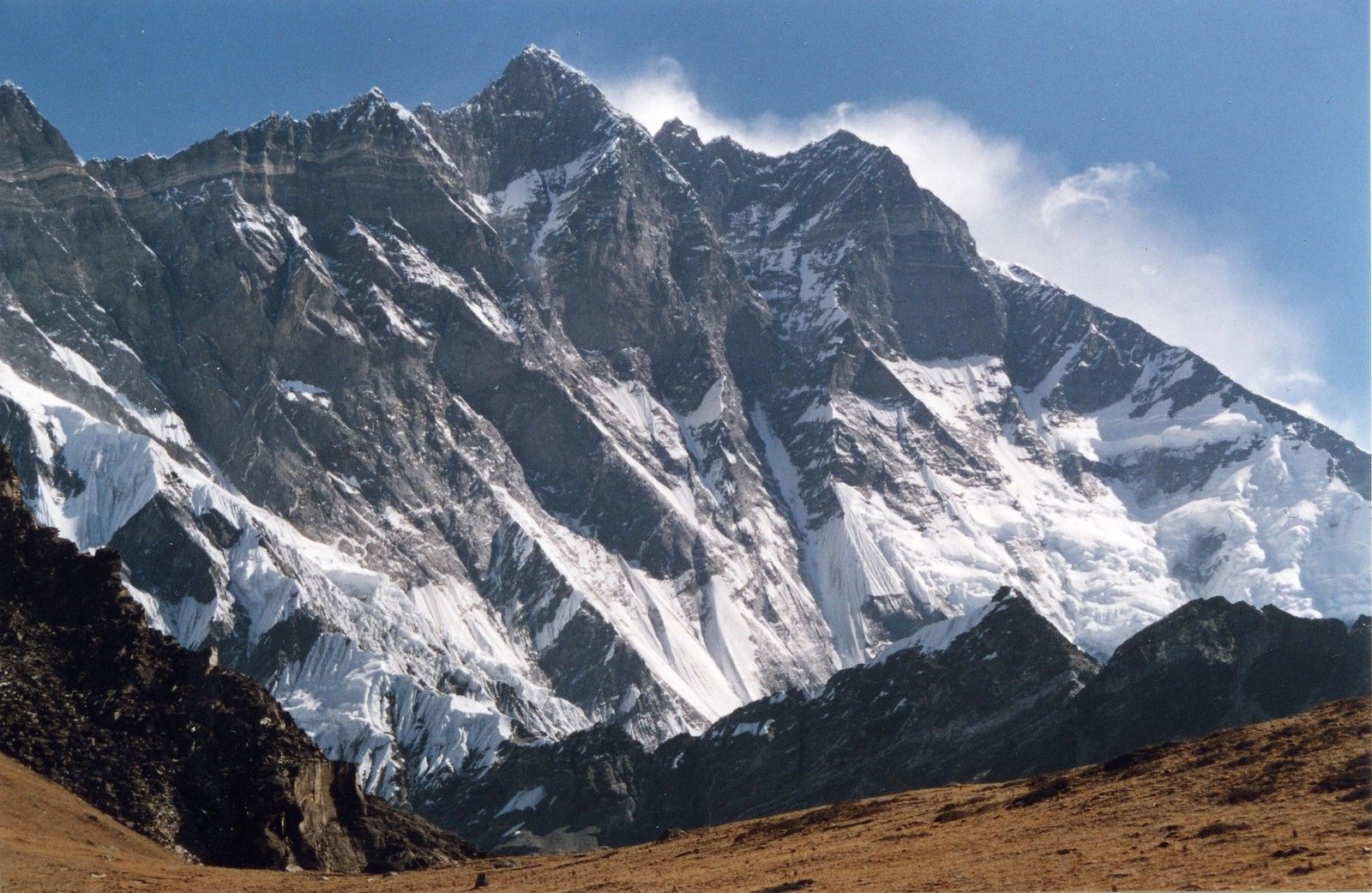
Lhotse Expedition Guide: Route, Season, Cost and Verified Operator Reviews (8,516 m)
Lhotse, at 8,516 m, is the fourth-highest mountain in the world, joined to Everest by the South Col. Its normal route shares the Everest South Col route through the Khumbu Icefall, the Western Cwm and the Lhotse Face, then branches off to climb a steep, narrow couloir to the summit. Expeditions take about six to eight weeks in spring, and many climbers use it as a first 8,000 m peak alongside Everest teams, or combine it with Everest. On ExpedReview, as of 23 October 2026, 4 operators have 4 verified client reviews for Lhotse: Adventure Consultants (5.0★, November 2024), Summitclimb (5.0★, October 2023, from US$18,450), Seven Summit Treks (4.6★, June 2022, unclaimed profile) and Tim Mosedale (3.4★, December 2018). Below are the reviews, the route, the season, costs and how to choose an operator.
Lhotse: key facts | | | |---|---| | Height | 8,516 m (27,940 ft), fourth-highest in the world | | Location | Khumbu region, Nepal–Tibet border, south of Everest | | First ascent | 18 May 1956, Ernst Reiss and Fritz Luchsinger (Swiss expedition) | | Normal route | West face via the Khumbu Icefall, Western Cwm, Lhotse Face and summit couloir | | Subsidiary summits | Lhotse Middle (about 8,414 m) and Lhotse Shar (about 8,383 m) | | Main season | Spring (April–May) | | Typical expedition length | About 6–8 weeks | | Operators reviewed on ExpedReview | 4, with 4 verified reviews (as of 23 Oct 2026) |
Lhotse operators with verified reviews
ExpedReview ranks operators by their verified client reviews for each place: the star rating, adjusted so one or two reviews, or only old ones, count for less than many recent ones. Every review is checked by hand before it is published, and operators cannot pay to appear or rank higher. Prices are set by the operators themselves. Data as of 23 October 2026.
| Rank | Operator | Based in | Rating here | Reviews | Latest review | Guide-listed price |
|---|---|---|---|---|---|---|
| 1 | Adventure Consultants | New Zealand | 5.0★ | 1 | November 2024 | No recent price listed |
| 2 | Summitclimb | United States | 5.0★ | 1 | October 2023 | From US$18,450 (lowest of 2 packages; up to US$56,450) |
| 3 | Seven Summit Treks (unclaimed profile) | Nepal | 4.6★ | 1 | June 2022 | No recent price listed |
| 4 | Tim Mosedale | United Kingdom | 3.4★ | 1 | December 2018 | No recent price listed |
What clients say
Adventure Consultants. The reviewer praises the whole team, from the office in Wanaka and the Kathmandu ground staff to the mountain team. Base camp was well run with "incredible" food, the climbing team handled safety exceptionally well, and the high camps were as comfortable as possible. They did not summit, but say the limiting factor was their own body, not the operator.
Summitclimb. A climber with several Himalayan expeditions behind them chose Lhotse partly to see for themselves whether Summitclimb's budget reputation was deserved. They say it "far exceeded" what they expected from a budget expedition, singling out the quality of the food.
Seven Summit Treks. A short June 2022 review praises "very good global service" and notes no supplementary oxygen was used, but adds: "Sherpa left me on the summit descent." That is a serious safety concern; ask any operator how it guarantees support on the descent.
Tim Mosedale. A climber on their first 8,000 m peak, writing in December 2018, enjoyed the extended trek to base camp and the medical preparation, but felt that the guide and base camp were stretched by a large group with both Lhotse and Everest climbers. Despite summiting, they say there were "significant safety risks that could have been avoided" and would not recommend the outfit. The review is now nearly eight years old.
With one review per operator, these are individual experiences. Ask for references from recent Lhotse clients.
The route
Khumbu Icefall to the Western Cwm
Lhotse climbers share base camp (about 5,364 m) and the lower route with Everest teams. The route crosses the Khumbu Icefall, a constantly moving maze of seracs and crevasses fixed each season by the Icefall Doctors, to Camp 1 at about 6,000 m and Camp 2 at about 6,400 m in the Western Cwm.
The Lhotse Face
From Camp 2, climbers ascend the Lhotse Face, a huge slope of hard ice and snow at up to about 40 to 50 degrees, on fixed ropes to Camp 3 at about 7,100 to 7,300 m. Everest climbers then traverse left towards the South Col, but Lhotse climbers continue more directly up the face to their own Camp 4 at about 7,800 to 7,900 m.
The summit couloir
On summit day, climbers enter the Lhotse couloir, a long, narrow gully of snow, ice and rock that leads to a tiny summit. Rockfall, loose snow and climbers above are hazards in the confined couloir, and the top section can be steep and mixed. The summit itself is small and exposed. Teams then descend the same route.
Lhotse and Everest together
Because the routes overlap, many operators run Lhotse alongside Everest, and some offer Everest–Lhotse combinations, climbing both in one season. This is very demanding and depends on weather, strength and oxygen supplies. Summitclimb's ExpedReview listing, for example, shows Lhotse packages from US$18,450 up to US$56,450 for its most comprehensive option. For Everest itself, see our Everest South Col guide.
Season and itinerary
Lhotse is climbed almost entirely in spring, when the Icefall is fixed and the Everest support network is in place, with summit windows usually in mid to late May. A typical expedition follows this pattern:
- Arrive in Kathmandu for permits and briefings.
- Fly to Lukla and trek to base camp over about 8 to 12 days, acclimatising on the way, sometimes climbing Lobuche East.
- Acclimatise with two or three rotations through the Icefall to Camps 1, 2 and 3.
- Rest at base camp, or lower down, while waiting for a weather window.
- Summit push over about five to seven days.
- Trek or fly out and return to Kathmandu.
Permits and rules
Climbing Lhotse requires a Nepal Department of Tourism expedition permit for the season, plus the Sagarmatha National Park entry permit (NPR 3,000) and the Khumbu Pasang Lhamu Rural Municipality card (NPR 3,000). Climbers also contribute to the cost of fixing the Icefall and the route. Nepal has rules on liaison officers, garbage deposits and bringing waste down, and royalty fees have changed in recent years, so ask your operator for current figures.
Risks
Lhotse has the same high-altitude risks as Everest: the moving Khumbu Icefall, avalanches, extreme cold, frostbite, falls on the Lhotse Face, exhaustion and altitude illness. The summit couloir adds rockfall, crowding and a steep, confined descent. As the Seven Summit Treks and Tim Mosedale reviews suggest, support on summit day and the strength of the team are critical. Most clients use supplementary oxygen from Camp 3 or higher.
Costs
Lhotse expeditions usually cost less than Everest with the same operator, because the royalty and some logistics are lower, but they are still among the most expensive climbs in the world. Prices depend on guide and Sherpa ratios, oxygen allowance, Western leadership, base camp services and helicopter use. Ask for a written quote showing what is included.
Choosing an operator
- Ask about summit day support. What is the Sherpa-to-client ratio, and will your Sherpa stay with you on the descent?
- Ask about oxygen. How many bottles, from which camp, and what reserves?
- Ask how they manage mixed Everest and Lhotse teams. Make sure leaders and Sherpas are not stretched.
- Ask about experience. How many Lhotse summits have their guides and Sherpas made?
- Read detailed reviews and ask for recent references.
History
Lhotse means "south peak" in Tibetan, a name given during the 1921 British reconnaissance of Everest. After Everest was first climbed in 1953, Lhotse became one of the great remaining prizes. The Swiss expedition of 1956 made the first ascent, with Ernst Reiss and Fritz Luchsinger reaching the summit on 18 May; days later, the same expedition made the second ascent of Everest.
Lhotse's other summits took much longer. Lhotse Shar (about 8,383 m) was first climbed in 1970 by an Austrian team. Lhotse Middle (about 8,414 m) remained the highest unclimbed named point on Earth until 2001, when a Russian team reached it via a difficult ridge. Lhotse's vast south face, more than 3,000 m high, is one of the biggest walls in the Himalaya; a Soviet team made the first ascent of the face to the summit in October 1990.
Experience and preparation
Most operators expect Lhotse climbers to have climbed at least one 6,000 to 7,000 m peak, such as Island Peak, Lobuche East or Ama Dablam, and preferably an 8,000 m peak such as Manaslu or Cho Oyu. You need to be confident on fixed ropes, moving efficiently with an ascender, abseiling and passing anchors, wearing crampons on steep, hard ice and climbing ladders in the Icefall. Train for six months or more with long days carrying a loaded pack, hill and stair work and strength training.
Oxygen and gear
Most clients use supplementary oxygen from Camp 3 or Camp 4, with a personal Sherpa carrying spare bottles. Ask about mask and regulator quality, flow rates and the reserve plan if a regulator fails or the weather delays the descent. Kit is the same as for Everest: an 8,000 m down suit, high-altitude boots, mitts, crampons, harness, ascender, helmet and a sleeping bag rated to about −30 °C or lower.
Crowds, conditions and climate
Because Lhotse shares its route with Everest, the lower mountain is busy in spring. Queues can build on the Lhotse Face on popular summit days, although the Lhotse couloir itself is usually less crowded than the Everest summit ridge. Strong winds, snow loading and drier conditions with more rockfall vary from year to year. In 2014, a serac collapse in the Khumbu Icefall killed 16 Nepali mountain workers and ended that year's spring season, a reminder that the shared route carries risk for everyone, especially the Sherpas who make many more trips through it than clients. Good operators minimise the number of Icefall crossings, often by acclimatising on Lobuche East first.
Life at base camp
Expect around six to eight weeks away from home, most of it at Everest Base Camp. Base camp is a temporary village on the moving Khumbu Glacier, with operators setting up dining tents, kitchens, communication tents and sometimes heated domes. Food, comfort and morale matter over such a long trip, as the Adventure Consultants and Summitclimb reviewers noted. Between rotations, climbers rest, eat, train lightly and wait for the weather forecasts that will decide their summit window.
Who Lhotse suits
Lhotse suits experienced high-altitude climbers who want an 8,000 m summit with Everest's infrastructure, but a lower overall cost and, usually, a less crowded summit. It is also a strong option for climbers who have already climbed Everest and want a second big peak from the same base camp, or for those combining both in one season. It is not suitable for anyone new to fixed ropes, steep ice or high altitude.
Frequently asked questions
How high is Lhotse?
8,516 m (27,940 ft), the fourth-highest mountain in the world.
Is Lhotse harder than Everest?
Lhotse is lower and shorter, but the summit couloir is steep and narrow. Overall it is a similarly serious climb, but it benefits from the same fixed ropes, camps and support network as the Everest route.
When was Lhotse first climbed?
On 18 May 1956, by Ernst Reiss and Fritz Luchsinger of a Swiss expedition.
How long does a Lhotse expedition take?
About six to eight weeks, including the trek in and acclimatisation.
Which operators have verified reviews for Lhotse?
As of 23 October 2026, Adventure Consultants, Summitclimb, Seven Summit Treks and Tim Mosedale, each with one review.
Can operators pay to rank higher on ExpedReview?
No. Operators cannot pay to appear, rank higher or have reviews removed.
Do I need oxygen to climb Lhotse?
Most commercial clients use supplementary oxygen high on the mountain. Climbing without it greatly increases the risk of altitude illness, frostbite and exhaustion.
Can I climb Everest and Lhotse in one season?
Some operators offer Everest–Lhotse combinations, but they demand great strength, a good weather window and plenty of oxygen. Ask about success rates and what happens if you only manage one summit.
What experience do I need for Lhotse?
Most operators expect previous high-altitude climbs on 6,000–7,000 m peaks and, preferably, an 8,000 m summit.
What is the Lhotse couloir?
A long, narrow gully of snow, ice and rock leading to Lhotse's summit. It is the crux of the normal route, with rockfall and steep, confined climbing.
What does the name Lhotse mean?
It means "south peak" in Tibetan, describing its position south of Everest.
When is the best time to climb Lhotse?
Spring, with summit windows usually in mid to late May, once the route has been fixed to the summit.