Everest 2026 Season Review: Record 1,008 Summits, Deaths, New Rules & What's Next for 2027
By Alessandro Ricco · August 20, 2026
Category: expedition-news
4 min read
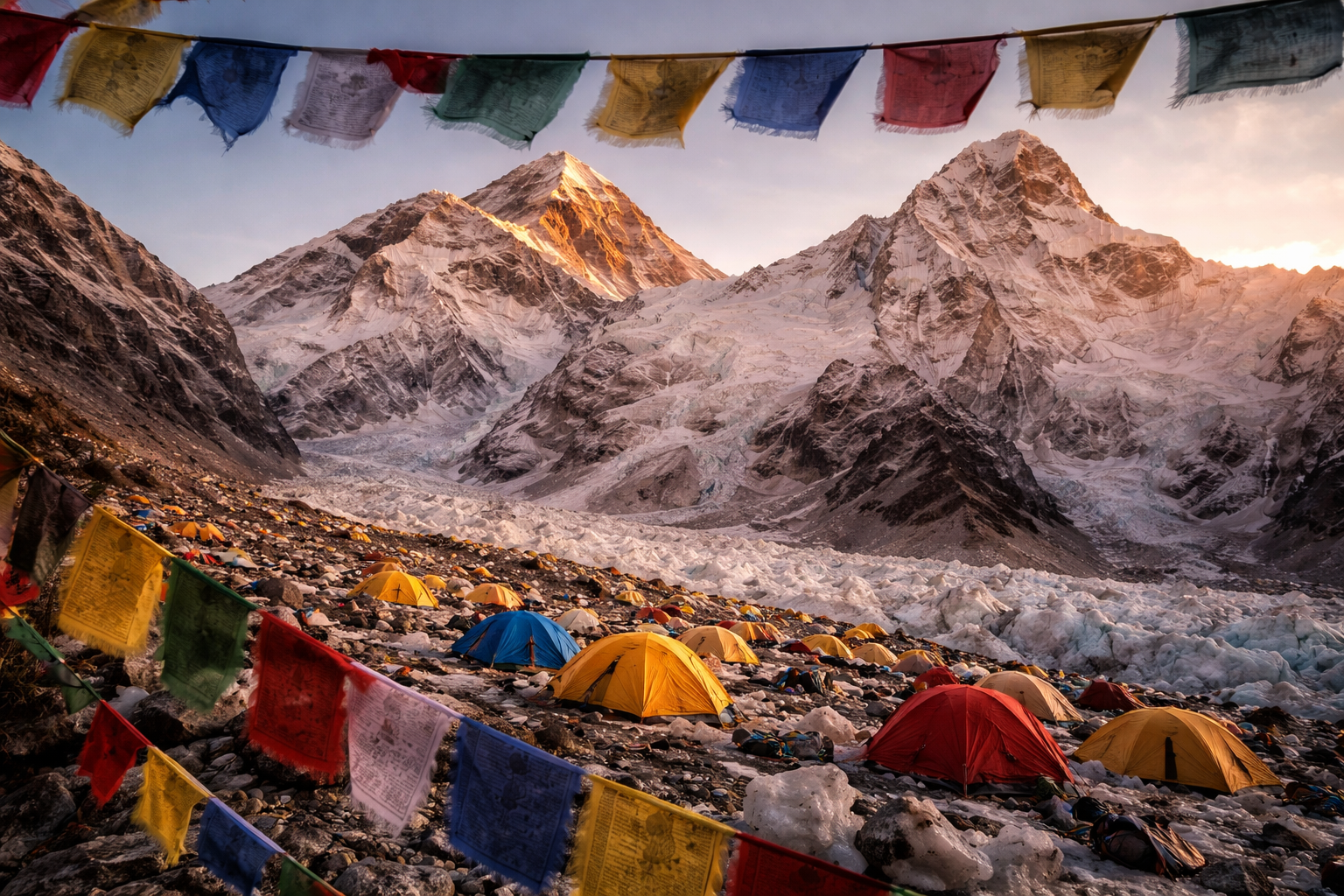
The spring 2026 Everest season was the busiest in history. Nepal's Department of Tourism reported 1,008 summits, beating the previous record of about 877 set in 2019. Nepal issued a record 495 Everest permits, and roughly 275 people summited on a single day in late May. At least five people died, three Nepali and two Indian. Every climber went up the Nepal side, because China did not open the Tibetan North Ridge to foreign climbers. It was also the first season under Nepal's higher US$15,000 permit fee (up from US$11,000) and new waste rules requiring climbers to bring 2 kg of rubbish down from above Camp 2. Records included Kami Rita Sherpa's 32nd summit, Lhakpa Sherpa's 11th (the women's record) and Kenton Cool's 20th, the most by a non-Sherpa climber. Looking ahead, Everest is not climbed in autumn 2026, the next season is spring 2027, and Nepal's proposed rule requiring a prior 7,000 m summit was still not law as of October 2026.
This review covers the full story of the 2026 season: the key numbers, the timeline, deaths and rescues, records, rule changes, controversies and what climbers planning for 2027 should know. It updates our earlier preview, "Everest 2026: What's Shaping Up to Be a Record-Breaking and Controversial Season", which predicted 850–900 summits. The real total beat even that.
| Statistic | 2026 | Comparison |
|---|---|---|
| Summits (Nepal side) | 1,008 (record) | ~877 in 2019 (previous record, Himalayan Database); 731 Nepal side in 2025 (preview estimate) |
| Everest permits issued | 495 (record) | 472 in 2025 |
| Busiest single day | ~274–275 summits (20–21 May; reports differ) | Single-day record |
| Deaths | 5 (3 Nepali, 2 Indian) | 18 in 2023; 8 in 2024; 5 in 2025 (press reports) |
| Everest permit fee (spring) | US$15,000 | US$11,000 until August 2025 |
| Everest royalties collected | ~NPR 1.08 billion (record) | ~NPR 695 million in 2025 |
| Tibet (north) side | Closed to foreign climbers | Open in 2024 and 2025 |
| Waste removed by SPCC | ~90,329 kg (9,750 kg from above base camp) | Largest recorded clean-up |
Key takeaways from Everest 2026
- Record numbers: 1,008 summits, 495 permits and about 275 summits in one day, all on the Nepal side.
- Comparatively safe: five deaths, one of the lowest death-to-summit ratios on record, helped by a long weather window.
- More expensive: the first season at the US$15,000 permit fee.
- Cleaner: new 2 kg high-camp waste rule and about 90 tonnes removed.
- Uncertain future: the north side's status and Nepal's 7,000 m rule are the two big open questions for 2027.
Is Mount Everest closed?
Everest is not "closed", but it is out of season. Climbing on Everest happens mainly in spring (April to early June) from Nepal, with occasional autumn attempts. As of October 2026:
- Nepal side (South Col route): no Everest climbing this autumn. Permits for spring 2027 will be issued from early 2027, with teams expected at base camp in early to mid-April.
- Tibet side (North Ridge): closed to foreign climbers for the whole of 2026, including autumn. China has not said whether it will open the north side for 2027.
- Everest Base Camp trek: open. The autumn trekking season (October–November) is one of the busiest times on the Everest Base Camp trek.
When does the Everest climbing season start?
The main season is spring. Teams arrive in Kathmandu in late March or early April, trek to base camp in mid-April and spend about 4–6 weeks acclimatising. Summit windows usually open in the second half of May, when the jet stream moves north before the monsoon. Expeditions typically wrap up by early June.
| Phase | 2026 timing | Typical timing (2027) |
|---|---|---|
| Permits issued / teams arrive in Kathmandu | Late March – mid-April | Late March – mid-April |
| Icefall Doctors open the route | Late March – early April | Late March – early April |
| Main arrival at Everest Base Camp | ~15 April onward | ~10–20 April |
| Acclimatisation rotations | Late April – mid-May | Late April – mid-May |
| Summit window | ~Mid-May to 29 May | ~Mid-May to end of May |
| Season close | Early June | Early June |
There is a smaller autumn season (September–October) on peaks such as Manaslu and Ama Dablam, but Everest itself is rarely climbed in autumn. Read our guides to the best time to climb Everest and how long it takes to climb Mount Everest.
The 2026 season timeline
| Date (2026) | Event |
|---|---|
| Early 2026 | China–Tibet Mountaineering Association does not open applications for the north side; it becomes a de facto closure |
| March | SPCC publishes 2026 waste and Icefall-fee rules; Global Rescue says long-line rescues are unlikely to be available to members in 2026 because qualified long-line pilots are unavailable, so climbers must reach Camp 2 or below for a helicopter pickup |
| Late March – early April | Eight Icefall Doctors fix ropes and ladders through the Khumbu Icefall |
| ~15 April | Main wave of teams arrives at Everest Base Camp |
| 3 May | First death of the season: Lakpa Dendi Sherpa, about 5,200 m, on the approach to base camp |
| 10–11 May | Two Nepali workers die, one between base camp and Camp 1, one on the Lhotse Face (fall) |
| Mid-May | Long stable weather window opens; summits begin in large numbers |
| 17 May | Kristin Harila summits Nuptse without O₂ (start of her Triple Crown) |
| 20–21 May | Busiest day in Everest history: ~274–275 summits |
| 22 May | Kenton Cool makes his 20th summit; two Indian climbers die of altitude-related illness on descent |
| 27 May | Kristin Harila summits Everest without supplemental oxygen, completing the Triple Crown |
| 29 May | A Nepali guide goes missing on descent; he is found alive in the Khumbu Icefall six days later |
| 29 May | Nepal's Department of Tourism reports 1,008 summits |
| Early June | Season closes; permits and climbing activity conclude |
Why were there so many summits in 2026?
- A long, stable weather window. Officials and operators credited an unusually long run of calm weather in mid to late May. It let teams spread their summit days, though crowding still built up on the busiest days.
- The Tibet closure. Teams that would normally have climbed the North Ridge moved to Nepal, adding to an already growing market.
- More permits. Nepal issued 495 Everest permits, a record, despite the 36% fee increase.
- A rush before stricter rules. Some commentators suggested that the proposed 7,000 m experience requirement encouraged less experienced climbers to try in 2026, before any new rule takes effect.
- More Sherpas counted. The summit total includes guides, Sherpas and high-altitude workers as well as foreign clients. Hired climbers now make up more than half of all Everest summits historically.
Note: Nepal's figure of 1,008 was reported before formal summit certificates were all issued. The Himalayan Database will publish its own verified total later, and it may differ slightly.
Deaths on Everest in 2026
| Date | Name | Nationality | Location | Reported cause |
|---|---|---|---|---|
| 3 May | Lakpa Dendi Sherpa (51) | Nepal | ~5,200 m, approach to base camp | Not officially stated |
| 10 May | Bijaya Ghimire Bishwakarma (35) | Nepal | Between base camp and Camp 1 | Not officially stated |
| 11 May | Phura Gyaljen Sherpa (20) | Nepal | ~7,000 m, Lhotse Face below Camp 3 | Fall |
| 22 May | Sandeep Are | India | Descending after summiting | Altitude-related illness |
| 22 May | Arun Kumar Tiwari | India | Descending after summiting | Altitude-related illness |
Five deaths against 1,008 summits gives one of the lowest death-to-summit ratios in Everest history, well below 2023's toll of 18. A Nepali guide reported missing after descending from the summit on 29 May was found alive in the Khumbu Icefall six days later. One of the season's most remarkable survival stories, he still appears on some early casualty lists.
For context, the Himalayan Database records 339 deaths on Everest on all routes through December 2025, against 13,737 summits. See our guide to Everest deaths and why they happen and our explainer on the death zone.
Was there an avalanche at Everest Base Camp in 2026?
We found no reports of a deadly avalanche at Everest Base Camp in the 2026 season. Everest Base Camp's worst avalanche remains the earthquake-triggered slide of 25 April 2015, which killed 22 people. The deadliest Khumbu Icefall avalanche was on 18 April 2014 (16 deaths). Read more in our Khumbu Icefall vs K2 Bottleneck comparison.
Records set in 2026
| Record | Climber | Detail |
|---|---|---|
| Most Everest summits (men) | Kami Rita Sherpa (Nepal) | 32nd summit, extending his own record; first summit in 1994 |
| Most Everest summits (women) | Lhakpa Sherpa (Nepal/USA) | 11th summit |
| Most Everest summits by a non-Sherpa | Kenton Cool (UK) | 20th summit on 22 May 2026 with Dorjee Gyelzen Sherpa |
| First woman to do the Everest Triple Crown in one season | Kristin Harila (Norway) | Nuptse (17 May), Lhotse (21 May), Everest without O₂ (27 May) |
| Most summits in a season | All climbers | 1,008 (Nepal side) |
| Most summits in a day | All climbers | ~274–275 |
| Largest Everest clean-up | SPCC | ~90,329 kg collected, 9,750 kg from above base camp |
Read our full profile of Kristin Harila.
New rules and changes in 2026
Higher permit fee: US$15,000
Nepal raised the Everest royalty for foreign climbers in the spring season from US$11,000 to US$15,000, effective from September 2025. Autumn permits rose to US$7,500 and winter/monsoon permits to US$3,750. It was the first increase since 2015. The higher fee helped push royalties to a record of about NPR 1.08 billion. See our Everest permit fee guide and the full cost of climbing Mount Everest.
| Season | Everest permit fee, Nepal (foreigners) from Sept 2025 | Previous fee |
|---|---|---|
| Spring (Mar–May) | US$15,000 | US$11,000 |
| Autumn (Sep–Nov) | US$7,500 | US$5,500 |
| Winter / summer (Dec–Feb, Jun–Aug) | US$3,750 | US$2,750 |
New waste rules
The Sagarmatha Pollution Control Committee (SPCC) required every climber and high-altitude worker going above Camp 2 to carry down at least 2 kg of waste from the high camps. That is in addition to the existing rule that each climber must bring 8 kg of rubbish back to base camp. Rangers at Camp 2 checked compliance. Combined with drone-assisted carries, the season's clean-up removed about 90 tonnes of waste.
Drones in the Khumbu Icefall
After a 2025 trial, heavy-lift drones were used more widely to carry oxygen, ropes and supplies from base camp to Camp 1, and to bring rubbish down. DJI reported one-way flights of about 8 minutes with its FlyCart 100, against 6–8 hours for a load carry on foot. That could reduce the number of dangerous load carries Sherpas make through the icefall.
Reduced helicopter rescue cover above Camp 2
Before the season, Global Rescue told members that long-line helicopter rescues were unlikely to be available in 2026 because qualified long-line pilots were unavailable, so climbers needing evacuation would have to descend to Camp 2 (about 6,400 m) or below, where a helicopter can land. Climbers were told to plan for more limited rescue options high on the mountain. That puts more weight on strong guide teams, spare oxygen and conservative turnaround times.
The controversies
The US$19 million helicopter fraud investigation
Nepal's Central Investigation Bureau pressed on with its case over alleged fraudulent helicopter rescues worth more than US$19.6 million (2022–2025). Investigators say rescue firms, helicopter companies, hospitals and trekking agencies staged or inflated evacuations, mostly of trekkers, and billed insurers with forged manifests and medical records. Six people were arrested in January 2026, and by early April police said 32 people had been charged and 10 arrested (AFP). Choosing an operator with transparent rescue procedures has never been more important.
Crowding on summit day
With around 275 people summiting on the busiest day, photos of queues on the summit ridge and Hillary Step circulated again. Most operators reported that the long weather window spread the crowds better than in 2019. Long waits in the death zone are still a leading concern.
The 7,000 m experience rule
Nepal's draft Tourism Bill would require foreign climbers to have summited a 7,000 m peak in Nepal before receiving an Everest permit. As of September–October 2026, the bill had passed the upper house but remained in committee in the lower house, with more than 260 amendments filed. The ministry has said it wants the rule in force for spring 2027. Climbers planning for 2027 should check the latest position with their operator.
Spring 2026 across Nepal's other peaks
Everest drew the headlines, but it was a record spring for Nepal's mountains generally. According to the Department of Tourism:
| Metric (spring 2026) | Figure |
|---|---|
| Climbers with permits for peaks other than Everest | 1,195 |
| Teams on other peaks | 149 |
| Number of peaks with permits issued | 31 |
| Royalties from other peaks | ~NPR 1.26 billion |
| Notable peaks with expeditions | Ama Dablam, Annapurna, Dhaulagiri, Lhotse, Makalu and others |
Heavy early-season snow delayed teams on Annapurna and Dhaulagiri. On Lhotse, which shares Everest's route up to the Lhotse Face, traffic rose in step with Everest. Kristin Harila's summit on 21 May was one of many. See our pages on Lhotse and the Everest region.
The 2026 numbers in context
A few calculations help put the season in perspective.
- Summits per permit. 1,008 summits against 495 permits looks like more than two summits per permit holder. That is because the summit count includes Sherpas, guides and high-altitude workers, who do not need a separate foreign climber's permit. In recent seasons hired climbers have made up roughly half of all summits.
- Death rate. Five deaths against 1,008 summits is about 0.5 deaths per 100 summits. That is far below Everest's long-term average of roughly 1 per 100 (measured against summits or attempts, depending on the method) and well below 2023 (18 deaths). Three of the five victims were Nepali workers, and two of them died low on the mountain, a reminder that support staff still carry a disproportionate share of the risk.
- Single-day crowding. About 275 summits in one day means several hundred people moving above the South Col in a single night, including climbers who turned back. Even with a long weather window, the busiest days still produced queues on the summit ridge.
- Revenue. Royalties of about NPR 1.08 billion (roughly US$8 million) from Everest alone made it the highest-earning season on record for Nepal's government, before counting the much larger spending on operators, Sherpa wages, lodges, flights and helicopters.
How a typical 2026 Everest expedition unfolded
For readers wondering what the season looked like from the inside, here is the typical arc for a client on a standard 8–9 week South Col expedition in 2026:
- Late March – early April: Kathmandu. Permit briefing at the Department of Tourism, gear checks and the flight to Lukla. Weather delays at Lukla airport are common.
- Early to mid-April: the trek in. About 8–10 days through Namche Bazaar, Tengboche, Dingboche and Lobuche, with acclimatisation hikes, arriving at base camp around 12–18 April.
- Late April: first rotation. Puja ceremony, ladder training, and the first trip through the Khumbu Icefall to Camp 1 and Camp 2. Teams in 2026 benefited from drones carrying some loads to Camp 1.
- Early May: second rotation. Up to Camp 2 again and a tag of Camp 3 on the Lhotse Face (about 7,100–7,300 m), then back to base camp. Some teams went down to Pheriche or Dingboche to recover.
- Mid-May: waiting for the window. Forecasts in 2026 showed an unusually long stable period, so operators could spread their teams over several summit days.
- Mid to late May: the summit push. Base camp to Camp 2, Camp 3 and Camp 4 over 3–4 days, then a night push to the summit and a descent to Camp 2 or base camp, collecting the required 2 kg of high-camp waste on the way down.
- Late May – early June: trek out and certification. Teams flew or walked out and applied to the Department of Tourism for summit certificates, verified with photos and statements from their guides.
"Flash" expeditions using hypoxic pre-acclimatisation at home shortened this timeline to about 3–5 weeks for some clients. Read more in our guides to how the body copes above 8,000 metres and Everest climbing styles.
Everest 2026 vs previous seasons
| Season | Nepal permits | Summits | Deaths | Notes |
|---|---|---|---|---|
| 2019 | 381 | ~877 (both sides; previous record, HDB) | 11 | Viral summit-queue photos |
| 2023 | 478 | ~600+ (Nepal) | 18 | Deadliest modern season |
| 2024 | ~419 | ~800+ (both sides) | 8 | North side reopened to foreigners |
| 2025 | 472 | ~731 (Nepal; preview estimate) | 5 | Last season at the US$11,000 fee |
| 2026 | 495 | 1,008 (Nepal) | 5 | Record; Tibet closed |
Older season figures are rounded from Nepal Department of Tourism and press reports. Final figures come from the Himalayan Database.
What the 2026 season means for 2027 climbers
- Expect another busy season. Demand remains very high. Book early with an operator that has a clear plan for avoiding crowded summit days.
- Budget for the higher fee. The US$15,000 permit is now built into package prices. As a reference point, published 2026–27 prices for a full-service Western-led South Col climb are around US$80,000 (Alpine Ascents lists US$80,000 for 2026; Madison Mountaineering lists US$79,500 for 2027), and Seven Summit Treks' 2026 VIP package is US$180,000; standard Nepali-operator packages cost less. See our Everest cost guide.
- Check the 7,000 m rule. If it passes, you may need a prior 7,000 m summit in Nepal, such as Himlung Himal or Baruntse. See our guide on what to climb before Everest and our Baruntse page.
- Watch the north side. If Tibet reopens for 2027, it could ease crowding on the South Col route. Compare the routes in our South Col vs North Ridge guide.
- Plan for limited rescue. Ask operators how they handle rescue above Camp 2, how much oxygen they allocate, and their Sherpa-to-client ratio.
- Read verified reviews. Use ExpedReview to check how operators performed in 2026. Our guide to choosing an Everest operator and Western vs Nepali operators guide will help.
Top-rated Everest operators on ExpedReview
The companies below have the highest average ratings from verified ExpedReview client reviews (minimum two reviews; data as of 22 October 2026).
| Route | Operator | ER average rating | Verified reviews |
|---|---|---|---|
| Everest – South Col | Climbing The Seven Summits | 5.0 / 5 | 14 |
| Everest – South Col | Dream Himalaya Adventures | 5.0 / 5 | 5 |
| Everest – South Col | Adventure Consultants | 5.0 / 5 | 3 |
| Everest – South Col | Pioneer Adventure | 4.7 / 5 | 2 |
| Everest – North Ridge | Kobler & Partner | 5.0 / 5 | 2 |
| Everest – North Ridge | Furtenbach Adventures | 4.8 / 5 | 12 |
Compare all operators on the Everest South Col page and the Everest North page.
The bottom line
Everest 2026 will be remembered as the season the mountain passed 1,000 summits in a single spring, with the lowest death toll relative to summits in years and a record clean-up. It was also a season of warnings: crowding on the busiest days, limited helicopter rescue high on the mountain, rising costs and uncertainty over access from Tibet. For anyone planning spring 2027, the lessons are clear. Choose an operator with strong safety systems and transparent rescue plans, build in time for weather, and keep a close eye on Nepal's new rules.
Frequently asked questions
How many people summited Everest in 2026?
Nepal's Department of Tourism reported 1,008 summits in spring 2026, a record. The previous record was about 877 in 2019. The figure includes Sherpas and guides, and the Himalayan Database will publish a final verified number.
How many people died on Everest in 2026?
Five: three Nepali workers and two Indian climbers, all on the Nepal side between 3 and 22 May 2026. A guide reported missing on 29 May was found alive six days later.
Is Mount Everest closed?
No, but it is out of season. Everest is climbed mainly in spring. The Nepal side reopens for spring 2027, while the Tibet side was closed to foreign climbers throughout 2026.
Was the north side of Everest closed in 2026?
Yes. The China–Tibet Mountaineering Association did not open applications for foreign climbers in 2026, so all expeditions climbed from Nepal. The north side also stayed closed in autumn 2026.
When does the Everest climbing season start?
Teams usually arrive at base camp in mid-April. Summit windows open from about mid-May and the season ends in early June. A smaller autumn season exists, but Everest itself is rarely climbed then.
When is the Everest 2027 season?
Spring 2027: roughly April to early June 2027, with summit attempts expected in the second half of May.
How much does an Everest permit cost in 2026?
US$15,000 per foreign climber for spring on the Nepal side, up from US$11,000. Autumn permits cost US$7,500 and winter/summer permits US$3,750.
What was the busiest day on Everest in 2026?
About 274–275 people summited on a single day in late May 2026. Reports put it on 20 or 21 May. It is the most in Everest history.
Who broke records on Everest in 2026?
Kami Rita Sherpa (32nd summit), Lhakpa Sherpa (11th, the women's record), Kenton Cool (20th, the most by a non-Sherpa) and Kristin Harila (first woman to do the Everest Triple Crown in one season).
How many Everest permits were issued in 2026?
A record 495 Everest permits for the spring 2026 season, up from 472 in 2025, from climbers of about 56 nationalities.
What new rules applied on Everest in 2026?
The higher US$15,000 permit fee, and a rule requiring climbers going above Camp 2 to carry down 2 kg of waste in addition to the 8 kg base camp quota. Drones were also used more widely to move loads.
Is there a 7,000 m requirement to climb Everest?
Not yet. Nepal's draft Tourism Bill would require a prior 7,000 m summit in Nepal, but as of October 2026 it had not become law. The government hopes to apply it from spring 2027.
Was there an avalanche at Everest Base Camp in 2026?
We found no reports of a deadly avalanche at Everest Base Camp in 2026. Everest's worst base camp avalanche was in April 2015.
How much does it cost to climb Everest in 2026?
Prices vary widely: published 2026–27 prices for a full-service Western-led South Col climb are around US$80,000 (Alpine Ascents lists US$80,000 for 2026; Madison Mountaineering lists US$79,500 for 2027), and Seven Summit Treks' 2026 VIP package is US$180,000; standard Nepali-operator packages cost less. Packages normally include the US$15,000 permit, oxygen, Sherpa support and logistics. See our Everest cost guide.
How many people have climbed Everest in total?
The Himalayan Database records 13,737 summits by 7,563 different people through December 2025. Adding spring 2026 takes the total to roughly 14,700 summits.
Did Kami Rita Sherpa climb Everest in 2026?
Yes. He made his 32nd summit, extending his own world record for the most Everest ascents.
How many people climbed other Nepal peaks in spring 2026?
Nepal issued permits to 1,195 climbers in 149 teams for 31 peaks other than Everest in spring 2026, including Ama Dablam, Annapurna and Dhaulagiri, generating about NPR 1.26 billion in royalties.
Can you climb Everest in autumn?
It is possible but rare. Nepal issues autumn Everest permits (US$7,500), but deep post-monsoon snow, shorter days and strong winds make it much harder, and few teams attempt it. In autumn 2026 the Tibet side was closed and no major Everest expeditions were reported.
Are drones used on Everest?
Yes. Since a 2025 trial, heavy-lift drones have carried oxygen, ropes and supplies from base camp to Camp 1 over the Khumbu Icefall and brought rubbish back down. DJI reported one-way flights of about 8 minutes. They were used more widely in 2026.
How much waste was removed from Everest in 2026?
The Sagarmatha Pollution Control Committee reported about 90,329 kg of waste collected in spring 2026, including about 9,750 kg from above base camp. It is the largest recorded Everest clean-up.
Sources
Data gathered by ExpedReview from official sources and news reporting, written in our own words:
- Nepal Department of Tourism, via The Kathmandu Post (29 May 2026) and New Business Age.
- The Independent: "Everest records busiest season ever" (2026).
- Reuters: Briton makes 20th Everest ascent (22 May 2026).
- The Tourism Times: SPCC 2026 waste rules and SPCC clean-up total.
- Alan Arnette: Everest 2026 season update and "Everest by the Numbers: 2026 Edition".
- Kristin Harila: Triple Crown (July 2026).
Related articles
- How to Choose an Everest Operator: A Checklist That Uses Evidence (US$37,900 to US$88,501)
A practical way to shortlist Everest operators using verified reviews, written support commitments and a few hard questions.
- Best operators
- How Much Does It Cost to Climb Mount Everest in 2027? US$41,000–224,000 (US$41,000 to US$224,000)
A guided Everest expedition costs about US$41,000 to US$224,000 per person in 2027.
- Best Everest Expedition Operators by Style: Premium, Tiered, Fast, Nepal-Based and Budget (US$41,000 to US$88,501,)
Which Everest operators verified climbers actually rate highest, split by expedition style, with permit fees, fatality data and the support questions that…
- When Is the Best Time to Climb Everest? Spring Window, Autumn, Winter and the Season Timeline
Why almost every Everest summit happens in a short May window, what autumn and winter offer, and when ExpedReview reviewers actually climbed.
- Everest Permit and Fees: How the Nepal Royalty Works, What Else You Pay and What Your Quote Should Include (US$41,000 to US$88,501)
Nepal's Everest royalty for foreign climbers by season and route, effective 1 September 2025, and what it does and does not cover.
- Everest Success Rate: What Percentage of Climbers Reach the Summit?
Everest summit rates from the Himalayan Database, how they differ by route and season, and what changes your own odds.
- Everest Deaths: 344 Recorded, 1.31% Death Rate and Causes
The Himalayan Database records 344 deaths on Everest from 26,316 members (1.31%).
- Western-Guided vs Nepal-Based Everest Operators: What You Actually Get (US$41,000 to US$88,501)
The support differences that drive Everest prices, guide and Sherpa ratios, oxygen and team size, and how verified clients rate both models.
- What to Climb Before Everest: A Step-by-Step Progression (US$14,300 to US$29,919)
A progression of peaks that builds the altitude, cold and rope skills Everest operators expect, with risk and cost data for each step.
- How to Climb Everest Responsibly: Waste Rules, Poo Bags, Sherpa Welfare, Crowding and New Nepal Rules (2026)
How to climb Mount Everest responsibly in 2026: Nepal's waste deposit and poo-bag rules, the new US$15,000 royalty, guide and tracking rules, crowding, Sherpa welfare and how to choose an ethical Everest operator.
- Can a Beginner Climb Mount Everest? Experience Needed, Training Plan and Step-by-Step Progression (2026)
Can you climb Everest with no experience?
- Everest Poop Problem: Poo Bag Rules, How Climbers Go to the Toilet and the Waste Clean-Up (2026)
How climbers go to the toilet on Everest, why human waste became a crisis, the mandatory poo bag rule since 2024, the 2026 waste-return rules and clean-up figures, and how other peaks such as Aconcagua, Denali and Rainier manage waste.
- 2023 Everest Season: Deaths, Permits and Why It Was the Deadliest Year
How many people died on Everest in 2023?
Tags: everest-2026, khumbu-icefall, drones, helicopter-fraud, kami-rita-sherpa