What Are Crampons? Meaning, Types, C1–C3 Ratings & How to Choose (2027 Guide)
By Blake Penson · August 25, 2021
Category: mountaineering-basics
8 min read
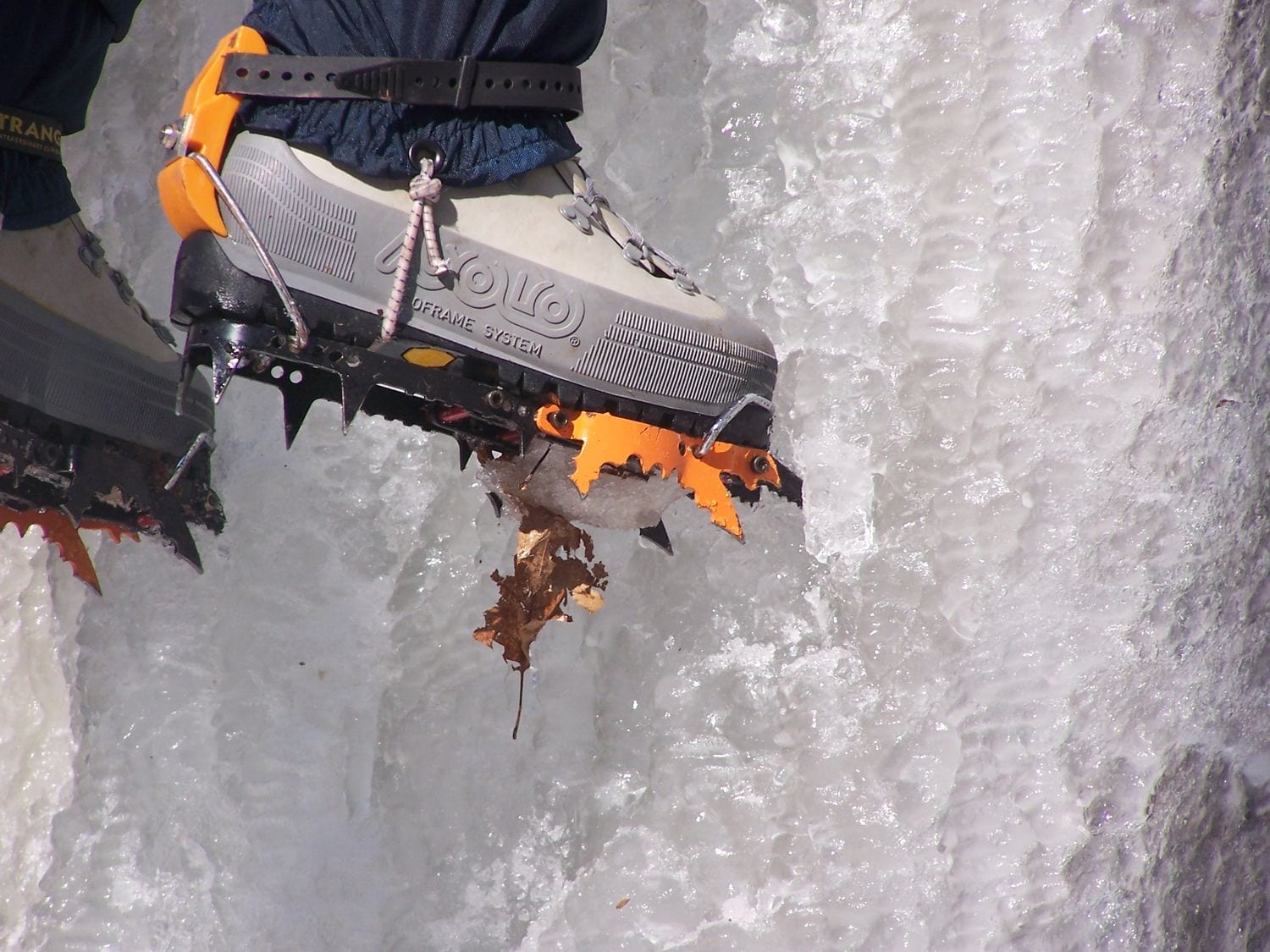
Crampons are metal frames with sharp spikes (called points) that attach to the soles of boots to give grip on ice and hard snow. A typical mountaineering crampon has 10 to 14 points: most point down into the surface, and two front points stick forward so the climber can kick into steep ice. They are made of steel (stronger and more durable, used for technical ice and rock) or aluminium (lighter, used for snow and ski touring). They fasten with straps, a toe cage and heel strap (hybrid), or a toe bail and heel lever (step-in). The right crampon depends on your boot's stiffness. Boots are rated B0–B3 and crampons C1–C3, and the two must match. Crampons are essential for glacier travel and for climbing peaks such as Mount Rainier, Mont Blanc, Kilimanjaro's crater rim in icy conditions, Aconcagua's upper slopes, Denali and every 8,000 m peak, including Everest.
This guide explains what the word means, how crampons work, their parts and types, how to match them to boots, how to fit and use them, and which crampons you need for popular climbs.
Crampons at a glance - Meaning: spiked traction devices for boots, used on ice and snow - Points: usually 10–14 (12 is the classic mountaineering number) - Materials: steel (e.g. Petzl Vasak 845 g, Black Diamond Sabretooth 890–910 g, Grivel G12 964–1,012 g a pair) or aluminium (e.g. Petzl Leopard FL ~360 g, Grivel Air Tech Light 556–592 g a pair) - Bindings: strap-on (C1), hybrid/semi-automatic (C2), step-in/automatic (C3) - Boot matching: B1 boots → C1; B2 → C1/C2; B3 → C1/C2/C3 - Safety standard: EN 893 / UIAA 153 - Typical price (2026): about US$210–$220 for popular steel mountaineering models (Petzl Vasak US$209.95, Black Diamond Sabretooth US$219.95, Grivel G12 US$220)
What does "crampon" mean?
The word crampon comes from French, from an older Germanic word for a hook or cramp-iron, and originally meant a metal hook or grappling iron. In mountaineering it means a spiked metal device fixed to a boot for walking and climbing on ice and snow. People sometimes write it as "cramp-ons", "clamp-ons" or "crampons spikes". The correct spelling is crampons (singular crampon).
Crampons are not the same as microspikes or ice cleats. Those are rubber harnesses with small chains and short spikes that stretch over running shoes or hiking boots for icy trails. They are great for winter hiking but unsafe for steep snow, glaciers or technical climbing.
A short history of crampons
People have used spiked footwear on ice for at least 2,000 years. Iron spikes strapped to shoes have been found in Celtic and Roman-era sites in the Alps, and herders in the Caucasus and the Alps used simple "four-point" irons for centuries.
| Year | Milestone |
|---|---|
| Ancient–1800s | Simple iron foot spikes used by herders and hunters in the Alps and Caucasus |
| 1908 | British climber Oscar Eckenstein publishes his design for a 10-point crampon that lets climbers walk on steeper ice without cutting steps; Henry Grivel's forge in Courmayeur begins making them soon after |
| 1929 | Laurent Grivel adds two forward-facing front points, creating the 12-point crampon and making front-pointing possible |
| 1938 | Front-pointing helps Anderl Heckmair's team climb the Eiger North Face |
| 1960s–1970s | Rigid crampons and the "front-pointing revolution" in ice climbing (Yvon Chouinard, Tom Frost and others) |
| 1970s–1980s | Step-in (clip-on) bindings become common with plastic double boots |
| 1990s–2000s | Lightweight aluminium crampons for ski mountaineering; modular mono-point designs for ice and mixed climbing |
| Today | EN 893 / UIAA 153 standard; huge range of specialised designs |
Before front points, climbers on steep ice had to cut steps with an axe. That was slow, exhausting work that limited what could be climbed.
How crampons work
Crampons concentrate the climber's weight onto small, sharp points that bite into ice or hard snow. On low-angle slopes, climbers use flat-footing (French technique), keeping all the downward points in contact with the surface. On steeper ground they use front-pointing (German technique), kicking the front points into the ice and standing on them, often with an ice axe for balance. Many climbers combine the two (American technique, or "three o'clock").
Why crampons matter so much
Boots, however good, cannot grip hard ice. A rubber sole on a frozen 30-degree slope behaves almost like a sledge. Crampons turn that slope into terrain you can walk on, and on steeper ground they let you stand on surfaces no sole could hold. They also cut the energy cost of moving on snow, because each step is secure and does not need to be kicked or cut. On glaciers, good crampon technique is just as important as roped travel and crevasse rescue. Most slips that lead to serious falls in the mountains happen on easy, moderate ground, often on the descent when climbers are tired, not on the steepest pitches. Well-fitted crampons, used with confidence, are among the simplest ways to cut that risk.
Parts of a crampon
| Part | What it does |
|---|---|
| Front points | Forward-facing teeth for kicking into steep snow and ice; can be horizontal or vertical, mono or dual |
| Secondary points | Angled points just behind the front points; provide stability when front-pointing |
| Downward points | Grip on flat and moderate terrain |
| Frame (front and heel sections) | The metal body the points are attached to |
| Linking bar (flex bar or rigid bar) | Joins front and heel sections; length-adjustable for boot size; flexible or rigid |
| Anti-balling plates | Plastic or rubber plates that stop wet snow from clumping under the crampon |
| Bindings | Straps, toe cage, toe bail and/or heel lever that attach the crampon to the boot |
Front points: horizontal vs vertical, mono vs dual
| Front-point type | Best for | Notes |
|---|---|---|
| Horizontal dual points | General mountaineering, snow, glacier, alpine routes | Better float in soft snow; most versatile |
| Vertical dual points | Steep water ice and alpine ice | Cut into ice like a blade; more precise |
| Mono-point | Hard ice, mixed and dry-tooling | Very precise placements; less stable for novices |
| Adjustable / modular | Climbers who do many styles | Front points can be swapped or moved |
Balling: why anti-balling plates matter
In warm, wet snow, snow can compact into a heavy ball under the crampon, so the points no longer touch the surface. This balling has caused many slips and falls. Anti-balling plates greatly reduce the problem. In very sticky conditions, climbers still tap the side of the boot with their ice axe to knock the snow off.
Types of crampons: strap-on, hybrid and step-in
The main difference between crampon types is the binding system.
| Type | Binding | Rating | Compatible boots | Best for |
|---|---|---|---|---|
| Strap-on (universal) | Plastic toe and heel cages with a strap | C1 | Almost any boot with a fairly stiff sole (B1–B3) | Hiking, glacier walking, snow slopes, trekking peaks |
| Hybrid (semi-automatic) | Front cage or strap, rear heel lever | C2 | Boots with a heel welt (B2–B3) | General mountaineering, alpine routes, Rainier, Mont Blanc |
| Step-in (automatic) | Front wire bail and rear heel lever | C3 | Fully rigid boots with toe and heel welts (B3) | Technical ice, steep alpine routes, 8,000 m peaks |
Strap-on crampons (C1)
Strap-on crampons fit a wide range of boots and are easy to use, but they are less secure on steep ground. They are the right choice for winter walking, glacier hiking and non-technical snow.
Hybrid crampons (C2)
Hybrid crampons combine a flexible front cage with a secure heel lever. They are the most popular choice for general mountaineering and suit most climbers on peaks such as Mount Rainier, Mount Baker and Mont Blanc.
Step-in crampons (C3)
Step-in crampons clip firmly to rigid boots with toe and heel welts. They give the most precise and secure connection. They are usually required for technical ice climbing and are the standard choice with double boots or 8,000 m boots on peaks such as Ama Dablam, Denali and Everest.
Matching crampons to boots: B and C ratings
Mountaineering boots are graded by stiffness, and crampons by binding type. They must be compatible, or the crampon can pop off or snap.
| Boot rating | Description | Compatible crampons | Example uses |
|---|---|---|---|
| B0 | Flexible walking boots or shoes | None (microspikes only) | Summer hiking |
| B1 | Stiffer hiking boots with some midsole stiffness | C1 | Winter walking, easy glaciers |
| B2 | Stiff mountaineering boots with a heel welt | C1, C2 | Alpine mountaineering, Rainier, Mont Blanc |
| B3 | Fully rigid boots with toe and heel welts | C1, C2, C3 | Technical ice, Denali, Himalayan peaks |
Quick rule: a crampon can never be "higher" than the boot. A C3 step-in crampon on a B1 boot is dangerous.
Steel vs aluminium crampons
| Steel | Aluminium | |
|---|---|---|
| Weight (pair), examples | Petzl Vasak 845 g; Grivel G12 964–1,012 g | Petzl Leopard FL ~360 g; Grivel Air Tech Light 556–592 g |
| Durability | Very high; handles rock and mixed terrain | Wears quickly on rock |
| Ice performance | Excellent on hard ice | Weaker on hard ice |
| Best for | Mountaineering, ice climbing, mixed routes, 8,000 m peaks | Ski touring, snow couloirs, light alpine routes |
| US list price, examples | Vasak US$209.95; Sabretooth US$219.95; G12 US$220 | Leopard FL US$209.95 |
Price ranges compiled by ExpedReview from retailer and manufacturer websites in 2026.
How many points should crampons have?
| Points | Typical use |
|---|---|
| 4–6 points (instep crampons) | Short icy sections; not for mountaineering |
| 10 points | Light glacier travel, ski mountaineering, easy snow |
| 12 points | Standard mountaineering and alpine climbing |
| 14 points | Technical ice and mixed climbing (extra secondary points) |
Crampons vs other traction devices
| Device | Spike length | Attaches to | Best for | Not suitable for |
|---|---|---|---|---|
| Ice cleats / Yaktrax-style coils | Very short studs or coils | Any shoe | Icy pavements and flat paths | Slopes, trails with exposure |
| Microspikes / trail crampons | ~8–15 mm | Running shoes, hiking boots | Packed snow and icy hiking trails | Glaciers, steep snow, ice climbing |
| Instep crampons (4–6 points) | Short | Hiking boots | Short icy sections | Mountaineering |
| Strap-on crampons (C1) | ~20–30 mm | B1–B3 boots | Winter walking, easy glaciers | Steep technical ice |
| Hybrid crampons (C2) | ~20–35 mm | B2–B3 boots | General mountaineering | Very steep ice (best with C3) |
| Step-in crampons (C3) | ~20–35 mm + aggressive front points | B3 boots | Technical ice, high altitude | Flexible boots |
The main point is that microspikes and ice cleats are trail tools, while crampons are climbing tools. Many winter accidents on popular hills happen when walkers in microspikes reach steeper, icier ground than their gear can handle. If a route needs an ice axe, it needs crampons. If it needs crampons, the people using them need to know how to self-arrest.
How to fit crampons
- Check compatibility. Make sure your boot rating matches the crampon type.
- Adjust the length. Set the linking bar so the crampon fits snugly from toe to heel. The front points should stick out about 2–3 cm beyond the boot's toe.
- Centre the boot. The boot should sit centred, with no gaps at the sides.
- Fasten securely. Close the heel lever firmly, or tighten the straps, and tuck away loose strap ends.
- Test it. Shake your foot and kick a wall. The crampon should not move on the boot.
- Recheck in the field. Straps loosen and snow gets into bindings, so check every time you stop.
Always fit crampons at home first, with the exact boots and socks you will climb in, and not for the first time on a glacier at 3 am.
How to walk in crampons safely
- Walk with your feet slightly wider apart than normal so the points don't catch your trousers or gaiters. Tripping on your own crampons is a classic cause of falls.
- Keep your feet flat on low and moderate slopes so all the points bite.
- Lift your feet deliberately, and don't shuffle.
- Front-point on steep ground, keeping your heels low and kicking firmly.
- Never glissade (slide) in crampons. The points can catch and cause leg injuries or a cartwheeling fall.
- Self-arrest with your feet up. If you fall on snow while wearing crampons, keep the points off the surface while braking with your ice axe.
- Learn on a course. Crampon and ice-axe technique is taught on every basic mountaineering course, and many guided climbs include a skills day.
Caring for your crampons
- Dry them after each trip to prevent rust (steel).
- Sharpen points with a hand file, never a grinder, which can ruin the steel's temper.
- Check frames and linking bars for cracks and replace worn points.
- Store them in a crampon bag or with point protectors to protect gear and packs.
- Follow the manufacturer's retirement advice: crampons with cracked parts or badly worn points should be replaced.
Choosing crampons by activity
The best crampon for you depends far more on what you plan to climb than on brand or price. Here is how the main activities compare.
Winter hiking and easy snow
If you are walking well-trodden winter trails or gentle snow slopes, you may not need full crampons at all. Microspikes or light C1 strap-on crampons are enough for icy paths. Move up to a proper 10–12 point C1 crampon on a B1 boot as soon as the slopes get steeper, more exposed or icier. On any slope where a slip could lead to a long slide, you need real crampons and an ice axe, and the skills to use them.
Glacier travel and trekking peaks
Glacier walking, whether a crevasse-rescue course, a Cascade volcano or a Himalayan trekking peak such as Island Peak or Mera Peak, calls for a 12-point steel crampon with horizontal front points and good anti-balling plates. A C2 hybrid on a B2 boot is the most common setup. On high Himalayan trekking peaks, where climbers often wear warmer B3 boots, C2 or C3 crampons both work. Horizontal front points give better grip in soft and refrozen snow.
General mountaineering and alpine routes
For classic alpine routes such as Mont Blanc, the Matterhorn, Gran Paradiso and the Cascade volcanoes, a 12-point steel C2 hybrid or C3 step-in is the workhorse choice. These routes mix snow, ice and rock, so steel's durability matters. Many guides recommend horizontal or slightly angled dual front points, which are forgiving on both snow and moderate ice.
Technical ice and mixed climbing
Steep water ice and mixed rock-and-ice routes need a rigid or semi-rigid C3 step-in crampon with vertical front points, often adjustable between dual and mono-point. These crampons are designed for precision. They hold tiny placements on hard ice and edges on rock, but they are less comfortable for long glacier approaches.
Ski mountaineering and ski touring
Weight matters most here. Ski mountaineers usually carry light aluminium 10–12 point crampons, often C2 or C3 to match their touring boots, for steep couloirs and icy summit ridges. Ultralight models such as the Petzl Leopard FL weigh about 360 g a pair. They are excellent on snow but wear quickly on rock and are not suited to hard alpine ice.
High-altitude expeditions
On Denali, Aconcagua, Ama Dablam and the 8,000 m peaks, climbers wear steel C3 step-in (or C2 hybrid) 12-point crampons on insulated double boots or one-piece 8,000 m boots. Crampons must fit the much larger boot, so many climbers need a longer linking bar. Fit them before leaving home: fixing a crampon at Camp 3 in -25°C with thick mitts is very hard.
Crampons in extreme cold
Very low temperatures cause their own problems:
- Brittle plastics. Plastic toe cages and straps can stiffen and crack in extreme cold. Steel bails and heel levers are more reliable on high peaks.
- Icing of bindings. Snow and ice can build up in heel levers and stop them closing fully. Clear them before clipping in.
- Boot shrinkage and stretch. Insulated boots compress and expand slightly with temperature, so recheck tension after the first hour of climbing.
- Handling with gloves. Practise putting crampons on and taking them off wearing the mitts you will use high on the mountain.
- Steel fatigue. Cold steel is slightly more brittle, which is another reason to inspect frames regularly for cracks.
Common crampon mistakes
| Mistake | Why it's dangerous | How to avoid it |
|---|---|---|
| Wrong crampon for the boot | Crampon can pop off or break | Match B and C ratings |
| Fitting for the first time on the mountain | Poor fit, lost time, cold hands | Fit and test at home with your boots and socks |
| Walking with feet too close together | Catching points on trousers or gaiters causes trips | Walk slightly wider than normal; wear gaiters or trousers with protective panels |
| No anti-balling plates in wet snow | Snow clumps under the crampon, causing slips | Use anti-balling plates; tap off snow with your axe |
| Glissading with crampons on | Points can catch and cause a tumbling fall or broken ankle | Remove crampons before glissading, or don't glissade |
| Blunt points on hard ice | Poor penetration and grip | File points regularly |
| Loose straps | Crampon slides off or twists | Recheck after every break |
Crampon buying checklist
Before you buy, check:
- What you will climb: glacier, alpine, ice, ski touring or high altitude.
- Your boots' B rating, and whether they have toe and heel welts.
- The binding type that matches your boots (C1, C2 or C3).
- Material: steel for most mountaineering, aluminium only for light snow use.
- Front points: horizontal for snow and general mountaineering, vertical or mono for steep ice.
- Anti-balling plates: included or available.
- Size adjustment: enough length for your largest boot (especially 8,000 m boots).
- Standards: EN 893 / UIAA 153 certification.
- Weight: lighter is better only if the crampon still suits your terrain.
- Your guide's kit list: many guided climbs specify crampon types.
If you are going on a guided trip, ask the operator before buying. Many companies rent crampons and boots in places such as Chamonix, Ashford (for Rainier), Kathmandu and Mendoza.
Which crampons do you need for popular climbs?
| Climb | Height | Recommended crampons | Notes |
|---|---|---|---|
| Kilimanjaro | 5,895 m | Usually not needed; microspikes sometimes useful after snowfall | Non-technical trekking peak |
| Everest Base Camp trek | 5,364 m | Not needed in season; microspikes in winter | Trek only |
| Island Peak / Lobuche East | 6,165 / 6,119 m | C2 hybrid or C3 step-in, steel, 12 points | Fixed-rope sections on steep snow/ice |
| Mount Rainier (Disappointment Cleaver) | 4,392 m | C2 hybrid, steel, 12 points | Glacier travel and steep snow |
| Mont Blanc (Goûter route) | 4,806 m | C2 hybrid, steel, 12 points | Mixed snow and rock |
| Matterhorn (Hörnli) | 4,478 m | C2 or C3, steel, 12 points | Mostly rock; crampons high up |
| Aconcagua (Normal route) | 6,961 m | C2 or C3, steel | Hard snow near the summit; double boots |
| Denali (West Buttress) | 6,190 m | C2 or C3, steel, 12 points | Extreme cold; double boots |
| Ama Dablam | 6,812 m | C3 step-in, steel, 12–14 points | Steep ice and rock on fixed ropes |
| Everest (South Col / North Ridge) | 8,849 m | C3 step-in, steel, 12 points | Used with 8,000 m boots on the Khumbu Icefall ladders and Lhotse Face |
On Everest, climbers wear crampons almost constantly above base camp, including while crossing aluminium ladders in the Khumbu Icefall. Crampons are part of every Everest gear list and a small but real part of what it costs to climb Mount Everest.
Top-rated operators for learning crampon skills on ExpedReview
Many climbers learn crampon technique on guided climbs and skills courses. These operators have the highest average ratings from verified ExpedReview client reviews for the routes below (minimum two reviews; data as of 22 October 2026).
| Climb | Operator | ER average rating | Verified reviews |
|---|---|---|---|
| Mont Blanc | SummitGuides | 4.6 / 5 | 8 |
| Denali | AAI (American Alpine Institute) | 5.0 / 5 | 3 |
| Ama Dablam | Tim Mosedale | 5.0 / 5 | 16 |
| Ama Dablam | Furtenbach Adventures | 4.9 / 5 | 5 |
Browse more on the Cascades, Alps and Everest region pages.
Frequently asked questions
What are crampons?
Crampons are metal frames with spikes that attach to the soles of boots, giving grip on ice and hard snow. They are essential gear for glacier travel, mountaineering and ice climbing.
What does crampons mean?
"Crampon" comes from French and originally meant a metal hook or cramp-iron. In mountaineering it means a spiked traction device fixed to a boot.
What are crampons used for?
For walking and climbing on ice, hard snow and glaciers: mountaineering, ice climbing, ski mountaineering and winter hiking on steep or icy terrain.
What is the difference between crampons and microspikes?
Microspikes are rubber harnesses with small chains and short spikes for icy trails. Crampons have long, rigid points and front points for glaciers, steep snow and ice. Microspikes are not safe for mountaineering.
What are the different types of crampons?
There are three main types by binding: strap-on (C1), hybrid or semi-automatic (C2), and step-in or automatic (C3). They also differ in material (steel or aluminium) and front-point design.
What do C1, C2 and C3 mean on crampons?
They are binding categories. C1 crampons are strap-on and fit most boots. C2 are hybrid, with a heel lever that needs a heel welt. C3 are step-in, needing rigid boots with toe and heel welts.
What boots do I need for crampons?
Your boot rating must match. B1 boots take C1 crampons, B2 take C1 or C2, and B3 take C1, C2 or C3. Flexible B0 shoes are not suitable for crampons.
How many points should crampons have?
For general mountaineering, 12 points. Ten-point crampons suit light glacier and ski touring use, and 14-point models are for technical ice and mixed climbing.
Are steel or aluminium crampons better?
Steel crampons are stronger and better on hard ice and rock, so they are best for most mountaineering. Aluminium crampons are lighter and suited to snow, ski touring and light alpine climbs.
Who invented crampons?
Simple foot spikes are ancient, but the modern 10-point crampon was designed by Oscar Eckenstein in 1908 and made by Henry Grivel. Laurent Grivel added front points in 1929.
Do you need crampons for Kilimanjaro?
Usually not. Standard Kilimanjaro routes are non-technical. After heavy snowfall, guides sometimes recommend microspikes for the crater rim.
Do you need crampons for Everest?
Yes. Climbers wear C3 step-in steel crampons on 8,000 m boots from the Khumbu Icefall to the summit, including when crossing ladders.
Do you need crampons for Mount Rainier?
Yes. All standard Rainier routes cross glaciers and steep snow, so 12-point steel crampons, usually C2 hybrid, are required along with an ice axe.
How do you put on crampons?
Adjust them to your boot at home. On the mountain, place the boot centred on the crampon, close the toe bail or cage, snap the heel lever or tighten the straps, and tuck away loose ends.
How much do crampons cost?
Popular steel mountaineering crampons list at about US$210–$220 in the US (Petzl Vasak US$209.95, Black Diamond Sabretooth US$219.95, Grivel G12 US$220). Basic strap-on models cost less.
Can you walk on rocks with crampons?
Yes, briefly. Steel crampons cope with rock sections on alpine routes, but rock dulls the points and can be slippery. Aluminium crampons wear quickly on rock.
How do you sharpen crampons?
Use a hand file to sharpen the points, keeping their original angles. Never use a power grinder, because the heat can weaken the steel.
Can you rent crampons?
Yes. Gear shops in mountaineering hubs such as Chamonix, Zermatt, Ashford (for Rainier), Kathmandu and Mendoza rent crampons, usually together with boots. Make sure the rented crampons fit your boots before setting off.
How long do crampons last?
With good care, steel crampons can last many seasons of mountaineering. Points wear with use, especially on rock, and need filing. Replace crampons with cracked frames, bent linking bars or points worn too short to sharpen.
What are 10-point crampons used for?
Ten-point crampons suit lighter uses such as glacier walking, ski mountaineering and easy snow climbs. For general mountaineering and steeper ground, 12-point crampons are standard.
Sources
Data gathered by ExpedReview from manufacturer and retailer websites and official standards, written in our own words:
- UIAA Safety Standard 153 (Crampons) and EN 893.
- Manufacturer specifications from major crampon makers (weights and binding categories), checked October 2026.
- Grivel family history and Alpinist on Eckenstein's 1908 crampon article.
- Manufacturer product pages: Petzl Vasak, Black Diamond Sabretooth, Grivel G12 (checked October 2026).
Tags: crampons, gear-basics, ice-climbing, mountaineering-essentials, glacier-travel