How the Body Copes Above 8,000 m: Oxygen Levels, Breathing & Acclimatisation on Everest
By Blake Penson · November 7, 2024
Category: health-and-safety
6 min read
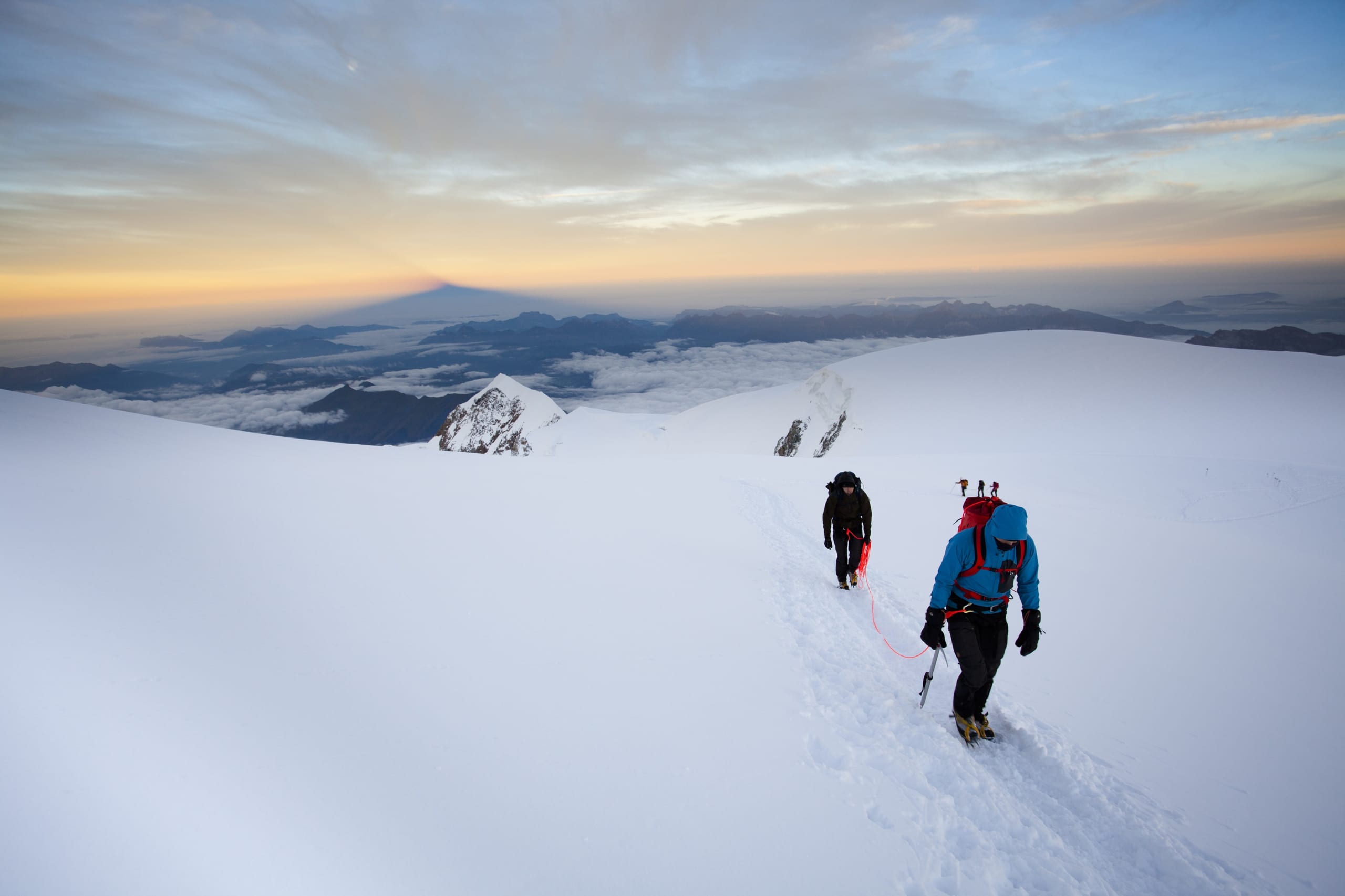
Above 8,000 metres the air pressure is only about a third of sea level, so each breath delivers roughly a third of the oxygen. The body copes in three ways. Over weeks of acclimatisation it breathes much harder, raises its heart rate and makes more red blood cells. Most climbers then add bottled oxygen to make up the shortfall. And they limit the time spent up there to hours, not days. Even after a full acclimatisation programme, an Everest climber's blood oxygen saturation at 8,000 m+ without bottled oxygen typically sits around 50–70%, compared with 95–100% at sea level. Breathing is so laboured that climbers take several breaths for every step. Bottled oxygen at 2–4 litres per minute makes the body behave as if it were thousands of metres lower, but it cannot remove the risk. The highest altitude where people live permanently is about 5,100 m. Above about 8,000 m nobody can survive indefinitely.
This guide explains how thin the air really is, what the body does to adapt, and how mountaineers turn that adaptation into a summit. Our companion article on what happens to your body in the death zone covers the dangers and illnesses in more detail.
Key numbers: oxygen and altitude - Oxygen percentage in the air: about 20.9% at every altitude. - Air pressure at 8,000 m: about 36% of sea level (~267 mmHg). - Air pressure on Everest's summit: about 33% of sea level (~253 mmHg). - Measured arterial oxygen at 8,400 m: mean 24.6 mmHg (normal ~95 mmHg), roughly 54% saturation (2007 study). - Highest permanent settlement: La Rinconada, Peru, about 5,100 m.
How thin is the air on Mount Everest?
"Thin air" means low air pressure, not a lower percentage of oxygen. Air on the summit of Everest is still about 21% oxygen, the same as at the beach. But because the pressure is about a third of sea level, a lungful of air holds only about a third as many oxygen molecules. The pressure of oxygen pushing into your lungs and blood drops by the same proportion.
Oxygen level by altitude
| Altitude | Example | Pressure (approx.) | % of sea-level oxygen available | Equivalent O₂ % at sea level |
|---|---|---|---|---|
| 0 m | Sea level | 760 mmHg | 100% | 20.9% |
| 2,400 m (8,000 ft) | Aircraft cabin / Cusco | 565 mmHg | 74% | ~15.5% |
| 3,440 m | Namche Bazaar | 500 mmHg | 66% | ~13.8% |
| 5,364 m | Everest Base Camp | 400 mmHg | 53% | ~11% |
| 6,400 m | Everest Camp 2 | 350 mmHg | 46% | ~9.6% |
| 7,100 m | Everest Camp 3 | 320 mmHg | 42% | ~8.8% |
| 8,000 m | South Col (Camp 4) | 267 mmHg | 35% | ~7.4% |
| 8,849 m | Everest summit | 253 mmHg | 33% | ~6.9% |
Pressures are typical climbing-season values. The summit value comes from direct measurement during the 1981 American Medical Research Expedition to Everest. Actual values change with weather and season.
Oxygen level at 8,000 metres vs 8,000 feet
People often mix these up:
- At 8,000 feet (2,438 m), the height of many ski resorts and the pressure inside an airliner cabin, you get about 74% of sea-level oxygen pressure. Most healthy people feel little more than mild breathlessness on exertion.
- At 8,000 metres (26,247 ft), the start of the death zone, you get about 35%. That is barely enough to keep a fully acclimatised person conscious and moving.
How hard is it to breathe on Mount Everest?
Very hard. Climbers describe it as:
- at base camp (5,364 m): breathless after walking uphill or climbing stairs, a racing heart at night, and waking up gasping;
- at Camp 2–3 (6,400–7,300 m): stopping every few steps on steep ground, struggling to talk while walking, and needing deep, rapid breaths even at rest;
- above 8,000 m without bottled oxygen: taking 5–10 breaths for every step, slowing to perhaps 100–200 vertical metres an hour, and feeling as if they are moving in slow motion;
- above 8,000 m with bottled oxygen: still hard work, but often described as feeling like 6,500–7,500 m, which allows a much steadier pace.
Breathing rate can top 50–60 breaths a minute on hard ground near the summit. Every breath of very cold, dry air also takes moisture and heat out of the body. That contributes to dehydration, sore throats and the hacking "Khumbu cough".
What is the highest altitude a human can breathe?
There are three useful answers.
| Limit | Altitude | What it means |
|---|---|---|
| Highest permanent settlement | ~5,100 m (La Rinconada, Peru) | Highest place where people live year-round |
| Highest long-term habitation (research/mining) | ~5,300–5,950 m | Short stays only; health declines over months |
| Upper limit of acclimatisation | ~7,500–8,000 m | Above this the body deteriorates faster than it can adapt |
| Highest summit without supplemental O₂ | 8,849 m (Everest) | First done in 1978; possible only for a few days at most |
| Armstrong limit | ~18,000–19,000 m | Body fluids boil at body temperature; survival impossible without a pressure suit |
Without acclimatisation, an unprepared person suddenly exposed to the pressure on Everest's summit, for example after a cabin depressurisation, would lose useful consciousness within a few minutes. The "time of useful consciousness" at about 9,000 m is often given as roughly 1–3 minutes.
How the body adapts: acclimatisation explained
Acclimatisation is the set of changes that let the body work in low oxygen. Some happen in minutes, others take weeks.
Minutes to hours: breathing and heart rate
- Hypoxic ventilatory response. Sensors in the carotid arteries detect low oxygen and tell the brain to breathe faster and deeper. This is the single most important early adaptation.
- Faster heart rate. The heart pumps more blood each minute to deliver more oxygen to tissues.
- Blood vessel changes. Vessels in the lungs tighten. This helps match blood flow to air flow, but in some people it drives the pressure rise behind HAPE.
Days: blood chemistry and fluids
- Kidney compensation. Breathing hard blows off carbon dioxide and makes the blood more alkaline. Over several days the kidneys excrete bicarbonate to bring pH back towards normal, which lets breathing rise even further. The drug acetazolamide (Diamox) speeds up this process.
- Plasma volume falls. The body sheds fluid, which concentrates red blood cells in the blood. That is part of why climbers urinate so much at altitude.
Weeks: red blood cells and muscles
- More red blood cells. Low oxygen stimulates the kidneys to release erythropoietin (EPO), which tells the bone marrow to make more red blood cells. Over 2–6 weeks haemoglobin can rise from about 14–15 g/dL to 18–20 g/dL or more.
- Muscle and mitochondrial changes. Muscles adapt to use oxygen more efficiently. But at extreme altitude muscle mass is also lost.
Acclimatisation timeline on an Everest expedition
| Week | Typical location | Highest sleep altitude | What the body is doing |
|---|---|---|---|
| 1 | Lukla to Namche Bazaar to Dingboche | 3,400–4,400 m | Breathing and heart rate up; mild headaches common |
| 2 | Lobuche to Everest Base Camp | 4,900–5,364 m | Kidneys adjusting; plasma volume down; appetite falls |
| 3 | First rotation to Camp 1/Camp 2 | 6,000–6,400 m | Red blood cell production rising; first exposure to 6,000 m+ |
| 4 | Recovery at base camp; second rotation | 6,400–7,100 m | Haemoglobin increasing; sleep remains disturbed |
| 5 | Rest, possibly lower in the valley | 4,000–5,364 m | Recovery of appetite and strength ("thick" blood) |
| 6–8 | Summit push via Camps 2, 3, 4 | 7,900–8,000 m (Camp 4) | Using all reserves; bottled O₂ from Camp 3 or 4 |
Our guide to how long it takes to climb Mount Everest explains the full itinerary, and the Everest region page covers acclimatisation treks such as the Everest Base Camp trek and the Three Passes.
Blood oxygen saturation at altitude: what's normal?
Climbers and expedition doctors check oxygen saturation (SpO₂) daily with a fingertip pulse oximeter. Readings fall steadily with altitude and vary widely between individuals; cold fingers, movement and nail polish can all distort them. The best direct measurement at extreme altitude comes from blood rather than fingertips: in 2007, researchers sampling arterial blood at 8,400 m on Everest found a mean PaO₂ of just 24.6 mmHg (range 19.1–29.5) in climbers breathing ambient air (Grocott et al., NEJM 2009).
The same study shows why acclimatisation matters so much. As the climbers went higher, the oxygen pressure in their arterial blood fell steadily, but their haemoglobin concentration rose. That rise was enough to keep the total oxygen content of their arterial blood at or above sea-level values all the way up to 7,100 m (23,294 ft). Only above that point did the body's compensation start to fail: at 8,400 m, where the barometric pressure was 272 mmHg, mean arterial oxygen content was 26% lower than at 7,100 m. The researchers also found a very small gap between alveolar and arterial oxygen, which suggests the lungs were working at the edge of their capacity to load oxygen into the blood.
In practice, this is why expedition doctors look at the whole picture rather than one fingertip number. A climber whose readings drop day after day at the same camp, or who becomes breathless at rest, is showing a warning sign however "normal" a single figure looks.
A single reading matters less than the trend and how the climber feels. A falling SpO₂ together with breathlessness at rest, confusion or poor coordination can point to HAPE or HACE and calls for immediate action.
How bottled oxygen helps above 8,000 m
Supplemental oxygen is the main reason thousands of people now reach the summit of Everest every year. It works by raising the oxygen pressure in the air the climber breathes.
How an oxygen system works
A typical high-altitude oxygen system has:
- a cylinder, usually a 3–4 litre composite bottle filled to very high pressure;
- a regulator that reduces the pressure and sets the flow rate, usually 0.5–4 litres per minute;
- a mask, often with a reservoir bag or valves to save oxygen when breathing out.
At 2–3 L/min a standard 4 L bottle typically lasts about 5–8 hours, depending on its fill pressure and the mask. That is why climbers carry one bottle and rely on Sherpas or caches for more.
Effect of oxygen flow rate
Higher flow rates raise the oxygen the climber breathes but empty bottles faster, so expeditions plan flow (commonly 0.5–4 L/min) against the number of bottles available. The real benefit depends on mask fit, breathing rate and workload.
Higher flow rates and more bottles mean more weight to carry up the mountain and more cost. That is one of the clearest differences between budget and premium Everest packages. See how much it costs to climb Mount Everest and our guide to Everest climbing styles.
Climbing above 8,000 m without supplemental oxygen
Only a small share of Everest ascents are made without bottled oxygen. Reinhold Messner and Peter Habeler first did it on 8 May 1978. Climbing without oxygen means:
- a much slower pace and a far greater risk of HACE, frostbite and exhaustion;
- higher death rates in studies of 8,000 m climbers;
- in some studies, measurable changes on brain scans after the expedition.
Climbers who go without oxygen usually limit their time above 8,000 m to a single long push. In May 2026 Norwegian climber Kristin Harila summited Everest without supplemental oxygen as the last peak of her Everest–Lhotse–Nuptse Triple Crown (see her profile).
When adaptation fails: AMS, HAPE and HACE
Acclimatisation has limits, and when the body cannot keep up, altitude illness follows. The three main forms are:
| Condition | What happens | Early signs | Key treatment |
|---|---|---|---|
| Acute mountain sickness (AMS) | Mild brain swelling and fluid shifts | Headache, nausea, poor appetite, fatigue, poor sleep | Rest, no further ascent, acetazolamide; descend if worsening |
| High-altitude pulmonary oedema (HAPE) | Fluid leaks into the lungs | Breathlessness at rest, dry then wet cough, reduced exercise tolerance | Descent, oxygen, nifedipine, hyperbaric bag |
| High-altitude cerebral oedema (HACE) | Severe brain swelling | Staggering gait (ataxia), confusion, drowsiness, behaviour change | Immediate descent, oxygen, dexamethasone |
AMS affects a large share of trekkers and climbers above 3,000 m. It is uncomfortable but rarely dangerous if handled sensibly. HAPE and HACE are much rarer, but they are the main medical killers at extreme altitude. Above 8,000 m they can develop in hours, and the usual treatment of "go down" may itself take most of a day. That is why expedition doctors and experienced guides watch so closely for the first signs: a climber who is unusually slow, coughing hard at rest or stumbling on easy ground.
Sleep above 8,000 metres
Sleep is one of the first things altitude takes away. Above about 4,000 m most people develop periodic breathing: cycles of deep breaths followed by pauses of up to 10–20 seconds, after which the sleeper often wakes with a gasp. Combined with cold, a cramped tent, the noise of wind, and the need to melt snow for water, this means climbers at Camp 4 often get only a few hours of broken sleep before the summit push.
Climbers deal with it by:
- sleeping on low-flow oxygen (often 0.5–1 L/min) at Camp 3 and Camp 4, which improves sleep quality and saves energy;
- taking acetazolamide, which reduces periodic breathing for many people;
- avoiding sleeping pills and alcohol, which can depress breathing dangerously at altitude;
- keeping the stay short, arriving at Camp 4 around midday, resting, and leaving for the summit the same night.
Eating and drinking above 8,000 metres
At extreme altitude appetite fades just as energy needs peak. A summit day can burn 6,000–10,000 kcal, while climbers may manage only a few hundred calories of gels, chocolate, nuts or soup. Digestion slows because blood is diverted from the gut, and nausea is common.
| Challenge | Practical approach used by expeditions |
|---|---|
| Loss of appetite | Small, frequent, familiar snacks; favourite foods from home |
| Poor fat digestion | Shift towards carbohydrate-rich foods high on the mountain |
| Dehydration | Aim for 4–6 litres a day; insulated bottles; drink every rest stop |
| Frozen food and water | Keep bottles and snacks inside the down suit |
| Weight loss | Build reserves before the expedition; eat well at base camp between rotations |
Most climbers lose 5–10 kg over an 8,000 m expedition, much of it muscle. A good base-camp kitchen, with fresh food, varied menus and reliable hygiene, makes a real difference to how strong a climber is on summit day. It is one of the most frequent themes in verified ExpedReview reviews of Everest operators.
Age, sex and individual differences
Altitude tolerance varies more between individuals than between groups. Some general findings:
- Age. Older climbers are not necessarily more prone to AMS, and climbers in their 60s and 70s have reached the summit of Everest. Recovery is slower, though, and the underlying risk of heart problems rises with age.
- Sex. Studies have not found a consistent difference in altitude-sickness risk between men and women. Women make up a growing share of 8,000 m climbers.
- Previous history. The best predictor of how someone will handle altitude is how they handled it before. A previous episode of HAPE is a strong warning sign.
- Fitness. High fitness does not prevent altitude illness, but fitter climbers move at a lower share of their maximum effort and keep more in reserve.
Why Sherpas and Tibetans cope better at altitude
Populations that have lived on the Tibetan plateau and in the high Himalaya for thousands of years show genetic adaptations to low oxygen. Research has identified:
- Variants of the EPAS1 and EGLN1 genes, which help limit excessive red blood cell production at altitude, so the blood does not become dangerously thick.
- Higher nitric oxide levels, which help keep blood vessels open and blood flowing.
- More efficient muscle metabolism, with evidence that Sherpa muscles use oxygen more economically.
These adaptations do not make Sherpas immune to altitude illness. Sherpa climbers still get HAPE and HACE and still face the extreme risks of the death zone, but they help explain the remarkable performances of climbers such as Kami Rita Sherpa, who made his 32nd Everest ascent in May 2026, and Lhakpa Sherpa, who set the women's record with her 11th.
New ways to acclimatise: hypoxic tents, "flash" expeditions and xenon
Some operators now shorten expeditions by pre-acclimatising climbers at home:
- Hypoxic tents and masks. Climbers sleep in a tent with reduced oxygen for several weeks before travelling. This can cut 1–3 weeks from an Everest itinerary. Evidence on how much it helps is mixed, and it does not replace real-world acclimatisation completely.
- "Flash" expeditions. Several Western operators offer Everest trips of about 3–4 weeks that combine hypoxic pre-acclimatisation, more bottled oxygen and helicopter logistics.
- Xenon gas. In 2025 one operator reported clients summiting Everest in under a week after xenon treatment combined with hypoxic pre-acclimatisation. Medical bodies, including the International Society for Mountain Medicine, have said there is no good evidence that xenon improves acclimatisation and have raised safety concerns.
How climbers keep their bodies working above 8,000 m
| Strategy | Why it helps |
|---|---|
| Climb high, sleep low | Exposure to altitude triggers adaptation; recovery happens lower down |
| Drink 4–6 litres a day | Replaces water lost through breathing; reduces blood thickness |
| Eat high-calorie food that's easy to digest | Slows muscle loss; fuels the summit push |
| Use bottled oxygen from Camp 3 or 4 | Raises blood oxygen and brain function; reduces frostbite risk |
| Strict turnaround times | Limits time in the death zone; keeps the descent in daylight |
| Daily health checks (SpO₂, pulse, symptoms) | Catches HAPE/HACE early |
| Experienced guides and Sherpas | Spot problems, carry spare oxygen, make objective calls |
Training your body before an 8,000 m climb
Most operators recommend 6–12 months of focused training before an 8,000 m expedition. Plans typically include:
- Aerobic base: long hours of low-intensity hiking, running or cycling, often 8–15 hours a week by the peak of training;
- Uphill load carrying: hiking with 15–25 kg packs, stair or incline training;
- Strength and durability: legs, core and back to cope with weeks of heavy days;
- Altitude experience: a 6,000–7,000 m peak first, such as Lobuche, Island Peak, Ama Dablam or Aconcagua, and many operators expect an earlier 8,000 m climb such as Manaslu or Cho Oyu before Everest. Read our guide on what to climb before Everest.
Top-rated 8,000 m operators on ExpedReview
The companies below have the highest average ratings from verified ExpedReview client reviews on 8,000 m routes (minimum two reviews; data as of 22 October 2026).
| Route | Operator | ER average rating | Verified reviews |
|---|---|---|---|
| Everest – South Col | Climbing The Seven Summits | 5.0 / 5 | 14 |
| Everest – South Col | Dream Himalaya Adventures | 5.0 / 5 | 5 |
| Everest – South Col | Adventure Consultants | 5.0 / 5 | 3 |
| Everest – North Ridge | Furtenbach Adventures | 4.8 / 5 | 12 |
| Manaslu | Furtenbach Adventures | 5.0 / 5 | 8 |
| Manaslu | Pioneer Adventure | 5.0 / 5 | 2 |
Compare more on the Everest South Col, Everest North, Lhotse and Manaslu pages.
Frequently asked questions
How hard is it to breathe on Mount Everest?
Extremely hard. Near the summit, each breath carries only about a third of the oxygen it would at sea level. Climbers without bottled oxygen often take 5–10 breaths per step, and even with oxygen, breathing is fast and laboured.
What is the oxygen level at 8,000 meters?
Air at 8,000 m is still about 20.9% oxygen, but the pressure is only about 35% of sea level. That gives roughly the same oxygen as breathing 7.4% oxygen at sea level.
What is the oxygen level on Mount Everest?
On the summit (8,849 m), barometric pressure is about 253 mmHg, or 33% of sea level. That is equivalent to about 6.9% oxygen at sea level, even though the air is still 21% oxygen.
How thin is the air on Mount Everest?
Air pressure on the summit is about one-third of sea level. Each breath contains about a third of the oxygen molecules, so the air feels extremely "thin" and the body struggles to get enough oxygen.
What is the highest altitude a human can breathe?
People can live permanently up to about 5,100 m (La Rinconada, Peru), acclimatise to about 7,500–8,000 m, and survive brief climbs to 8,849 m without bottled oxygen. Above roughly 8,000 m no one can survive indefinitely.
What is the 8,000 m death zone?
It is the altitude above about 8,000 m where the body can no longer acclimatise and slowly deteriorates. All 14 of the world's 8,000 m peaks reach into it. Read our full guide to the death zone.
What is the blood oxygen level at the top of Everest?
A 2007 study measured a mean arterial oxygen pressure of 24.6 mmHg and an estimated saturation of about 54% in climbers breathing ambient air at 8,400 m. Normal sea-level values are about 95 mmHg and 95–100%.
How do climbers survive above 8,000 meters?
Through weeks of acclimatisation, bottled oxygen, careful hydration and nutrition, short summit pushes timed to weather windows, strict turnaround times and strong support teams.
How long does it take to acclimatise for Everest?
Most expeditions spend about 4–6 weeks acclimatising, with several rotations up to 6,400–7,300 m, before the summit push. Some "flash" expeditions shorten this by pre-acclimatising in hypoxic tents at home.
Can you climb Everest without oxygen?
Yes, but very few do. Messner and Habeler first did it in 1978. It is much more dangerous, with higher rates of altitude illness, frostbite and death.
How much oxygen do Everest climbers use?
Typically 2–4 litres per minute while climbing and about 0.5–1 L/min while sleeping, from Camp 3 or Camp 4 upward. A standard client uses several bottles on the summit push.
Why do Sherpas cope better at altitude?
Generations of living at high altitude have produced genetic adaptations, such as variants of the EPAS1 gene, along with better blood flow and more efficient muscle metabolism. They still get altitude sickness, though.
What does lack of oxygen do to the brain at altitude?
It slows thinking and reaction time, impairs judgement and memory, and can cause hallucinations. In severe cases it leads to high-altitude cerebral oedema (HACE), which can be fatal without descent.
Is 8,000 feet considered high altitude?
Yes. 8,000 ft (2,438 m) is the usual threshold where altitude sickness can start. But it is very different from 8,000 metres. At 8,000 ft you still get about 74% of sea-level oxygen pressure, against about 35% at 8,000 m.
What is the oxygen level at Everest Base Camp?
At 5,364 m, air pressure is about 53% of sea level, equivalent to breathing about 11% oxygen.
How fast can you climb above 8,000 meters?
Without bottled oxygen, often only about 100–200 vertical metres an hour. With oxygen, 150–300 m an hour is more typical. Summit day on Everest from the South Col usually takes 8–12 hours up and 4–6 hours down.
Can you train for 8,000 meters at home?
You can build fitness and use hypoxic tents to pre-acclimatise, but nothing fully replaces time at real altitude. Most operators require previous 6,000–8,000 m experience before Everest.
What happens to your heart rate above 8,000 meters?
Resting heart rate rises sharply at altitude, often to 80–100+ beats per minute at high camps, and climbing pushes it close to its maximum. Interestingly, the maximum heart rate a person can reach falls at extreme altitude, which limits how hard they can work.
Why do climbers lose weight at high altitude?
Appetite falls, digestion becomes less efficient and the body burns huge amounts of energy keeping warm and climbing. The body also breaks down muscle at extreme altitude. Most climbers lose 5–10 kg on an 8,000 m expedition.
Do you sleep at 8,000 meters on Everest?
Usually only briefly. Climbers reach Camp 4 (about 7,900–8,000 m) around midday, rest and sleep on low-flow oxygen for a few hours, then leave for the summit between about 8 pm and midnight.
Sources
Data gathered by ExpedReview from peer-reviewed research and official sources, written in our own words:
- Grocott MPW et al., "Arterial blood gases and oxygen content in climbers on Mount Everest", New England Journal of Medicine (2009). nejm.org
- West JB, "Barometric pressures on Mt. Everest", Journal of Applied Physiology (1983/1996).
- Beall CM et al., Simonson TS et al., studies on EPAS1/EGLN1 high-altitude adaptation (Science, PNAS, 2010).
- International Society for Mountain Medicine statement on xenon (2025).
- Nepal Department of Tourism 2026 season records via New Business Age.
This article is general information, not medical advice. Consult a physician experienced in high-altitude medicine before any high-altitude climb.
Related articles
- How to Choose an Everest Operator: A Checklist That Uses Evidence (US$37,900 to US$88,501)
A practical way to shortlist Everest operators using verified reviews, written support commitments and a few hard questions.
- Best operators
- How Much Does It Cost to Climb Mount Everest in 2027? US$41,000–224,000 (US$41,000 to US$224,000)
A guided Everest expedition costs about US$41,000 to US$224,000 per person in 2027.
- Best Everest Expedition Operators by Style: Premium, Tiered, Fast, Nepal-Based and Budget (US$41,000 to US$88,501,)
Which Everest operators verified climbers actually rate highest, split by expedition style, with permit fees, fatality data and the support questions that…
- When Is the Best Time to Climb Everest? Spring Window, Autumn, Winter and the Season Timeline
Why almost every Everest summit happens in a short May window, what autumn and winter offer, and when ExpedReview reviewers actually climbed.
- Everest Permit and Fees: How the Nepal Royalty Works, What Else You Pay and What Your Quote Should Include (US$41,000 to US$88,501)
Nepal's Everest royalty for foreign climbers by season and route, effective 1 September 2025, and what it does and does not cover.
- Everest Success Rate: What Percentage of Climbers Reach the Summit?
Everest summit rates from the Himalayan Database, how they differ by route and season, and what changes your own odds.
- Everest Deaths: 344 Recorded, 1.31% Death Rate and Causes
The Himalayan Database records 344 deaths on Everest from 26,316 members (1.31%).
- Western-Guided vs Nepal-Based Everest Operators: What You Actually Get (US$41,000 to US$88,501)
The support differences that drive Everest prices, guide and Sherpa ratios, oxygen and team size, and how verified clients rate both models.
- What to Climb Before Everest: A Step-by-Step Progression (US$14,300 to US$29,919)
A progression of peaks that builds the altitude, cold and rope skills Everest operators expect, with risk and cost data for each step.
- How to Climb Everest Responsibly: Waste Rules, Poo Bags, Sherpa Welfare, Crowding and New Nepal Rules (2026)
How to climb Mount Everest responsibly in 2026: Nepal's waste deposit and poo-bag rules, the new US$15,000 royalty, guide and tracking rules, crowding, Sherpa welfare and how to choose an ethical Everest operator.
- Can a Beginner Climb Mount Everest? Experience Needed, Training Plan and Step-by-Step Progression (2026)
Can you climb Everest with no experience?
- Everest Poop Problem: Poo Bag Rules, How Climbers Go to the Toilet and the Waste Clean-Up (2026)
How climbers go to the toilet on Everest, why human waste became a crisis, the mandatory poo bag rule since 2024, the 2026 waste-return rules and clean-up figures, and how other peaks such as Aconcagua, Denali and Rainier manage waste.
- 2023 Everest Season: Deaths, Permits and Why It Was the Deadliest Year
How many people died on Everest in 2023?
Tags: death-zone, altitude-sickness, hape-hace, sherpas, high-altitude-physiology