Five 6,000 m Peaks to Climb in Nepal Next Spring: Ama Dablam, Mera, Cholatse, Island Peak and Lobuche
By Blake Penson · November 10, 2021
Category: destination-guides
10 min read
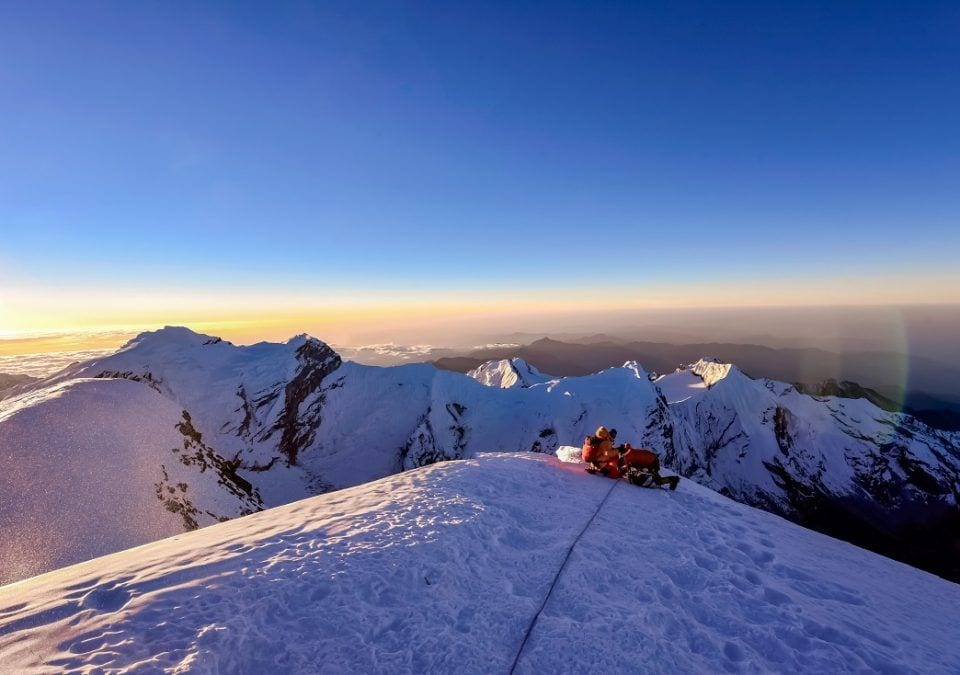
Five of the best 6,000 m peaks to climb in Nepal in spring are, from easiest to hardest: Mera Peak (6,476 m), a high but non-technical glacier climb; Lobuche East (6,119 m) and Island Peak, or Imja Tse (6,189 m), short technical climbs with fixed ropes above the Everest Base Camp trail; Cholatse (6,440 m), a steep ice and snow peak for experienced climbers; and Ama Dablam (6,812 m), a serious technical expedition on rock, snow and ice. All five are in the Khumbu or the neighbouring Hinku valley in eastern Nepal and are reached via Lukla. The spring season runs from about April to May, with a second season in October and November. Mera, Island Peak and Lobuche suit fit trekkers with basic crampon and rope skills; Cholatse and Ama Dablam need real alpine climbing experience. Below we look at each peak, how hard it really is, and how to choose between them.
| Peak | Height | Difficulty | Typical trip length | Best for |
|---|---|---|---|---|
| Mera Peak | 6,476 m | Non-technical glacier climb | About 2 to 3 weeks | First high-altitude summit |
| Lobuche East | 6,119 m | Short steep sections with fixed ropes | About 2.5 to 3 weeks | First technical 6,000er; Everest acclimatisation |
| Island Peak (Imja Tse) | 6,189 m | Glacier, fixed-rope headwall, exposed ridge | About 2.5 to 3 weeks | First technical 6,000er |
| Cholatse | 6,440 m | Steep snow and ice, exposed ridges | About 3 to 4 weeks | Experienced alpinists |
| Ama Dablam | 6,812 m | Sustained rock, snow and ice | About 4 weeks | Experienced climbers before an 8,000er |
Why climb a 6,000 m peak in Nepal?
Nepal is best known for Everest and the other 8,000 m giants, but its 6,000 m peaks are where most climbers learn high-altitude mountaineering. They let you experience real altitude, glacier travel and Himalayan expedition life in two to four weeks, at a fraction of the cost and risk of an 8,000 m expedition. They are also some of the most beautiful climbs in the range, with views of Everest, Lhotse, Makalu and Cho Oyu from their summits.
Nepal divides its permitted peaks into expedition peaks and a group of smaller "trekking peaks" (officially NMA peaks), administered by the Nepal Mountaineering Association with a simpler and cheaper permit system. Mera, Island Peak and Lobuche East are trekking peaks; Ama Dablam and Cholatse are expedition peaks with permits from the Department of Tourism. The label "trekking peak" is misleading: every one of these climbs needs crampons, an ice axe and rope skills, and on several of them a fall could be fatal.
Why spring?
Nepal has two climbing seasons, spring before the monsoon and autumn after it. In spring, from about April to May, temperatures are warmer, days are longer and the snow cover on the glaciers is generally better, which can make crevassed sections and steep snow easier. The trade-off is that afternoons are often cloudy, with occasional snow showers, and views are hazier than in autumn. Spring is also the Everest season, so the Khumbu is busy with climbers heading to Everest and Lhotse, and many of them use Lobuche East or Island Peak to acclimatise. Book lodges and flights early.
1. Mera Peak (6,476 m)
Mera Peak rises above the Hinku and Hongu valleys, south of Everest and east of Lukla, and is the highest of Nepal's trekking peaks. Its standard route from the north is a long, gentle glacier climb with no steep technical sections, so for many people it is the first high-altitude summit. From the top the view takes in five of the six highest mountains in the world: Everest, Kangchenjunga, Lhotse, Makalu and Cho Oyu.
Mera has several summits close together, and operators differ on which one they aim for, so ask before you book. The usual itinerary flies to Lukla, crosses the Zatrwa La pass, which is often snowbound in early spring, or takes a longer, gentler approach through the Hinku valley forests, then climbs to Khare, at about 5,000 m. From Khare, teams go to Mera La and a high camp at about 5,800 m on a rocky outcrop, then make the summit push. The last steep slope below the top is usually fixed with a short rope.
The challenge on Mera is altitude, not technique. The Zatrwa La route gains height very fast after Lukla, and climbers who rush it often suffer. Choose an itinerary with enough days in the Hinku valley. Read our Mera Peak guide and our page on how to choose a Mera Peak operator.
2. Lobuche East (6,119 m)
Lobuche rises above the Khumbu Glacier, west of the Everest Base Camp trail, and its two summits, Lobuche East and Lobuche West, are separated by a long, notched ridge. Lobuche East is the trekking peak; Lobuche West, at about 6,145 m, is an expedition peak and is rarely climbed.
The normal route on Lobuche East follows the south ridge. From a base camp near the lodges at Lobuche, climbers move to a high camp on rocky ground, then climb slabs and snow to the glacier and up a steep ridge to the summit area, with fixed ropes on the steepest sections. Many teams stop at a false summit a little below the true top, which is reached along a corniced and exposed ridge. Ask your operator which point they plan to reach. Lobuche East is popular as an acclimatisation climb for Everest and as a step up from trekking. See our Lobuche guide and how to choose a Lobuche operator.
3. Island Peak, or Imja Tse (6,189 m)
Island Peak stands in the upper Imja valley above Chhukung, on a ridge that runs south from Lhotse Shar. It got its English name from members of Eric Shipton's 1951 reconnaissance, who saw it as an island in a sea of ice from Dingboche, and it was first climbed in 1953 by a team including Charles Evans, Alfred Gregory and Tenzing Norgay as training for the first ascent of Everest. In 1983 it was officially renamed Imja Tse, but most people still call it Island Peak.
The standard route goes from base camp at about 5,087 m, sometimes via a high camp at about 5,600 m, up a rocky gully to the glacier, across the glacier to a steep snow and ice headwall of about 100 m, climbed on fixed rope with an ascender, and finally along a narrow, exposed ridge to the summit. The headwall and ridge are the crux and need confidence on fixed ropes. Summit day often takes 10 to 12 hours. Many climbers combine Island Peak with the Everest Base Camp trek, which gives good acclimatisation. Read our Island Peak guide.
4. Cholatse (6,440 m)
Cholatse is a beautiful, steep peak on the ridge between the Khumbu and Gokyo valleys, above the lake at Tshola Tsho and opposite Taboche. It is a much more serious climb than the trekking peaks. The first ascent was made in 1982 by an American and British team via the south-west ridge, and the steep north face is a famous hard route reserved for strong alpinists. Today most expeditions climb the south-west ridge, which involves steep snow and ice, exposed corniced sections and some rock, with several camps and fixed ropes.
Cholatse sees far fewer climbers than Ama Dablam, which makes it a superb, quiet objective for climbers who already have experience of steep ice and fixed ropes on peaks such as Island Peak or Lobuche, or of alpine routes in the Alps. Only a small number of operators run it each season.
5. Ama Dablam (6,812 m)
Ama Dablam is the most famous of Nepal's 6,000 m peaks and one of the most beautiful mountains in the world, rising above Pangboche and Dingboche on the Everest trail. Its name means "mother's necklace", after the hanging glacier on its face that resembles the traditional pendant worn by Sherpa women. It is often called the Matterhorn of the Himalaya and is one of the most climbed expedition peaks in Nepal.
The normal route follows the south-west ridge. From base camp at about 4,600 m, climbers reach Camp 1 on a rocky ridge, then climb a sustained section of rock, including the famous Yellow Tower, to Camp 2, perched on a tiny platform. Above, the route crosses the Grey Tower and the Mushroom Ridge, a snow arête, to Camp 3, below the hanging glacier, and then climbs steep snow and ice slopes to the summit. Ropes are fixed on almost the whole route above Camp 1, but the climbing is steep and exposed throughout. The first ascent was made in 1961 by Mike Gill, Barry Bishop, Mike Ward and Wally Romanes, members of Sir Edmund Hillary's Silver Hut expedition.
Ama Dablam is a serious undertaking that requires good rock and ice skills, previous high-altitude experience and real fitness. It also has hazards from falling ice and rock, and in recent seasons there has been concern about the number of rescues; read our article on rescues on Ama Dablam. Although it can be climbed in spring, the autumn season is more popular. See our Ama Dablam guide and how to choose an Ama Dablam operator.
How to choose the right peak
The right peak depends on your experience. If you have trekked at altitude but never climbed with crampons and rope, Mera Peak is the natural first choice, although the altitude is serious. If you have some basic mountaineering skills, from a course in the Alps or a guided climb of a glaciated peak, Island Peak or Lobuche East is a good next step, with fixed ropes on steep ground. If you have climbed steep ice and want a quiet, committing objective, look at Cholatse. If you have several of these peaks behind you and want a technical climb that will prepare you for an 8,000 m peak, Ama Dablam is the classic choice.
Whatever you choose, prepare properly. Practise with crampons, an ice axe, a harness and an ascender before you go, and train for long days with a pack. Our guide to training for mountaineering explains how. Learn the signs of acute mountain sickness, and ask your operator about acclimatisation days, guide-to-client ratios on summit day and turnaround times.
Stepping stones to bigger peaks
For many climbers these peaks are part of a longer progression. A typical path might start with a trek to Everest Base Camp or Kilimanjaro, move on to Mera Peak or Island Peak, then to Lobuche East or a climb in the Alps, then to Ama Dablam, Aconcagua or a 7,000 m peak such as Himlung Himal, and finally to an 8,000 m peak such as Manaslu. Each step adds altitude, technical difficulty and length, and each teaches you how your body responds to the next level. Climbers who skip steps are more likely to struggle, turn back or put themselves and their team at risk. If Everest is your long-term goal, our guide to what to climb before Everest sets out a full progression.
Planning, permits and cost
All five peaks require a climbing permit, a Sagarmatha National Park entry permit for the Khumbu peaks or a Makalu-Barun permit for Mera, and the local Khumbu Pasang Lhamu rural municipality fee. Climbing permit fees for both trekking and expedition peaks are lower in autumn and winter than in spring, and Nepal revised its royalty rates in 2025. Your operator will normally handle the paperwork. Costs vary widely depending on the operator's model, the guide ratio, the itinerary and whether you combine the climb with a trek. Our pages for each peak list the operators that publish prices, and our rankings show what verified clients say.
Frequently asked questions
What is the easiest 6,000 m peak in Nepal?
Mera Peak is usually considered the easiest technically, because its standard route is a non-technical glacier climb. Its altitude of 6,476 m still makes it a serious undertaking.
Is Island Peak harder than Mera Peak?
Technically, yes. Island Peak has a steep fixed-rope headwall and an exposed summit ridge. Mera Peak is higher but less technical.
When is the best time to climb 6,000 m peaks in Nepal?
The main seasons are spring, from about April to May, and autumn, from about October to November.
Do I need climbing experience for Island Peak or Lobuche?
You need basic skills with crampons, an ice axe and fixed ropes with an ascender. Many operators include a training day before the climb.
How hard is Ama Dablam?
Ama Dablam is a technical climb on rock, snow and ice, with fixed ropes on most of the route. It needs previous high-altitude and technical climbing experience.
Tags: nepal, 6000ers, ama-dablam, mera-peak, khumbu