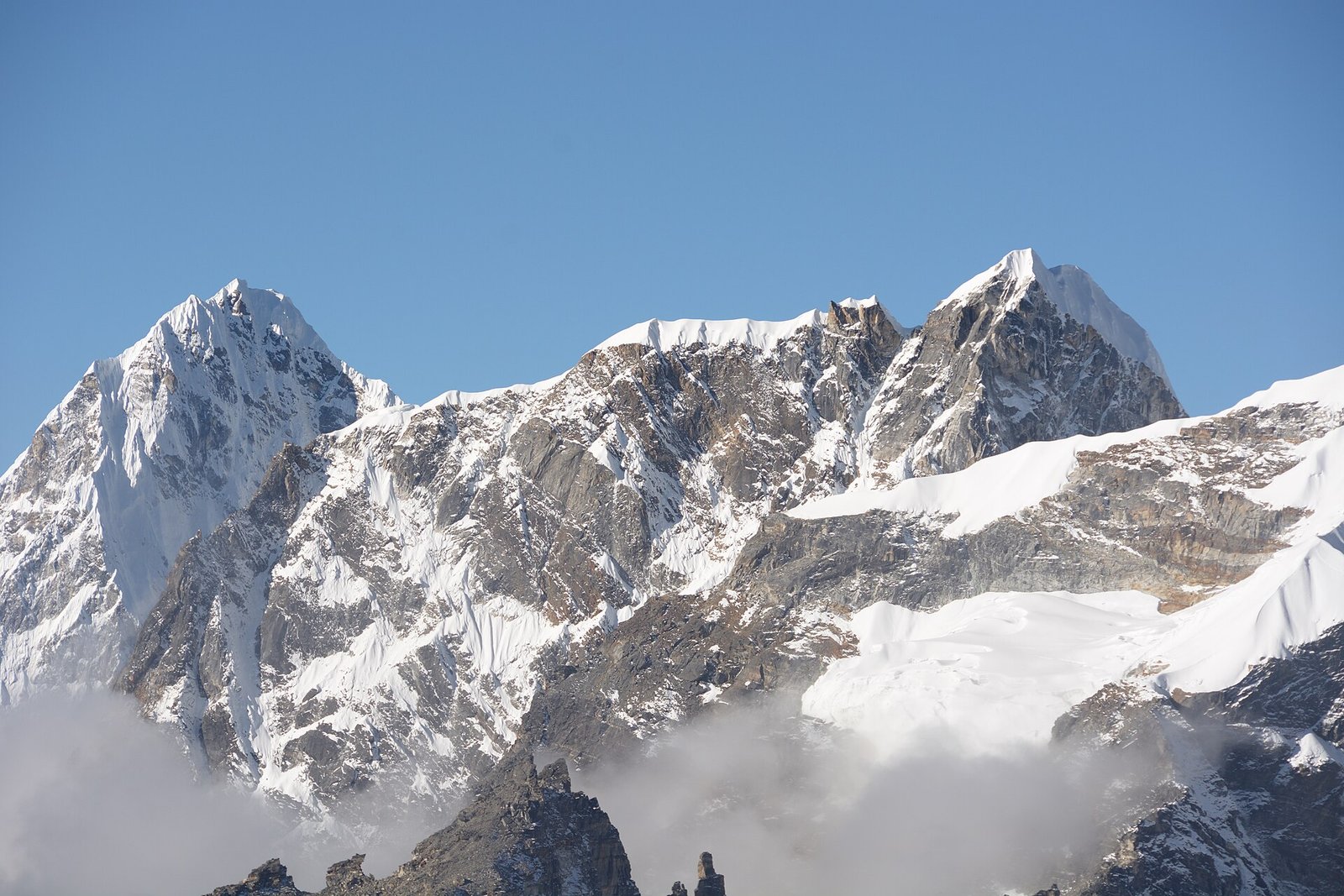
Lobuche East Climbing Guide: Route, Itinerary, Cost and Verified Guide Reviews (6,119 m)
Lobuche East is a 6,119 m peak above the Khumbu Glacier in Nepal, a few hours' walk from Everest Base Camp (some sources give about 6,090 m). It is steeper and more technical than Island Peak or Mera Peak, with fixed ropes on snow and ice slopes up to about 45 degrees and an exposed final ridge. Most people climb it in about 12 to 19 days, often combined with the Everest Base Camp trek or as acclimatisation for Ama Dablam or Everest. On ExpedReview, as of 23 October 2026, 4 operators have 12 verified client reviews for Lobuche East. Ranked first is Summitclimb (4.9★ from 6 reviews, from US$4,450), then Climbing The Seven Summits (5.0★ from 4 reviews, from US$6,995), Adventure Consultants (5.0★ from 1 review, April 2026) and Pioneer Adventure (5.0★ from 1 review). Below are the reviews, the route, a sample itinerary, costs and how to choose an operator.
Lobuche East: key facts | | | |---|---| | Height | 6,119 m (20,075 ft); some lists give about 6,090 m | | Location | Khumbu region, Nepal, above the village of Lobuche | | First recorded ascent | 25 April 1984, Laurence Nielson and Ang Gyalzen Sherpa | | Normal route | South-east ridge from high camp | | Difficulty | Alpine PD+/AD-, fixed ropes on slopes up to about 45° | | Seasons | Spring (April–May) and autumn (October–November) | | Typical trip length | 12–19 days from Kathmandu | | Operators reviewed on ExpedReview | 4, with 12 verified reviews (as of 23 Oct 2026) |
Lobuche East operators with verified reviews
ExpedReview ranks operators by their verified client reviews for each place: the star rating, adjusted so one or two reviews, or only old ones, count for less than many recent ones. Every review is checked by hand before it is published, and operators cannot pay to appear or rank higher. Prices are set by the operators themselves. Data as of 23 October 2026.
| Rank | Operator | Based in | Rating here | Reviews | Guide-listed price |
|---|---|---|---|---|---|
| 1 | Summitclimb | United States | 4.9★ | 6 | From US$4,450 (lowest of 4 packages; up to US$8,350) |
| 2 | Climbing The Seven Summits | United States | 5.0★ | 4 | From US$6,995 |
| 3 | Adventure Consultants | New Zealand | 5.0★ | 1 | No recent price listed |
| 4 | Pioneer Adventure | Nepal | 5.0★ | 1 | No recent price listed |
Also listed for Lobuche East, with no reviews here yet: Dream Himalaya Adventures, Furtenbach Adventures, Bold Himalaya and Everest Trekking Routes.
What clients say
Summitclimb. The six reviews, all posted in October and December 2023, are positive about the guides, Sherpas and organisation. Several describe combined trips: two clients used Lobuche as acclimatisation for Ama Dablam, praising leaders Paul, Dan and Dorji Sherpa; others combined Lobuche with the Everest Base Camp trek in groups of about eight. One beginner took the trip with a wilderness medicine (REDMed) course and summited on their first Himalayan trip. One reviewer completed the expedition six years before writing, so not every review reflects the current trip.
Climbing The Seven Summits. Four reviews from January 2024 to May 2025 describe Everest Base Camp treks combined with Lobuche, and in one case three peaks, with two Sherpas for two climbers. Clients praise the tea houses, food, safety and the chance to camp at the real Everest Base Camp.
Adventure Consultants. An April 2026 reviewer trekked to Everest Base Camp and then summited Lobuche East, saying they knew they were in "safe and professional hands" from first contact.
Read reviews carefully: many describe combined trips, so they say as much about the trek or the bigger expedition as about Lobuche itself.
The route
Approach
Lobuche East rises above the village of Lobuche (about 4,940 m) on the main Everest Base Camp trail. Most teams acclimatise on the trek, often visiting Everest Base Camp and Kala Patthar first, then walk to a base camp at around 4,950 m and a high camp at about 5,400 to 5,600 m on the rocky slopes of the south-east ridge.
Summit day
Summit day usually starts at 1 or 2 am. The route climbs rock slabs and scree from high camp to the edge of the glacier, then follows snow and ice slopes on fixed ropes, with sections up to about 45 degrees, to the south-east ridge. Many climbers stop at a false summit, at around 6,000 m, which is still a fine achievement. The true summit lies further along a narrow, exposed and corniced ridge, often with a dip to cross, and many guided teams only continue if conditions and time allow. Ask your operator which summit they aim for and how often they reach it.
From the top, the views take in Everest, Lhotse, Nuptse, Ama Dablam, Pumori, Cho Oyu and Makalu. The descent follows the same route back to high camp or base camp, making a long day of 8 to 12 hours.
Difficulty and skills
Lobuche East is a step up from Island Peak or Mera Peak. You should be able to:
- walk with crampons on steep snow and ice;
- climb fixed ropes with an ascender (jumar) and abseil or arm-wrap down;
- move confidently on exposed ground at altitude;
- handle a long day above 5,500 m in the cold.
Most operators accept fit trekkers with some previous mountain experience and teach rope skills at base camp. Prior experience on a 5,000 m or 6,000 m peak, or an alpine course, makes the climb safer and more enjoyable.
Sample itinerary
A typical 18-day trip combining Lobuche East with Everest Base Camp might look like this:
- Arrive in Kathmandu.
- Fly to Lukla (2,860 m) and trek to Phakding.
- Trek to Namche Bazaar (3,440 m).
- Acclimatisation day in Namche.
- Trek to Tengboche or Deboche.
- Trek to Dingboche (4,410 m).
- Acclimatisation day in Dingboche.
- Trek to Lobuche (4,940 m).
- Trek to Gorak Shep and Everest Base Camp.
- Climb Kala Patthar and return to Lobuche.
- Move to Lobuche base camp; skills training.
- Move to high camp.
- Summit day and return to base camp.
- Spare day for weather. 15–17. Trek back to Lukla.
- Fly to Kathmandu.
Shorter programmes climb Lobuche after acclimatising in the Khumbu without visiting base camp; longer ones add Island Peak or the Three Passes.
Season
The best seasons are spring (April to May), when it is warmer and the Everest expeditions are at base camp, and autumn (October to November), with clear skies but colder temperatures and shorter days. Winter is very cold and windy, and the monsoon brings cloud and snow on the mountain.
Permits
Climbers need a climbing permit for Lobuche East, a Sagarmatha National Park entry permit (NPR 3,000) and the Khumbu Pasang Lhamu Rural Municipality entry card (NPR 3,000; NPR 2,000 for SAARC and Chinese nationals). The climbing permit is arranged by your operator through Nepal's permit system, and its fee varies with the season, so ask your operator for the current figure. Garbage deposit and liaison rules also apply.
Cost
On ExpedReview, guide-listed prices for Lobuche East range from US$4,450 (Summitclimb's lowest package, up to US$8,350 for its most comprehensive option) to US$6,995 (Climbing The Seven Summits). Higher-priced trips usually include more Western leadership, better lodges, higher Sherpa-to-client ratios, Everest Base Camp camping or added peaks. Always check what is included: international flights, the Lukla flight, permits, equipment, insurance, tips and personal costs are often extra.
Choosing an operator
- Ask which summit they aim for and their recent true-summit success rate.
- Ask about the climbing Sherpa ratio on summit day; one to two clients per Sherpa is common on good trips.
- Check acclimatisation. A good itinerary builds up gradually and allows a spare day.
- Ask about training. Good operators run a skills day on fixed ropes before the climb.
- Check the operator's Khumbu record, rescue plans and insurance requirements.
- Read reviews closely for comments about safety and turnaround decisions.
Lobuche East and Lobuche West
The Lobuche massif has two main summits. Lobuche East, the subject of this page, is the popular trekking-style climb. Lobuche West, at about 6,145 m, is a separate, more remote and technical objective, classed as an expedition peak and rarely climbed commercially. When operators advertise "Lobuche Peak", they almost always mean Lobuche East.
Combining Lobuche with other climbs
Because it sits on the main Everest Base Camp trail, Lobuche East is easy to combine with other objectives:
- Everest Base Camp and Kala Patthar: the most common pairing, giving excellent acclimatisation before the climb.
- Island Peak: a popular double, usually crossing the Kongma La pass between Chhukung and Lobuche. See our Island Peak guide.
- The Three Passes: for strong trekkers who want a longer trip. See our Three Passes guide.
- Ama Dablam: many teams climb Lobuche to acclimatise and practise fixed-rope skills before Ama Dablam. See our Ama Dablam guide.
- Everest: spring expeditions often climb Lobuche East to acclimatise instead of making extra trips through the Khumbu Icefall.
- Mera Peak: some long programmes link Mera, the Amphu Lapcha pass, Island Peak and Lobuche. See our Mera Peak guide.
Altitude and safety
The biggest danger on Lobuche East, as on most Himalayan trekking peaks, is altitude. Climbers go from sea level to above 6,000 m in under two weeks, and acute mountain sickness, high-altitude pulmonary oedema and cerebral oedema can affect anyone. Follow a gradual itinerary, drink plenty of water, report symptoms early and descend if they get worse. On the mountain, the main hazards are falls on steep slopes or the exposed ridge, cold injuries on the pre-dawn start, icy conditions in autumn and occasional rockfall on the lower slabs. Late-season climbs can find bare, hard ice where there was snow, making the route slower and more tiring.
Good operators set clear turnaround times, use fixed ropes on the steep sections, carry radios and a medical kit, and have a plan for helicopter evacuation from the Khumbu. Make sure your insurance covers climbing to at least 6,500 m and helicopter rescue.
Gear
Most operators provide group gear such as tents, ropes and cooking equipment. You will usually need:
- mountaineering boots suitable for 6,000 m (double or insulated single boots), crampons and an ice axe;
- a harness, helmet, ascender, belay/rappel device, locking carabiners and slings;
- a down jacket, insulated trousers or salopettes, waterproof shell layers and warm gloves and mitts;
- a sleeping bag rated to about −20 °C, sunglasses, goggles and sun protection.
Boots, crampons and down clothing can be hired in Kathmandu, Namche or Chhukung, but check the fit carefully before you leave.
Who Lobuche East suits
Lobuche East suits trekkers who have walked at altitude before and want a real climb with fixed ropes, steeper snow and an exposed summit ridge, without the commitment of a 7,000 m or 8,000 m expedition. It is also a sensible step for climbers planning Ama Dablam, Everest or another big peak, because it teaches the fixed-rope routines used on those mountains. If you have never worn crampons or used a harness, consider Island Peak or Mera Peak first, or take an alpine course at home before you go.
Frequently asked questions
How hard is Lobuche East?
It is harder than Island Peak or Mera Peak, with steeper fixed-rope sections and an exposed ridge, but it is within reach of fit trekkers with basic crampon and rope skills after training.
Is Lobuche East a good preparation for Everest?
Yes. Many Everest and Ama Dablam teams use it to acclimatise and practise fixed-rope skills before their main climb.
What is the difference between the false and true summits?
The false summit is at about 6,000 m. The true summit is further along a narrow, corniced ridge and is only reached when conditions and time allow.
How much does it cost to climb Lobuche East?
As of 23 October 2026, guide-listed prices on ExpedReview range from US$4,450 to US$8,350 (Summitclimb) and from US$6,995 (Climbing The Seven Summits).
Which operators have verified reviews for Lobuche East?
As of 23 October 2026, Summitclimb (4.9★ from 6), Climbing The Seven Summits (5.0★ from 4), Adventure Consultants (5.0★ from 1) and Pioneer Adventure (5.0★ from 1).
Can operators pay to rank higher on ExpedReview?
No. Operators cannot pay to appear, rank higher or have reviews removed.
How long does it take to climb Lobuche East?
Most trips take 12 to 19 days from Kathmandu. Summit day itself usually takes 8 to 12 hours from high camp and back.
When was Lobuche East first climbed?
The first recorded ascent was on 25 April 1984, by Laurence Nielson and Ang Gyalzen Sherpa.
Do I need climbing experience for Lobuche East?
Previous experience with crampons and fixed ropes helps a lot. Most operators teach the basics at base camp, but you should be fit and comfortable at altitude.