Mount Rainier Climbing Routes Compared: Disappointment Cleaver, Emmons, Kautz & Liberty Ridge (2027)
By Blake Penson · September 15, 2022
Category: route-comparisons
9 min read
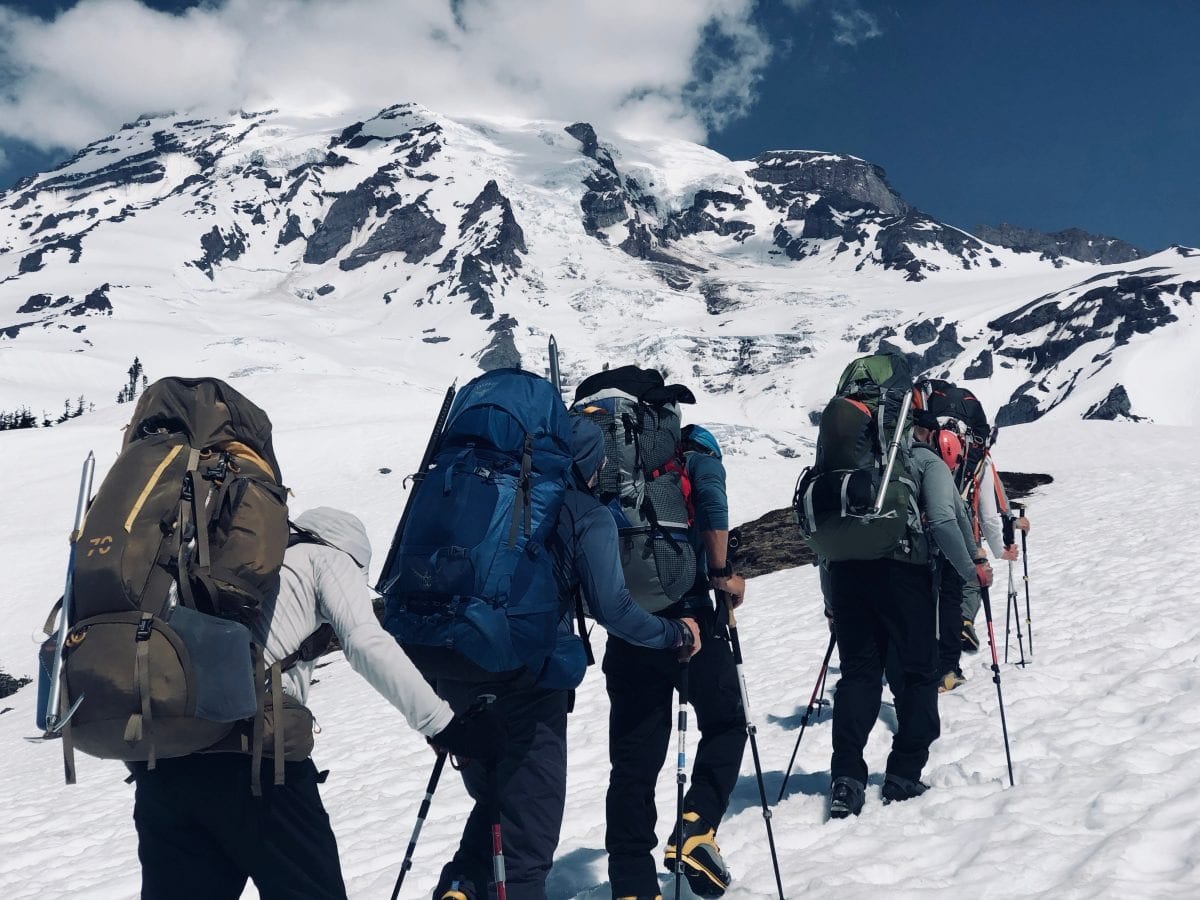
Mount Rainier (14,410 ft / 4,392 m) has more than 40 climbing routes, but four do most of the work. The Disappointment Cleaver–Ingraham Glacier route from Paradise is the easiest and by far the most popular, carrying most guided climbers. The Emmons–Winthrop Glacier route from White River is the "next step up": a less-travelled glacier route on the north-east side. The Kautz Glacier route adds a short section of steep alpine ice. Liberty Ridge, a North American classic, is the hardest and most committing of the four. All standard routes cross heavily crevassed glaciers, gain about 9,000–10,000 ft (2,700–3,000 m) from the trailhead, and usually take 2–4 days. Climbers need roped glacier travel, crampon and ice-axe skills, and a National Park Service climbing permit (the cost-recovery fee is $82 per person per climb in 2026). Roughly half of all climbers who set out reach the summit, according to the NPS.
This guide compares the four main routes side by side: difficulty, camps, timing, seasons, success factors, guiding options and costs. It is meant to help you choose the right line for your experience.
| Summit (Columbia Crest) | 14,410 ft / 4,392 m (NPS official) |
| Location | Mount Rainier National Park, Washington, USA (Cascade Range) |
| Type | Glaciated active stratovolcano; most glaciated peak in the contiguous US |
| Topographic prominence | ~13,200 ft (~4,030 m), among the most prominent peaks in the world |
| First recorded ascent | 1870 (Hazard Stevens and P.B. Van Trump) |
| Climbers per year | ~9,500–11,000 attempts (9,530 in 2022) |
| Summit success | about half of climbers (NPS) |
| Climbing season | Mainly May–September |
| Climbing fee (2026) | $82 per person per climb, plus park entrance |
Why Mount Rainier is such a popular climb
Rainier rises about 9,000 ft above Paradise and towers over Seattle and Tacoma, about 60 miles (100 km) away. It is an active stratovolcano and the most glaciated peak in the contiguous United States, with more than two dozen named glaciers covering much of its upper slopes. That combination is unusual. Climbers get a genuinely alpine, Himalaya-style glacier experience, with crevasse fields, icefalls, high camps and alpine starts, within a two-hour drive of a major city.
Its prominence, about 13,200 ft, means the mountain stands almost completely alone, so summit views stretch across the Cascades to Mount Adams, Mount St. Helens, Mount Hood and Mount Baker. For many US climbers, Rainier is the benchmark: the climb that shows whether they are ready for Denali, the Andes or the Himalaya.
Mount Rainier routes at a glance
| Route | Start (trailhead) | High camp | Total elevation gain | Typical duration | Difficulty | Best season | Share of climbers |
|---|---|---|---|---|---|---|---|
| Disappointment Cleaver – Ingraham Glacier | Paradise, 5,400 ft (1,646 m) | Camp Muir, 10,188 ft (3,105 m) | ~9,000 ft (2,740 m) | 2–4 days (guided 3–5 incl. training) | Moderate glacier climb; Grade II | Late May – early Sept | Large majority |
| Emmons – Winthrop Glacier | White River, ~4,400 ft (1,340 m) | Camp Schurman, ~9,500 ft (2,900 m) | ~10,000 ft (3,050 m) | 2–4 days | Moderate–advanced glacier climb; Grade II | June – July (best) | Second most popular |
| Kautz Glacier | Paradise, 5,400 ft | Camp Hazard, ~11,300 ft (3,440 m), or the Castle | ~9,000 ft | 2–4 days | Advanced; steep snow and alpine ice to ~45–50°; Grade II–III | June – July | Small fraction |
| Liberty Ridge | White River, ~4,400 ft | Thumb Rock, ~10,700 ft (3,260 m) | ~10,000+ ft, plus descent route | 3–5 days | Advanced; steep snow, ice and loose rock; Grade IV | Mid-May – June | Small fraction (~100+ attempts a year) |
Elevations from NPS route descriptions and operator materials. Route conditions change every year.
Disappointment Cleaver – Ingraham Glacier route
Overview
The Disappointment Cleaver (DC) route climbs the south-east side of the mountain from Paradise via Camp Muir. It is Rainier's standard route and the one used by nearly all guided summit climbs. In peak season it often has a boot-packed trail, wands and, on some sections, fixed lines or ladders installed by the guide services. That makes it the most accessible route, though it is still a serious glacier climb.
Route description
- Paradise to Camp Muir (5,400 to 10,188 ft). Climbers follow the Skyline Trail and then the Muir Snowfield, a broad, non-crevassed slope that is easy in good weather but notoriously disorienting in whiteouts. It takes about 4–7 hours. Camp Muir has a ranger hut, public shelter, guide service huts and toilets.
- Camp Muir to Ingraham Flats (~11,100 ft). Most climbers leave between midnight and 2 am. They cross the Cowlitz Glacier, pass through Cathedral Gap, and reach the Ingraham Glacier. Guided groups often stay at Ingraham Flats as a higher camp.
- The Disappointment Cleaver (~11,500–12,300 ft). A rock and snow rib between the Ingraham and Emmons glaciers. It is steep, loose in late season, and the most exposed section of the climb. Rockfall and icefall from above are the main hazards.
- Upper mountain to the crater rim (~12,300–14,150 ft). Switchbacks on the upper Ingraham or Emmons glacier lead around crevasses to the crater rim. The route changes through the season as crevasses open.
- Crater rim to Columbia Crest (14,410 ft). A walk across the summit crater to the true summit.
Summit day is usually 10–14 hours round trip from Camp Muir. Guided climbs typically take three to five days, including a snow-school or training day.
Who it's for
Fit beginners with basic mountaineering training, or anyone joining a guided climb. Many guided clients climb the DC as their first glacier summit and as a stepping stone towards Denali, Aconcagua or the Himalaya.
Hazards
- Rockfall and icefall on the Cleaver, especially later in the season.
- Crevasses on the Ingraham and upper Emmons glaciers.
- Whiteouts and navigation errors on the Muir Snowfield.
- The 1981 Ingraham Glacier icefall accident killed 11 people (10 clients and 1 guide). It was one of the worst mountaineering accidents in US history and led to changes in the route.
Emmons – Winthrop Glacier route
Overview
The Emmons–Winthrop route climbs the north-east side of the mountain from the White River area via Camp Schurman. The Emmons is the largest glacier by area in the contiguous United States. The NPS describes the route as the logical "next step up" from the DC. It has a gentler overall angle but fewer amenities, less traffic, more crevasse navigation and no guide-installed fixed gear.
Route description
- White River campground (~4,400 ft) to Glacier Basin. About 3.5 miles on the Glacier Basin Trail through forest.
- Inter Glacier to Camp Curtis (~9,000 ft). A steep snowfield (the Inter Glacier) leads to a rocky ridge called Camp Curtis.
- Camp Curtis to Camp Schurman (~9,500 ft). A short descent onto the Emmons Glacier and a traverse to Camp Schurman, beside Steamboat Prow, with a ranger hut and toilets.
- The Corridor (~10,200–11,600 ft). A long, relatively crevasse-free ramp of glacial snow up the middle of the Emmons.
- Upper Emmons to the crater rim. Climbers weave through crevasses and cross the bergschrund before reaching the crater rim and Columbia Crest.
Who it's for
Climbers with solid glacier-travel and crevasse-rescue skills who want a quieter route, or guided teams seeking a less crowded experience. By late July, crevasses often make the upper route complex.
Kautz Glacier route
Overview
The Kautz Glacier route climbs the south side of the mountain from Paradise. It follows roughly the line of Lt. August Kautz's pioneering 1857 attempt, the first serious attempt on Rainier. Its defining feature is the Kautz Ice Chute, one or two steep pitches of alpine ice (about 40–50°+) that add a true technical element.
Route description
- Paradise to the Nisqually Glacier. Climbers follow the Skyline Trail, then cross the Nisqually Glacier or descend via "the Fan" depending on conditions.
- Wapowety Cleaver to the Castle / Camp Hazard (~11,300 ft). Snow slopes and rocky benches lead to bivy sites at the Castle or Camp Hazard. An alternative approach comes from Comet Falls and Van Trump Park.
- Kautz Ice Chute. Climbers drop onto the Kautz Glacier and climb the chute, often pitching it out with ice screws. It is exposed to icefall from the Kautz ice cliff above, so speed matters.
- Upper Kautz / Wapowety Cleaver to the summit. Easier snow slopes lead onto the upper Nisqually Glacier and then the crater rim.
Most climbers descend via the Disappointment Cleaver to avoid down-climbing the ice chute.
Who it's for
Experienced climbers comfortable leading or following steep alpine ice with ice screws, or guided teams looking for a step up in technical difficulty from the DC.
Liberty Ridge route
Overview
Liberty Ridge splits the mountain's north face between the Liberty Wall and the Willis Wall, rising directly to Liberty Cap (14,112 ft), Rainier's north summit. It was first climbed in 1935 and was included in Steve Roper and Allen Steck's Fifty Classic Climbs of North America. It is the most famous and most committing of Rainier's standard routes. Only around 100–150 climbers attempt it each year.
Route description
- White River to Glacier Basin and Inter Glacier, as on the Emmons route.
- St Elmo Pass (~7,400 ft) and the Winthrop Glacier. Climbers cross the pass, descend onto the Winthrop Glacier and traverse around Curtis Ridge, often camping there.
- Carbon Glacier to the toe of Liberty Ridge. A crevassed crossing of the Carbon Glacier, the glacier that reaches lowest in the contiguous US.
- Liberty Ridge to Thumb Rock (~10,700 ft). Steep snow and loose rock lead to a cramped bivy at Thumb Rock.
- Black Pyramid and upper ridge. Climbers continue up steep snow and ice to 45–50°+ past the Black Pyramid, cross a bergschrund, and reach Liberty Cap.
- Descent. Usually via the Emmons–Winthrop route.
Hazards
Rockfall, avalanches, serac fall from the Liberty Cap glacier, bad weather and the route's remoteness all make rescue very difficult. In May 2014, six climbers (four clients and two guides) died on Liberty Ridge, the worst accident on Rainier since 1981.
Who it's for
Experienced alpinists only, or small, specialised guided teams. It is a big step up from the DC and Emmons. See our explainer on the difference between mountaineering and alpinism.
Mount Rainier climbing statistics over time
The NPS has published climber numbers since 1950. It stopped recording successful summits after 2018, but the long-run data shows how steady Rainier's popularity has been.
| Year | Climbers | Successful | Success rate |
|---|---|---|---|
| 1970 | 3,192 | 1,972 | 62% |
| 1980 | 7,690 | 3,939 | 51% |
| 1990s peak (1998) | 11,188 | 6,479 | 58% |
| 2000 (record attempts) | 13,114 | 6,083 | 46% |
| 2010 | 10,643 | 4,920 | 46% |
| 2014 | 10,949 | 6,240 | 57% |
| 2016 | 10,971 | 5,245 | 48% |
| 2018 | 10,762 | 5,135 | 48% |
| 2020 (pandemic) | 2,752 | not recorded | — |
| 2022 | 9,530 | not recorded | ~half (NPS estimate) |
Source: NPS Annual Climbing Statistics; success rates calculated by ExpedReview. Across 2014–2018, about 50% of the roughly 54,000 recorded climbers reached the summit. Weather is the single biggest reason climbers turn back, followed by fitness, altitude and route conditions.
Other routes on Mount Rainier
Beyond the big four, Rainier offers many other lines for experienced parties:
| Route | Side | Character |
|---|---|---|
| Fuhrer Finger | South | Steep snow couloir from Paradise; popular early-season ski descent |
| Gibraltar Ledges | South | Historic route on rock ledges below Gibraltar Rock; best in winter or early spring when frozen |
| Ptarmigan Ridge | North-west | Remote, committing ridge with ice and rock; Grade IV |
| Mowich Face | West | Broad, steep snow and ice face; Grade III–IV |
| Sunset Ridge | West | Long, remote ridge climb |
| Tahoma Glacier | West | Remote glacier route with big crevasses |
| Willis Wall | North | Extremely dangerous ice and rock face under huge seracs; rarely climbed |
These routes see far fewer climbers, often need long approaches, and may have little or no rescue access.
A typical guided Disappointment Cleaver itinerary
| Day | Activity |
|---|---|
| Day 0 | Gear check with the guide service (often in Seattle or Ashford) |
| Day 1 | Training day: crampon technique, self-arrest, rope travel (some programmes combine this with the climb to Camp Muir) |
| Day 2 | Hike from Paradise (5,400 ft) to Camp Muir (10,188 ft), 4–7 hours; some teams move on to Ingraham Flats |
| Day 3 | Alpine start at around midnight–2 am; summit (14,410 ft) by mid-morning; descend to Camp Muir and Paradise |
| Day 4 | Weather or contingency day (on 4–5 day programmes) |
Longer programmes add an extra day at high camp to help acclimatisation, which noticeably improves summit chances for climbers coming from sea level.
Comparing the routes: difficulty, crowds and scenery
| Factor | Disappointment Cleaver | Emmons–Winthrop | Kautz Glacier | Liberty Ridge |
|---|---|---|---|---|
| Technical difficulty | Lowest | Low–moderate | Moderate (steep ice) | High |
| Crevasse complexity | Moderate; route maintained | Moderate–high late season | Moderate | High (Carbon Glacier) |
| Objective hazards | Rockfall on the Cleaver | Crevasses, bergschrund | Icefall over the chute | Rockfall, avalanche, serac fall |
| Crowds | Busiest | Moderate | Quiet | Very quiet |
| Facilities at high camp | Huts, toilets, rangers | Ranger hut, toilets | None (bivy sites) | None |
| Rescue access | Best | Good | Moderate | Difficult |
| Guided options | Many | Several | Fewer | Very few |
| Scenery highlights | Little Tahoma, Ingraham icefall | Emmons Glacier, Steamboat Prow | Kautz ice cliff, Nisqually | Willis Wall, Liberty Wall |
Which Mount Rainier route should you choose?
- First glacier climb, guided: Disappointment Cleaver. It has the most guided departures, the best facilities and rescue access, and the highest chance of a well-supported summit.
- First glacier climb, independent with experienced partners: Disappointment Cleaver or Emmons–Winthrop, early in the season when crevasses are better bridged.
- Second Rainier climb, or looking for fewer crowds: Emmons–Winthrop. It is similar in difficulty but quieter, with a different side of the mountain and a bigger glacier experience.
- Adding technical ice: Kautz Glacier, ideally after gaining experience on steep snow and placing ice screws.
- Experienced alpinists seeking a classic: Liberty Ridge, in good early-season conditions and with a solid plan for weather, rockfall and self-rescue.
A good rule of thumb is to climb the DC or Emmons first, even if you are an experienced rock climber. Learning how Rainier's weather, glaciers and altitude behave on an easier route makes the harder lines far safer.
Safety on Mount Rainier
Rainier is a big, glaciated volcano close to the Pacific, and its weather can change within hours. Lenticular clouds forming over the summit often warn of strong winds and incoming storms. The main hazards are:
- Weather and whiteouts. Many accidents start with parties becoming lost on the Muir Snowfield or the upper mountain in poor visibility. Carry a GPS track and wands, and know when to turn back.
- Crevasse falls. Every standard route crosses crevassed glaciers. Roped travel and crevasse-rescue skills are essential, and snow bridges weaken quickly in warm afternoons.
- Rockfall and icefall. The Disappointment Cleaver, Kautz Ice Chute and Liberty Ridge are all exposed. Climbing early in the day, when it is coldest, reduces the risk.
- Altitude. Few climbers acclimatise properly before Rainier. Headaches, nausea and fatigue are common above Camp Muir, and severe altitude illness is possible.
- Cold injuries. Wind chill on the summit can fall well below freezing even in July.
The park's climbing rangers staff Camp Muir and Camp Schurman in summer and lead rescues on the mountain. They do so in difficult conditions, and helicopter rescue depends heavily on the weather. There have been many climbing-related deaths on Rainier since the first recorded fatality in 1897. The two worst accidents were the 1981 Ingraham Glacier icefall (11 deaths) and the 2014 Liberty Ridge accident (6 deaths).
Best time to climb Mount Rainier
| Month | Conditions |
|---|---|
| April – May | Early season: more snow coverage, fewer open crevasses, more storms; good for Liberty Ridge (May–June) |
| June – July | Peak season: most stable weather, good snow bridges; best for all routes |
| August | Warmer, more crevasses and rockfall; DC often still guided with route changes |
| September | Late season: icy, broken glaciers, more rockfall; fewer guided climbs |
| October – March | Winter: severe storms, short days, avalanche risk; experienced climbers only |
Permits, fees and regulations
| Requirement | Detail (2026) |
|---|---|
| Climbing cost-recovery fee | $82 per person per climb, all ages (adjusted annually for inflation); paid online through Pay.gov before arrival |
| Who must pay | Anyone travelling on glaciers, attempting the summit, or going above the high camps |
| Registration | In person at a park ranger station on the day of the climb or the day before |
| Wilderness permit | Required for overnight stays in the park's wilderness (including the high camps) |
| Park entrance fee | Separate; annual and America the Beautiful passes accepted |
| Human waste | Climbers must use blue bags or toilets at high camps |
| Guided climbs | Only concessioners and authorised commercial operators may guide in the park |
Hiking only as far as Camp Muir or Camp Schurman does not need the climbing fee, though overnight stays need a wilderness permit.
Guided vs independent climbs
Guided climbs. The NPS authorises a small number of primary guide concessioners for Rainier's main routes, including Rainier Mountaineering (RMI) and Alpine Ascents International. Several other companies hold commercial authorisations for specific routes and seminars. A typical guided DC climb lasts three to five days including training, at a client-to-guide ratio of about 2:1 to 4:1.
| Guided Rainier climb (published price) | Price per person |
|---|---|
| RMI Four Day Summit Climb (DC route), 2026 | US$2,595 (2027: US$2,995 peak season, US$2,595 early/late) |
| Alpine Ascents Muir/DC climb, 2027 | US$3,750 |
Data gathered by ExpedReview from operator websites (checked October 2026). Alpine Ascents International lists its 2027 Muir/DC climb at US$3,750, including the NPS climbing and entrance fees, at a 2:1 climber-to-guide ratio. Prices vary by operator, group size and inclusions.
Independent climbs. Independent parties need solid glacier and crevasse-rescue skills, must register and pay the fee, and must be fully self-sufficient. Many first-timers climb the DC or Emmons with experienced partners after a mountaineering course.
Training and skills for Mount Rainier
- Fitness: about 10–16 weeks of training, building to long days carrying 35–50 lb (16–23 kg) packs and gaining 3,000–5,000 ft (900–1,500 m) a day.
- Skills: crampon technique, ice-axe self-arrest, roped glacier travel and crevasse rescue. Guided climbs include a training day. See what crampons are and how to choose them.
- Gear: mountaineering boots (B2 or B3), 12-point steel crampons, ice axe, harness, helmet, glacier glasses and layered clothing.
- Altitude: most climbers feel the effects of altitude above about 10,000 ft, and headaches are common at Camp Muir.
Rainier as a stepping stone
Rainier is a classic training peak for bigger objectives:
| Next objective | Why Rainier helps |
|---|---|
| Denali (6,190 m) | Glacier travel, cold-weather camping, crevasse rescue |
| Aconcagua (6,961 m) | Long summit days, altitude, fitness |
| Mont Blanc (4,806 m) | Similar height and glacier terrain |
| Himalayan trekking peaks (Island Peak, Mera Peak) | Fixed-rope and crampon skills |
| Everest (8,849 m) | Many operators recommend Rainier early in an Everest progression; see what to climb before Everest and how much it costs to climb Mount Everest |
Rainier guide companies on ExpedReview
No Mount Rainier operator yet has the minimum of two verified ExpedReview client reviews we use for a top-rated list, so we are not ranking Rainier companies on this page. Browse all Rainier operators and their reviews on our Mount Rainier page, and compare nearby peaks on our Cascades, Mount Baker, Mount Shuksan and Forbidden Peak pages.
The bottom line
For most climbers, the Disappointment Cleaver is the right first route on Rainier: well supported, well guided and a superb introduction to glacier mountaineering. The Emmons–Winthrop is the natural second step, the Kautz adds steep ice, and Liberty Ridge is a classic for experienced alpinists. Whichever you choose, train well, go early in the season, respect the weather and turnaround times, and pick a guide or partners whose skills match the route.
Frequently asked questions
What are the main climbing routes on Mount Rainier?
The four main routes are the Disappointment Cleaver–Ingraham Glacier, the Emmons–Winthrop Glacier, the Kautz Glacier and Liberty Ridge. The mountain has more than 40 routes and variations in total.
What is the easiest route up Mount Rainier?
The Disappointment Cleaver–Ingraham Glacier route from Paradise via Camp Muir. It is the most travelled and best maintained, and it is used by nearly all guided climbs.
What is the hardest route on Mount Rainier?
Among the standard routes, Liberty Ridge is the hardest and most committing. More extreme lines on the Willis Wall and Mowich Face are harder still, and far more dangerous.
How many routes are there up Mount Rainier?
More than 40 established routes and variations, but the Disappointment Cleaver and Emmons–Winthrop routes account for the vast majority of climbers.
Can you climb Mount Rainier without a guide?
Yes, provided you have the right skills and equipment, pay the climbing fee, and register with the park. Independent climbers need roped glacier travel and crevasse-rescue skills.
Can you climb to the top of Mount Rainier?
Yes. Roughly 9,500–11,000 people attempt the summit each year, and about half reach it. It is a serious glacier climb, not a hike.
How long does it take to climb Mount Rainier?
Most climbs take 2–4 days. Guided Disappointment Cleaver climbs usually take 3–5 days including training. Summit day from Camp Muir is typically 10–14 hours round trip.
What is the success rate on Mount Rainier?
The NPS says about half of climbers reach the summit. Over 2014–2018, when the park still recorded successful climbs, about 50% of roughly 10,000–11,500 climbers a year summited.
How high is Camp Muir?
Camp Muir sits at about 10,188 ft (3,105 m) on the south side of Mount Rainier. It is the high camp for the Disappointment Cleaver route.
How much does it cost to climb Mount Rainier?
The 2026 NPS climbing fee is $82 per person, plus park entry. Published guided prices start at US$2,595 for RMI's four-day DC climb (2026) and Alpine Ascents' 2027 Muir climb is US$3,750.
When is the best time to climb Mount Rainier?
June and July usually offer the best weather and snow conditions. The broader season runs from May to September, and Liberty Ridge is best in mid-May to June.
Do you need a permit to climb Mount Rainier?
Yes. Every climber going above the high camps or onto the glaciers must pay the annual climbing cost-recovery fee and register in person. Overnight stays also need a wilderness permit.
Is Mount Rainier harder than Mont Blanc?
They are similar in height and both need glacier skills. Rainier usually involves more elevation gain from the trailhead (about 9,000 ft) and no high mountain huts with meals, so many climbers find it more physically demanding.
What is the Disappointment Cleaver?
A rocky ridge between the Ingraham and Emmons glaciers at about 11,500–12,300 ft. It gives the standard route its name and is the most exposed section of that climb.
What is the Camp Muir to summit distance?
About 3–4 miles (5–6.5 km) depending on the route that season, with about 4,200 ft (1,280 m) of elevation gain.
Can beginners climb Mount Rainier?
Fit beginners can climb the Disappointment Cleaver route with a guide service, which includes training in crampon, ice-axe and rope skills. Independent climbing needs prior glacier experience.
Who was the first to climb Mount Rainier?
The first recorded ascent was in 1870 by Hazard Stevens and Philemon Beecher Van Trump. Fay Fuller became the first woman to reach the summit, in 1890.
Is Mount Rainier dangerous to climb?
It is a serious mountain. Crevasses, rockfall, icefall and fast-changing weather all pose risks, and climbers have died on every major route. Climbing with a guide or experienced partners, early in the season and with strict turnaround times, greatly reduces the risk.
Which Rainier route is best for a first climb?
The Disappointment Cleaver–Ingraham Glacier route. It has the most guided departures, the best facilities and rescue access, and a well-defined route during peak season.
Sources
Data gathered by ExpedReview from official sources and operator websites, written in our own words:
- NPS Mount Rainier: Annual Climbing Statistics and Frequently Asked Questions.
- NPS Mount Rainier: Climbing Fee FAQs (2026 fee $82).
- NPS: Regulations for Guiding on Mount Rainier.
- Alpine Ascents International: Mount Rainier Muir climb price and schedule (2027 schedule).
- NPS route descriptions for the Disappointment Cleaver, Emmons–Winthrop, Kautz and Liberty Ridge routes.
Related articles
- How to choose a guide
- Best operators
- Cascades Climbing Guides: Verified Reviews for Mount Baker and Mount Shuksan
Climbing in the North Cascades: operators ranked by verified ExpedReview client reviews for Mount Baker and Mount Shuksan, the main peaks and routes, glacier courses, season, permits, skills, cost and how to choose an operator.
- Mount Rainier Guides and Climbing Guide: Routes, Season, Permits and Preparation
Mount Rainier (4,392 m), the most glaciated peak in the contiguous United States: the Disappointment Cleaver and Emmons routes, Camp Muir and Camp Schurman, season, climbing fees and permits, skills, training, risks and how to choose a guide.
Tags: mount-rainier, washington, glacier-travel, disappointment-cleaver, liberty-ridge