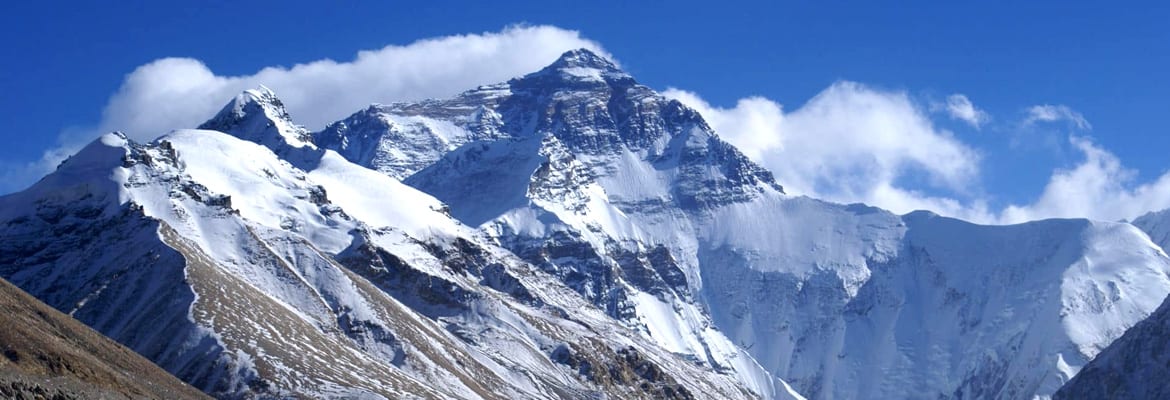
Everest North Side (North Col / Northeast Ridge): Verified Guide Reviews, Cost, Route and 2027 Access
The north side of Everest is climbed from Tibet, China, via the North Col (about 7,000 m) and the Northeast Ridge to the 8,849 m summit. It avoids the Khumbu Icefall of the Nepal side and you can drive to Base Camp, but it is colder and windier, the summit day runs along an exposed ridge with the Second Step, and helicopter rescue is generally not available. Access depends on the China-Tibet Mountaineering Association (CTMA): it did not open the north side to foreign climbers in spring 2026, and Tibet's 8,000 m peaks stayed closed through autumn 2026. Operators expect a reopening for spring 2027, but nothing had been announced by October 2026. On ExpedReview, as of 23 October 2026, three operators have 16 verified client reviews for this route: Furtenbach Adventures (4.8★ from 12 reviews), Kobler & Partner (5.0★ from 2) and Summitclimb (4.6★ from 2). The only listed starting price is from US$88,501 (Furtenbach Adventures, updated June 2026). Below are the rankings, then everything you need to know about the route.
Everest north side: key facts | | | |---|---| | Summit | 8,849 m (2020 China–Nepal survey: 8,848.86 m) | | Route | North Col and Northeast Ridge | | Country | China (Tibet Autonomous Region) | | Permit authority | China-Tibet Mountaineering Association (CTMA) | | Base Camp | about 5,150 m, reached by road | | High camp | about 8,300 m | | Main crux | Second Step, about 8,600 m | | Season | Spring; summits usually in May | | Access 2026 | Closed to foreign climbers in spring and autumn 2026; spring 2027 expected but unconfirmed | | CTMA permit | about US$15,800–18,000 per foreign climber (team of four or more), per Alan Arnette's 2026 cost survey | | Operators reviewed on ExpedReview | 3, with 16 verified reviews (as of 23 Oct 2026) | | Currency | Chinese yuan (renminbi); US dollars used by operators | | Languages | Tibetan, Mandarin Chinese; English with operators |
Guides ranked by verified reviews
Rankings use each operator's verified ExpedReview client reviews for this route: the star rating, adjusted so that one or two reviews, or only old ones, count for less than many recent ones. Ties go to the guide with more reviews. Every review is checked by hand before it is published, and critical reviews stay up. Data as of 23 October 2026.
| Rank | Operator | Based in | Rating here | Reviews | Latest review | From price |
|---|---|---|---|---|---|---|
| 1 | Furtenbach Adventures | Austria | 4.8★ | 12 | July 2025 | US$88,501 (updated June 2026) |
| 2 | Kobler & Partner | Switzerland | 5.0★ | 2 | April 2023 | Not listed |
| 3 | Summitclimb | United States | 4.6★ | 2 | November 2023 | Not listed |
Category scores from those reviews:
| Operator | Safety | Value | Food | Team spirit | Camps |
|---|---|---|---|---|---|
| Furtenbach Adventures | 4.8 | 4.7 | 4.8 | 4.9 | 4.9 |
| Kobler & Partner | 5.0 | 5.0 | 5.0 | 5.0 | 5.0 |
| Summitclimb | 4.5 | 4.5 | 4.5 | 5.0 | 4.5 |
Only one of the 16 reviews was published in the past 24 months, partly because the north side has had few open seasons since 2020. Treat older reviews with care, and ask operators about their most recent north-side seasons.
What clients say
Across the 16 reviews, safety came up in 11 (10 in 4–5★ reviews), Sherpas and porters in 9, food in 10, oxygen in 4 and summit outcomes in 5 (one in a lower-rated review). Reviewers praised training support before the trip, food and Base Camp services, strong Sherpa teams and oxygen logistics. One lower-rated 2025 review questioned how an operator's "100 percent success" figure was calculated, arguing that it only counted clients allowed to leave Base Camp for the summit. It is a useful reminder to ask any operator exactly how its success rate is defined. See Everest success rates.
Is the north side open? The 2026 closure and 2027 outlook
The north side depends entirely on the CTMA. It closed to foreigners in 2008 around the Olympic torch ascent and from 2020 because of the Covid-19 pandemic. In 2026, the CTMA did not open its normal application process for the spring season, effectively closing the route, and ExplorersWeb reported in autumn 2026 that Cho Oyu and Shishapangma would also stay closed, with no sign of special permits for Everest. Outfitters expect the north side to reopen for spring 2027, but the number of permits and fees had not been announced. If you are planning a north-side climb, confirm the CTMA application window with your operator before paying deposits, and have a plan B, such as switching to the South Col route.
China's rules for foreign climbers
According to CTMA documents reported by ExplorersWeb, climbers must submit a full medical dossier and a climbing résumé with certificates of previous ascents, and those ascents may be no more than 1,000 m lower than the peak they plan to attempt. Alan Arnette reported a 7,000 m experience requirement for non-Chinese members. Every foreign climber must be accompanied by a professional mountain guide, and supplemental oxygen must be used above 7,000 m. These rules are stricter than Nepal's, and can be enforced at short notice.
The route camp by camp
| Camp | Approximate altitude | Notes |
|---|---|---|
| Base Camp (Chinese Base Camp) | 5,150 m | Reached by road via Lhasa or Shigatse; near Rongbuk Monastery |
| Intermediate Camp | 5,800 m | On the East Rongbuk Glacier; yaks carry loads |
| Advanced Base Camp (ABC) | 6,400 m | Main base for the climb |
| Camp 1, North Col | 7,000 m | Reached by fixed ropes up snow and ice slopes |
| Camp 2 | 7,500–7,800 m | Windy ridge of rock and snow |
| Camp 3 (high camp) | 8,300 m | Summit push starts around midnight |
| First, Second and Third Steps | about 8,500–8,700 m | Rock steps on the Northeast Ridge |
| Summit | 8,849 m |
Expeditions usually spend six to eight weeks in Tibet, with acclimatisation rotations to ABC and the North Col before the summit push. The walk from Base Camp to ABC follows the East Rongbuk Glacier, and yaks carry equipment.
The Second Step
The Second Step, at about 8,600 m, is the best-known obstacle on the route: a steep rock band about 30 m high, with a ladder near the top. Chinese climbers placed the first ladder in 1975, and it was replaced in 2008. On summit day, climbers clip into fixed ropes and climb the ladder in down suits and crampons, at night, at extreme altitude. Bottlenecks can form here on busy days, and it is one of the places where descent is hardest if something goes wrong.
Getting to Tibet
Foreign climbers cannot travel independently in Tibet. Your operator, working with the CTMA, arranges a Chinese visa (often a group visa if you enter from Nepal), a Tibet Travel Permit and the climbing permit. Teams usually enter by flying to Lhasa, or overland from Kathmandu, then drive across the Tibetan plateau over several days via Shigatse and Tingri to Base Camp. The drive is comfortable, but it brings you to about 5,150 m quickly, so the stops on the way are part of your acclimatisation. Expect restrictions on what you can bring, including books and maps, and on photographing military or official sites, and allow for document checks along the road.
A typical expedition schedule
Every operator has its own plan, but a standard north-side expedition of six to eight weeks looks like this:
- Travel and drive to Base Camp (about one week), with acclimatisation nights in Lhasa or Shigatse and Tingri.
- Base Camp to Advanced Base Camp (several days), with a night at Intermediate Camp and rest days.
- First rotation to the North Col, sleeping at about 7,000 m, then down to ABC.
- Second rotation towards Camp 2 or a night at the North Col, depending on the operator's plan.
- Rest at Base Camp or a lower village to recover.
- Summit push over about five days from ABC: North Col, Camp 2, Camp 3, summit and descent.
- Return to Base Camp and the drive out.
Flash or pre-acclimatised expeditions shorten the rotations by sleeping in hypoxic tents at home before the trip. Whether the CTMA allows such schedules in 2027 is not yet known.
Summit day on the Northeast Ridge
From Camp 3 at about 8,300 m, climbers usually leave around midnight. The route climbs the Exit Cracks to reach the crest of the Northeast Ridge, then follows the ridge past the First Step and up the Second Step ladder. Above, the Third Step is shorter, and a final snow slope and traverse lead to the summit. The whole climb is above 8,300 m, in the dark for the first hours, and climbers often take eight to twelve hours to reach the summit, plus several hours to descend to Camp 3 or lower. Because the ridge is long and exposed, a strict turnaround time and a reliable oxygen supply are essential.
Experience and training
Because of China's rules and the nature of the route, the north side suits climbers who have already climbed at least one high peak, usually a 7,000 m or 8,000 m mountain, and who are comfortable with fixed ropes, jumars, crampons on rock and ice, and long days in a down suit. Train for many months with long, back-to-back days carrying a pack. See training for mountaineering and what to climb before Everest.
North side vs south side
| North (Tibet) | South (Nepal) | |
|---|---|---|
| Access | Drive to Base Camp | Fly to Lukla and trek about 8–10 days |
| Icefall | No Khumbu Icefall | Khumbu Icefall, a major objective hazard |
| Climate | Colder, windier | Somewhat warmer, more sheltered |
| High camp | about 8,300 m | South Col, about 7,900 m |
| Summit day | Long, exposed ridge; Second Step | Balcony, South Summit, Hillary Step area |
| Rescue | Helicopter rescue generally not permitted | Helicopters can reach Base Camp and above |
| Permit | CTMA, about US$15,800–18,000 | Nepal, US$15,000 (from 2025, spring season) |
| Rules | Experience requirement, guide and oxygen above 7,000 m mandatory | Fewer formal requirements |
| Crowds | Usually smaller | Often very crowded |
| Political risk | Closures at short notice | More stable access |
See our full comparison: Everest South Col vs Northeast Ridge.
Cost
Alan Arnette's 2026 cost survey put the median price of a Tibet-side expedition at US$68,900, up 14.5% from 2025, and the median for international operators at US$90,800. The CTMA permit alone is about US$15,800–18,000 per person for a team of four or more, covering transport from the entry point to Base Camp, hotels, a liaison officer, the trash fee and yak transport. Operators who bring Nepali Sherpas pay about US$4,500 per Sherpa for a CTMA work permit, plus wages. Prices for 2027 may change when the CTMA announces its terms. On ExpedReview, the only listed price is Furtenbach Adventures' from US$88,501. See our Everest cost guide and Everest permit fee.
Environment and waste
The CTMA charges a garbage and human waste deposit for each team permit, and Chinese authorities have run clean-up campaigns on the north side, including limits on climbers and campaigns to remove old rubbish and bodies from high on the mountain. Ask your operator how it removes waste from ABC and the high camps.
Rescue and insurance
Rescue on the Tibet side is handled by a centralised team, and helicopter rescue is generally not permitted, so evacuation from high on the mountain relies on climbers and Sherpas. According to Arnette, rescue fees are not capped and are charged to the rescued climber. Check that your insurance covers rescue in Tibet specifically, and ask your operator how it handles evacuations, how much oxygen it carries per client and how many Sherpas it assigns.
Best time to climb
The north side is climbed in spring. Teams usually arrive in Tibet in April, acclimatise through late April and early May, and summit when the jet stream lifts off the summit, typically in mid to late May. The north side is exposed to the jet stream and colder than the south. Autumn expeditions are rare. See best time to climb Everest.
History of the north side
- 1921–1924: British expeditions approached through Tibet, when Nepal was closed to foreigners. In 1922 they made the first serious summit attempt, reaching about 8,300 m. See Mick Conefrey on the first attempt to climb Everest.
- 1924: George Mallory and Andrew Irvine disappeared high on the Northeast Ridge. Whether they reached the summit is still unknown. Mallory's body was found in 1999.
- 1960: A Chinese team, Wang Fuzhou, Gonpo and Qu Yinhua, made the first ascent from the north on 25 May 1960.
- 1975: A Chinese expedition placed the ladder on the Second Step.
- 1980: Reinhold Messner made the first solo ascent of Everest, without supplemental oxygen, from the north in August.
- 2008: China closed the north side for the Olympic torch ascent.
- 2017: Kilian Jornet climbed from Rongbuk Base Camp to the summit in about 26 hours without supplemental oxygen. See speed climbing vs safety.
- 2020–2023: Closed to foreign climbers during the pandemic.
- 2026: Not opened to foreign climbers.
How to choose a north-side operator
Only a few international operators regularly guide on the north side. When comparing them:
- Ask how many north-side seasons they have run since 2019, and their summit and safety record there.
- Ask about Sherpa-to-client ratios, oxygen quantity and flow rates, and backup oxygen at high camp.
- Ask how they handle evacuation without helicopters.
- Ask what happens to your payment if the CTMA does not open the route.
- Read recent verified reviews and ask for references.
See how to choose an Everest guide and our interview with Lukas Furtenbach on flash climbing.
Frequently asked questions
Is the north side of Everest open in 2027?
Operators expect it to reopen for spring 2027, but as of October 2026 the CTMA had not announced anything. Confirm with your operator before paying.
How much does it cost to climb Everest from Tibet?
Alan Arnette's 2026 survey put the median at US$68,900, with international operators at about US$90,800. The CTMA permit is about US$15,800–18,000.
Which operator is ranked first for Everest North Col on ExpedReview?
Furtenbach Adventures, with 4.8★ from 12 verified reviews (latest July 2025), as of 23 October 2026.
Is the north side harder than the south side?
It avoids the Khumbu Icefall, but it is colder and windier, its high camp is higher, the summit day is long and exposed, and helicopter rescue is generally not available.
What experience do I need for the north side?
China requires a climbing résumé and previous ascents, reported as a 7,000 m peak for foreign climbers, plus a medical dossier.
Is supplemental oxygen required on the north side?
Yes. CTMA rules require oxygen above 7,000 m.
How are ExpedReview reviews verified?
Every review is checked by hand by our team before it is published, and critical reviews stay up.
Related articles
- How to choose a guide
- Best operators
- Tibet Guides: Verified Reviews for Everest North Side, Tibetan Plateau Tours and Climbing in Tibet
Climbing and trekking in Tibet: operators ranked by verified ExpedReview client reviews for the Everest North Col route and Tibetan Plateau tours, the 2026 closure and 2027 outlook, China's permit rules, Cho Oyu and Shishapangma, Kailash, travel permits, season and how to choose an operator.