Tibet Guides: Verified Reviews for Everest North Side, Tibetan Plateau Tours and Climbing in Tibet
By Blake Penson, Founder of ExpedReview · Everest summiter · Seven Summits climber · 20-year mountaineer · Industry expert
Tibet, the high plateau of south-western China, is home to the north side of Everest and two other 8,000 m peaks with well-used Tibetan routes, Cho Oyu and Shishapangma, as well as some of the world's great overland journeys and pilgrimages. Climbing and travel there are tightly controlled: every foreign visitor needs a Tibet Travel Permit and an organised tour, and mountaineering permits are issued only by the China Tibet Mountaineering Association (CTMA). In 2026 the CTMA did not open the north side of Everest to foreign climbers, and Tibet's 8,000 m peaks stayed closed through the autumn; operators expect a reopening for spring 2027, but nothing had been announced by October 2026. On ExpedReview, as of 23 October 2026, 4 operators have 19 verified client reviews in Tibet across two places, the Everest North Col route and Tibetan Plateau tours. Ranked first is Furtenbach Adventures (4.8★ from 12 reviews, latest July 2025), followed by Feeding The Rat Expeditions (5.0★ from 3 reviews, latest February 2022) and Kobler & Partner (5.0★ from 2 reviews, latest April 2023). Below are the rankings, then a guide to climbing and travelling in Tibet.
Tibet: key facts | | | |---|---| | Location | Tibet Autonomous Region, China | | Average elevation | Over 4,000 m across much of the plateau | | 8,000 m peaks with Tibetan routes | Everest (north side), Cho Oyu, Shishapangma | | Gateway | Lhasa (about 3,650 m), or overland from Kathmandu when the border is open | | Permits | Tibet Travel Permit; climbing permits from the CTMA | | Rules | Foreign visitors must travel with a licensed guide on an organised tour | | Status of 8,000 m peaks | Closed to foreigners in 2026; reopening expected but unconfirmed for 2027 | | Operators reviewed on ExpedReview | 4, with 19 verified reviews (as of 23 Oct 2026) |
Tibet guides ranked by verified reviews
Rankings use each operator's verified ExpedReview client reviews in Tibet: the star rating, adjusted so that one or two reviews, or only old ones, count for less than many recent ones. Every review is checked by hand before it is published, and operators cannot pay for a better position. Data as of 23 October 2026.
| Rank | Operator | Based in | Rating here | Reviews | Latest review | Reviewed for |
|---|---|---|---|---|---|---|
| 1 | Furtenbach Adventures | Austria | 4.8★ | 12 | July 2025 | Everest North Col (12) |
| 2 | Feeding The Rat Expeditions | Australia | 5.0★ | 3 | February 2022 | Tibetan Plateau tour (3) |
| 3 | Kobler & Partner | Switzerland | 5.0★ | 2 | April 2023 | Everest North Col (2) |
| 4 | Summitclimb | United States | 4.6★ | 2 | November 2023 | Everest North Col (2) |
For climb-specific rankings and route details, see our Everest north side guide and our Tibetan Plateau page.
What clients say
Furtenbach Adventures has the most reviews by far, and recent reviewers praised a personal training coach provided months before the expedition and a helpful, supportive team. The most recent Furtenbach review, from July 2025, is rated 3.4★ and argues that the company's advertised 100 percent success rate counts only the climbers who are allowed to leave base camp for the summit, not every client who signs up. That is a useful reminder to ask any operator exactly how it calculates its success rate. Summitclimb's two reviews from 2023 describe an enjoyable two-month expedition and experienced leaders, and Kobler & Partner has two 5.0★ reviews from 2023. Feeding The Rat Expeditions' three reviews are for tours of the Tibetan Plateau, not climbs.
Why Tibet?
For climbers, Tibet's attraction is the north side of Everest and the relatively accessible 8,000 m peaks of Cho Oyu and Shishapangma. The north side of Everest avoids the Khumbu Icefall, and you can drive to base camp. Cho Oyu, at 8,188 m, has long been considered one of the most straightforward 8,000 m peaks from Tibet, and Shishapangma, at 8,027 m, is the only 8,000 m peak entirely within China. For travellers, Tibet offers a unique culture, great monasteries such as the Potala Palace and Jokhang in Lhasa, Tashilhunpo in Shigatse and Rongbuk below Everest, high lakes and the sacred mountain of Kailash.
The Everest north side
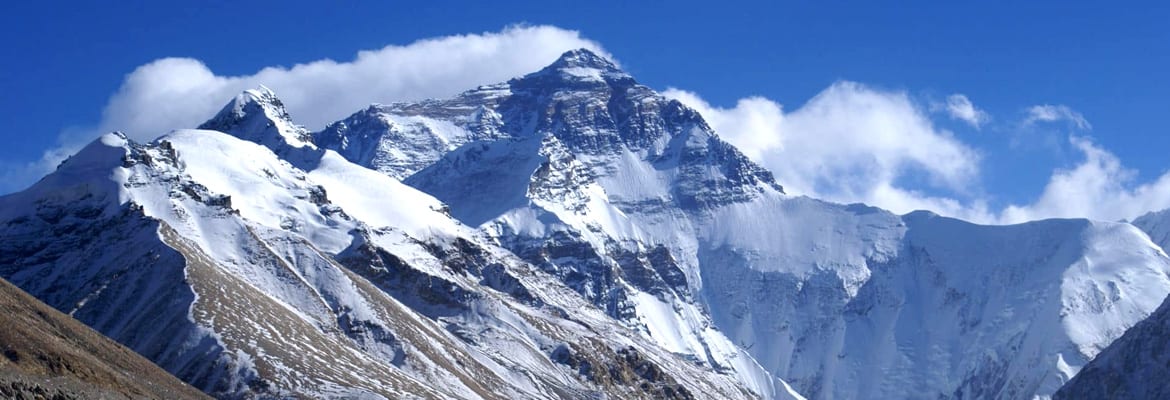
The north side route climbs from Everest Base Camp in the Rongbuk valley, at about 5,150 m, to an advanced base camp at about 6,400 m, then up the North Col, at about 7,000 m, and along the north and north-east ridges to the summit. It avoids the icefall of the south side but is colder and windier, with the exposed Second Step on summit day and limited helicopter rescue. Our full Everest north side guide covers the route, the history, the rules, costs and how to choose an operator, and our comparison of the South Col and North-East Ridge weighs up the two sides.
Is Tibet open? The 2026 closure
Climbing in Tibet depends entirely on the CTMA. The north side of Everest was closed to foreigners in 2008, around the Olympic torch ascent, and from 2020 because of the Covid-19 pandemic. In 2026 the CTMA did not open its normal application process for the spring season, effectively closing Everest's north side to foreign climbers, and ExplorersWeb reported in autumn 2026 that Cho Oyu and Shishapangma would also stay closed. Operators expect the peaks to reopen for spring 2027, but at the time of writing, no permit numbers or fees had been announced. If you plan to climb in Tibet, confirm the permit situation with your operator before paying any deposit, and have a plan B on the Nepal side, such as the South Col route or Manaslu.
China's rules for climbers
According to CTMA documents reported by ExplorersWeb, foreign climbers must submit a full medical file and a climbing résumé with certificates of previous ascents, which may be no more than 1,000 m lower than the peak they plan to attempt. For Everest, a 7,000 m experience requirement has been reported. Every foreign climber must be accompanied by a professional mountain guide, and supplementary oxygen must be used above 7,000 m on Everest. These rules are stricter than Nepal's and can change at short notice.
Cho Oyu and Shishapangma
Cho Oyu, at 8,188 m, the sixth highest mountain in the world, stands on the Nepal–Tibet border west of Everest. Its normal route from Tibet, via the north-west ridge and face, has long been considered one of the most accessible 8,000 m climbs, with a drive almost to base camp and one technical section, a short ice cliff above Camp 1. In recent years, while Tibet was closed, some operators began running Cho Oyu from the Nepal side, a harder and more avalanche-prone route. Our comparison of Manaslu and Cho Oyu covers the choice between them as a first 8,000 m peak.
Shishapangma, at 8,027 m, is the lowest of the 14 eight-thousanders and the only one entirely in China. It is often climbed in autumn as a shorter 8,000 m expedition, but its true summit is reached by a long, exposed and avalanche-prone ridge from the central summit, and many past ascents stopped short; our article on finding the true summits of the 8,000ers explains why. In October 2024 avalanches on Shishapangma killed four climbers, including two American women attempting all 14 peaks, and their Nepali guides.
Travelling in Tibet
Foreign travellers need a Chinese visa or, if travelling from Nepal, a group visa, and a Tibet Travel Permit, issued only through licensed Tibetan tour agencies. Independent travel is not allowed: you must travel with a guide on a pre-arranged itinerary, and some areas need additional permits, such as the Alien's Travel Permit and military permits for border areas, including Everest Base Camp and Kailash. Permits are sometimes suspended, especially around sensitive dates. Most tours start in Lhasa, which is reached by flight or the Qinghai–Tibet railway, or overland from Kathmandu via the Kerung border crossing when it is open to foreigners.
Tibetan Plateau tours
A typical Tibetan Plateau tour starts in Lhasa, at about 3,650 m, with time to acclimatise while visiting the Potala Palace, the Jokhang temple and the monasteries of Sera and Drepung. Overland routes then cross high passes and lakes such as Yamdrok Tso to Gyantse and Shigatse, and on to Everest Base Camp in the Rongbuk valley, where tourists can stay near the Rongbuk monastery and see the north face of Everest. Some tours continue west to Lake Manasarovar and Mount Kailash. Our Tibetan Plateau page covers them in more detail.
Kailash
Mount Kailash, at about 6,638 m, in western Tibet, is sacred to Hindus, Buddhists, Jains and followers of Bon, and climbing it is not permitted. Instead, pilgrims walk the kora, a circuit around the mountain of about 52 km that crosses the Drolma La pass, at about 5,600 m. Most trekkers take three days. Together with nearby Lake Manasarovar, Kailash is one of the great pilgrimage destinations of Asia.
Altitude and health
Almost all of Tibet lies above 3,500 m, and flying straight to Lhasa from low altitude can cause altitude sickness. Allow at least two or three days in Lhasa before going higher, drink plenty, avoid alcohol at first, and learn the symptoms of acute mountain sickness. Medical facilities outside Lhasa and Shigatse are limited, and helicopter evacuation is generally not available, so carry good insurance and follow your guide's advice.
Best time to go
For climbing, Everest's north side is climbed in spring, from April to May, and Cho Oyu and Shishapangma in both spring and autumn, from September to October. For travel, April to October is the main season, with May, June, September and October usually the best months. July and August bring some rain, though far less than in Nepal. Winter is cold and dry, with fewer visitors, but some areas close.
How to choose a Tibet operator
For climbs, choose an operator with long experience on the north side and good relationships with the CTMA, and ask how it will handle the permit uncertainty, what happens to your deposit if the season is cancelled, the Sherpa and oxygen plan, and how it calculates success rates. For tours, choose a licensed operator that works with Tibetan guides and drivers and can explain the current permit rules. Read the reviews above, and our Everest north side guide for a full list of questions.
A short history of climbing in Tibet
British expeditions of the 1920s and 1930s approached Everest from Tibet, because Nepal was closed to foreigners. In 1924 George Mallory and Andrew Irvine disappeared high on the north-east ridge, and whether they reached the summit is still debated. After 1950 Tibet was closed to Western climbers, and the north side was first climbed by a Chinese team in 1960, whose members reported reaching the summit via the Second Step. Cho Oyu was first climbed in 1954 by an Austrian expedition led by Herbert Tichy, and Shishapangma in 1964 by a Chinese team, the last of the 8,000 m peaks to be climbed. Tibet reopened to foreign expeditions in the early 1980s, and Reinhold Messner made his solo ascent of Everest from the north, without supplementary oxygen, in 1980. Since then the north side has become the main alternative to Nepal, although its access has been interrupted several times by closures.
What it costs
Climbing in Tibet usually costs more than the equivalent climb in Nepal, because CTMA permit, liaison and transport fees are high and all logistics must go through Chinese agencies. On ExpedReview, the only listed starting price for the Everest north side is from US$88,501 (Furtenbach Adventures, updated June 2026); see the Everest north side guide for details. Tour prices depend on group size, length and season, and include the permits, guide, driver and vehicle that are required by law. Whatever you book, check what happens to your payments if permits are suspended or the season is cancelled, as happened in 2026.
Responsible travel
Tibet's high, dry environment recovers slowly, and waste at Everest's north base camp has been a long-standing problem; Chinese authorities have run clean-up campaigns and restricted tourist access to the area above the Rongbuk monastery. Choose operators that carry out their rubbish, use local Tibetan staff and respect religious sites: walk clockwise around monasteries, chortens and the Kailash kora, ask before photographing people, and do not take photographs inside temples unless permitted. Our guide to responsible climbing has more practical advice that also applies in Tibet.
Frequently asked questions
Is the north side of Everest open?
Not in 2026. The CTMA did not open the north side to foreign climbers in spring 2026, and Tibet's 8,000 m peaks stayed closed through the autumn. A reopening is expected for spring 2027 but had not been confirmed by October 2026.
Can I travel independently in Tibet?
No. Foreign travellers need a Tibet Travel Permit and must travel on an organised tour with a licensed guide.
Which 8,000 m peaks can you climb from Tibet?
Everest's north side, Cho Oyu and Shishapangma are climbed from Tibet when the CTMA issues permits.
Is Cho Oyu easier than Manaslu?
Cho Oyu's Tibetan route is usually considered slightly more straightforward, but it depends on access from China. When Tibet is closed, Manaslu is the usual alternative.
Which operator is ranked first in Tibet on ExpedReview?
As of 23 October 2026, Furtenbach Adventures is ranked first, with 4.8★ from 12 verified reviews, the latest from July 2025.