Best Ama Dablam Operators 2027: Ranked by Verified Climber Reviews
Rebuild of the existing URL /region/everest/ama-dablam/how-to-choose. The slug stays the same. The page now leads with the 2027 operator ranking.
Short answer: On verified climber reviews of Ama Dablam expeditions, the best Ama Dablam operators for 2027 are Tim Mosedale (★ 4.95 from 16 verified reviews), Furtenbach Adventures (★ 4.92 from 5) and Summitclimb (★ 4.80 from 3). Tim Mosedale has by far the most Ama Dablam reviews on ExpedReview. Furtenbach and Summitclimb have the most recent ones. Ratings are for Ama Dablam trips only, rechecked on 22 October 2026.
ExpedReview holds 31 verified Ama Dablam reviews across 32 listed operators. That is a small but real data set for a peak that only a few hundred people attempt each year. Operators with no Ama Dablam reviews are left out.
Best Ama Dablam operators 2027: the ranking
| # | Operator | Rating at Ama Dablam | Reviews here | Latest review | ERTI |
|---|---|---|---|---|---|
| 1 | Tim Mosedale | ★ 4.95 | 16 | 10 Jan 2023 | ERTI 4.42 |
| 2 | Furtenbach Adventures | ★ 4.92 | 5 | 28 Mar 2026 | ERTI 4.76 |
| 3 | Summitclimb | ★ 4.80 | 3 | 3 Feb 2026 | ERTI 4.62 |
Early data (1–2 verified reviews here, not ranked):
| Operator | Rating here | Reviews here | Latest review | ERTI |
|---|---|---|---|---|
| 360 Expeditions | ★ 5.00 | 2 | 24 Mar 2021 | ERTI 4.61 |
| Elite Exped | ★ 5.00 | 2 | 27 Nov 2021 | ERTI 3.95 |
| Summit8000 | ★ 5.00 | 1 | 30 Sep 2026 | ERTI 3.75 |
| Madison Mountaineering | ★ 5.00 | 1 | 9 Nov 2022 | ERTI 3.54 |
| Seven Summit Treks | ★ 4.80 | 1 | 11 May 2022 | ERTI 3.91 |
Several operators have perfect scores from one or two reviews, some from 2021–2022. They appear under "early data" and are not ranked above operators with more evidence.
The ranked operators
1. Tim Mosedale: the most-reviewed Ama Dablam leader
Sixteen verified Ama Dablam reviews averaging ★ 4.95. Tim Mosedale is a UK-based leader who has run Ama Dablam trips for many seasons. His published price for 2026 is US$9,995 (first schedule) or US$9,655 (second schedule). His page also notes that the Ama Dablam permit rose from US$300 to US$1,000 per person from September 2025 (operator page, checked 22 Oct 2026). The newest review on ExpedReview is from January 2023, so ask about his 2027 Sherpa team and leadership. Profile.
2. Furtenbach Adventures: premium, with recent reviews
Five verified reviews averaging ★ 4.92, the latest from March 2026, after an autumn 2025 climb. Furtenbach is an Austrian operator known for its high-end Himalayan logistics. Its Ama Dablam page did not show a price when we checked on 22 October 2026, so request a quote. Profile.
3. Summitclimb: budget, full service
Three verified reviews averaging ★ 4.80, the latest from February 2026. Summitclimb publishes US$6,850 for its full-service Ama Dablam climb and US$8,350 for Lobuche Peak plus Ama Dablam, plus a cheaper base-camp-only service (operator page, checked 22 Oct 2026). It is the lowest published full-service price among the ranked operators. Profile.
What Ama Dablam demands
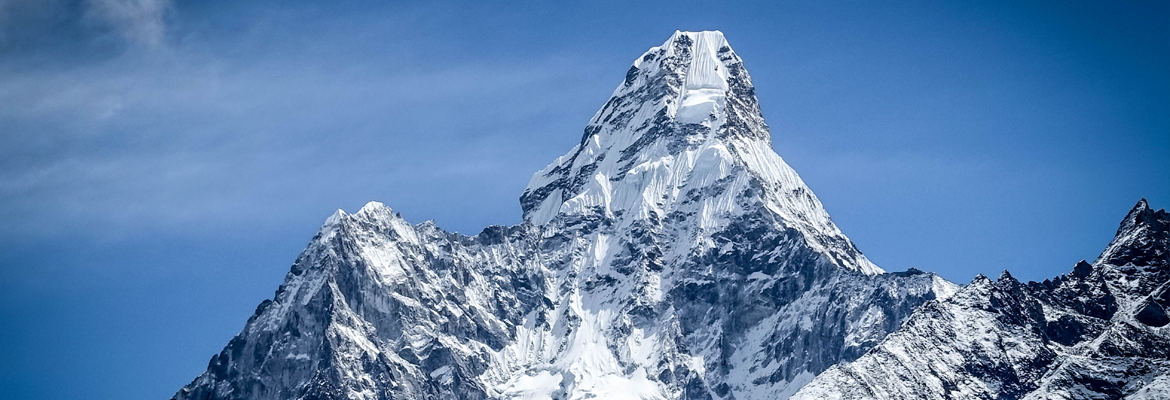
Ama Dablam (6,812 m / 22,349 ft) rises above the Everest Base Camp trail near Pangboche. It is far more technical than a trekking peak. The usual route is the Southwest Ridge. It has sustained rock and mixed climbing around the Yellow Tower above Camp 1, exposed ridges toward Camp 2, and then the snow and ice of the Mushroom Ridge and summit slopes, all on fixed ropes. Climbers need to be comfortable ascending fixed ropes with jumars and abseiling on steep ground at altitude, in crampons. Operators usually ask for previous experience on a 6,000 m peak, alpine climbing or ice climbing, and solid rope skills.
Most expeditions last about 3–4 weeks, including the trek in through the Khumbu (see the EBC trek), acclimatisation, often on Lobuche Peak, and a summit window. Most climbs happen in autumn (October–November), with a smaller spring season.
Permits and official fees
Nepal's Department of Tourism set new royalties from 1 September 2025. For foreign climbers, the Ama Dablam royalty is US$1,000 per person in spring and autumn, and US$500 in winter and summer (Department of Tourism, checked 22 Oct 2026). The same schedule lists a refundable garbage-management deposit of US$2,000 per team for Ama Dablam. Climbers also need the Sagarmatha National Park entry permit (NPR 3,000 for foreigners, Nepal Tourism Board) and the Khumbu Pasang Lhamu Rural Municipality fee. Nepal's amended rules also require a team on peaks below 8,000 m to take at least one mountain guide.
Budget, too, for the Nepal visa, for your share of the team's permit-related costs (some operators bundle the garbage deposit and liaison-officer costs into the price, others list them separately), and for summit bonuses for the climbing Sherpas. These are paid on top of the general tip pool. Ask for every one of these in writing before you pay a deposit.
Ama Dablam cost bands for 2027
From the operators' own published prices (checked 22 Oct 2026):
| Band | Published price | Example |
|---|---|---|
| Budget full service | about $6,850–8,350 | Summitclimb (Ama Dablam only or with Lobuche) |
| Mid-range, western leader | about $9,655–9,995 | Tim Mosedale (2026 schedules) |
| Premium | on request | Furtenbach Adventures |
Add flights to Kathmandu, insurance that covers helicopter rescue, summit bonuses and tips, personal gear, and any extra oxygen. Some operators carry bottled oxygen for emergencies only, while others offer it for the summit. Ask what is included.
How to choose an Ama Dablam operator: 9 questions
- What is the climber-to-Sherpa ratio above Camp 1, and on summit day? 1:1 on summit day is common at the premium end. Ask for the number in writing.
- Who is the sirdar, and how many times has he summited Ama Dablam?
- Who fixes the ropes, and is your team part of a shared rope-fixing arrangement on the mountain?
- Where does the team sleep: Camp 2 or Camp 3? (Camp 3 sits beneath the Dablam serac. Many teams now avoid it or keep their stay there short.)
- What is the acclimatisation plan? Is it a Lobuche Peak rotation, or rotations on Ama Dablam itself?
- What is the turnaround rule, and who enforces it?
- What is the rescue plan? Is a helicopter on call, and who pays? Ama Dablam has seen several rescues in recent seasons. Read our report on rescues on Ama Dablam.
- Is oxygen carried, and for whom?
- Can you show me verified reviews of Ama Dablam itself, not just of your Everest or trekking trips?
Is Ama Dablam dangerous?
Ama Dablam carries real objective hazards: rockfall in the gullies, serac fall from the Dablam above the old Camp 3, cold, exposure, and the challenge of descending tired on fixed lines. Deaths and rescues are recorded every few seasons. The best risk reduction is a strong Sherpa team, sound acclimatisation, a strict turnaround time, and the skills to move efficiently on fixed ropes. It is a serious technical peak, not an extension of a trek, and you should train for it that way.
About the early-data operators
Five more operators have Ama Dablam reviews, but too few to rank. 360 Expeditions and Elite Exped each have two five-star reviews, both from 2021. Summit8000 has one five-star review from a May 2026 trip. Madison Mountaineering has one from 2022, and Seven Summit Treks has one at ★ 4.80 from 2022. A single review can be accurate, but it cannot show consistency across seasons, guides and weather. If one of these operators is on your shortlist, ask for recent climbers you can contact, and check their profiles for reviews of other Himalayan peaks.
A typical Ama Dablam itinerary
The plan below is a common outline. Operators vary it.
| Days | What happens |
|---|---|
| 1–3 | Arrive in Kathmandu, gear check, fly to Lukla (2,860 m) |
| 4–9 | Trek through Namche Bazaar (3,440 m) and Tengboche (about 3,867 m / 12,687 ft) to Pangboche and Ama Dablam Base Camp (about 4,600 m) |
| 10–16 | Acclimatisation: a rotation to Camp 1, and often a Lobuche Peak climb, with nights higher up |
| 17–23 | Summit window: Base Camp, Camp 1, Camp 2 (sometimes Camp 3), the summit, and back down |
| 24–28 | Spare weather days, trek out to Lukla, fly to Kathmandu |
Shorter "flash" programmes reduce the time on the mountain by pre-acclimatising at home, in hypoxic tents, or on another peak. Ask how well this has worked for the operator's past climbers, and whether reviews mention it.
Who Ama Dablam suits and how to prepare
Ama Dablam suits climbers who have already been to 6,000 m. Many do Island Peak, Lobuche East or Mera Peak first, or climb in the Alps or Andes. They should be able to jumar and abseil on steep, rocky ground without thinking about it. Useful preparation:
- Rope-skills days on a local crag or indoor wall: changing over at anchors, passing knots on fixed lines, and abseiling with a heavy pack.
- Alpine routes graded about AD to D, for exposure and moving on mixed terrain in crampons.
- Endurance training for 8–12 hour days with a pack, plus hill repeats with weight.
- A previous high peak so you know how your body handles altitude above 6,000 m.
Climbers who are strong on a trek but new to technical ground should start with a trekking peak combined with the Everest Base Camp trek, then come back.
Why our ranking looks different
Some Ama Dablam operator lists rank companies without a single client rating behind the order. Ours uses only verified reviews of Ama Dablam itself. Big names that run Ama Dablam but have no Ama Dablam reviews with us yet are therefore not ranked. That is not a judgement on them. It means we have no climber evidence to show you yet.
Ama Dablam at a glance
Ama Dablam rises above the Khumbu valley in north-east Nepal, south of Everest. The main summit is 6,812 m (22,349 ft) and a lower western summit reaches about 6,170 m. The name means "mother's charm box" in Sherpa: the two long ridges are a mother's arms and the hanging glacier below the summit is the dablam, the pendant worn by Sherpa women. Anyone trekking to Everest Base Camp sees it for days, and its steep ridges have earned it the nickname "the Matterhorn of the Himalayas" (Wikipedia: Ama Dablam).
The first ascent was made on 13 March 1961 by Mike Gill, Barry Bishop, Mike Ward and Wally Romanes, by the Southwest Ridge. They had spent the winter at about 5,800 m nearby as part of Sir Edmund Hillary's Silver Hut scientific expedition, which explains how they were so well acclimatised in early spring. Today the Southwest Ridge is by far the most popular route, and Ama Dablam is among the most popular permitted peaks in the Himalaya.
The Southwest Ridge route, camp by camp
Commercial expeditions follow the Southwest Ridge with fixed ropes on most of the steep ground. Camp heights vary slightly by season and source.
Base camp, about 4,600 m. A grassy meadow above Pangboche, reached in a few hours from the village. Expedition base camps here are comfortable by Himalayan standards, with dining tents, cooks and solar power.
Advanced base camp / yak camp, about 5,300–5,400 m. Some teams use an intermediate camp on the moraine before the boulder field.
Camp 1, about 5,700–5,800 m. Reached across a long boulder field and slabs. The camp sits on a narrow, rocky ridge with limited tent platforms.
Camp 2, about 5,900–6,000 m. The section from Camp 1 to Camp 2 is the technical core of the lower route: exposed granite ridge, slabs and the "Yellow Tower", a short steep rock step usually climbed on fixed rope with jumars. Camp 2 itself is a tiny, exposed perch.
Camp 3, about 6,200–6,300 m (now often skipped). Before November 2006 most teams used a Camp 3 below the Dablam. That month a serac collapse from the hanging glacier swept away tents at Camp 3 and killed six climbers. Since then many teams use only two camps and make a long summit push from Camp 2, or place Camp 3 in a different spot.
Summit, 6,812 m. Above Camp 2 the route climbs the Mushroom Ridge, a corniced snow and ice arête, then steep snow and ice slopes to the summit. Summit day from Camp 2 typically takes 8 to 12 hours round trip, depending on conditions and crowding on the ropes.
Ama Dablam requires a climbing permit and, under Nepali rules, a liaison officer arrangement. Your operator handles both.
Technical skills you need before Ama Dablam
Ama Dablam is a serious climb even with fixed ropes. Operators differ in how much experience they ask for, but a sensible minimum is:
- Previous climbing at altitude, ideally one or more 6,000 m peaks such as Island Peak, Lobuche East or Mera Peak, or high Andean peaks.
- Confident use of fixed ropes: ascending with a jumar (mechanical ascender) and safety lanyard, passing anchors, and abseiling (rappelling) on a figure-of-eight or ATC, wearing crampons and thick gloves.
- Movement on rock in boots: graded scrambling and easy rock climbing, roughly up to the level of a hard alpine scramble, with exposure.
- Crampon technique on steep snow and ice.
- Cold-weather self-care: managing hands, feet, hydration and food at temperatures well below −20 °C with wind.
If you lack any of these, a skills course or a training peak beforehand is a better investment than a cheaper expedition. Several operators combine Lobuche East or another 6,000 m peak with Ama Dablam for exactly this reason.
Weather and seasons, month by month
Ama Dablam has two climbing seasons, the same as Everest: spring (April and May) and autumn (September to November). Autumn is the main season for Ama Dablam, and most commercial expeditions run in October and November (Wikipedia: Ama Dablam).
| Month | Conditions (general pattern) | Expedition traffic |
|---|---|---|
| January–February | Very cold and windy; winter climbs only | Very rare |
| March | Cold, improving; early spring teams | Low |
| April | Spring season; stable windows begin | Moderate |
| May | Warmer, pre-monsoon cloud and afternoon snow | Moderate early |
| June–August | Monsoon; heavy cloud and snow high up | None |
| September | Monsoon clears late in the month | Building |
| October | Main season; clear, cold, stable | Busiest |
| November | Colder and windier, often very clear | Busy |
| December | Very cold; occasional late teams | Low |
The busiest weeks in the autumn can bring queues on the fixed ropes between Camp 1 and Camp 2 and on the summit slopes. Ask your operator how it times summit days to avoid crowds.
Acclimatisation and altitude
Most expeditions start with an 8 to 10 day trek from Lukla through Namche Bazaar to base camp, often with a detour via Everest Base Camp, Kala Patthar or a 6,000 m training peak. That approach is the first stage of acclimatisation. On the mountain, teams normally make one or two rotations to Camp 1 or Camp 2, returning to base camp to rest, before the summit push.
Supplementary oxygen is not normally used to climb Ama Dablam, but good operators carry emergency oxygen at high camps. Ask whether they do, and who decides when it is used.
Rescue, evacuation and insurance
Helicopter long-line rescues have been carried out on Ama Dablam, but they depend on the weather, the location of the casualty and the availability of a suitably equipped helicopter and crew. Ground rescue from the ridge is slow and difficult. Your insurance should specifically cover mountaineering to at least 7,000 m with ropes and ice axes, helicopter search, rescue and evacuation, and medical repatriation. Many travel policies exclude climbing with technical equipment, so read the wording, not just the altitude limit.
Gear list with typical costs
Expeditions provide group gear: tents at high camps, ropes, stoves, cooking equipment and base camp facilities. You bring your personal climbing kit. Prices below are approximate retail ranges for mid-range new kit in US dollars (unverified; some items can be rented in Kathmandu).
| Item | Typical cost (new) |
|---|---|
| Insulated mountaineering boots suitable for 6,000–7,000 m (double or high-altitude single boots) | $600–1,100 |
| Crampons compatible with your boots | $150–250 |
| Climbing harness | $60–120 |
| Helmet | $60–150 |
| Mechanical ascender (jumar), belay/rappel device, locking and non-locking carabiners, slings | $150–250 |
| Mountaineering ice axe | $80–180 |
| Down suit or heavy down jacket and trousers | $500–1,200 |
| Expedition sleeping bag, about −25 °C comfort | $400–900 |
| Waterproof shell jacket and trousers | $250–600 |
| Insulated expedition mitts and several pairs of gloves | $150–300 |
| Base and mid layers | $150–400 |
| Glacier glasses and ski goggles | $80–250 |
| 45–55 litre climbing pack | $150–300 |
| Headtorch, spare batteries, thermos, water bottles with insulated covers | $80–150 |
Base camp life, food and tipping
Commercial base camps on Ama Dablam are usually well set up: individual sleeping tents, a heated dining tent, cooks producing a mix of Nepali and western food, solar or generator power for charging, and in some cases internet. Higher up, meals are simple: freeze-dried meals, noodles, soups and hot drinks.
Tipping climbing Sherpas, cooks and base camp staff is customary and is often listed separately from the expedition price. Ask each operator for its expected tip amounts or tip pool in writing before you book, because they vary considerably. Some operators also include a summit bonus for climbing Sherpas.
Training for Ama Dablam
Plan on at least six months of focused preparation if you already have alpine experience.
- Endurance: four to five sessions a week, including long hill days of six to ten hours with a 10–15 kg pack.
- Strength: two sessions a week focused on legs, core and upper body pulling strength for jumaring.
- Technical: regular rock climbing (indoor and outdoor), fixed-rope practice with an ascender and abseil device in gloves, and time on steep snow and ice with crampons.
- Altitude: a 6,000 m peak in the preceding one to two years, or as part of the trip.
Booking checklist
- You have read the operator's verified Ama Dablam reviews on ExpedReview and noted the date of the latest one.
- You know the climbing Sherpa-to-client ratio on summit day and the maximum team size.
- The itinerary shows the approach trek, rotations, summit window days and contingency days.
- The quote lists the royalty, garbage deposit, liaison officer costs, Lukla flights, high-camp equipment and food.
- You know what emergency oxygen and medical kit are carried at high camps.
- You know the tip expectations in writing.
- Your insurance covers technical mountaineering to 7,000 m and helicopter rescue.
- You meet the operator's experience requirements, or have booked a training peak first.
The approach trek: Lukla to Ama Dablam base camp
Almost every Ama Dablam expedition begins with the same walk as the Everest Base Camp trek, which doubles as the first stage of acclimatisation. A typical approach:
- Fly Kathmandu (or Ramechhap) to Lukla, 2,846 m; walk to Phakding. A short first day.
- Phakding to Namche Bazaar, 3,440 m. Permit checks at Monjo, then the long climb to Namche.
- Rest and acclimatisation day in Namche. A short hike up towards Khumjung or the Everest View Hotel.
- Namche to Tengboche or Deboche, about 3,800 m. The first full view of Ama Dablam's west face.
- Tengboche to Pangboche, about 3,950 m. Many teams receive a blessing from a lama in Pangboche before the climb.
- Pangboche to Ama Dablam base camp, about 4,600 m. A short, steep walk up to the meadow below the Southwest Ridge.
Some operators add a side trip to Dingboche, Chhukung or a 6,000 m trekking peak such as Lobuche East before base camp. That adds days and cost but gives a stronger acclimatisation base and a chance to practise rope skills on easier ground.
A sample rotation and summit plan
Once at base camp, a common pattern looks like this (details vary by operator and weather):
- Days 1–2 at base camp: rest, puja ceremony, skills refresher on fixed ropes near camp.
- Rotation 1: climb to Camp 1, sleep, and touch Camp 2 or the Yellow Tower before returning to base camp.
- Rest: two to three days at base camp to recover.
- Summit push: base camp to Camp 1, Camp 1 to Camp 2, summit day from Camp 2 and descent to Camp 2 or Camp 1, then down to base camp.
- Contingency: three to five spare days for bad weather or illness.
The total time from Kathmandu back to Kathmandu is usually three to four weeks.
Altitude illness on Ama Dablam
By the time climbers reach Camp 2 they are near 6,000 m, high enough for HAPE and HACE in people who are not well acclimatised. The key protections are a slow approach trek, at least one rotation to Camp 1 or Camp 2 before the summit push, honest reporting of symptoms, and an operator that carries emergency oxygen and medication at high camps. Descending from the ridge is slow, so it is important to act on early warning signs. Talk to a mountain-medicine or travel doctor about medication such as acetazolamide and dexamethasone before the trip.
Climbing Sherpas and staff welfare
Commercial Ama Dablam climbs rely on Nepali climbing Sherpas who fix ropes, carry loads to high camps and guide clients on summit day, and on cooks and kitchen staff at base camp. Ask your operator how many climbing Sherpas work per client on summit day, what insurance they carry (Nepal requires insurance for mountain workers), whether they receive a summit bonus, and how tips are shared. Good operators answer these questions readily.
Food, water and hygiene
At base camp, cooks prepare cooked meals three times a day and boil or filter all drinking water. Stomach illness is one of the most common reasons climbers lose strength before the summit push, so hand hygiene matters: use hand sanitiser before every meal, and avoid untreated water entirely. At high camps, meals are simpler and you may need to melt snow for water. Bring your own favourite snacks for summit day, when appetite is poor.
Ama Dablam as a step towards 8,000 m peaks
Many climbers use Ama Dablam as a stepping stone between trekking peaks and an 8,000 m expedition. It gives you experience of a multi-week Himalayan expedition, of living at base camp, of rope work at altitude with cold hands, and of a long summit day close to 7,000 m, without the cost or the extreme altitude of an 8,000 m peak. If Everest or another 8,000 m peak is your long-term goal, choose an Ama Dablam operator that also runs those climbs, so you can see how it works before you commit to the bigger trip. Our Everest cost guide explains what the next step usually costs.
Common mistakes on Ama Dablam
- Arriving without rope skills. Learning to jumar and abseil in crampons and big gloves on the mountain wastes acclimatisation days and energy. Practise at home until it is automatic.
- Underestimating the cold. Camp 2 and the summit ridge are exposed to wind. Cold hands make rope work slow and dangerous. Bring proper expedition mitts and a spare pair.
- Rushing the summit window. Pressure to summit on a particular day, from a flight home or a crowded rope, leads to poor decisions. Keep spare days and be willing to use them.
- Overpacking for high camps. Space on the Camp 1 and Camp 2 platforms is limited and everything must be carried up. Agree with your operator in advance what you carry and what the Sherpa team carries.
- Choosing on price alone. A cheaper trip can mean fewer climbing Sherpas, older equipment at high camps or no emergency oxygen. Compare like with like.
- Skipping the insurance small print. Many policies exclude technical climbing. Check the wording for ropes, ice axes and the altitude limit before you pay.
Who Ama Dablam is not for
Ama Dablam is not a good first Himalayan objective for someone whose only previous high-altitude experience is a trek. If you have never used crampons, an ice axe or fixed ropes, or have not been above about 5,500 m, start with a trekking peak such as Island Peak, Lobuche East or Mera Peak, or a skills course, and come back to Ama Dablam a season or two later. You will enjoy it more and be safer on the ridge.
Related guides
- Best Everest Base Camp Trek Operators 2027
- Everest Base Camp Trek Cost 2027
- How much does it cost to climb Everest?
- Best Kilimanjaro Operators 2027
- Kilimanjaro Routes Compared
- All Ama Dablam operators and reviews
FAQ
What is the best Ama Dablam operator for 2027?
On verified Ama Dablam reviews (checked 22 Oct 2026), Tim Mosedale ranks first at 4.95 from 16 reviews, followed by Furtenbach Adventures (4.92, 5 reviews) and Summitclimb (4.80, 3 reviews).
How much does an Ama Dablam expedition cost?
Published 2026–27 prices run from about $6,850 (Summitclimb, full service) to $9,995 (Tim Mosedale), and premium operators quote on request. The foreign royalty is $1,000 per climber in spring or autumn (from 1 Sep 2025).
Is Tim Mosedale good for Ama Dablam?
Tim Mosedale has 16 verified Ama Dablam reviews on ExpedReview, averaging 4.95. That is the most of any operator. The latest is from January 2023.
Is Ama Dablam dangerous?
Yes, it is a serious technical peak with rockfall, serac and exposure hazards, and rescues and deaths occur. Choose an operator with a strong Sherpa ratio, a clear rescue plan and a strict turnaround time.
How hard is Ama Dablam to climb?
Ama Dablam needs technical rock, ice and fixed-rope skills at altitude, usually with previous 6,000 m peak experience. It is much harder than Island Peak or Lobuche.
When is the best time to climb Ama Dablam?
Most expeditions climb in autumn (October–November), with a smaller spring season.
Do I need a guide for Ama Dablam?
Nepal's amended mountaineering rules require teams on peaks under 8,000 m to take at least one mountain guide. In practice, nearly all climbers join a guided expedition.
Who is the best Ama Dablam operator?
On verified climber reviews of Ama Dablam, Tim Mosedale ranks first on ExpedReview with ★ 4.95 from 16 verified reviews, followed by Furtenbach Adventures (★ 4.92 from 5) and Summitclimb (★ 4.80 from 3), checked 22 Oct 2026.
How high is Ama Dablam?
The main summit of Ama Dablam is 6,812 m (22,349 ft). The lower western summit is about 6,170 m.
How many people have died on Ama Dablam?
There is no single official running total. Recorded accidents include the 2006 Camp 3 serac collapse that killed six climbers and several individual fatal falls and incidents since, including in 2014, 2016, 2018 and 2025.
How hard is Ama Dablam?
It is harder than trekking peaks such as Island Peak. Climbers need confidence on exposed rock and ice, fixed-rope technique, crampon skills and prior experience at about 6,000 m.
How long does it take to climb Ama Dablam?
Most expeditions last about 3 to 4 weeks from Kathmandu, including an approach trek of 8–10 days, rotations on the mountain and a summit window.
Do you need oxygen for Ama Dablam?
Most climbers summit without supplementary oxygen. Good operators carry emergency oxygen at high camps for medical use.
What experience do I need for Ama Dablam?
Most operators expect previous high-altitude climbing, ideally a 6,000 m peak, plus practical skill with crampons, ice axe, jumar and abseiling on fixed ropes.
What is the Ama Dablam permit cost?
Nepal's Department of Tourism lists the Ama Dablam royalty at $1,000 per climber in spring and autumn and $500 in winter and summer from 1 September 2025, plus a refundable garbage deposit.
Can you climb Ama Dablam without a guide?
Nepal's rules require climbers on sub-8,000 m peaks to climb with at least one licensed mountain guide, and permits are arranged through registered agencies.
What is the hardest part of Ama Dablam?
Most climbers find the Yellow Tower above Camp 1 and the exposed Mushroom Ridge above Camp 2 the hardest sections.
What is the Ama Dablam expedition itinerary?
Most expeditions run three to four weeks: a 6–8 day approach trek from Lukla via Namche and Pangboche to base camp at about 4,600 m, one or two rotations to Camp 1 and Camp 2, a summit push from Camp 2, and spare days for weather.
Where is Ama Dablam base camp?
Ama Dablam base camp is on a meadow above Pangboche in the Khumbu, at about 4,600 m, a few hours' walk from the main Everest Base Camp trail.
Is Ama Dablam harder than Island Peak?
Yes. Island Peak is a trekking peak with a short glacier and headwall. Ama Dablam is higher, longer and more technical, with sustained exposed rock, snow and ice on fixed ropes.
Can you see Ama Dablam on the Everest Base Camp trek?
Yes. Ama Dablam dominates the view from around Tengboche, Pangboche and Dingboche for several days of the EBC trek.
What does Ama Dablam mean?
Ama Dablam means 'mother's charm box' in Sherpa. The ridges are seen as a mother's arms and the hanging glacier as the dablam, a pendant worn by Sherpa women.
Who first climbed Ama Dablam?
Mike Gill, Barry Bishop, Mike Ward and Wally Romanes made the first ascent on 13 March 1961 by the Southwest Ridge.
Related articles
- How to choose a guide
- Best operators
- How Dangerous Is Ama Dablam? Deaths, Difficulty and Who Guides It
Ama Dablam's recorded deaths and summits, why it is technical rather than high, permit fees and the operators verified climbers rate.
- Ama Dablam Rescues: Why So Many Climbers Are Airlifted from Camp 3, Deaths, Risks and How to Prepare
Why Ama Dablam (6,812 m) sees so many helicopter rescues, especially from Camp 3.