Best Everest Base Camp Trek Operators: Ranked by Verified Reviews
By Blake Penson · August 26, 2026
Category: destination-guides
9 min read
Rebuild of the existing URL /blog/best-everest-base-camp-trek-companies-2026. The slug stays the same and the content is updated for 2027.
Short answer: On verified client reviews of Everest Base Camp treks, the best-rated EBC trek operators for 2027 are Adventure Consultants (★ 5.00 from 8 verified reviews), Ace the Himalaya (★ 5.00 from 7) and Climbing The Seven Summits (★ 5.00 from 7). Alpine Ramble has the largest set of reviews on the trail: ★ 4.99 from 18 verified reviews. Every rating is for Everest Base Camp trips only, rechecked on 22 October 2026.
ExpedReview has 90 verified Everest Base Camp reviews across 95 listed operators. Operators with no EBC reviews are left out. The table is the answer. The rest of this page helps you choose between the operators in it.
Best Everest Base Camp trek operators 2027: the ranking
| # | Operator | Rating at Everest Base Camp | Reviews here | Latest review | ERTI |
|---|---|---|---|---|---|
| 1 | Adventure Consultants | ★ 5.00 | 8 | 26 Aug 2026 | ERTI 4.82 |
| 2 | Ace the Himalaya | ★ 5.00 | 7 | 5 Oct 2026 | ERTI 4.82 |
| 3 | Climbing The Seven Summits | ★ 5.00 | 7 | 14 May 2026 | ERTI 4.90 |
| 4 | Adventure Magic Treks and Expedition | ★ 5.00 | 6 | 28 Sep 2026 | ERTI 4.56 |
| 5 | Alpine Ramble | ★ 4.99 | 18 | 19 Jan 2026 | ERTI 4.74 |
| 6 | Ian Taylor Trekking | ★ 4.98 | 9 | 4 Feb 2025 | ERTI 4.62 |
| 7 | Dream Himalaya Adventures | ★ 4.96 | 5 | 8 Jun 2026 | ERTI 4.86 |
| 8 | Summitclimb | ★ 4.92 | 5 | 27 Nov 2023 | ERTI 4.62 |
| 9 | The Mountain Company | ★ 4.78 | 9 | 21 May 2021 | ERTI 4.69 |
Early data (1–2 verified reviews here, not ranked):
| Operator | Rating here | Reviews here | Latest review | ERTI |
|---|---|---|---|---|
| View Nepal Treks and Expedition | ★ 5.00 | 2 | 8 Sep 2026 | ERTI 4.00 |
| Breeze Adventure | ★ 5.00 | 2 | 17 Jul 2026 | ERTI 3.97 |
| Family Adventure Treks & Expedition | ★ 5.00 | 1 | 7 Sep 2026 | ERTI 3.75 |
| Next Trip Nepal Treks and Expedition | ★ 5.00 | 1 | 17 Aug 2026 | ERTI 3.73 |
| Alpine Club of Himalaya | ★ 5.00 | 1 | 29 Oct 2024 | ERTI 3.91 |
| 360 Expeditions | ★ 5.00 | 1 | 3 Mar 2021 | ERTI 4.61 |
| Sherpa Expedition and Trekking | ★ 5.00 | 1 | 2 Oct 2019 | ERTI 3.05 |
| Adventure Peaks | ★ 5.00 | 1 | 24 May 2019 | ERTI 3.73 |
| Broad Adventure | ★ 4.90 | 2 | 4 Jul 2022 | ERTI 3.73 |
| Tim Mosedale | ★ 4.20 | 2 | 9 May 2019 | ERTI 4.42 |
| Adventure White Mountain | ★ 1.00 | 1 | 15 Jan 2024 | ERTI 2.97 |
Ties are broken by number of verified reviews, then by the most recent review. Operators with one or two EBC reviews are listed under "early data" and not ranked. That includes one operator with a 1-star review. We show every result, good or bad.
The top operators in more detail
1. Adventure Consultants: premium, small groups, western leadership
Eight verified EBC reviews, all five stars, the latest from 26 August 2026. Adventure Consultants is a New Zealand company best known for Everest expeditions. Its standard EBC trek costs $6,250 for the March and April 2027 departures and $5,950 for October 2027 (operator page, checked 22 Oct 2026). It also runs a luxury version. You pay for its systems and leadership, not for a different trail. Profile.
2. Ace the Himalaya: Nepal-based, best value among the top four
Seven verified reviews, all five stars, the latest only weeks ago (5 October 2026). Ace the Himalaya is Kathmandu-based. Its 14-day EBC trek is published at $1,550 solo, $1,500 per person for 2–3, $1,450 for 4–9 and $1,380 for 10–14 people, for 2026 and 2027 (operator page, checked 22 Oct 2026). It lists a helicopter between Kathmandu and Lukla as an extra of $450 per person each way. Searchers often compare Ace with the "best EBC operator". On our data it ties for the top rating. Profile.
3. Climbing The Seven Summits: trek-and-stay at base camp
Seven verified EBC reviews, all five stars. CTSS's "Everest Base Camp Trek & Stay" team departure is listed at $5,995. Its page asks trekkers for a $300 Sherpa tip pool (operator page, checked 22 Oct 2026). It is the choice for trekkers who want to sleep at an expedition base camp in season. Profile.
4. Adventure Magic Treks: Nepal-based, recent reviews
Six verified reviews, all five stars, the latest from 28 September 2026. It is listed on ExpedReview from $1,350. Confirm the current price with the operator. Profile.
5. Alpine Ramble: the most reviewed EBC operator
Eighteen verified reviews averaging ★ 4.99. If you trust a large sample more than a perfect score from a few people, Alpine Ramble has the strongest evidence on the trail. Profile.
Also ranked
Ian Taylor Trekking (★ 4.98, 9 reviews), Dream Himalaya Adventures (★ 4.96, 5), Summitclimb (★ 4.92, 5) and The Mountain Company (★ 4.78, 9). The Mountain Company's newest EBC review is from 2021 and Summitclimb's from 2023, so ask both about current guides.
Nepal-based or international operator?
Every EBC trek runs on Nepali guides, porters and teahouses. A Nepal-based operator (Ace the Himalaya, Adventure Magic, Alpine Ramble, Dream Himalaya) contracts them directly. Published prices usually sit between about $1,300 and $2,500 for a 12–14 day trek with flights, permits, lodging and meals. An international operator (Adventure Consultants, CTSS, Ian Taylor, The Mountain Company) adds a western leader or its own medical and safety protocols, fixed departures, and support at home. The price is roughly three to four times higher. Our reviews show high satisfaction with both. Choose on group size, the experience of the lead guide, and how altitude problems are handled.
Licensed guides: Nepal's 2023 rule
Since 1 April 2023, the Nepal Tourism Board requires foreign trekkers in the country's national parks and conservation areas to trek with a licensed guide, booked through a registered agency. Reports of how strictly this is enforced in the Khumbu have varied, so ask your operator how it handles the rule in 2027. Any operator in this table will provide a licensed guide.
What to compare between EBC operators
- Days and acclimatisation. A standard trek is 12–14 days, with rest days in Namche Bazaar (3,440 m / 11,286 ft) and Dingboche (4,410 m / 14,469 ft).
- Flights. In peak seasons, Lukla flights often leave from Ramechhap (Manthali), several hours' drive from Kathmandu. Check who pays for the transfer.
- Guide-to-trekker and porter ratios. Ask for them in writing.
- Altitude protocol. Ask about pulse-oximeter checks, a descent plan and evacuation insurance requirements.
- Lodging. Ask whether rooms are twin-share or private, and whether the price is per room or per person in a group.
- Group size and departures. Fixed group departures are cheaper per person and good for solo travellers. A private trek lets you set the pace and add rest days, and Nepal-based operators often charge only a little more for two people.
- Insurance. Most operators require a policy that covers helicopter evacuation from altitude. Check the altitude limit in yours before you pay a deposit.
- What is excluded. Typical extras are Kathmandu meals, hot showers, charging, Wi-Fi, tips and the Nepal visa.
A full breakdown is in Everest Base Camp Trek Cost 2027. Planning a summit later? See how much it costs to climb Everest.
Route facts to check against any itinerary
The usual route climbs from Lukla (2,860 m / 9,383 ft) through Phakding, Namche Bazaar, Tengboche (about 3,867 m / 12,687 ft), Dingboche, Lobuche and Gorak Shep to Everest Base Camp (about 5,364 m / 17,598 ft). Most treks add a dawn climb of Kala Patthar (about 5,644 m / 18,519 ft) for the classic view of Everest. Note that Tibet's north base camp is a separate place reached by road. Kangshung is the remote east face, not the north base camp.
When to trek with any of these operators
Most EBC departures run in the two main seasons. Autumn (late September to November) brings the clearest skies after the monsoon. Spring (March to May) is warmer, the rhododendrons bloom lower down, and base camp is busy with Everest expeditions. That is when trek-and-stay options such as the CTSS departure make sense. Winter treks are possible but cold, and teahouses higher up may close. Monsoon treks (June to August) bring cloud, leeches lower down, and more weather delays at Lukla. Ask any operator how many spare days it builds in for flight delays. One or two buffer days is normal in peak season.
Red flags when choosing an EBC operator
- A price far below the published range of reputable Nepal-based operators. A cheap trek usually means fewer guides per trekker, cheaper rooms, or extras left out of the price.
- No written itinerary with rest days. A trek that skips acclimatisation days in Namche and Dingboche raises the risk of altitude sickness.
- Pressure to book a helicopter rescue through the operator's preferred company. Check that your insurance covers evacuation to at least 6,000 m and that you know who calls the helicopter.
- No verifiable reviews. Ask the operator to point you to client reviews you can check, and look for a profile with verified EBC reviews.
- Vague answers about porter loads and equipment. Good operators give porters proper gear and limit their loads.
How hard is the Everest Base Camp trek?
EBC is not a technical climb. The challenge is altitude and how many days you walk in a row. Expect five to seven hours of walking on most days, and up to eight on the base camp day. Fit hikers who train for two or three months with long walks and stair work, ideally carrying a daypack, usually do well. Acclimatisation matters more than fitness. Climbing slowly, drinking enough water, and being willing to stop or descend matter more than speed. Every operator in our table follows an itinerary with at least two acclimatisation days. Ask to see yours.
Everest Base Camp at a glance
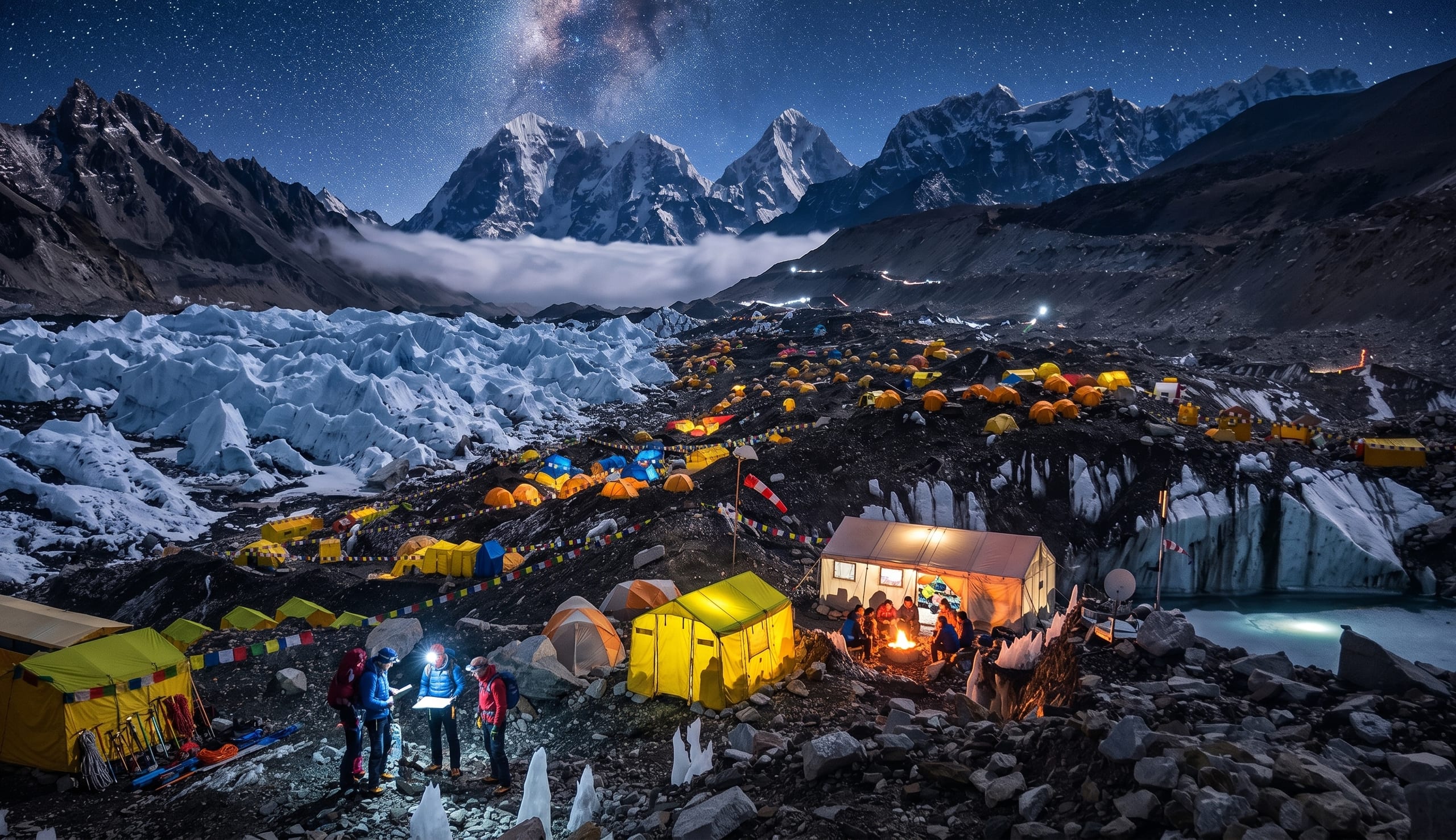
The trek ends at South Base Camp in Nepal, at about 5,364 m (17,598 ft), on the moraine of the Khumbu Glacier. Most trekkers fly from Kathmandu to Lukla (2,846 m) and walk up the Dudh Kosi valley through Namche Bazaar (3,440 m), the Sherpa hub of the Khumbu, then on through Tengboche and Dingboche (4,260 m) to Lobuche and Gorak Shep. The highest point most trekkers reach is not base camp itself but Kala Patthar, a viewpoint above Gorak Shep at roughly 5,545–5,645 m depending on the source, from which Everest's summit is clearly visible. Around 40,000 people a year walk to base camp from Lukla.
Base camp itself moves slightly each season because it sits on a moving glacier. In 2022 Nepal announced plans to relocate it 200 to 400 m lower because the glacier is thinning. In spring the climbing expeditions' tents fill the area; in autumn it is much emptier. If you want to see the expedition village, trek in April or early May.
The trek is non-technical, but it is long and high. You spend about a week above 4,000 m, and altitude, not fitness, decides most outcomes. That is why the operator you pick matters: a good one builds in acclimatisation days, watches your health and has a plan when someone falls ill.
A standard 12-day itinerary, day by day
Most good operators run something close to this. Fourteen-day versions add a day for flight delays at Lukla and a second acclimatisation day. Altitudes are commonly published approximations.
Day 1: Fly Kathmandu (or Ramechhap) to Lukla, 2,846 m; walk to Phakding, about 2,610 m. A short, mostly downhill first day of three to four hours. In peak season many Lukla flights leave from Ramechhap (Manthali), several hours' drive from Kathmandu, because of air-traffic congestion at Kathmandu airport. Ask your operator which airport your flight uses.
Day 2: Phakding to Namche Bazaar, 3,440 m. You enter Sagarmatha National Park at Monjo, where permits are checked, cross several suspension bridges including the high Hillary Bridge, and climb steeply to Namche. Six to seven hours.
Day 3: Acclimatisation day in Namche. A short hike up to the Everest View Hotel or Khumjung, around 3,800–3,900 m, then back down to sleep. Namche has bakeries, gear shops, ATMs and the last reliable range of supplies.
Day 4: Namche to Tengboche, about 3,860 m. A scenic contour path with views of Ama Dablam and Everest, then a descent to the river and a climb to Tengboche Monastery, the largest in the Khumbu.
Day 5: Tengboche to Dingboche, about 4,410 m. Through Pangboche and into the Imja valley. The trees thin out and the landscape becomes alpine.
Day 6: Acclimatisation day in Dingboche. A hike up the ridge of Nangkartshang above the village, gaining several hundred metres, then a rest afternoon.
Day 7: Dingboche to Lobuche, about 4,940 m. Past Dughla and the climbers' memorials at Thukla Pass. A cold, high night.
Day 8: Lobuche to Gorak Shep, about 5,164 m, and on to Everest Base Camp, 5,364 m. The trail follows the Khumbu Glacier's lateral moraine. Drop your bags at Gorak Shep, walk to base camp and back. A long day of seven to eight hours.
Day 9: Kala Patthar at dawn, then down to Pheriche, about 4,240 m. An early start for sunrise on Everest, then a long descent. Pheriche has a Himalayan Rescue Association aid post that runs during the main seasons.
Day 10: Pheriche to Namche Bazaar. Long but downhill, with thicker air.
Day 11: Namche to Lukla. The last walking day and usually the crew's farewell evening, when tipping happens.
Day 12: Fly Lukla to Kathmandu or Ramechhap. Weather delays at Lukla are common. Build at least one, and preferably two, spare days into your plans before your international flight home.
Weather and the best time to trek, month by month
The Khumbu has a monsoon climate. The two main trekking seasons are spring (March to May) and autumn (late September to November). These are the same windows used for climbing Everest and Ama Dablam.
| Month | Conditions (general pattern) | Trail traffic |
|---|---|---|
| January | Very cold, often clear; snow possible on high passes | Very quiet |
| February | Cold and clear, warming late in the month | Quiet |
| March | Warming, rhododendrons begin lower down; good views | Building |
| April | Peak spring season; expedition village at base camp | Busy |
| May | Warmer, hazier; pre-monsoon cloud builds in the afternoons | Busy early |
| June | Monsoon arrives; frequent cloud and rain lower down | Quiet |
| July | Monsoon; leeches in the lower valleys, flight cancellations common | Very quiet |
| August | Monsoon; similar to July | Very quiet |
| September | Monsoon tails off late in the month | Building |
| October | Peak autumn season; clear skies, cold nights | Busiest |
| November | Clear, colder; still excellent | Busy |
| December | Cold, mostly clear, short days | Quiet |
This is a broad pattern, not a forecast. Nights above 4,500 m are below freezing for most of the year. Lukla flights depend on visibility, and cancellations can happen in any season.
Altitude sickness and safety on the EBC trek
Acute mountain sickness is the main health risk on this trek. Symptoms such as headache, nausea, loss of appetite, poor sleep and unusual tiredness usually begin above about 2,500 m and often appear around Dingboche and Lobuche. Most cases are mild and settle with rest. The serious forms, HAPE (fluid in the lungs) and HACE (swelling of the brain), can develop quickly and need immediate descent.
What a good operator does, and what to ask about:
- Acclimatisation days in Namche and Dingboche, and a sleeping altitude that rises by no more than about 300–500 m a night above 3,000 m, in line with widely used mountain-medicine guidance.
- Daily health checks with a pulse oximeter and a symptom questionnaire, with clear rules for when a trekker rests, descends or is evacuated.
- A first-aid trained guide with a stocked kit.
- Satellite or mobile communication that works across the route.
- A named evacuation provider and a plan for working with your insurer.
The Himalayan Rescue Association runs seasonal aid posts at Pheriche and at Everest Base Camp during the climbing season. They can treat altitude illness and advise on evacuation.
Other risks are more ordinary. Stomach upsets are common; drink treated water and wash your hands often. Yak trains have right of way on narrow trails, so always stand on the uphill side when they pass. In cold weather, frostbite on fingers and toes is possible at Kala Patthar at dawn.
Rescue, evacuation and insurance
Helicopter evacuation is the standard way out for a serious medical problem in the Khumbu. It is expensive, which is why insurance matters more than almost any other booking decision. Make sure your policy:
- covers trekking to at least 5,500–6,000 m (Kala Patthar is above 5,500 m);
- includes helicopter search, rescue and evacuation and medical repatriation;
- covers cancellation, curtailment and delay, including missed connections caused by Lukla weather.
Some insurers require pre-authorisation for a rescue flight. Ask your operator how it handles that and whether it has an arrangement with an assistance company. Carry your policy number and emergency contact details in your daypack.
Teahouses, food and daily life on the trail
The trek uses teahouses, which are family-run lodges with simple twin rooms and a shared, heated dining room. Lower down, many have attached bathrooms and hot showers; higher up, rooms are basic, unheated and very cold at night, toilets are shared and showers cost extra. Charging devices and Wi-Fi usually cost extra too, and the price of everything rises with altitude because goods are carried in by porters or yaks.
Menus are surprisingly broad. The staple is dal bhat (rice, lentil soup and vegetable curry, usually with free refills), alongside noodle soups, fried rice, potatoes, pasta, pancakes and eggs. Many trekkers avoid meat above Namche, because it has been carried up for days without refrigeration. Most packages include three meals a day; drinks, snacks and hot water often are not.
Gear list with typical costs
Teahouse trekking needs less kit than camping. Your porter will usually carry a duffel of around 10–15 kg (porter-load limits vary by operator; ask). Prices below are approximate retail ranges for mid-range new kit in US dollars (unverified, and much of it can be rented or bought cheaply in Kathmandu's Thamel district).
| Item | Why | Typical cost (new) |
|---|---|---|
| Broken-in trekking boots | Long days on rocky trails | $150–300 |
| Sleeping bag, about −10 °C comfort | Lodges above Dingboche are unheated | $200–450 (or rent) |
| Down jacket | Evenings, Kala Patthar at dawn | $150–350 (or rent) |
| Waterproof shell jacket and trousers | Snow and rain | $150–400 |
| Fleece mid-layers (x2) | Layering | $50–150 each |
| Thermal base layers | Cold nights | $50–150 |
| Trekking trousers (x2) | Daily walking | $50–100 each |
| Warm hat, sun hat, buff | Sun and wind | $30–60 |
| Liner and insulated gloves | Cold mornings | $40–100 |
| Trekking socks (4–5 pairs) | Blisters | $15–25 a pair |
| Daypack, 25–35 litres | Daily kit | $80–150 |
| Duffel bag | For the porter | $50–120 |
| Headtorch | Early starts | $30–80 |
| Trekking poles | Descents | $50–150 |
| Water bottles (2 x 1 litre) and purification | Avoid buying bottled water | $20–60 |
| Category 3–4 sunglasses, SPF 50 sunscreen | High UV and snow glare | $40–150 |
Training for the Everest Base Camp trek
Plan on 8 to 12 weeks of preparation if you are reasonably active. The aim is to be comfortable walking five to seven hours a day for ten or more days in a row, with a lot of climbing and descending.
- Weeks 1–4: three or four cardio sessions of 45–60 minutes a week (walking, cycling, running or swimming) and a two- to three-hour hill walk at the weekend. Two short leg and core strength sessions.
- Weeks 5–8: add stair or incline work with a 5–7 kg pack. Make the weekend walk four to six hours and, at least twice, walk on consecutive days.
- Weeks 9–11: your longest walks, six to seven hours, in the boots you will wear. If possible, include a day at altitude.
- Final week: reduce training, rest, and check your kit.
Fitness makes the trek more enjoyable but does not prevent altitude sickness. If you have a medical condition, talk to a doctor before you book.
Tipping guides and porters
Tipping is customary in Nepal and makes up a meaningful share of what trekking crews earn. Operators publish their own guidance, and amounts are usually set per day or as a share of the trip price. Many trekkers budget roughly 10% of the trek cost for tips, shared between guide and porters (unverified rule of thumb; follow your operator's written guidance). Hand tips to each crew member individually, in Nepali rupees, at the end of the trek. Some international operators collect a tip pool in advance; Climbing The Seven Summits, for example, lists a $300 Sherpa tip pool on its EBC trek page (checked 22 Oct 2026).
Booking checklist
- You have read the operator's verified EBC reviews on ExpedReview and noted the date of the latest review.
- The itinerary has acclimatisation days in Namche and Dingboche and at least one spare day for Lukla weather.
- The quote lists permits, Lukla flights (and which airport they leave from), lodging, meals and guide and porter costs.
- You know the group size and the guide-to-trekker ratio.
- You know how health is checked each day and what the evacuation plan is.
- You know the porter load limit and the tipping guideline.
- Your insurance covers trekking to 6,000 m and helicopter evacuation.
- You know the cancellation terms and what happens if a Lukla flight is cancelled.
- Your international flight home leaves at least two days after your planned return to Kathmandu.
Other routes in the Everest region
Most of the operators ranked above also run alternatives to the classic trail. They are worth considering if you have already done EBC or want fewer people.
- Gokyo Lakes and Gokyo Ri: a parallel valley west of the main trail, with a chain of turquoise glacial lakes and a viewpoint at about 5,360 m that many trekkers rate above Kala Patthar.
- Gokyo to EBC via the Cho La: links the two valleys over a 5,400 m pass, often with a short glacier crossing.
- Three High Passes: a full circuit over Kongma La, Cho La and Renjo La, for experienced trekkers with three weeks.
- EBC from Tibet: the North Base Camp, at about 5,150–5,200 m, is reached by road from Lhasa and needs Chinese permits arranged through a licensed agency in Tibet.
ExpedReview has very few verified reviews for Gokyo, the Three Passes and the Tibet side so far, so we do not rank operators for them yet.
How to read EBC reviews before you book
Verified reviews are most useful when you read them for specifics rather than stars. When you look through an operator's EBC reviews on ExpedReview, look for: the month and year of the trek, so you know the review reflects current guides; comments on how the guide handled altitude symptoms; whether the itinerary changed because of Lukla weather and how that was managed; the quality of lodges and food; and whether porters were well treated. A long run of recent, detailed reviews tells you more than a perfect average from a few years ago. That is why our ranking table shows the date of each operator's latest verified review next to its rating.
Common mistakes on the Everest Base Camp trek
- Walking too fast in the first days. The trail from Lukla to Namche is easy to rush. Altitude catches up with you later, around Dingboche and Lobuche.
- Skipping acclimatisation days. The Namche and Dingboche rest days exist for a reason. Use them for short hikes up and back.
- Booking a tight international flight. Lukla weather delays are common. Leave at least one or two spare days.
- Drinking untreated water. Stomach illness is the most common health problem on the trail after altitude.
- Choosing the cheapest quote without reading it. Check what is left out: flights, transfers, porter, tips and insurance.
- Ignoring symptoms. Tell your guide about headaches, nausea or breathlessness early. A rest day is easy; an evacuation is not.
Related guides
- Everest Base Camp Trek Cost 2027
- How much does it cost to climb Everest?
- Best Ama Dablam Operators 2027
- Best Kilimanjaro Operators 2027
- Kilimanjaro Routes Compared
- All EBC operators and reviews
FAQ
What is the best Everest Base Camp trek operator?
On verified EBC reviews (checked 22 Oct 2026), Adventure Consultants, Ace the Himalaya and Climbing The Seven Summits share the top rating of 5.00, from 8, 7 and 7 reviews. Alpine Ramble has the most reviews: 18, averaging 4.99.
What is the best EBC trek operator for value?
Among the top-rated operators, Ace the Himalaya (5.00, 7 reviews) publishes 14-day EBC prices from $1,380 to $1,550 per person, depending on group size. Adventure Magic Treks (5.00, 6 reviews) and Alpine Ramble (4.99, 18 reviews) are also Nepal-based.
Where can I find Everest Base Camp operator reviews?
ExpedReview lists verified client reviews of EBC treks for each operator at /location/everest-base-camp. On 22 Oct 2026 it held 90 verified EBC reviews.
Is Ace the Himalaya a good EBC trek company?
Ace the Himalaya has 7 verified Everest Base Camp reviews on ExpedReview, all five stars, the latest on 5 Oct 2026. It ties for the top rating.
Which Everest Base Camp trek companies use western guides?
Adventure Consultants, Climbing The Seven Summits, Ian Taylor Trekking and The Mountain Company are international operators. Their trips cost more than those of Nepal-based companies.
Do I need a guide for Everest Base Camp?
Nepal has required foreign trekkers in national parks to use a licensed guide since April 2023. Check with your operator how the rule is applied in the Khumbu for 2027.
How high is Tengboche?
Tengboche Monastery sits at about 3,867 m (12,687 ft), on day 4 or 5 of a standard EBC trek.
Who is the best Everest Base Camp trek operator?
On verified client reviews of EBC treks, Adventure Consultants, Ace the Himalaya, Climbing The Seven Summits and Adventure Magic Treks all hold ★ 5.00 ratings from 6–8 verified reviews on ExpedReview (checked 22 Oct 2026). Alpine Ramble has the most EBC reviews, 18, at ★ 4.99.
What are the best Everest Base Camp trek companies?
The best-rated EBC trek companies by verified reviews on ExpedReview are Adventure Consultants, Ace the Himalaya, Climbing The Seven Summits, Adventure Magic Treks, Alpine Ramble, Ian Taylor Trekking, Dream Himalaya Adventures, Summitclimb and The Mountain Company.
Is Ace the Himalaya good for Everest Base Camp?
Ace the Himalaya has ★ 5.00 from 7 verified EBC reviews on ExpedReview, with the latest from 5 October 2026. Its published 14-day EBC price ranges from $1,380 to $1,550 per person depending on group size (checked 22 Oct 2026).
Where can I read Everest Base Camp operator reviews?
ExpedReview publishes verified client reviews filtered by location at /location/everest-base-camp. On 22 Oct 2026 there were 90 verified EBC reviews.
What is EBC?
EBC stands for Everest Base Camp. Most people mean the South Base Camp in Nepal, at about 5,364 m, and the 12–14 day trek to reach it from Lukla.
How long is the Everest Base Camp trek?
Most itineraries take 12 to 14 days from Lukla and back, including two acclimatisation days. Allow 15 to 17 days in Nepal in total.
How hard is the Everest Base Camp trek?
It is non-technical but demanding because of the altitude and the length. You walk five to eight hours a day and spend about a week above 4,000 m.
Do I need a guide for the Everest Base Camp trek?
Nepal introduced a rule in April 2023 requiring foreign trekkers in national parks and conservation areas to trek with a licensed guide. How it is applied in the Khumbu has varied, so check the current rule with your operator.
What is the best time to trek to Everest Base Camp?
The best periods are spring (March to May) and autumn (late September to November). October is the busiest month. The monsoon, June to August, brings cloud, rain and flight cancellations.
How high is Everest Base Camp?
South Base Camp in Nepal is at about 5,364 m (17,598 ft). North Base Camp in Tibet is at about 5,150–5,200 m.
Can you see Everest from Everest Base Camp?
The summit is mostly hidden from base camp itself. The best close view is from Kala Patthar, above Gorak Shep, usually climbed at dawn the day after you visit base camp.
Do I need travel insurance for Everest Base Camp?
Yes. Choose a policy that covers trekking to at least 6,000 m and includes helicopter evacuation and medical repatriation.
Can beginners do the Everest Base Camp trek?
Yes, many trekkers have no high-altitude experience. Train for two to three months, choose an itinerary with acclimatisation days and pick an operator with strong verified reviews.
What is the Everest Base Camp trek with a helicopter return?
Some operators offer a helicopter flight back from Gorak Shep or base camp to Lukla or Kathmandu instead of walking down. It saves three to four days and costs extra; Ace the Himalaya lists $450 each way for a helicopter option (checked 22 Oct 2026).
How much should I tip on the Everest Base Camp trek?
Follow your operator's written guidance. Many trekkers budget about 10% of the trek price for tips, shared between guide and porters, paid in Nepali rupees at the end.
Related articles
- How to choose a guide
- Everest Base Camp Trek Cost: Permits, Flights, Operators and Budgets ($1,400–2,500)
Listed EBC trek prices on ExpedReview, the two permits every trekker needs, and the best-reviewed trekking operators.
- Everest Base Camp Trek Guide 2026: Itinerary, Permits, Best Time, Altitude and Operators
Everything to know before trekking to Everest Base Camp: how long it takes, the day-by-day itinerary, permits and fees, Lukla and Ramechhap flights, best months, altitude sickness, fitness, gear and top-rated operators.
Tags: everest-base-camp, nepal, guide-comparison, expedition-costs, trust-index