The Seven Summits: List, Heights, Order, Cost and How to Climb Them (2027)
By Blake Penson · January 31, 2024
Category: seven-summits
7 min read
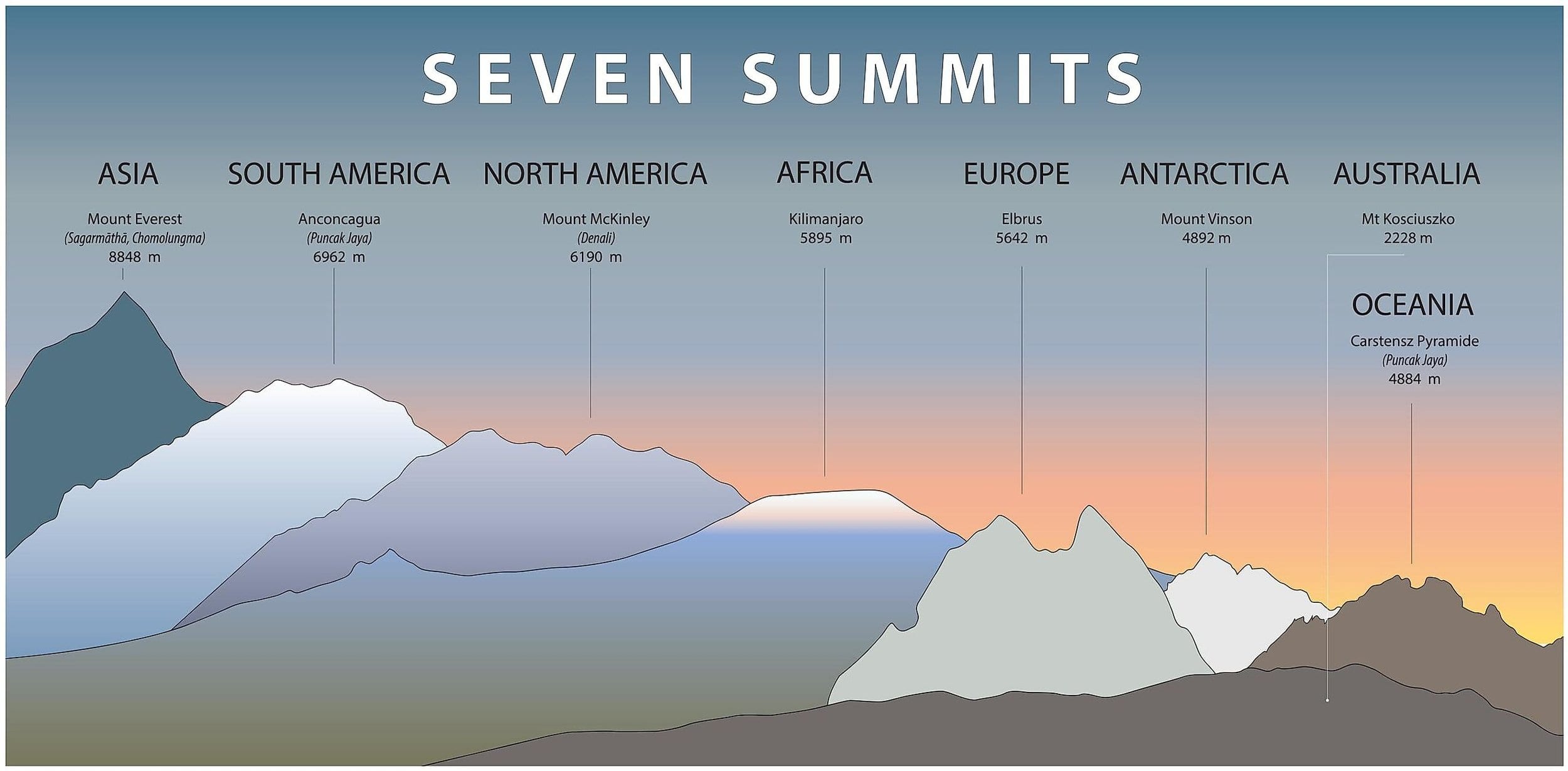
The Seven Summits are the highest mountains on each of the seven continents: Everest (8,849 m, Asia), Aconcagua (6,961 m, South America), Denali (6,190 m, North America), Kilimanjaro (5,895 m, Africa), Elbrus (5,642 m, Europe), Vinson (4,892 m, Antarctica) and, for Australasia/Oceania, either Carstensz Pyramid (4,884 m, Indonesia) or Mount Kosciuszko (2,228 m, Australia). There are two common lists: the Bass list, which uses Kosciuszko, and the Messner list, which uses Carstensz Pyramid and is the one most serious climbers follow. Many climbers do both, making eight peaks. Most climbers start with Kilimanjaro or Elbrus, build experience on Aconcagua and Denali, and leave Everest until they have climbed at least one other 8,000 m peak. Completing all seven usually takes several years and a large budget, mostly driven by Everest and Vinson. ExpedReview ranks operators for each mountain by verified climber reviews.
| Continent | Mountain | Height | Country | Typical expedition |
|---|---|---|---|---|
| Asia | Everest | 8,849 m | Nepal / China | ~6–9 weeks |
| South America | Aconcagua | 6,961 m | Argentina | ~18–21 days |
| North America | Denali | 6,190 m | USA (Alaska) | ~3 weeks |
| Africa | Kilimanjaro | 5,895 m | Tanzania | ~6–9 days |
| Europe | Elbrus | 5,642 m | Russia | ~8–10 days |
| Antarctica | Vinson | 4,892 m | Antarctica | ~2–3 weeks |
| Oceania (Messner) | Carstensz Pyramid | 4,884 m | Indonesia | ~1–2 weeks |
| Australia (Bass) | Kosciuszko | 2,228 m | Australia | 1 day |
What are the Seven Summits?
The idea is simple: climb the highest mountain on every continent. The challenge is not just height but variety. The Seven Summits take you from the tropical slopes of Kilimanjaro to the extreme cold of Antarctica, from Denali's self-supported glacier expeditions to the jungle-fringed limestone of Carstensz Pyramid. Each mountain tests different skills, and completing them all takes years of planning, training and travel.
The project took off in the 1980s. American businessman Dick Bass completed his list, using Kosciuszko for Australia, when he reached the top of Everest in April 1985. Canadian climber Pat Morrow completed the list using Carstensz Pyramid in 1986, and Reinhold Messner, who argued that Carstensz was the right choice for the continent of Australasia, completed it later that year. Since then, the Seven Summits have become one of the most popular goals in mountaineering.
Carstensz Pyramid or Kosciuszko?
The debate is about how to define a continent. Kosciuszko is the highest point on mainland Australia and an easy day walk. Carstensz Pyramid, on the island of New Guinea, sits on the same continental shelf as Australia and is the highest point of the wider continent of Australia (Sahul) or Oceania. It is also a genuine technical rock climb. Most climbers who take the Seven Summits seriously follow the Messner list and climb Carstensz, and many also walk up Kosciuszko to complete both lists.
Carstensz is the hardest of the seven to reach. Access depends on permits, security in Papua and helicopter flights from Timika, and trips are frequently delayed or cancelled. See our Carstensz Pyramid guide for the current situation.
The mountains
Everest (8,849 m, Asia)
The highest mountain in the world and the biggest challenge of the seven. Most climbers go via the South Col route from Nepal or the North Col route from Tibet, using supplementary oxygen and Sherpa support. Expeditions take about two months. Nepal raised the spring climbing royalty for foreigners to US$15,000 from September 2025. See Everest rankings and the Everest cost guide.
Aconcagua (6,961 m, South America)
The highest mountain outside Asia. The Normal Route is non-technical but a serious high-altitude expedition, with strong winds and cold. It is excellent preparation for bigger peaks. See climbing Aconcagua.
Denali (6,190 m, North America)
Denali, which the US government now officially calls Mount McKinley, is a cold, glaciated mountain in Alaska. Teams carry heavy loads and pull sleds, with no porters, and the high latitude makes it feel higher and colder than its altitude suggests. Many climbers find it the hardest of the seven after Everest. See the Denali page and the Denali gear list.
Kilimanjaro (5,895 m, Africa)
The world's highest free-standing mountain and the most accessible of the seven. It is a trek rather than a technical climb, but its altitude makes it a real challenge. Many climbers start their Seven Summits here. See Kilimanjaro.
Elbrus (5,642 m, Europe)
Elbrus, a dormant volcano in Russia's Caucasus, is usually counted as Europe's highest mountain. The standard south route uses snowcats or a cable car to reduce the climb, but summit day is long and cold, and bad weather has caught many climbers out. Some climbers consider Mont Blanc (about 4,808 m) as Europe's highest, depending on where you draw the border between Europe and Asia, but Elbrus is the standard choice. Many governments currently advise against travel to Russia, which affects insurance and logistics, so check advice for your country before planning. See Elbrus.
Vinson (4,892 m, Antarctica)
The highest mountain in Antarctica is technically straightforward but very remote and cold. Climbers fly from Punta Arenas in Chile to Union Glacier and then to Vinson base camp. It is one of the most expensive of the seven because of flight logistics. See Vinson and the Vinson cost guide.
Carstensz Pyramid (4,884 m, Oceania)
A limestone rock climb near the equator in Indonesian Papua, with fixed ropes, scrambling and a famous Tyrolean traverse. It is technically the hardest of the seven, apart from Everest's altitude, and the most complicated to access.
Kosciuszko (2,228 m, Australia)
An easy walk in Kosciuszko National Park, New South Wales, often done from Thredbo using a chairlift in summer.
The best order to climb the Seven Summits
There is no fixed order, but a sensible progression builds skills and altitude experience:
- Kilimanjaro – introduction to altitude.
- Elbrus – cold, snow and crampon skills (if travel is possible).
- Aconcagua – a full high-altitude expedition.
- Denali – glacier travel, heavy loads and self-sufficiency.
- Vinson – remote, cold expedition (can come earlier if you have glacier skills).
- Carstensz Pyramid – technical rock skills (timing depends on access).
- Everest – last, after other high peaks, ideally including an 8,000 m peak such as Manaslu or Cho Oyu.
Seasons also shape the order. Aconcagua and Vinson are climbed in the southern summer (roughly November to February), Denali in May to July, Everest mainly in spring, Elbrus in summer, and Kilimanjaro year-round with the best weather in the drier months. Carstensz trips are usually scheduled in permit windows, and operators currently plan departures in spring and autumn.
See what to climb before Everest and Mount Everest for beginners.
How long does it take?
Most climbers take several years to complete the Seven Summits, fitting expeditions around work, family and savings. A few climbers have completed them in a matter of months, but these record attempts require very strong climbers, big budgets and a lot of luck with logistics and weather. The total time on the mountains alone is roughly four to five months, with Everest taking the biggest share.
How much do the Seven Summits cost?
The total cost varies hugely depending on operators, service levels and travel. Everest is by far the most expensive, followed by Vinson because of Antarctic flights, then Carstensz, Denali and Aconcagua. Kilimanjaro and Elbrus are the cheapest. Add flights, gear, insurance, training climbs and time off work. For individual mountains, see the cost guides for Everest, Aconcagua, Kilimanjaro and Vinson, and our comparison of high-altitude expedition costs.
Skills you need
The Seven Summits require a wide range of skills:
- Altitude experience: acclimatisation and recognising altitude illness.
- Cold-weather skills: managing layers, preventing frostbite and living in the cold.
- Glacier travel and crevasse rescue: essential for Denali and Vinson.
- Crampon and ice axe skills: for Elbrus, Aconcagua, Denali, Vinson and Everest.
- Fixed-rope techniques: using ascenders and abseiling, essential for Everest and Carstensz.
- Rock climbing: for Carstensz Pyramid.
- Expedition life: coping with long weeks in tents, bad weather and setbacks.
See skills to learn before a mountaineering trip, glacier travel and how to train for mountaineering.
Planning a multi-year campaign
Treat the Seven Summits as a long-term project rather than a list of separate trips. A realistic plan might look like this:
- Year 1: Kilimanjaro, plus a mountaineering skills course and alpine climbs to learn crampon, ice axe and rope skills.
- Year 2: Aconcagua, with glacier travel and crevasse rescue training ahead of Denali.
- Year 3: Denali and, if logistics allow, Elbrus.
- Year 4: Vinson and Carstensz Pyramid, depending on access and budget, and an 8,000 m peak such as Manaslu or Cho Oyu.
- Year 5: Everest.
Many climbers move faster or slower, depending on experience, money and time off work. What matters is that each peak builds on the last and that you arrive at Everest with real altitude experience.
Why Seven Summits campaigns stall
The most common reasons climbers do not finish are not about fitness alone. Money runs out, especially after an unsuccessful Everest or Denali attempt. Access problems hold climbers up: Carstensz trips are often delayed or cancelled because of permits, security or weather, and travel to Russia for Elbrus is currently difficult for many nationalities. Injuries, frostbite and family or work commitments also interrupt plans. Build flexibility into your plan, keep a contingency fund, and accept that some mountains may take more than one attempt.
Insurance and health
You need insurance that covers mountaineering at the altitude of each peak, including evacuation and rescue. Remote mountains such as Vinson, Denali and Carstensz have very expensive evacuations, and some policies exclude certain countries or regions. See a doctor before each expedition, and learn about altitude illness and cold injuries. See what is acute mountain sickness and death zone effects on the body.
Choosing operators
Choosing the right operator for each mountain is one of the most important decisions you will make. Some climbers stay with one operator for all seven, building a relationship and a track record. Others choose the best operator for each mountain. Look at guide qualifications (such as IFMGA guides), guide-to-client ratios, safety records, what is included and verified reviews from past climbers. ExpedReview ranks operators by verified reviews; start with the Everest rankings and how to choose an Aconcagua operator.
Beyond the Seven Summits
Some climbers go further. The Explorers Grand Slam adds the North and South Poles to the Seven Summits. Others take on the Volcanic Seven Summits (the highest volcano on each continent) or the 14 peaks over 8,000 m. See our guide to the 14 8,000 m peaks.
Frequently asked questions
What are the Seven Summits?
The highest mountains on each continent: Everest, Aconcagua, Denali, Kilimanjaro, Elbrus, Vinson and either Carstensz Pyramid or Kosciuszko.
Which is the hardest of the Seven Summits?
Everest, because of its altitude. Denali is often considered the second hardest because of cold, heavy loads and self-sufficiency, while Carstensz Pyramid is the most technical rock climb.
Which is the easiest of the Seven Summits?
Kosciuszko is an easy walk. Of the high peaks, Kilimanjaro is the most accessible.
Who was the first to climb the Seven Summits?
Dick Bass completed the Bass list (with Kosciuszko) in 1985. Pat Morrow was the first to complete the Messner list (with Carstensz Pyramid) in 1986.
How long does it take to climb the Seven Summits?
Most climbers take several years. The time on the mountains is about four to five months in total.
What is the best order to climb the Seven Summits?
Start with Kilimanjaro or Elbrus, progress to Aconcagua and Denali, then Vinson and Carstensz, and finish with Everest.
Why is Carstensz Pyramid one of the Seven Summits?
It is the highest mountain on the Australian continental plate (Oceania), on the island of New Guinea.
Is Mont Blanc one of the Seven Summits?
Not usually. Elbrus is generally considered Europe's highest mountain, although some argue for Mont Blanc depending on the boundary between Europe and Asia.
Do you need technical skills for the Seven Summits?
Yes, for most of them. You need crampon, ice axe and fixed-rope skills, glacier travel and crevasse rescue for Denali and Vinson, and rock climbing for Carstensz Pyramid. Kilimanjaro and Kosciuszko are treks.
What is the Explorers Grand Slam?
It is the Seven Summits plus reaching the North and South Poles. It is one of the hardest and most expensive adventure challenges in the world.
Can you climb the Seven Summits without Everest experience?
Everest is usually the last peak, and most operators require previous high-altitude experience, often an 8,000 m peak, before accepting you.
Tags: seven-summits, kilimanjaro, aconcagua, everest, denali, training