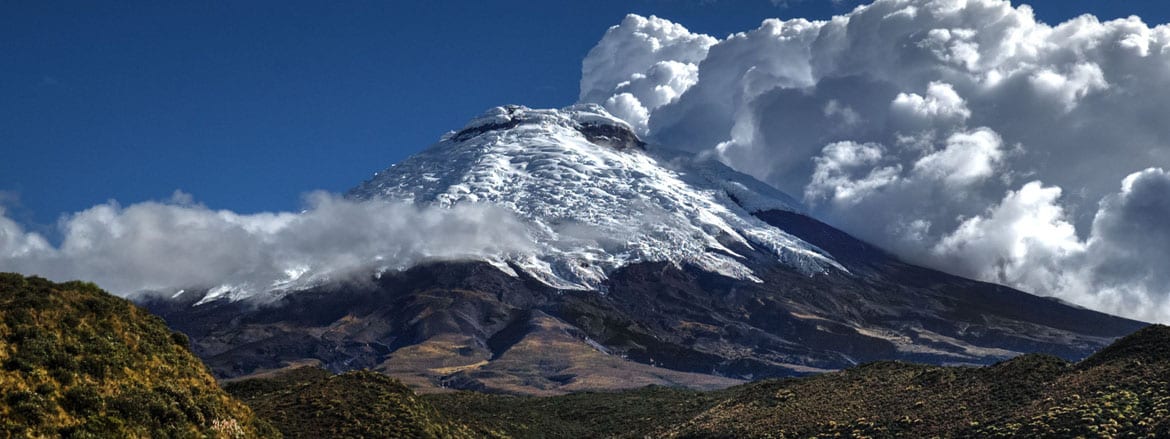
Chimborazo Climbing Guide: Routes, Refuges, Season, Difficulty and Verified Reviews
Chimborazo, at about 6,263 m, is Ecuador's highest mountain, and because of the Earth's equatorial bulge its summit is the point on the Earth's surface farthest from the planet's centre. Most climbers leave the Whymper refuge (about 5,000 m) around 11 pm or midnight for a long summit night of 8 to 10 hours up, over rock and scree to El Castillo and then a long glacier slope to the Veintimilla summit and on to the higher Whymper summit. It is harder and longer than Cotopaxi or Cayambe, with rockfall danger low on the route, and climbers usually attempt it at the end of a one- to two-week Ecuador programme. The best months are often December to January and June to August. On ExpedReview, as of 23 October 2026, 1 operator has a verified client review for Chimborazo: Kobler & Partner, based in Switzerland (5.0★ from 1 review, January 2020). Below are the review, routes, season, difficulty and how to choose an operator.
Chimborazo: key facts | | | |---|---| | Elevation | About 6,263 m (ExpedReview's place data lists 6,268 m) | | Location | Western Cordillera, Chimborazo Fauna Production Reserve, near Riobamba, Ecuador | | Type | Inactive glaciated stratovolcano | | First ascent | 4 January 1880: Edward Whymper with Jean-Antoine and Louis Carrel | | Summits | Whymper (main) and Veintimilla (slightly lower), plus Politécnica and Nicolás Martínez | | Bases | Carrel refuge (about 4,850 m) and Whymper refuge (about 5,000 m) | | Summit day | About 8–10 hours up, 3–5 hours down | | Season | Best December–January and June–August | | Operators reviewed on ExpedReview | 1, with 1 verified review (as of 23 Oct 2026) |
Chimborazo operators with verified reviews
ExpedReview ranks operators by their verified client reviews for each place: the star rating, adjusted so one or two reviews, or only old ones, count for less than many recent ones. Every review is checked by hand before it is published, and operators cannot pay to appear or rank higher. Data as of 23 October 2026.
| Rank | Operator | Based in | Rating here | Reviews | Latest review | Guide-listed price |
|---|---|---|---|---|---|---|
| 1 | Kobler & Partner | Switzerland | 5.0★ | 1 | January 2020 | No recent price listed |
AAI (American Alpine Institute), Climbing The Seven Summits and Adventure Consultants also run trips to Chimborazo but have no reviews for it on ExpedReview yet.
What clients say
Kobler & Partner. A January 2020 review calls the trip "a fantastic mountain experience" and "without any doubt the best so far" of the reviewer's expeditions with different operators. The reviewer praises a varied programme with mountains and some culture, an "excellent acclimatisation strategy", plenty of food and drink, comfortable huts, tents, hotels and homestays, and easy logistics. The team had an Austrian mountain guide, Andreas Neuschmid, and two local Ecuadorian guides from the partner Andean Summit Adventure, climbing in rope teams of one guide and two clients, which "allowed for optimal security and support". The reviewer felt the higher cost compared with other operators was worth it. This is a single, older review, so ask any operator for recent references.
Why climb Chimborazo?
Chimborazo is the highest mountain in Ecuador and a big step up from the country's other volcanoes. Its unique claim, as the farthest point from the Earth's centre, about 2 km farther than Everest's summit, draws climbers from around the world. It is a serious, high glacier climb, and a good preparation for Aconcagua, Denali or Himalayan peaks.
History
Chimborazo was once thought to be the highest mountain in the world. In 1802, the Prussian naturalist Alexander von Humboldt, with Aimé Bonpland and Carlos Montúfar, climbed to about 5,875 m before turning back, a height record at the time. His descriptions of its vegetation zones helped found the science of biogeography. In 1880, Edward Whymper, who had made the first ascent of the Matterhorn, reached the summit with the Italian guides Jean-Antoine and Louis Carrel, and later climbed it again with two Ecuadorians to prove his ascent. The refuges are named after Whymper and the Carrels.
The normal route
Getting to the refuges
From Riobamba, a drive of about one to one and a half hours takes you to the Carrel refuge at about 4,850 m. From there, a walk of about 45 minutes leads to the Whymper refuge at about 5,000 m, the base for most summit attempts. Many teams sleep at the Whymper refuge or a high camp nearby.
Summit night
Teams leave late at night. The route first climbs scree and rock to the rocky outcrop known as El Castillo, then continues onto the glacier, where climbers rope up and put on crampons. A long, steep glacier slope, often hard ice or deep snow, leads to the Veintimilla summit. From there, a walk of about 30 to 60 minutes across a slight dip leads to the higher Whymper summit. Climbers try to start down early, before the sun softens the snow and increases rockfall danger lower on the route.
Season and weather
Chimborazo is in the drier western range, but the weather is unpredictable. Many guides prefer December to January and June to August. Winds can be very strong, especially from July to September, and temperatures fall well below freezing at night.
Difficulty
Chimborazo is technically moderate but very demanding. The summit night is long, the glacier slopes are steep and often icy, and altitude above 6,000 m makes everything harder. Rockfall in the lower section has increased as glaciers retreat, and some routes have changed. You need to be fit, acclimatised and comfortable on steep snow and ice with crampons and an ice axe.
Guide rules
Ecuador's rules require climbers on its main glaciated peaks in protected areas to be accompanied by a licensed mountain guide. Ask your operator to confirm the current rules and that its guides are certified by ASEGUIM, the Ecuadorian mountain guide association.
Choosing an operator
- Check guide certification and the rope team ratio, ideally one guide to two clients.
- Ask about acclimatisation, usually including Cotopaxi or Cayambe first.
- Ask about the route and turnaround times.
- Ask what is included, such as transfers, refuges, meals and gear rental.
- Read recent reviews.
See our Ecuador guide, Cotopaxi guide and Cayambe guide.
Farthest from the centre of the Earth
The Earth is not a perfect sphere: it bulges at the equator, so the radius there is about 21 km greater than at the poles. Chimborazo sits just over 1° south of the equator, so although its summit is more than 2,500 m lower than Everest's above sea level, it is about 2 km farther from the Earth's centre. That makes it the closest point on Earth to the stars, and the point on land where you are farthest from the centre of the planet.
Acclimatisation
Chimborazo is usually the last and highest climb of an Ecuador programme. Most climbers spend at least ten days acclimatising first, with hikes around Quito and Otavalo, then climbs of peaks such as Rumiñahui, Illiniza Norte, Cayambe and Cotopaxi. Climbing Cotopaxi or Cayambe first also lets guides check your crampon technique and stamina on a long summit night. Attempting Chimborazo without good acclimatisation is a common cause of failure and altitude sickness.
Dangers on Chimborazo
- Rockfall. As glaciers have retreated, loose rock lower on the route has become more dangerous, especially when it warms in the morning. This is one reason teams start early and aim to be off the lower slopes before the sun hits them.
- Avalanches on the steep glacier slopes, especially after fresh snow.
- Crevasses, particularly near the summit plateau.
- Altitude illness, as the summit is well above 6,000 m.
- Cold and wind. Wind chill on the upper mountain can be severe.
- Exhaustion. The summit night is long, and many accidents happen on the descent.
Training and experience
Chimborazo suits climbers who already have experience on glaciers and steep snow, ideally including another 5,000 m+ peak such as Cotopaxi or Cayambe. Train for months, with long hill days carrying a pack, stair and step work, and strength and core training. Practise using crampons and an ice axe on steep ground, and make sure you are comfortable on a rope team.
Gear
You will need:
- Insulated or double mountaineering boots
- Crampons, an ice axe, a harness and a helmet
- Warm layers, a down jacket and waterproof shells
- Insulated gloves and mitts, a warm hat and a balaclava
- A headlamp with spare batteries
- Glacier glasses, goggles and high-factor sun cream
- A sleeping bag for the refuge
Operators in Quito and Riobamba often rent technical gear.
Sample programme
- Arrive in Quito.
- Acclimatisation in Quito.
- Hike Rucu Pichincha.
- Hike near Otavalo.
- Climb Cayambe or Illiniza Norte.
- Rest at a lodge.
- Climb Cotopaxi.
- Rest day.
- Drive to Riobamba and the Chimborazo refuges.
- Summit night on Chimborazo.
- Spare day for weather.
- Return to Quito.
The Chimborazo reserve and the last ice merchant
Chimborazo sits in the Chimborazo Fauna Production Reserve, where vicuñas, reintroduced to Ecuador in the late 1980s, graze on the high páramo. Local Puruhá and Kichwa communities live on the lower slopes. For centuries, ice merchants, or hieleros, cut blocks of glacier ice from Chimborazo and carried them down by mule to sell in local markets. Baltazar Ushca, widely known as the last ice merchant of Chimborazo, became famous for continuing this tradition into old age.
Who Chimborazo suits
Chimborazo suits experienced trekkers and climbers who have already climbed a glaciated peak above 5,000 m and are looking for a serious challenge. It is a good preparation for Aconcagua, Denali or a Himalayan 7,000 m peak. If you have not yet been on a glacier, start with Cotopaxi or Cayambe.
Cost
ExpedReview has no recent guide-listed price for Chimborazo. Costs vary a lot depending on whether you join a multi-peak programme with an international operator, which typically includes guides, transport, hotels and lodges, refuges and most meals, or book a short climb with a local agency once you are already acclimatised. Ask exactly what is included, especially the guide-to-client ratio, refuge nights, park fees, transport and gear rental, and whether a spare weather day is built in.
Riobamba
Riobamba, about 30 km south-east of the mountain, is the usual base for Chimborazo climbs. It has hotels, restaurants and a busy Saturday market, and was Ecuador's first capital, where the country's first constitution was signed in 1830. The city sits at about 2,750 m, so it is a comfortable place to rest between climbs, and on clear mornings Chimborazo, Tungurahua, El Altar and Carihuairazo are all visible from its streets and viewpoints.
Summit-day tips
Eat and drink well the afternoon before, and try to rest even if you cannot sleep. Keep a thermos of hot drink and easy snacks in an inside pocket so they do not freeze. Keep your pace slow and steady, as the climb to the Veintimilla summit is long and steady effort works better than bursts. Agree on a turnaround time with your guide before you leave, and stick to it. Save energy for the descent, which is steep and tiring on tired legs, and where many slips happen.
Frequently asked questions
How hard is Chimborazo?
It is technically moderate but very demanding, with a long summit night, steep glacier slopes and altitude above 6,000 m.
How long does it take to climb Chimborazo?
About 8 to 10 hours up from the Whymper refuge and 3 to 5 hours down.
When is the best time to climb Chimborazo?
December to January and June to August are usually best.
Do I need a guide to climb Chimborazo?
Yes. Ecuador requires climbers on its main glaciated peaks to go with a licensed guide.
Which operators have verified reviews for Chimborazo?
As of 23 October 2026, Kobler & Partner (5.0★ from 1 review).
Why is Chimborazo the farthest point from the Earth's centre?
Because the Earth bulges at the equator. Chimborazo is near the equator, so its summit is about 2 km farther from the centre than Everest's.
What is the difference between the Veintimilla and Whymper summits?
The Veintimilla summit is slightly lower. The Whymper summit is the true high point, about 30 to 60 minutes beyond it.
Where do Chimborazo climbs start?
From the Whymper refuge at about 5,000 m, near Riobamba.
Is Chimborazo harder than Cotopaxi?
Yes. Chimborazo is higher, its summit night is longer, and it has more rockfall and steeper glacier slopes.
Who first climbed Chimborazo?
Edward Whymper, with Jean-Antoine and Louis Carrel, on 4 January 1880.
How high is the Whymper refuge?
About 5,000 m, a short walk above the Carrel refuge.
Can operators pay to rank higher on ExpedReview?
No. Operators cannot pay to appear, rank higher or have reviews removed.
Related articles
- How to choose a guide
- Best operators
- Ecuador Climbing Guides: Verified Reviews for Cotopaxi, Chimborazo and Cayambe
Climbing Ecuador's volcanoes: operators ranked by verified ExpedReview client reviews for Cotopaxi, Cayambe, Chimborazo and Rumiñahui, the main peaks, acclimatisation, season, volcanic activity, guides, cost and how to choose an operator.