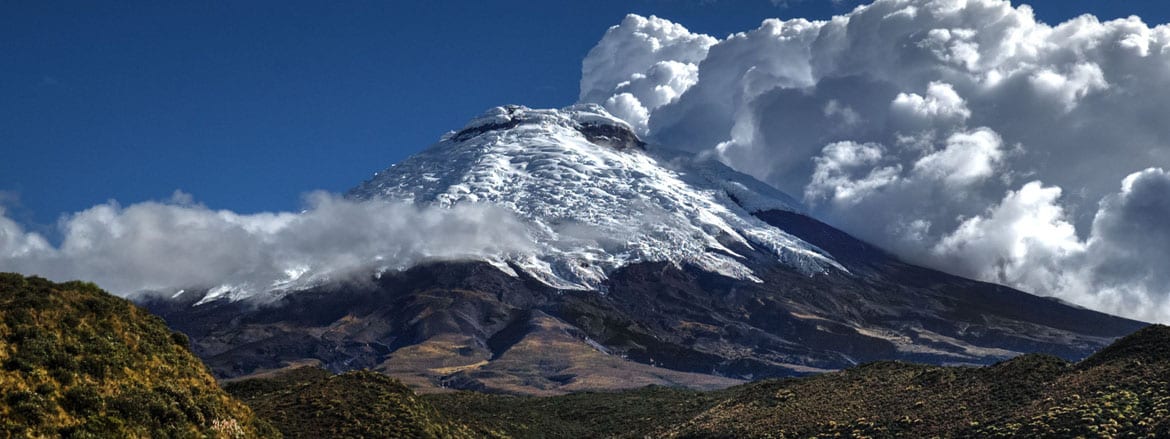
Cotopaxi Climbing Guide: Route, José Rivas Refuge, Season, Volcanic Activity and Verified Reviews
Cotopaxi (5,897 m), about 50 km south of Quito, is Ecuador's second-highest mountain and one of the highest active volcanoes in the world. Climbers stay at the José Rivas refuge at about 4,864 m and leave around midnight for a summit climb of about 5 to 7 hours on a glacier, with crevasses and a few steeper sections, reaching the rim of the summit crater at dawn. It is one of the most popular high glacier climbs in South America and is a good first 5,000 m+ glacier peak for fit beginners who acclimatise well and climb with a guide. It can be climbed all year, with December to February and June to August often best. Volcanic activity has closed the summit at times, most recently after eruptions in 2015 and activity in 2022 and 2023, so always check current status. On ExpedReview, as of 23 October 2026, 3 operators have 4 verified client reviews for Cotopaxi: Summit Stoke, based in Ecuador (5.0★ from 2, latest February 2026), Ian Taylor Trekking (5.0★ from 1, July 2024) and Climbing The Seven Summits (5.0★ from 1, October 2022, from US$4,995). Below are the reviews, the route, season, difficulty and how to choose an operator.
Cotopaxi: key facts | | | |---|---| | Elevation | 5,897 m (19,347 ft) | | Location | Cotopaxi National Park, about 50 km south of Quito | | Type | Active stratovolcano | | First ascent | 28 November 1872: Wilhelm Reiss and Ángel Escobar | | Base | José Rivas refuge, about 4,864 m | | Summit day | About 5–7 hours up, 2–3 hours down | | Season | All year; December–February and June–August often best | | Operators reviewed on ExpedReview | 3, with 4 verified reviews (as of 23 Oct 2026) |
Cotopaxi operators with verified reviews
ExpedReview ranks operators by their verified client reviews for each place: the star rating, adjusted so one or two reviews, or only old ones, count for less than many recent ones. Every review is checked by hand before it is published, and operators cannot pay to appear or rank higher. Prices are set by the operators themselves. Data as of 23 October 2026.
| Rank | Operator | Based in | Rating here | Reviews | Latest review | Guide-listed price |
|---|---|---|---|---|---|---|
| 1 | Summit Stoke | Ecuador | 5.0★ | 2 | February 2026 | No recent price listed |
| 2 | Ian Taylor Trekking | United States | 5.0★ | 1 | July 2024 | No recent price listed |
| 3 | Climbing The Seven Summits | United States | 5.0★ | 1 | October 2022 | From US$4,995 (updated December 2025) |
What clients say
Summit Stoke. Two reviews from February 2026 describe beginner programmes. One client describes "a very well-organised and seriously extraordinary multi week beginner expedition" in June 2025, with guides who were "knowledgable, fun, friendly and very professional" and strong communication from the first info meeting with the owners. Another came "with almost no prior experience", felt safe on every climb, learned a lot and praises a programme with "a great balance between training, climbing, and recovery".
Ian Taylor Trekking. A July 2024 review praises the hotels, particularly Cotopaxipungo, and a highly experienced guide who kept the reviewer motivated through acclimatisation hikes before the night climb to the summit.
Climbing The Seven Summits. An October 2022 review describes a last-minute programme with a glacier course and a summit of Cotopaxi and nearby mountains, praising the coordination by Caroline in the office and guide Edgar, "one of the most talented and genuine guides I have worked with during my seven years of mountaineering". The reviewer calls the summit "challenging".
Why climb Cotopaxi?
Cotopaxi's almost perfect snow cone is one of the most famous sights in the Andes. It is high, accessible and not very technical, with a refuge reached by road, so it is one of the best places in the world for a first big glacier climb. Reaching the crater rim at sunrise, with steam rising from the crater and views of Chimborazo, Antisana and Cayambe, is unforgettable. Many climbers use Cotopaxi to prepare for Aconcagua, Denali or Himalayan peaks.
History and volcanic activity
The German geologist Wilhelm Reiss and the Colombian Ángel Escobar made the first ascent on 28 November 1872. Cotopaxi has erupted many times, and major eruptions in 1744, 1768 and 1877 sent huge mudflows (lahars) down the valleys, causing great destruction. In 2015, renewed eruptions closed the mountain to climbers until 2017. In 2022 and 2023, increased activity led the authorities to close the summit again for periods, while lower areas of the park stayed open. Ecuador's Instituto Geofísico monitors the volcano, and access rules can change quickly.
The normal route
Getting to the refuge
From Quito, drive about two hours south to Cotopaxi National Park, then up a dirt road to a car park at about 4,600 m. From there, a steep walk of about 45 minutes to an hour on volcanic sand leads to the José Rivas refuge at about 4,864 m.
Summit night
Teams usually leave around midnight. Above the refuge, the route climbs scree and sand to the glacier at about 5,000 m, where climbers rope up and put on crampons. The route then climbs the glacier, winding between crevasses and seracs, with some short, steep sections of 35 to 40 degrees. Near the top, it passes the Yanasacha rock wall and reaches the crater rim. The crater is about 800 m across, and you can sometimes see fumaroles inside. The descent follows the same route.
Season and weather
Cotopaxi can be climbed all year. December to February and June to August are often the most stable, though June to August can be windy. Weather can change quickly, with snow, wind and whiteouts.
Difficulty
Cotopaxi is a non-technical glacier climb, but it is still serious. Most climbers find the altitude the hardest part. You need to be fit, acclimatised and comfortable walking in crampons and using an ice axe. Total summit night is often 8 to 10 hours.
Guide rules
Ecuador's rules require climbers on its main glaciated volcanoes within national parks to be accompanied by a licensed mountain guide. Ask your operator to confirm the current rules and that its guides are certified by ASEGUIM, the Ecuadorian mountain guide association.
Choosing an operator
- Check the volcano's current status and the operator's plan if the summit is closed.
- Check guide certification and the guide-to-client ratio, usually one to two.
- Ask about acclimatisation and spare days.
- Ask what is included, such as transfers, refuge nights, meals and gear rental.
- Read recent reviews.
See our Ecuador guide and Cayambe guide.
Acclimatisation
Good acclimatisation is the key to success on Cotopaxi. Climbers who arrive in Quito and try the summit within a few days are far more likely to struggle or turn back. A typical programme spends at least five to seven days acclimatising first, with hikes such as Rucu Pichincha (about 4,700 m) above Quito, the Fuya Fuya peaks near Otavalo, Pasochoa, or Rumiñahui and Illiniza Norte, which are close to Cotopaxi. Many programmes also climb Cayambe or another glaciated peak first. Nights at highland haciendas and lodges near the park, such as those the reviewers mention, help too.
Dangers on Cotopaxi
- Altitude illness. This is the most common problem. Ascend gradually and descend if symptoms become serious.
- Crevasses and seracs. The glacier changes from year to year, with crevasses opening and snow bridges weakening. Rope teams and guides who know current conditions are essential.
- Weather. Strong winds, snowstorms and whiteouts can arrive quickly.
- Volcanic activity. Ash emissions and gas can close the summit or the whole park. Follow official closures.
- Cold. Temperatures near the summit can fall to −10 °C or lower, especially with wind.
Training and experience
Cotopaxi is a realistic goal for fit beginners with a good guide, as the Summit Stoke reviewers show. You should be able to walk uphill for many hours and be comfortable with discomfort, cold and lack of sleep. Many programmes include a day of glacier training, covering cramponing, ice axe use, roped travel and self-arrest. Train for months with long hill walks carrying a pack, stair work and strength training. Previous experience at altitude, for example on a trek above 4,000 m, is very helpful.
Gear
You will need:
- Mountaineering boots compatible with crampons
- Crampons, an ice axe, a harness and a helmet
- Warm layers, a down jacket and waterproof shells
- Insulated gloves and mitts, a warm hat and a balaclava
- A headlamp with spare batteries
- Glacier glasses, goggles and high-factor sun cream
- A sleeping bag for the refuge
Many operators in Quito rent technical gear.
Cotopaxi National Park
Cotopaxi National Park covers high páramo grassland around the volcano, with the Limpiopungo lagoon, wild horses, Andean foxes and sometimes Andean condors. Many climbers stay at lodges or haciendas on the edges of the park before going to the refuge, and the park also offers mountain biking, horse riding and hikes around the lagoon. The park can be busy with day visitors at weekends, so expect traffic on the road to the car park.
Sample programme
- Arrive in Quito.
- Acclimatisation in Quito and a city tour.
- Hike Rucu Pichincha.
- Hike Fuya Fuya or another peak near Otavalo.
- Climb a glaciated peak such as Cayambe, or an Illiniza peak.
- Rest at a lodge near Cotopaxi National Park.
- Glacier training and a move to the José Rivas refuge.
- Summit night on Cotopaxi, then return to Quito.
- Spare day for weather.
Cost
On ExpedReview, Climbing The Seven Summits lists its Ecuador programme from US$4,995. Multi-week programmes usually include guides, transport, hotels and lodges, refuge nights and most meals. Shorter local trips that climb only Cotopaxi cost much less, but you must arrive already acclimatised.
Who Cotopaxi suits
Cotopaxi suits fit trekkers looking for their first glacier climb, and climbers preparing for bigger mountains. It is a good way to find out how you cope with altitude above 5,500 m. If you have no glacier experience, choose a programme with training days and a good guide ratio, and be ready to turn back if your guide decides conditions or your health are not right.
The José Rivas refuge
The José Rivas refuge, at about 4,864 m on the volcano's northern slope, is the base for almost all summit attempts. It has dormitories, a dining room and a kitchen. Climbers usually arrive in the afternoon, eat an early dinner and try to sleep for a few hours before leaving around midnight. Even if you do not summit, the walk up from the car park to the refuge is a popular hike for day visitors.
Quito and travel in Ecuador
Quito, at about 2,850 m, has an international airport and a UNESCO-listed colonial centre, and is a good place to start acclimatising. The US dollar is Ecuador's currency. Most visitors can enter without a visa for short stays, but check the rules for your passport. Petty crime is a risk in cities, so follow local advice and use registered taxis or your operator's transport.
Cotopaxi and the Avenue of the Volcanoes
Cotopaxi lies on the Avenue of the Volcanoes, the name Alexander von Humboldt is credited with giving the valley between Ecuador's two Andean ranges. Nearby peaks include Rumiñahui, the Illinizas, Antisana and, further south, Chimborazo.
Frequently asked questions
How hard is Cotopaxi?
It is a non-technical glacier climb, but altitude, cold and a long summit night make it demanding.
How long does it take to climb Cotopaxi?
About 5 to 7 hours up from the José Rivas refuge and 2 to 3 hours down.
When is the best time to climb Cotopaxi?
All year, though December to February and June to August are often best.
Is Cotopaxi open for climbing?
It depends on volcanic activity. Check current status with your operator before booking.
Which operators have verified reviews for Cotopaxi?
As of 23 October 2026, Summit Stoke (5.0★ from 2), Ian Taylor Trekking (5.0★ from 1) and Climbing The Seven Summits (5.0★ from 1).
Do I need a guide to climb Cotopaxi?
Yes. Ecuador requires climbers on its main glaciated volcanoes to go with a licensed guide.
Can beginners climb Cotopaxi?
Yes, fit beginners can climb it with a certified guide, good acclimatisation and some glacier training.
Is Cotopaxi harder than Cayambe?
Most climbers find Cotopaxi a little easier than Cayambe, which has more crevasses and worse weather, though Cotopaxi is higher.
Who first climbed Cotopaxi?
Wilhelm Reiss and Ángel Escobar, on 28 November 1872.
How high is the José Rivas refuge?
About 4,864 m. It is about a 45-minute to one-hour walk from the car park at about 4,600 m.
Can operators pay to rank higher on ExpedReview?
No. Operators cannot pay to appear, rank higher or have reviews removed.
Related articles
- How to choose a guide
- Best operators
- Ecuador Climbing Guides: Verified Reviews for Cotopaxi, Chimborazo and Cayambe
Climbing Ecuador's volcanoes: operators ranked by verified ExpedReview client reviews for Cotopaxi, Cayambe, Chimborazo and Rumiñahui, the main peaks, acclimatisation, season, volcanic activity, guides, cost and how to choose an operator.