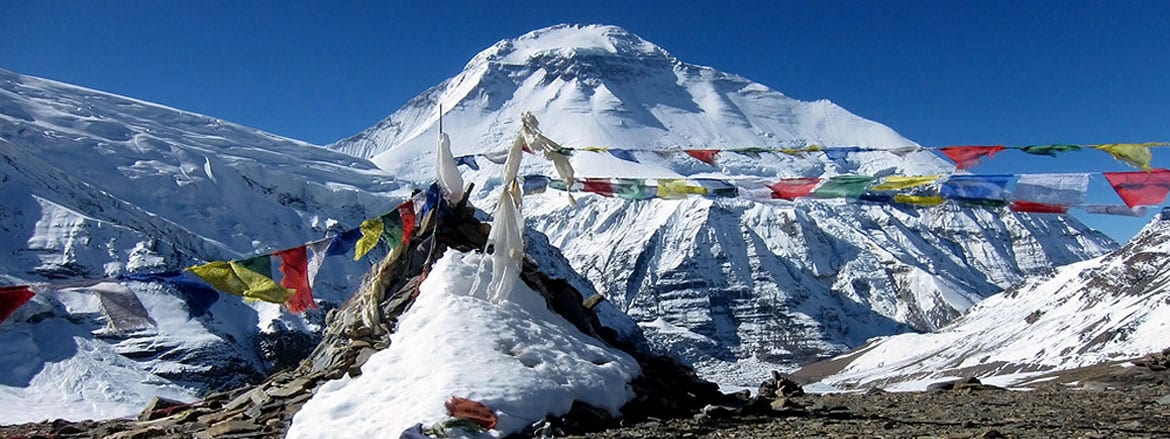
Dhaulagiri I Guides: Verified Reviews, Normal Route, Season and How to Climb the 7th Highest Mountain
Dhaulagiri I, at 8,167 m (26,795 ft), is the seventh highest mountain in the world and the highest peak entirely within Nepal's Dhaulagiri Himal. It rises above the Kali Gandaki gorge in west-central Nepal, and its name means "white mountain" in Sanskrit. The normal route climbs the north-east ridge from a base camp on the Chhonbardan Glacier, reached by helicopter or by a hard trek over French Pass. It is one of the more serious 8,000 m peaks, with significant avalanche risk, unstable weather and lower summit rates than Manaslu or Cho Oyu, and expeditions take about six to seven weeks in spring (April to May) or autumn (September to October). On ExpedReview, as of 23 October 2026, 3 operators have 6 verified client reviews for Dhaulagiri I. Ranked first is The Mountain Company (4.8★ from 4 reviews, latest June 2021), followed by Pioneer Adventure (5.0★ from 1 review, latest November 2021) and Seven Summit Treks (5.0★ from 1 review, latest October 2019). Below are the rankings, then a full guide to climbing and trekking on Dhaulagiri.
Dhaulagiri I: key facts | | | |---|---| | Height | 8,167 m (26,795 ft) | | Location | Dhaulagiri Himal, Myagdi district, west-central Nepal | | Rank | Seventh highest mountain in the world | | First ascent | 13 May 1960, Swiss-Austrian expedition (Kurt Diemberger, Peter Diener, Ernst Forrer, Albin Schelbert, Nawang Dorje and Nima Dorje) | | Normal route | North-east ridge from the Chhonbardan Glacier | | Seasons | Spring (April to May) and autumn (September to October) | | Expedition length | About 6 to 7 weeks | | Trek | Dhaulagiri Circuit over French Pass (about 5,360 m) and Dhampus Pass (about 5,240 m) | | Operators reviewed on ExpedReview | 3, with 6 verified reviews (as of 23 Oct 2026) |
Dhaulagiri I guides ranked by verified reviews
Rankings use each operator's verified ExpedReview client reviews for Dhaulagiri I: the star rating, adjusted so that one or two reviews, or only old ones, count for less than many recent ones. Every review is checked by hand before it is published, and operators cannot pay for a better position. Data as of 23 October 2026.
| Rank | Operator | Based in | Rating here | Reviews | Latest review |
|---|---|---|---|---|---|
| 1 | The Mountain Company | United Kingdom | 4.8★ | 4 | June 2021 |
| 2 | Pioneer Adventure | Nepal | 5.0★ | 1 | November 2021 |
| 3 | Seven Summit Treks | Nepal | 5.0★ | 1 | October 2019 |
None listed a recent price at the time of writing.
What clients say
It is important to read these reviews carefully, because they cover two different trips. The four Mountain Company reviews describe a trek around Dhaulagiri, over French Pass and through the Hidden Valley, not an ascent of the mountain. Reviewers praised the planning, extra acclimatisation days, a rest day in the Hidden Valley, strong local staff and good food, and one described it as their first guided Himalayan trek. The Pioneer Adventure review (November 2021) describes a Dhaulagiri expedition without supplementary oxygen and praises a professional, honest Sherpa team. The Seven Summit Treks review (October 2019) describes an expedition leader focused on getting members to the summit. All reviews are at least four years old, so ask any operator for recent references.
Why Dhaulagiri?
Dhaulagiri is a mountain for experienced high-altitude climbers who want a big, remote and less crowded 8,000 m peak. It sees a fraction of the traffic of Everest or Manaslu, its base camp is wild and isolated, and the views over the Kali Gandaki to the Annapurnas are among the best in the Himalaya. When it was first measured from the plains of India in the early 19th century, it was briefly believed to be the highest mountain in the world, until Kangchenjunga and later Everest were measured higher.
It is also a hard and dangerous mountain. The weather is often unstable, with heavy snowfall and high winds, and the route has significant avalanche exposure. Dhaulagiri has one of the higher fatality rates among the 8,000ers, and many expeditions go home without a summit. It is not a peak for a first 8,000 m attempt.
History
The mountain was surveyed in 1808 and attempted several times in the 1950s by Swiss, Argentine and German-Swiss teams, all of which failed. In 1960 a Swiss-Austrian expedition led by Max Eiselin made the first ascent via the north-east ridge, supported by a Pilatus Porter aircraft named "Yeti" that ferried loads to the north-east col, an early and famous use of an aircraft to support a Himalayan expedition. The plane later crash-landed on the mountain, and the crew walked out. On 13 May 1960 Kurt Diemberger, Peter Diener, Ernst Forrer, Albin Schelbert, Nawang Dorje and Nima Dorje reached the summit. In 1969 an American expedition on the south-east ridge lost seven members in an avalanche, one of the worst accidents of the era. Since then climbers have opened routes on all sides, but almost every commercial expedition now uses the north-east ridge.
The normal route
Base camp, at about 4,700 m, sits on the Chhonbardan Glacier below the north face. From there the route climbs a long, crevassed glacier valley, exposed to avalanches from the slopes above, to Camp 1 near the north-east col at about 5,700 to 5,900 m. This section is the most dangerous part of the climb. Camp 2, at about 6,400 to 6,600 m, and Camp 3, at about 7,200 to 7,400 m, sit on the broad north-east ridge, and the summit push climbs snow and rock along the ridge and a final traverse and gully to the top. Ropes are fixed on much of the route each season by the main operators' Sherpa teams. The upper ridge can be very windy, and route-finding near the top is difficult in poor visibility.
Most climbers use supplementary oxygen from Camp 3. Climbing without oxygen is possible, as the Pioneer Adventure reviewer did, but it is much harder and riskier.
Getting to base camp
There are two ways to reach base camp. Most commercial expeditions now fly by helicopter from Pokhara or Kathmandu to base camp or to a landing spot nearby, which saves about a week but means you need to acclimatise carefully on arrival, often with a rotation to a nearby peak or a pre-acclimatisation climb elsewhere. The traditional approach is a trek of about a week up the Myagdi Khola from Darbang, through forest and gorges to Italian Base Camp, then up the glacier to Dhaulagiri Base Camp. The trek is beautiful but rough, with some exposed sections, and is much less developed than the Everest or Annapurna trails.
The Dhaulagiri Circuit trek
Trekkers can see the mountain on the Dhaulagiri Circuit, one of the most demanding treks in Nepal. It follows the Myagdi valley to Italian Base Camp and Dhaulagiri Base Camp, crosses French Pass, at about 5,360 m, into the Hidden Valley, a high, wild basin between Dhaulagiri and Tukuche Peak, and then crosses Dhampus Pass, at about 5,240 m, before descending to Marpha or Jomsom in the Kali Gandaki. It takes about two to three weeks. It is a camping trek, with no teahouses above the lower villages, and it involves glacier walking and high passes that can be snowbound. It is a serious undertaking, best done with an experienced operator. The Mountain Company's reviews above describe this trek.
Season
Dhaulagiri is climbed in both spring and autumn. In spring, from about mid-April to late May, teams aim for a summit window in mid or late May, before the monsoon. In autumn, from about September to mid-October, teams aim for a window in late September or early October, after the monsoon. Both seasons see heavy snowfall at times, and conditions on the lower route vary greatly from year to year. Good operators include plenty of spare days.
Requirements and preparation
Climbers on Dhaulagiri should already have at least one 8,000 m peak, ideally Manaslu or Cho Oyu, as well as experience on technical terrain at altitude. You need to be comfortable on fixed ropes with an ascender and abseiling, on steep snow and ice, and in a high-altitude camp in a storm. A year or more of structured training is essential. Our articles on training for mountaineering, the effects of the death zone on the body and acute mountain sickness will help you prepare.
A typical expedition timeline
Most Dhaulagiri expeditions follow a similar shape. The first few days are spent in Kathmandu on permits, briefings and gear checks. Teams then fly by helicopter or begin the trek in, and those who fly usually spend several days at or near base camp adjusting before doing any climbing. The first rotation typically goes to Camp 1 to sleep and return, timed for cold, early starts through the avalanche-prone glacier valley. A second rotation goes to Camp 2, and sometimes touches Camp 3, before a return to base camp to rest. Then comes the wait for a summit window, which can last a week or more on Dhaulagiri, followed by a four- to five-day push to the summit and back. With travel, contingency days and the walk or flight out, the whole trip takes six to seven weeks. Shorter itineraries exist, built around pre-acclimatisation at home or on another peak, but on a mountain with weather as unsettled as Dhaulagiri's, time is one of the most valuable safety margins you can buy.
Dhaulagiri compared with other 8,000ers
Climbers often ask how Dhaulagiri compares with the more popular 8,000 m peaks. Compared with Manaslu, it is a little higher, far less crowded and more serious, with a more dangerous lower section and a harder summit day. Compared with Cho Oyu, often considered the most straightforward 8,000er, it is much more committing and has lower success rates. Compared with Everest, it is lower and needs less oxygen, but has thinner infrastructure, fewer teams to share the work of fixing ropes and breaking trail, and a more remote setting for rescue. Many climbers see it as a good choice for a second or third 8,000 m peak, after Manaslu or Cho Oyu and before the harder peaks such as Annapurna I, Kangchenjunga or K2. Our article on the true summits of the 8,000ers also covers Dhaulagiri's sometimes confusing summit area, where some climbers have stopped short of the highest point in poor visibility.
Permits and cost
Climbers need a Nepal climbing permit for Dhaulagiri, issued through a registered agency by the Department of Tourism, plus any local area fees. Royalty fees for non-Everest 8,000 m peaks are lower in autumn than in spring, and Nepal revised its fees from September 2025. Total costs depend on the operator's model, helicopter use, the Sherpa-to-client ratio and the oxygen allowance. Ask for a full breakdown.
Risks and how operators manage them
The main hazards are avalanches between base camp and Camp 1, serac fall, crevasses, storms on the upper ridge and altitude illness. Good operators manage them with conservative scheduling through the avalanche zone, starting early when the snow is firm, strong Sherpa support, enough oxygen, firm turnaround times and a clear plan for helicopter rescue. Ask every operator about these points and about their recent record on the mountain.
How to choose a Dhaulagiri operator
Few operators run Dhaulagiri each season, so check what the operator's experience on this specific mountain is. Ask about the leader's previous Dhaulagiri expeditions, the Sherpa-to-client ratio, the oxygen plan, the helicopter and acclimatisation plan, spare days and the turnaround policy. Read the reviews above with care, since some describe the trek. For other options in the area, see our Dhaulagiri region page, the Dhaulagiri VII (Putha Hiunchuli) page and our Dolpo trek guide. If this is your first 8,000er, look at Manaslu first.
Frequently asked questions
How high is Dhaulagiri I?
Dhaulagiri I is 8,167 m (26,795 ft) high, the seventh highest mountain in the world.
When was Dhaulagiri first climbed?
On 13 May 1960, by a Swiss-Austrian expedition via the north-east ridge.
How hard is Dhaulagiri?
It is one of the more serious 8,000 m peaks, with avalanche risk on the lower route, unstable weather and difficult route-finding near the top. It is not suitable for a first 8,000 m peak.
When is the best time to climb Dhaulagiri?
Spring, with summits in mid to late May, and autumn, with summits in late September or early October.
Can you trek around Dhaulagiri?
Yes. The Dhaulagiri Circuit crosses French Pass and Dhampus Pass and takes about two to three weeks. It is a demanding camping trek.
Which operator is ranked first for Dhaulagiri I on ExpedReview?
As of 23 October 2026, The Mountain Company is ranked first, with 4.8★ from 4 verified reviews, the latest from June 2021. Those reviews are for the trek around the mountain.
Related articles
- How to choose a guide
- Best operators
- Dhaulagiri & Dolpo Guides: Verified Reviews, Expeditions and Treks
Dhaulagiri I (8,167 m), Putha Hiunchuli, the Dhaulagiri Circuit and Dolpo: operators ranked by verified ExpedReview client reviews, plus routes, permits, seasons, skills and how to choose a guide.