Dhaulagiri & Dolpo Guides: Verified Reviews, Expeditions and Treks
By Blake Penson, Founder of ExpedReview · Everest summiter · Seven Summits climber · 20-year mountaineer · Industry expert
The Dhaulagiri region of west-central Nepal covers Dhaulagiri I (8,167 m), the seventh-highest mountain in the world, the 7,000 m trekking peak of Putha Hiunchuli (Dhaulagiri VII), the tough Dhaulagiri Circuit trek over French Pass, and the remote Tibetan-Buddhist region of Dolpo to the north-west. It is one of the quietest and wildest corners of the Nepal Himalaya. On ExpedReview, as of 23 October 2026, 4 operators have 11 verified client reviews across 3 places in the region. Ranked first is The Mountain Company (4.9★ from 8 reviews, latest June 2021), followed by Furtenbach Adventures (5.0★ from 1 review, March 2026), Pioneer Adventure (5.0★ from 1 review, November 2021) and Seven Summit Treks (5.0★ from 1 review, October 2019). Below are the ranking, the main objectives and how to choose a guide.
Dhaulagiri & Dolpo: key facts | | | |---|---| | Highest peak | Dhaulagiri I, 8,167 m (7th highest in the world) | | First ascent | 13 May 1960, Swiss–Austrian expedition | | Other objectives | Putha Hiunchuli (Dhaulagiri VII, about 7,246 m); Dhaulagiri Circuit trek; Upper and Lower Dolpo treks | | Gateways | Pokhara, Beni and Darbang (circuit); Juphal airstrip (Dolpo) | | Seasons | Spring (April–May) for Dhaulagiri I; autumn (September–November) for treks and Putha Hiunchuli | | Operators reviewed on ExpedReview | 4, with 11 verified reviews (as of 23 Oct 2026) |
Dhaulagiri & Dolpo operators ranked by verified reviews
Rankings use each operator's verified ExpedReview client reviews in this region: the star rating, adjusted so that one or two reviews, or only old ones, count for less than many recent ones. Every review is checked by hand before it is published, and operators cannot pay for a better position. Data as of 23 October 2026.
| Rank | Operator | Based in | Rating here | Reviews | Latest review | Reviewed for |
|---|---|---|---|---|---|---|
| 1 | The Mountain Company | United Kingdom | 4.9★ | 8 | June 2021 | Dhaulagiri I (4), Dolpo (4) |
| 2 | Furtenbach Adventures | Austria | 5.0★ | 1 | March 2026 | Putha Hiunchuli (1) |
| 3 | Pioneer Adventure | Nepal | 5.0★ | 1 | November 2021 | Dhaulagiri I (1) |
| 4 | Seven Summit Treks | Nepal (unclaimed profile) | 5.0★ | 1 | October 2019 | Dhaulagiri I (1) |
Read the place labels with care. The four Mountain Company reviews filed under Dhaulagiri I describe the Dhaulagiri Circuit trek, with French Pass and the Hidden Valley, not an expedition to the 8,000 m summit. They are good evidence of how the company runs the circuit, but not of 8,000 m climbing.
What clients say
The Mountain Company has eight reviews, all written in May and June 2021. On the Dhaulagiri Circuit, clients praise extra acclimatisation days, a rest day in the Hidden Valley, clear pre-trip information and a strong emphasis on wellbeing and safety. One review gives 4.4★, noting that the food was ample but inevitably basic. On Upper Dolpo, four clients describe a superbly organised camping trek through very remote country, including Phoksundo Lake, monasteries and villages that see little tourism, and one joined a longer Upper Dolpo to Mustang section of the Great Himalaya Trail.
Furtenbach Adventures has one short review from March 2026 for Putha Hiunchuli, describing a perfectly organised expedition with an excellent Sherpa team and naming the lead Sherpa. For more on that peak see our Putha Hiunchuli guide.
Pioneer Adventure has one review from November 2021 by a client who climbed Dhaulagiri I without supplementary oxygen and praises the professionalism and kindness of the Sherpa team.
Seven Summit Treks has one five-star review from October 2019 for Dhaulagiri I.
Most of these reviews are four to five years old, and only one is from the last 24 months. Ask each company what it has run recently and how many clients reached the top.
Dhaulagiri I
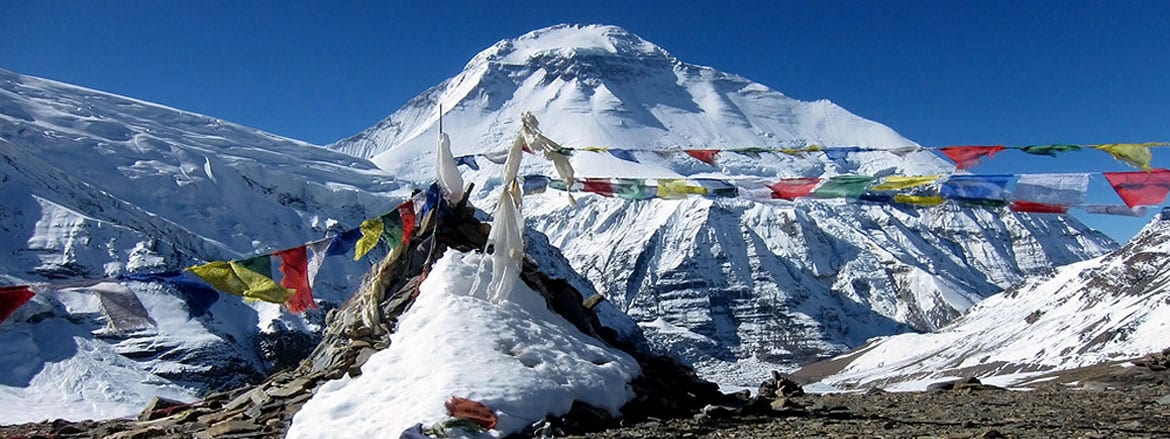
Dhaulagiri means "white mountain" in Sanskrit, and from the south it rises in a single sweep of nearly 7,000 m above the Kali Gandaki gorge, which separates it from Annapurna. For about thirty years after Western surveyors measured it in 1808, it was thought to be the highest mountain in the world. It was the last of the 8,000 m peaks in Nepal to be climbed: on 13 May 1960 a Swiss–Austrian expedition put Kurt Diemberger, Peter Diener, Ernst Forrer, Albin Schelbert and Sherpas Nawang Dorje and Nima Dorje on the summit by the north-east ridge, supported by a small aircraft that flew loads to the north-east col.
The north-east ridge is still the normal route. Most commercial expeditions reach base camp at about 4,700 m on the Chhonbarban Glacier, either by trekking in over French Pass or by helicopter, and place camps on the north-east col and the ridge above. The upper mountain is exposed to strong winds, and the lower route has avalanche and serac hazard. Dhaulagiri I has a higher fatality rate than Everest, Cho Oyu or Manaslu, and it is an objective for experienced 8,000 m climbers, not a first big peak.
Putha Hiunchuli (Dhaulagiri VII)
At about 7,246 m, Putha Hiunchuli is the most westerly major peak of the Dhaulagiri massif and one of the more accessible 7,000 m peaks in Nepal. Its normal route is a long glacier climb with little technical difficulty, which makes it a popular step between a 6,000 m trekking peak and a first 8,000 m peak. Most expeditions approach from Dolpo, flying to Juphal.
The Dhaulagiri Circuit trek
The Dhaulagiri Circuit is one of the hardest trekking routes in Nepal. It starts near Beni or Darbang in the Myagdi valley, follows the Myagdi Khola up through farmland and forest, then climbs onto the moraine and ice of the Chhonbarban Glacier to Dhaulagiri base camp. From there it crosses French Pass (about 5,360 m) into the high, empty Hidden Valley and then Dhampus Pass (about 5,240 m) before descending to Marpha or Tukuche in the Kali Gandaki valley. The usual length is 14 to 18 days, mostly camping, and some sections cross glacier and steep, unstable moraine. It is a trek for experienced trekkers who are comfortable with camping, glacier travel and being days from help.
Dolpo
Dolpo lies north-west of Dhaulagiri, behind the main Himalayan range on the edge of the Tibetan Plateau. Much of it is protected in Shey Phoksundo National Park, Nepal's largest national park, which holds the deep turquoise Phoksundo Lake at about 3,600 m. Dolpo's villages keep Tibetan Buddhist and Bon traditions, and the region became widely known through Peter Matthiessen's book The Snow Leopard and the film Himalaya.
Lower Dolpo treks, which reach Phoksundo Lake, take around 10 to 14 days and are less restricted. Upper Dolpo, which includes Shey Gompa and the high passes beyond the lake, is a restricted area with a higher permit fee and usually needs three weeks or more. Both are camping treks with long days above 4,000 m.
Permits
Requirements depend on the objective. Your operator should arrange them:
- Dhaulagiri I and Putha Hiunchuli: a climbing permit from Nepal's Department of Tourism, plus a liaison officer and the usual expedition fees and garbage deposit.
- Dhaulagiri Circuit: Annapurna Conservation Area Permit for the eastern section, plus local area fees; ask your operator for the current list.
- Dolpo: Shey Phoksundo National Park entry, and a restricted-area permit for Upper Dolpo or Lower Dolpo. Restricted areas require a licensed guide arranged through a registered agency; since March 2026 solo trekkers can get the permit.
Fees change regularly, so ask for the current figures in writing and whether they are included in the price.
Seasons
- Spring (April–May): the main season for Dhaulagiri I expeditions.
- Autumn (September–November): the main season for the circuit trek, Putha Hiunchuli and Lower Dolpo, with clear skies after the monsoon.
- Summer (June–August): Dolpo lies in the rain shadow and is one of the few parts of Nepal where summer trekking is practical, though flights into Juphal are often disrupted.
- Winter: high passes are snowbound; most trips do not run.
How to choose an operator
- Match the operator to the objective. A company with strong trek reviews may not run 8,000 m expeditions, and vice versa. Ask how many times it has run your exact trip.
- For Dhaulagiri I, ask about the team. Ask for the Sherpa-to-client ratio, oxygen supply, and how the route through the avalanche-prone lower sections is managed.
- For the circuit, ask about the glacier and passes. Is there a climbing guide for the glacier section? What happens if French Pass is snowbound?
- Ask about rescue. This is remote country. How would a casualty be evacuated, and does your insurance cover helicopter rescue to the height you will reach?
- Ask about staff welfare. Porters on the circuit cross two passes above 5,000 m; ask how they are equipped and insured.
- Read reviews in full. Check the date and what each reviewer actually did.
Skills and fitness by objective
Dolpo treks. No technical skills, but you need to be fit for many consecutive days of six to eight hours' walking, often above 4,000 m, and comfortable camping for two or three weeks. Previous experience on a long Nepal trek such as the Annapurna Circuit or Everest Base Camp is a good base.
Dhaulagiri Circuit. All of the above, plus the ability to move on steep moraine and glacier, often roped, and to wear crampons. A day of skills practice before French Pass is sensible. If you have never walked on a glacier, take a basic course first.
Putha Hiunchuli. You need real expedition experience: confident use of crampons, ice axe, fixed lines and an ascender, and a good record at altitude on 6,000 m peaks such as Mera Peak or Island Peak. Expect four to five weeks away.
Dhaulagiri I. Previous 8,000 m experience is strongly advised, ideally on a peak such as Manaslu or Cho Oyu, plus solid technical skills on steep snow and ice. Expect six to seven weeks away.
Getting there
The Dhaulagiri Circuit starts with a drive from Pokhara to Beni and on up the Myagdi valley to Darbang or beyond; new roads have shortened the walk-in in recent years. Dolpo is normally reached by flying from Kathmandu or Pokhara to Nepalgunj on the southern plains, then on a small plane to Juphal. Flights into Juphal are short and often delayed by weather, so leave spare days at both ends. Dhaulagiri I expeditions either trek in over French Pass from the Myagdi valley or fly by helicopter to base camp, which saves time but removes much of the acclimatisation of the walk-in.
What it costs
ExpedReview does not hold current prices from the reviewed operators for this region, so ask each one for a written quote. Dhaulagiri I expeditions cost similar amounts to other Nepal 8,000 m peaks, and the price depends heavily on the number of climbing Sherpas, the amount of oxygen and whether helicopters are used. Upper Dolpo is one of the more expensive treks in Nepal because of the restricted-area permit and the length of the camping trip. Compare quotes line by line: permits, flights to Juphal, crew, food, equipment and rescue arrangements should all be clear.
Responsible travel
Dolpo's communities are small and their resources, from firewood to grazing, are limited. Choose operators that use gas or kerosene rather than wood, carry out rubbish and pay and insure their staff properly. Ask before photographing people or entering monasteries, and walk clockwise round chortens and mani walls.
Frequently asked questions
How high is Dhaulagiri?
Dhaulagiri I is 8,167 m, the seventh-highest mountain in the world.
When was Dhaulagiri first climbed?
On 13 May 1960, by a Swiss–Austrian expedition via the north-east ridge.
How hard is the Dhaulagiri Circuit trek?
It is one of Nepal's hardest treks, with glacier travel, two passes above 5,200 m and many nights of camping. It suits experienced trekkers.
What is the difference between Upper and Lower Dolpo?
Lower Dolpo reaches Phoksundo Lake on a shorter, less restricted trek. Upper Dolpo goes further north to Shey Gompa and high passes, needs a costlier restricted-area permit and usually takes three weeks or more.
Which operators are best reviewed in the Dhaulagiri region on ExpedReview?
As of 23 October 2026, The Mountain Company ranks first (4.9★ from 8 reviews), followed by Furtenbach Adventures, Pioneer Adventure and Seven Summit Treks.
Can operators pay to rank higher on ExpedReview?
No. Operators cannot pay to appear, rank higher or have reviews removed.
When is the best time to visit Dolpo?
Autumn, from September to November, is the most popular season. Because Dolpo lies in the rain shadow of the main range, summer trekking is also possible, although flights to Juphal are often disrupted by weather in the monsoon.
Do I need a guide for Dolpo or the Dhaulagiri Circuit?
Yes. Restricted areas such as Upper Dolpo require a licensed guide, and the glacier sections of the circuit should only be crossed with an experienced guide.