Carstensz Pyramid Guides: Verified Reviews, Route, Access, Permits and Cost
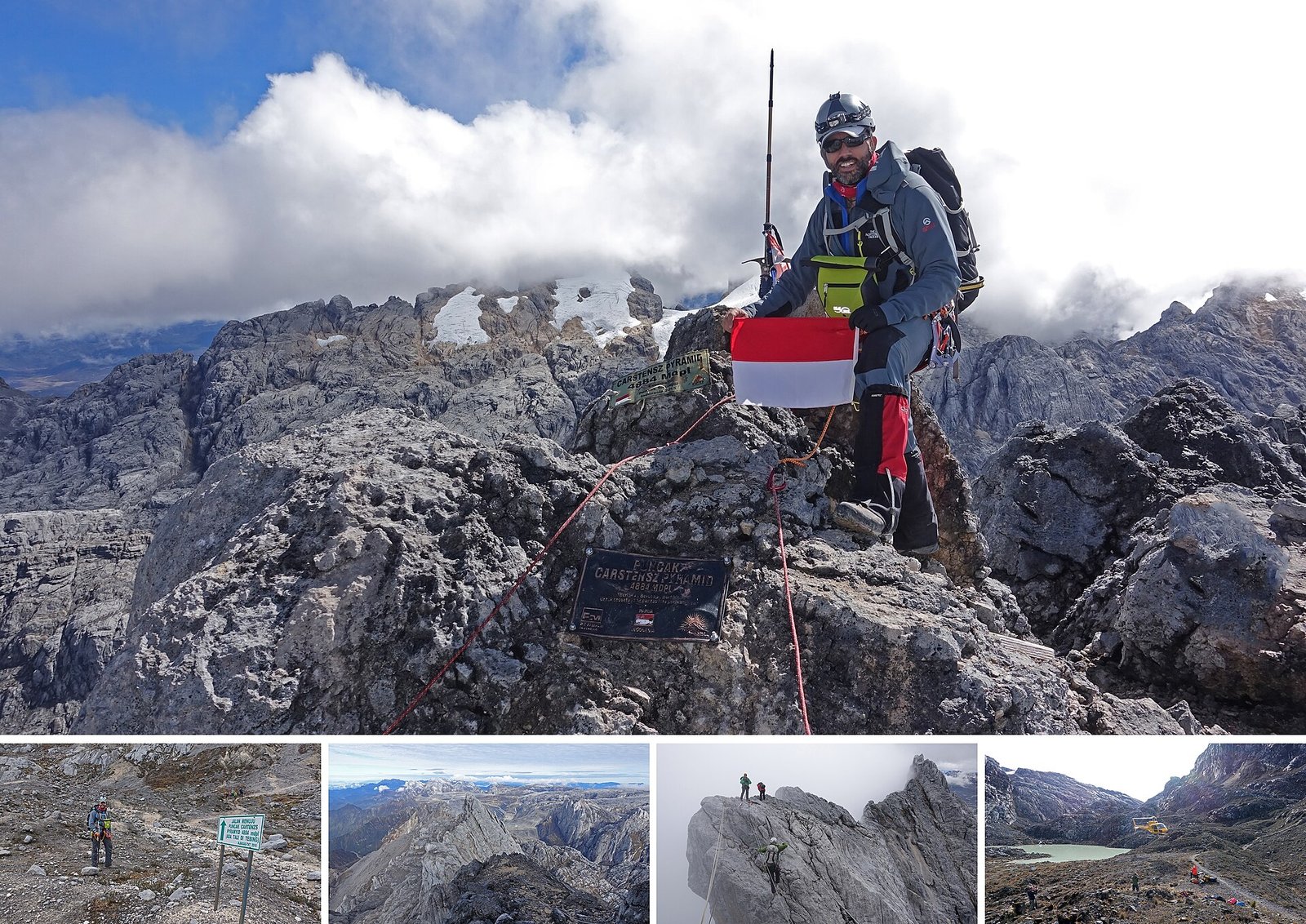
Carstensz Pyramid, or Puncak Jaya, at 4,884 m (16,024 ft), is the highest mountain in Oceania and the highest island peak in the world. It rises in the Sudirman Range of the Indonesian province of Central Papua, on the island of New Guinea, and is the Oceania summit on the Messner list of the Seven Summits. Unlike the other Seven Summits it is a genuine rock climb: the normal route is a day of steep limestone climbing on fixed ropes, with a famous Tyrolean traverse near the top. The hard part is getting there. Access is by helicopter from Timika or a multi-day jungle trek, permits depend on the Indonesian authorities, and the mountain has been closed for long periods; it reopened in 2024 after about five years. Expect an expedition of about 10 to 14 days and costs that are among the highest per day of any of the Seven Summits. On ExpedReview, as of 23 October 2026, 5 operators have 8 verified client reviews. The listed operators are led by Furtenbach Adventures (4.6★ from 3 reviews, latest October 2024) and Adventure Consultants (5.0★ from 1 review, latest March 2026). Below are the rankings, then a full guide to the climb.
Carstensz Pyramid: key facts | | | |---|---| | Height | 4,884 m (16,024 ft) | | Location | Sudirman Range, Central Papua, Indonesia (New Guinea) | | Rank | Highest in Oceania; highest island peak in the world; one of the Seven Summits (Messner list) | | First ascent | 13 February 1962, Heinrich Harrer, Philip Temple, Russell Kippax and Albert Huizenga | | Normal route | North face (Harrer route), rock climbing on fixed ropes with a Tyrolean traverse | | Access | Helicopter from Timika, or jungle trek from Sugapa | | Typical expedition | About 10 to 14 days | | Listed prices on ER | From US$25,811 and from US$26,900 (two operators, 2026) | | Operators reviewed on ExpedReview | 5, with 8 verified reviews (as of 23 Oct 2026) |
Carstensz guides ranked by verified reviews
Rankings use each operator's verified ExpedReview client reviews for Carstensz Pyramid: the star rating, adjusted so that one or two reviews, or only old ones, count for less than many recent ones. Every review is checked by hand before it is published, and operators cannot pay for a better position. Data as of 23 October 2026.
| Rank | Operator | Based in | Rating here | Reviews | Latest review | From price |
|---|---|---|---|---|---|---|
| 1 | Furtenbach Adventures | Austria | 4.6★ | 3 | October 2024 | US$25,811 (June 2026) |
| 2 | Adventure Consultants | New Zealand | 5.0★ | 1 | March 2026 | US$26,900 (January 2026) |
| 3 | Berkat Carstensz Indonesia | Indonesia | 4.2★ | 1 | May 2019 | – |
| 4 | SummitCarstensz | Indonesia | 2.8★ | 2 | September 2025 | – |
One further operator, with a single review from 2019, is not listed here. Prices are starting prices set by the operator, not quotes. Climbing The Seven Summits also runs Carstensz trips but has no reviews here yet.
What clients say
Furtenbach Adventures' three reviews come from its October 2024 expedition, one of the first groups to climb after the mountain reopened following about five years of closure. Reviewers described meeting in Bali, flying to Timika, waiting three nights in a hotel for permission to fly to base camp, and then climbing quickly; one went up and down the route in under five hours, and the whole team summited. The Adventure Consultants reviewer (March 2026) praised the organisation and their guide and combined the climb with a surfing holiday in Bali.
The SummitCarstensz reviews include a 1★ rating from September 2025 by a client who said the company took a large deposit, cancelled the climb a few days before the start date and did not refund the deposit. Delays and cancellations are common on Carstensz, so read every operator's cancellation and refund terms before you pay.
Why climb Carstensz?
Most people climb Carstensz because it is one of the Seven Summits. Reinhold Messner argued that the Oceania summit should be the highest peak on the Australian continental plate, which includes New Guinea, rather than Mount Kosciuszko on the Australian mainland, and most serious Seven Summits climbers now include Carstensz. Our guide to climbing the Seven Summits explains the two lists, and our Kosciuszko page covers the other option.
It is also an extraordinary place. The route runs through a landscape of jagged grey limestone, glacial lakes and rapidly shrinking equatorial glaciers, high above the rainforest. The Puncak Jaya glaciers are among the last tropical glaciers in the world, and they are expected to disappear within years. Nearby is the Grasberg mine, one of the largest gold and copper mines in the world, whose presence has shaped access to the mountain for decades.
The normal route
The normal route, first climbed by Heinrich Harrer's team in 1962, follows the north face and the summit ridge. From base camp at the Lake Valley, at about 4,200 m, climbers start in the dark, scramble to the base of the face and climb steep, rough limestone on fixed ropes with ascenders, gaining several hundred metres. On the ridge, the route crosses a series of gaps, including the famous Tyrolean traverse, where climbers cross a deep notch hanging from a rope, and then climbs and scrambles along the exposed ridge to the summit. The descent is by abseil. Most teams complete the round trip in 10 to 14 hours, although fast, fit teams can be much quicker.
The limestone is sharp and grippy when dry, but very slippery when wet, and rain, sleet or snow is likely most afternoons. Cold, wet ropes and hands make the climbing much harder, so teams start early.
Access: helicopter or jungle
There are two ways to reach base camp. The most common now is a helicopter from Timika, a mining town on the south coast, directly to base camp, a flight of under an hour. It is fast but depends on clear weather and on official permission, and delays of several days are common. The alternative is a trek of about five to seven days from the highland village of Sugapa through dense rainforest, mud and river crossings, with local porters. The trek is a real adventure but harder than the climb for many people, and it depends on local security conditions and agreements with local communities.
A typical helicopter itinerary
Most helicopter-based trips follow a similar pattern, although delays can stretch any of the stages. Climbers meet the team in Bali or Jakarta, then fly to Timika, often via another Indonesian city. In Timika the team checks gear, completes paperwork and waits for permission and a weather window to fly. That wait can be a day or a week; as the October 2024 reviewers found, three nights is not unusual. Once the helicopter lands at base camp, most teams spend a day adjusting to the altitude, checking skills on the lower slabs and preparing the ropes, then make the summit attempt on the next suitable morning. Some teams climb on the day after arrival if they are already acclimatised. After the summit, the team waits for the helicopter out, which can again be held up by cloud, and returns to Timika and Bali. A trip of about ten days is typical, but booking flights home with plenty of margin, or a flexible ticket, is sensible.
The jungle trek option
For climbers who want the full experience, the jungle trek from Sugapa is one of the great approach marches of the world. It passes through the lands of the Moni and Dani peoples, crosses rivers and swamps, climbs through dense, dripping rainforest and finally emerges into the high limestone country below the peak. It is wet, muddy and physically hard, and it depends on agreements with local communities and on the security situation in the highlands. It is not always available, and when it is, it adds about a week and a half to the trip, including the return. Ask your operator whether it is currently running, and why or why not.
Climbing Carstensz on a Seven Summits programme
Carstensz is often the hardest summit to schedule on a Seven Summits programme, because closures, permits and delays are so unpredictable. Many climbers fit it in between the bigger expeditions, using its short length and moderate altitude as a break from high-altitude climbing. It is a good idea to have your rock and rope skills in order well before your trip, ideally with a few days of guided rock climbing and abseiling. Because the altitude is lower than many of the other summits, fitness matters less than technique and comfort on exposed ground.
Permits and security
Climbing Carstensz requires permits from several Indonesian authorities, and only licensed operators can obtain them. The mountain has a long history of closures linked to the mine, local disputes and the armed conflict in parts of Papua, and it was closed for about five years before reopening in 2024. Several governments advise against travel to parts of Papua, so check your government's latest travel advice and your insurance cover before booking. A good operator will explain the current situation honestly and will not take you to the mountain if it is unsafe.
Season
Carstensz lies close to the equator, so there is no strong seasonal variation in temperature, and climbs happen throughout the year. Rain is frequent at any time, and climbs are timed around permits, helicopter availability and operator schedules rather than a fixed season. Expect daytime temperatures near freezing at the summit and heavy rain or snow showers most afternoons. Mornings are usually the clearest part of the day, which is why summit attempts start in the dark and why helicopter flights are usually scheduled early. Fog can roll in quickly, and a team that is slow on the ridge may face a wet, cold descent by abseil in poor visibility.
How hard is Carstensz?
Carstensz is the most technical of the Seven Summits on its normal route. You need to be comfortable climbing steep rock in mountain boots or approach shoes, using an ascender on fixed ropes, abseiling, and crossing the Tyrolean traverse. Most operators expect previous rock climbing experience and will check your skills before the climb. The altitude is moderate, but it can still cause problems for people who fly straight to base camp from sea level. Train for climbing as well as fitness: indoor and outdoor rock climbing, abseiling practice and work on rope techniques will help.
Cost
Carstensz is expensive for its length, because of helicopter costs, permits and security arrangements. On ExpedReview at the time of writing, two operators listed prices: Furtenbach Adventures from US$25,811 (updated June 2026) and Adventure Consultants from US$26,900 (updated January 2026). Ask what is included, especially the helicopter, permits and accommodation in Timika during delays, and what happens to your money if the expedition is cancelled.
Kit
You need a harness, helmet, ascender, belay device, slings and locking carabiners, light mountaineering boots or sturdy approach shoes, gloves with good grip for wet rock and rope, full waterproofs, warm layers, and a sleeping bag for cold, wet nights at base camp. Crampons may be needed if there is fresh snow or ice. Pack for rain at every stage.
A brief history
The peak was named after the Dutch explorer Jan Carstensz, who reported seeing snow on the equator from his ship in 1623 and was ridiculed in Europe for it. Dutch expeditions explored the region in the early 20th century, and in 1936 Colijn, Dozy and Wissel reached the Ngga Pulu snowfield, which was then higher than the rock pyramid. Heinrich Harrer, of Seven Years in Tibet fame, made the first ascent of the Carstensz Pyramid in 1962 with Philip Temple, Russell Kippax and Albert Huizenga. Since the region became part of Indonesia, the peak has been known officially as Puncak Jaya.
How to choose a Carstensz operator
Look for an operator with recent experience on the mountain, a clear permit process and an honest approach to security. Ask how it handles delays and cancellations, whether the helicopter is included, what the refund policy is, how many guides go on the route and what rock climbing skills it expects. Our Oceania region page and how to climb the Seven Summits cover the wider context.
Frequently asked questions
How high is Carstensz Pyramid?
Carstensz Pyramid, or Puncak Jaya, is 4,884 m (16,024 ft) high.
Is Carstensz one of the Seven Summits?
Yes, on the Messner list. The Bass list uses Mount Kosciuszko in Australia instead.
How hard is Carstensz Pyramid?
It is the most technical of the Seven Summits, with steep rock climbing on fixed ropes and a Tyrolean traverse. You need rock climbing and rope skills.
How do you get to Carstensz base camp?
Usually by helicopter from Timika, or by a jungle trek of about five to seven days from Sugapa.
Is Carstensz open to climbers?
It reopened in 2024 after about five years of closure, but access depends on permits and security. Check the current situation with your operator and your government's travel advice.
Which operator is ranked first for Carstensz on ExpedReview?
As of 23 October 2026, Furtenbach Adventures is ranked first, with 4.6★ from 3 verified reviews, the latest from October 2024.
Related articles
- How to choose a guide
- Best operators
- Carstensz Pyramid and Oceania Guides: Verified Reviews for Carstensz and Kosciuszko
Climbing in Oceania: operators ranked by verified ExpedReview client reviews for Carstensz Pyramid and Mount Kosciuszko, the two "Seven Summits" of Oceania, access, permits, season, skills, cost and how to choose an operator.
- Climbing Carstensz Pyramid (2026–27): Access, Permits, Helicopter Route, Difficulty and the Climb
How to climb Carstensz Pyramid (Puncak Jaya, 4,884 m), the Seven Summit of Oceania: current access and the helicopter route from Timika, Lorentz National Park permits (SIMAKSI) and licensed operators, the 2026 season, the route and Tyrolean traverse, skills and gear.