Carstensz Pyramid and Oceania Guides: Verified Reviews for Carstensz and Kosciuszko
By Blake Penson, Founder of ExpedReview · Everest summiter · Seven Summits climber · 20-year mountaineer · Industry expert
Oceania has two Seven Summits, depending on which list you follow: Carstensz Pyramid (Puncak Jaya, 4,884 m) in Indonesian Papua, the highest island peak in the world and a genuine rock climb, on the Messner list; and Mount Kosciuszko (2,228 m) in Australia, an easy walk in summer and a snow climb in winter, on the original Bass list. Many Seven Summits climbers do both. Carstensz is reached by helicopter from Timika or a jungle trek, depends on Indonesian permits, and reopened in 2024 after about five years of closure. On ExpedReview, as of 23 October 2026, 5 operators have 18 verified client reviews in Carstensz and Oceania across 2 places. Ranked first is Climbing The Seven Summits (5.0★ from 11 reviews, latest August 2024, all for Kosciuszko), followed by Furtenbach Adventures (4.6★ from 3 reviews, latest October 2024) and Adventure Consultants (5.0★ from 1 review, latest March 2026), both for Carstensz. Below are the rankings, then a guide to climbing in Oceania.
Oceania: key facts | | | |---|---| | Carstensz Pyramid | 4,884 m, Sudirman Range, Central Papua, Indonesia; first climbed 13 February 1962 | | Mount Kosciuszko | 2,228 m, Snowy Mountains, New South Wales, Australia | | Carstensz access | Helicopter from Timika, or a 5–7 day jungle trek from Sugapa | | Carstensz expedition | About 10–14 days | | Kosciuszko summit walk | About 13 km return from the top of the Thredbo chairlift in summer | | Operators reviewed on ExpedReview | 5, with 18 verified reviews (as of 23 Oct 2026) |
Oceania guides ranked by verified reviews
Rankings use each operator's verified ExpedReview client reviews in Carstensz and Oceania: the star rating, adjusted so that one or two reviews, or only old ones, count for less than many recent ones; ties go to the operator with more reviews. Every review is checked by hand before it is published, critical reviews stay up, and operators cannot pay for a better position. Data as of 23 October 2026.
| Rank | Operator | Based in | Rating here | Reviews | Reviewed for | Latest review |
|---|---|---|---|---|---|---|
| 1 | Climbing The Seven Summits | United States | 5.0★ | 11 | Kosciuszko (11) | August 2024 |
| 2 | Furtenbach Adventures | Austria | 4.6★ | 3 | Carstensz Pyramid (3) | October 2024 |
| 3 | Adventure Consultants | New Zealand | 5.0★ | 1 | Carstensz Pyramid (1) | March 2026 |
| 4 | Berkat Carstensz Indonesia | Indonesia | 4.2★ | 1 | – | May 2019 |
| 5 | SummitCarstensz | – | 2.8★ | 2 | Carstensz Pyramid (2) | September 2025 |
The rankings mix two very different trips. Climbing The Seven Summits' reviews are all for Kosciuszko, while the other four operators are reviewed for Carstensz. On our Carstensz page, Furtenbach Adventures lists Carstensz from US$25,811 (June 2026) and Adventure Consultants from US$26,900 (January 2026).
What clients say
Climbing The Seven Summits' Kosciuszko reviewers mostly took its winter mountaineering course on the Main Range, which the company calls the Australian Alpine Academy. They praised meticulous preparation, detailed gear checks, caring and knowledgeable guides, "delicious mountain meals" and even a surprisingly comfortable backcountry toilet; one said the course had built confidence for an upcoming Nepal expedition, and another that it had "added fuel to an already burning fire". The Carstensz reviews come mostly from 2024, just after the mountain reopened. Furtenbach Adventures' reviewers said they were among the first groups to climb after five years of closure and that the whole team reached the summit; one described flying from Bali to Timika, waiting three nights for the helicopter, then climbing up and down in under six hours with a small team of three. That reviewer criticised the food provided by locals at base camp, noting it was not Furtenbach's, and advised bringing your own, and warned that it rains every day. Adventure Consultants' 2026 reviewer praised the organisation and the guiding. SummitCarstensz's lowest review, from September 2025, says the company took a large deposit, cancelled the climb a few days before the start and would not refund it.
Carstensz Pyramid
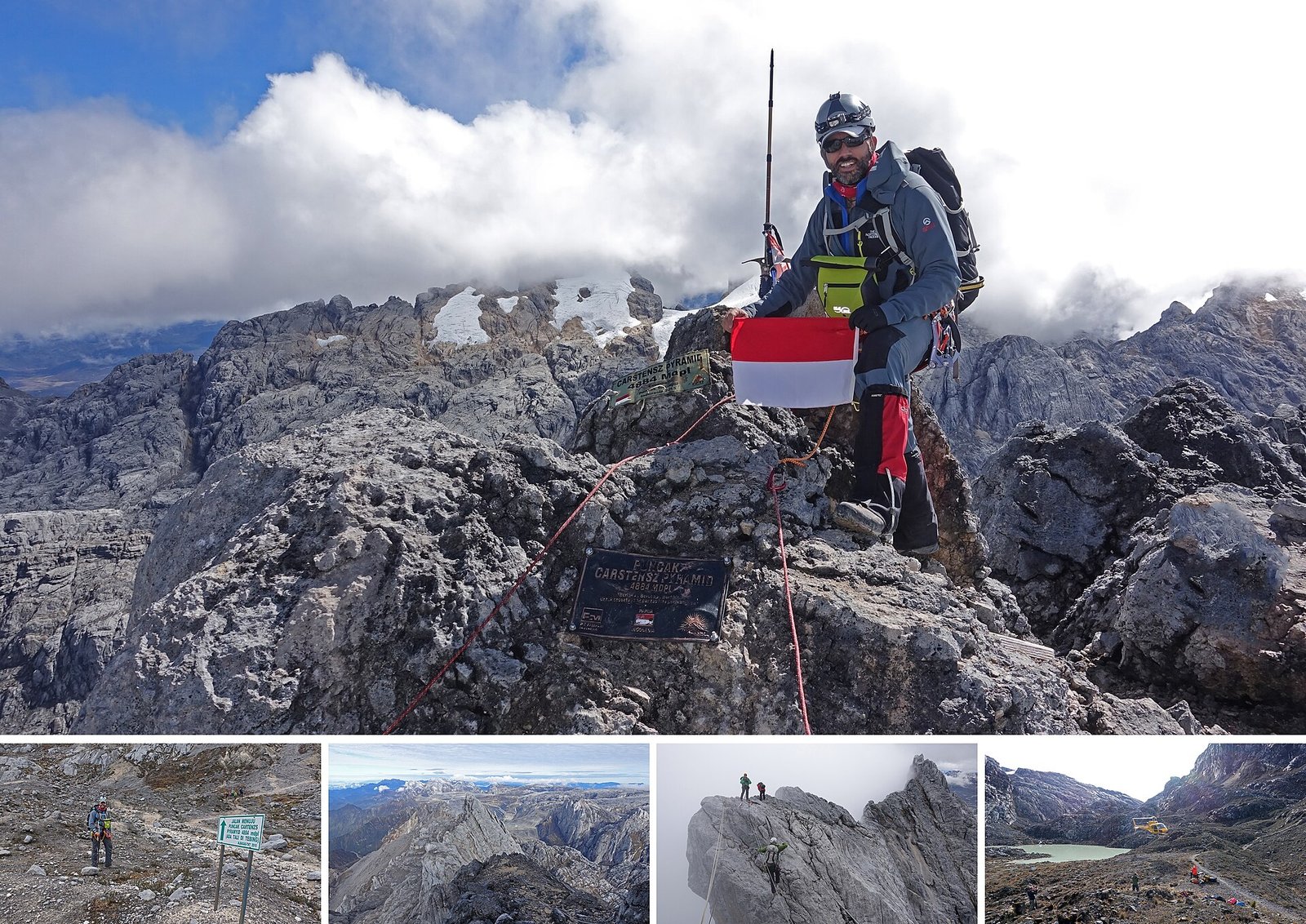
Carstensz Pyramid, or Puncak Jaya, rises from the equatorial glaciers and limestone of the Sudirman Range in Indonesian Papua, on the island of New Guinea. It was first climbed on 13 February 1962 by Heinrich Harrer, Philip Temple, Russell Kippax and Albert Huizenga. Unlike most of the Seven Summits, it is a real rock climb: the normal route follows the north face on steep limestone with fixed ropes, then an exposed summit ridge with a famous Tyrolean traverse across a deep notch. Most climbers reach the summit and return to base camp in one long day, often in rain or cloud.
Access is the hardest part. Most expeditions now fly by helicopter from Timika, a mining town on the south coast, directly to base camp, but flights depend on weather and permits and are often delayed. The alternative is a five- to seven-day trek from the highland village of Sugapa through rainforest, mud and rivers. Nearby is the Grasberg mine, one of the largest gold and copper mines in the world, whose presence has shaped access to the mountain for decades. The region has a history of political unrest, and the mountain has been closed for long periods, most recently for about five years until 2024. Permits and access can change at short notice, so choose an operator with recent experience and clear terms on cancellations and refunds.
Mount Kosciuszko
Mount Kosciuszko, at 2,228 m, is the highest mountain in mainland Australia, in Kosciuszko National Park in New South Wales. It was named by the Polish explorer Paweł Strzelecki in 1840 after the Polish-Lithuanian patriot Tadeusz Kościuszko. In summer, it is an easy walk: from the top of the Kosciuszko Express chairlift at Thredbo, a walk of about 13 km return on a raised steel walkway and track reaches the summit; a longer route starts from Charlotte Pass. In winter, from about June to October, the Main Range is covered in snow and becomes a place for snowshoeing, ski touring and mountaineering courses, with strong winds, whiteouts and cold. Climbing The Seven Summits' winter courses use it to teach skills such as cramponing, self-arrest and snow camping.
Which is the "real" Oceania summit?
When Dick Bass first completed the Seven Summits in 1985, his list included Kosciuszko, the highest point of the Australian continent. Reinhold Messner and others argued that the continent of Australia-Oceania includes New Guinea, so Carstensz Pyramid should be the summit instead. Today most climbers treat Carstensz as the more significant summit, but many do both to be sure. The difference matters in practice: Kosciuszko adds a few days and little risk to a Seven Summits project, while Carstensz adds a technical climb, a remote expedition, a large cost and uncertain access, so plan for it early.
A typical Carstensz expedition
Most helicopter-based Carstensz trips follow a similar pattern, although delays can stretch any stage. Teams usually gather in Bali, then fly to Timika, where they wait in a hotel for permits and a clear weather window for the helicopter. The flight to base camp, at about 4,200 m in the Yellow Valley, takes under an hour, so climbers arrive high without acclimatising, and some operators spend a day or more at base camp before the climb. Summit day starts in the dark, with a scramble to the foot of the north face, then hours of jumaring up fixed ropes on steep, often wet limestone, followed by the exposed ridge, the Tyrolean traverse and the final gaps to the summit. The descent is by abseil, and teams usually return to base camp in the afternoon, ten to fourteen hours after leaving. Many fly out the next day if the weather allows, but waiting days on either side are common, which is why most operators allow 10 to 14 days in total.
Hazards
The main hazards on Carstensz are cold and wet conditions, which can lead to hypothermia, falls on wet rock, rockfall, lightning and the effects of arriving at 4,200 m by helicopter without acclimatisation. Afternoon storms are common, so teams start early. Rescue is difficult and depends on helicopters and weather. On the trek-in route, add the risks of jungle travel, such as injury, illness and river crossings. On Kosciuszko, the summer walk is low-risk, but the weather on the Main Range can change quickly, and in winter, whiteouts, strong winds and cold have caught out walkers and skiers. Carry warm clothing and a map, and check the forecast.
Gear
For Carstensz, you need a climbing harness, helmet, ascender, belay and abseil device, slings and carabiners, rock shoes or stiff approach boots, and good waterproof clothing, plus warm layers and gloves that work on wet ropes. Mountaineering boots are useful for the snowy sections near the top. For the trek, add rubber boots, which are often best in the mud. For a winter Kosciuszko course, operators usually provide technical gear such as crampons, ice axes and snowshoes, but you need warm, windproof clothing.
Beyond Carstensz and Kosciuszko
Oceania has other great mountains. New Zealand's Southern Alps, with Aoraki/Mount Cook (3,724 m), offer serious glacier mountaineering and some of the best alpine courses in the region, and several operators run guided climbs and courses there. Papua New Guinea's Mount Wilhelm (4,509 m) is a popular trek in the highlands. We will add more places to this guide as verified reviews come in.
Responsible travel in Papua
The highlands around Carstensz are home to Papuan communities, including the Moni and Amungme peoples, whose land the routes cross. Expeditions depend on local porters, landowners and permits, and the area's politics are complex. Choose an operator that works fairly with local communities, follows the current rules for access, and is open with you about the security situation and any risks. Check your government's travel advice for Papua before booking.
Getting there
For Carstensz, most climbers fly into Bali's international airport at Denpasar, where many expeditions meet, then take a domestic flight to Timika in Central Papua, often via another Indonesian city. Allow spare days at both ends for delays, and avoid booking non-refundable onward flights too tightly. Some teams combine the expedition with time in Bali afterwards, as one reviewer did with surfing. For Kosciuszko, the nearest towns are Jindabyne and Thredbo, about five to six hours' drive from Sydney or two to three hours from Canberra, where the nearest major airport is. In summer, the Kosciuszko Express chairlift at Thredbo runs daily for walkers, and in winter, access to the Main Range is by skis, snowshoes or the resort lifts, depending on the route. Park entry fees apply to vehicles in Kosciuszko National Park.
Season
Carstensz can be climbed all year, because it is near the equator, but it rains almost every day, so expect wet rock and cloud. Many operators run expeditions in particular windows depending on permits and logistics. Kosciuszko can be walked from about November to May, when the snow has melted; winter courses run from about July to September.
Skills and fitness
For Carstensz, you need rock-climbing experience, ideally on multi-pitch routes, comfort with fixed ropes, ascenders and abseiling in the wet, and good fitness for a long day at nearly 5,000 m. For the trek-in option, add several days of hard jungle walking. For Kosciuszko in summer, you only need to be able to walk about 13 km; winter courses suit fit beginners.
Cost
Carstensz is one of the more expensive Seven Summits for its height, mainly because of the helicopter and permit costs; on ExpedReview, Furtenbach Adventures lists it from US$25,811 and Adventure Consultants from US$26,900. Kosciuszko costs very little to walk in summer; for a guided winter course, Climbing The Seven Summits lists Kosciuszko from US$1,995 (updated March 2026). Check what is included and the cancellation terms.
How to choose an operator
For Carstensz, ask when the operator last ran the expedition, how it handles permits, helicopter delays and closures, who the guides are, what happens to your deposit if the trip is cancelled, and what food is provided at base camp. The SummitCarstensz review shows why refund terms matter. For Kosciuszko, decide whether you want an easy summer walk or a winter course, and check the guides' qualifications.
Frequently asked questions
What is the highest mountain in Oceania?
Carstensz Pyramid (Puncak Jaya, 4,884 m) in Indonesian Papua. Mount Kosciuszko (2,228 m) is the highest in mainland Australia.
Is Carstensz Pyramid open to climbers?
It reopened in 2024 after about five years of closure, but access depends on Indonesian permits and can change at short notice.
How hard is Carstensz Pyramid?
It is a rock climb on fixed ropes with an exposed ridge and a Tyrolean traverse, the most technical of the Seven Summits' normal routes.
How long is the walk up Mount Kosciuszko?
About 13 km return from the top of the Thredbo chairlift in summer.
Which operator is ranked first in Oceania on ExpedReview?
As of 23 October 2026, Climbing The Seven Summits is ranked first, with 5.0★ from 11 verified reviews for Kosciuszko, the latest from August 2024.