Mount Baker Guides: Verified Reviews, Routes, Courses, Season and Cost
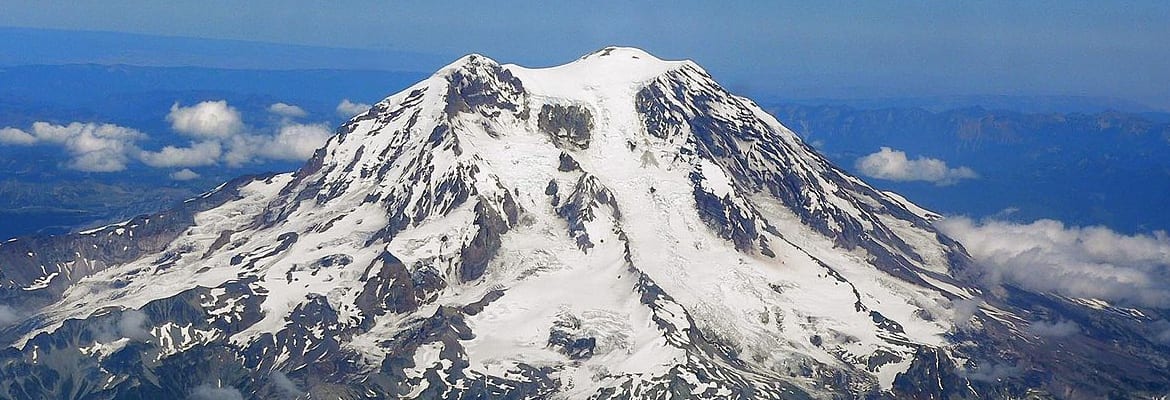
Mount Baker, at 3,286 m (10,781 ft) in Washington's North Cascades, is a glaciated volcano and one of the best first glacier climbs in North America. Most guided climbs take three days, with a hike to a high camp on the glacier, a day of snow and crevasse-rescue training, and a summit day of roughly 1,500 m of ascent by the Easton Glacier on the south side or the Coleman-Deming route on the north-west. Neither route is technically difficult, but both cross crevassed glaciers and steep snow, so you need crampons, an ice axe and a rope team. On ExpedReview, as of 23 October 2026, 2 operators have 21 verified client reviews for Mount Baker: AAI (American Alpine Institute) is ranked first (5.0★ from 14 reviews, latest August 2026), followed by Climbing The Seven Summits (5.0★ from 7 reviews, latest August 2026), which lists climbs from US$1,195 (updated March 2026). Below are the rankings, then everything you need to know to climb Mount Baker.
Mount Baker: key facts | | | |---|---| | Elevation | 3,286 m (10,781 ft) | | Location | North Cascades, Washington, USA | | Type | Glaciated stratovolcano | | First recorded ascent | 1868, by Edmund Coleman, John Tennant, David Ogilvy and Thomas Stratton | | Main routes | Easton Glacier (south), Coleman-Deming (north-west) | | Usual guided climb | 3 days, often with glacier skills training | | Best season | Late May to August | | Operators reviewed on ExpedReview | 2, with 21 verified reviews (as of 23 Oct 2026) |
Mount Baker guides ranked by verified reviews
Rankings use each operator's verified ExpedReview client reviews for Mount Baker: the star rating, adjusted so that one or two reviews, or only old ones, count for less than many recent ones; ties go to the operator with more reviews. Every review is checked by hand before it is published, and operators cannot pay for a better position. Prices are the operators' own starting prices, not quotes. Data as of 23 October 2026.
| Rank | Operator | Based in | Rating here | Reviews | Latest review | From price |
|---|---|---|---|---|---|---|
| 1 | AAI (American Alpine Institute) | United States | 5.0★ | 14 | August 2026 | No recent price listed |
| 2 | Climbing The Seven Summits | United States | 5.0★ | 7 | August 2026 | US$1,195 (updated Mar 2026) |
Both operators have perfect ratings, so the ranking mainly reflects AAI's larger number of reviews. Both are a sound choice; the right one for you depends on dates, group size and whether you want a straight climb or a longer course.
What clients say
The reviews are notably consistent. AAI reviewers who took the three-day Baker climb or longer courses such as Alpinism 1 described patient, knowledgeable guides who were good teachers and managed risk well, and one reviewer said the skills were broken down into an easy-to-follow progression. Several AAI reviews are for courses that include Baker, rather than a summit climb alone, and a few cover avalanche courses that are listed here. Climbing The Seven Summits reviewers were equally positive: one, a self-described "desert rat" who had never used crampons, an ice axe or a rope, said the guides were kind, supportive and patient and made them feel safe on the mountain. All 21 reviews are rated 5.0 for safety.
Why climb Mount Baker?
Mount Baker is often recommended as the best first big glacier climb in the United States. It is lower and shorter than Mount Rainier, at 3,286 m compared to 4,392 m, with less altitude and a shorter summit day, but it is heavily glaciated, so it teaches all the skills you need for bigger mountains: walking in crampons, self-arrest with an ice axe, travelling roped together and crevasse rescue. The North Cascades scenery is spectacular, and from the summit you can see the San Juan Islands, Mount Shuksan, Glacier Peak and Rainier. Many climbers use Baker as preparation for Rainier, Denali or the bigger mountains of the Andes and Himalaya.
The volcano
Mount Baker is an active stratovolcano, the northernmost of the major volcanoes of the US Cascades. Its last significant eruptions were in the mid-19th century, and in 1975 a rise in heat and steam from Sherman Crater, just south of the summit, caused concern but no eruption. Steam vents still smell of sulphur in Sherman Crater, and climbers on the Easton route pass its rim on the way to the summit. Mount Baker carries more glacial ice than any Cascade volcano except Rainier, and the nearby Mt. Baker Ski Area recorded a world-record snowfall of 1,140 inches (about 29 m) in the 1998–99 season, which is why the mountain holds so much snow and ice.
The Easton Glacier route
The Easton Glacier route, on the south side, is the usual route for guided climbs early in the season. It starts at Schreiber's Meadow, at about 1,000 m, and follows a trail through forest and meadows to the moraine of the Easton Glacier, where most parties camp at about 1,800 to 2,000 m. From high camp, the route climbs the broad Easton Glacier, past crevasses that open up as the summer goes on, to the rim of Sherman Crater, then up the steeper Roman Wall to the summit plateau and the true summit, Grant Peak. Summit day involves around 1,300 to 1,500 m of ascent and is long, with most parties starting in the early hours to climb on firm snow.
The Coleman-Deming route
The Coleman-Deming route, on the north-west side, is the route of the first ascent and starts at the Heliotrope Ridge trailhead, at about 1,100 m. The trail climbs to camps near Hogsback, at the edge of the Coleman Glacier, at about 1,800 to 2,100 m. The route then crosses the Coleman Glacier, which is heavily crevassed, to the saddle between Baker and Colfax Peak, and climbs the Deming Glacier and the steep Roman Wall on the north side to the summit plateau. The route is slightly more demanding than the Easton and is popular later in the season.
Difficulty and skills
Both routes are graded as glacier climbs, with snow slopes up to about 35 to 40 degrees on the Roman Wall. You do not need previous experience on a guided climb, as the first two days include training in walking in crampons, self-arrest, roped travel and crevasse rescue, but you do need good fitness. Summit day is around 10 to 12 hours return. The best training is hiking with a heavy pack on steep trails, and building up to days with 1,000 m or more of ascent.
Courses and longer programmes
Many climbers do Baker as part of a course rather than a straight climb. AAI's Alpinism 1 course and other operators' glacier courses spend several days on Baker's glaciers learning crevasse rescue, snow anchors and rope skills before a summit attempt. These are an excellent foundation if you plan to climb bigger mountains, or to climb without a guide later. Several reviews on this page describe such courses.
Typical three-day guided climb
Day one: meet in Bellingham or at the trailhead, check gear and hike to high camp, which takes four to six hours with a heavy pack. Day two: snow school on the glacier, practising crampon technique, self-arrest, roped travel and crevasse rescue, with an early night. Day three: an alpine start, typically around midnight to 2 a.m., climb to the summit, return to camp, pack up and descend to the trailhead.
Best time to climb
The main season runs from late May to August. Early in the season the glaciers are well covered with snow, and the Easton is the usual route; as summer goes on, crevasses open and the routes become more complex. By late August and September, the glaciers can be broken and icy. The North Cascades weather is changeable, and summit attempts can be cancelled because of storms or poor visibility. Because the mountain stands close to the Pacific, moist air from the ocean brings heavy cloud and precipitation, and a clear forecast in Seattle does not always mean a clear day on the summit. Guides watch the forecasts closely and often build a spare half-day into the plan, or adjust the timing of the summit attempt, to make the most of weather windows. Even in midsummer, temperatures at the summit can fall well below freezing at night, and the wind on the summit plateau can be strong, so bring warm layers as well as sun protection.
Permits and access
Mount Baker lies in the Mount Baker Wilderness of the Mount Baker-Snoqualmie National Forest. Unlike Rainier, there is no climbing fee for Baker, but parking at the trailheads requires a recreation pass, and climbers should register and follow wilderness rules, including packing out human waste in the waste bags that are provided or required in some areas. Guided parties operate under Forest Service permits, which is one reason to check that your operator is authorised to guide on the mountain.
Cost
Climbing The Seven Summits lists Baker climbs from US$1,195 (updated March 2026); AAI has no recent price on ExpedReview. Prices vary with the length of the programme and the client-to-guide ratio. Check whether the price includes group equipment, rental gear, food on the mountain and transport.
Getting there
Fly into Seattle-Tacoma International Airport. The trailheads are about two and a half hours' drive north, and Bellingham is the nearest town. Many guides meet in Bellingham or Sedro-Woolley, and some offer transport from Seattle.
Gear
You need mountaineering boots that take crampons, crampons, an ice axe, a harness, a helmet, a warm sleeping bag, a waterproof shell, insulated layers, gloves, glacier glasses and sun cream. Most guides rent technical equipment. The snow reflects strong sunlight, so protect your skin and eyes.
How to choose a guide
Check that your operator is permitted to guide on Mount Baker, ask about the client-to-guide ratio on summit day, how much training is included, and the route they plan to use. Read the reviews above, and our Cascades page for other climbs in the range, such as Mount Shuksan and Forbidden Peak.
History
The Lummi people know the mountain as Kulshan. The name Mount Baker comes from Lieutenant Joseph Baker, who saw it from Vancouver's expedition in 1792. The first recorded ascent was in August 1868, by the English-born artist and climber Edmund Coleman with John Tennant, David Ogilvy and Thomas Stratton, after several earlier attempts by Coleman. Their route, up the north-west side, gave its name to the Coleman Glacier and, with the Deming Glacier, the Coleman-Deming route. In the early 20th century, the mountain was the scene of the Mount Baker Marathon, a race from Bellingham to the summit and back, run from 1911 to 1913 and stopped after a racer fell into a crevasse, though he survived.
Hazards
Mount Baker is not technically difficult, but it is still a serious mountain. Crevasses are the main hazard, especially late in the season, when snow bridges weaken. Avalanches occur on the steeper slopes, including the Roman Wall, especially after fresh snow or in warm conditions, and there have been several fatal accidents on Baker over the years. Whiteouts are common, and the broad glaciers are easy to get lost on in poor visibility; several accidents have involved parties that lost the route on descent. Sulphur gases can collect in Sherman Crater, so do not linger in its lowest parts. Guided parties manage these risks by roping together, choosing routes and timing carefully, and turning back when conditions are poor.
After Mount Baker
Baker is a stepping stone. Many climbers go on to Mount Rainier, which is higher, longer and more serious, or to more technical Cascade climbs such as Mount Shuksan's Fisher Chimneys. Others use the skills they learn on Baker for high-altitude expeditions, such as Aconcagua, the volcanoes of Mexico and Ecuador, or Denali, which needs strong glacier skills, sled-hauling and camping on snow; see our Alaska page for more on Denali.
Frequently asked questions
How hard is Mount Baker to climb?
It is a non-technical glacier climb but requires good fitness, crampon and ice-axe skills and roped glacier travel. Guided climbs include the training you need.
How long does it take to climb Mount Baker?
Most guided climbs take three days, including a day of glacier training. Summit day is usually 10 to 12 hours.
Is Mount Baker harder than Rainier?
No. Baker is lower and shorter, with less altitude and a shorter summit day, which is why many climbers do it first.
What is the best route for a first climb?
The Easton Glacier, on the south side, is the usual route for guided climbs, especially early in the season.
Which operator is ranked first for Mount Baker on ExpedReview?
As of 23 October 2026, AAI (American Alpine Institute) is ranked first, with 5.0★ from 14 verified reviews, the latest from August 2026.
Related articles
- How to choose a guide
- Best operators
- Cascades Climbing Guides: Verified Reviews for Mount Baker and Mount Shuksan
Climbing in the North Cascades: operators ranked by verified ExpedReview client reviews for Mount Baker and Mount Shuksan, the main peaks and routes, glacier courses, season, permits, skills, cost and how to choose an operator.