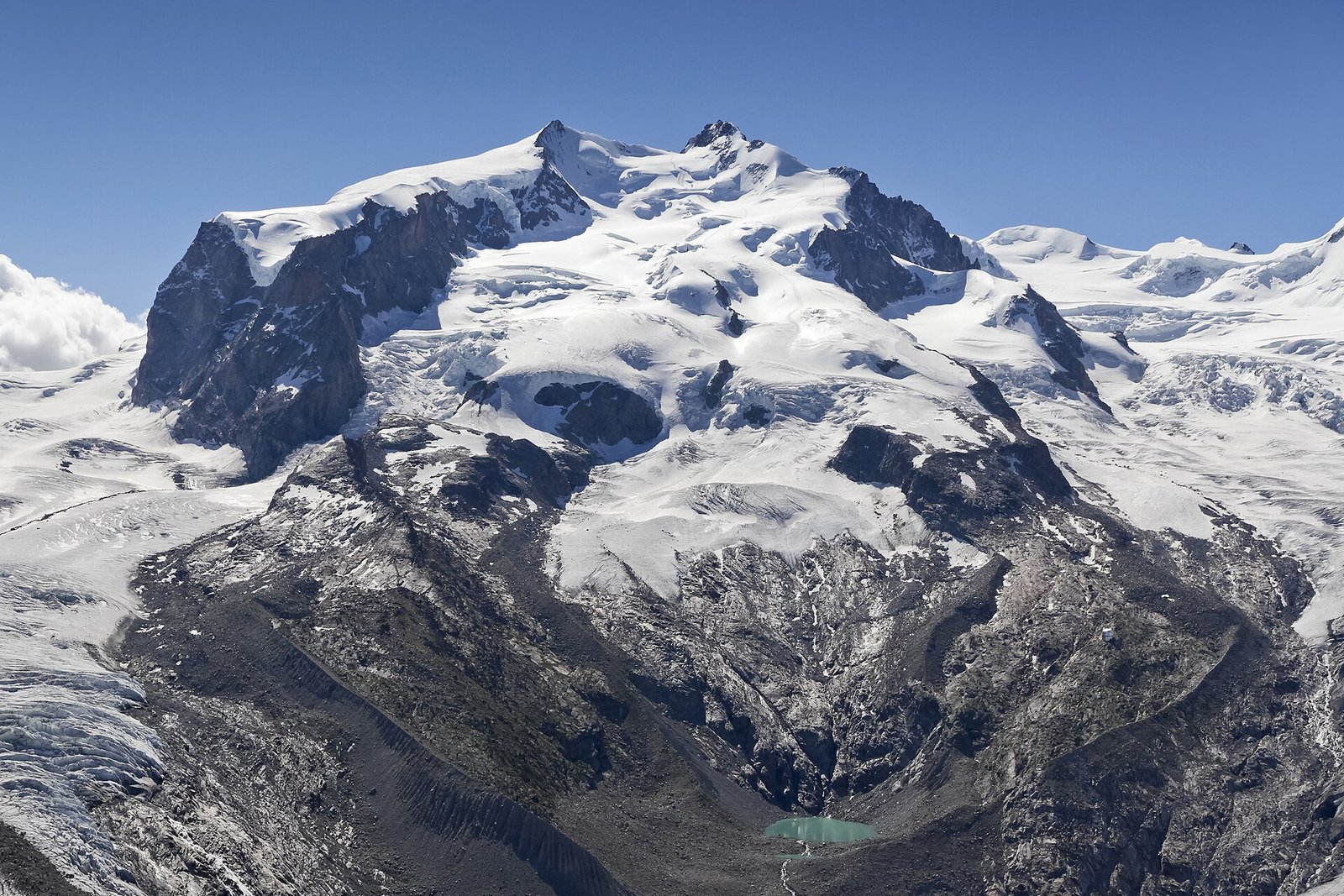
Monte Rosa Guides: Verified Reviews, Expedition Training, Dufourspitze and Gnifetti Routes
Monte Rosa is a huge glaciated massif on the border of Switzerland and Italy, with a dozen or more summits above 4,000 m. Its highest point, the Dufourspitze (4,634 m), is the highest mountain in Switzerland and the second highest in the Alps after Mont Blanc. The massif is climbed from Zermatt on the Swiss side, where the Dufourspitze normal route starts at the Monte Rosa hut, and from Alagna, Gressoney and Champoluc on the Italian side, where lifts give quick access to peaks such as Punta Gnifetti and its Margherita hut, the highest building in Europe. Its high glaciers and huts also make it one of the best places in the Alps to train for bigger expeditions. On ExpedReview, as of 23 October 2026, one operator has 7 verified client reviews for Monte Rosa: Furtenbach Adventures (4.9★, latest March 2026), whose reviews are for expedition training courses, from US$2,101 (updated June 2026). SummitGuides also runs trips here but has no reviews for Monte Rosa yet. Below are the rankings, then a guide to climbing and training on Monte Rosa.
Monte Rosa: key facts | | | |---|---| | Highest point | Dufourspitze, 4,634 m (15,203 ft) | | Location | Pennine Alps, Switzerland–Italy border | | First ascent of the Dufourspitze | 1 August 1855 | | Main bases | Zermatt (Switzerland); Alagna Valsesia, Gressoney, Champoluc (Italy) | | Classic routes | Dufourspitze from the Monte Rosa hut; Punta Gnifetti from the Italian side | | Highest hut | Capanna Regina Margherita, about 4,554 m | | Best season | Late June to mid-September | | Operators reviewed on ExpedReview | 1, with 7 verified reviews (as of 23 Oct 2026) |
Monte Rosa guides ranked by verified reviews
Rankings use each operator's verified ExpedReview client reviews for Monte Rosa: the star rating, adjusted so that one or two reviews, or only old ones, count for less than many recent ones. Every review is checked by hand before it is published, and operators cannot pay for a better position. Prices are the operators' own starting prices, not quotes. Data as of 23 October 2026.
| Rank | Operator | Based in | Rating here | Reviews | Latest review | From price |
|---|---|---|---|---|---|---|
| 1 | Furtenbach Adventures | Austria | 4.9★ | 7 | March 2026 | US$2,101 (updated Jun 2026) |
Also running trips on Monte Rosa, with no reviews here yet: SummitGuides (based in Italy).
What clients say
All seven Furtenbach Adventures reviews describe expedition training courses in the Monte Rosa massif rather than a single summit climb, and several are in German. Reviewers said the massif's vast glaciers, huts and many 4,000 m peaks were the perfect environment to simulate a real expedition. One described a course that built up in difficulty, starting with technical drills and a night in a hut, then two days camping on the snow, learning to pitch and secure tents, dig platforms and melt snow for water. Others praised the repetition of glacier travel and crevasse rescue, and several German-speaking reviewers described the course as the next step from Alpine training towards the great mountains of the world, with one fulfilling a long-held dream of a 4,000 m summit. The guides were singled out for their competence and encouragement.
Why Monte Rosa?
Monte Rosa offers something for every level. For first-time Alpinists, the Italian side has some of the easiest 4,000 m peaks in the Alps, such as the Punta Gnifetti, Vincent Pyramid and Ludwigshöhe, reached by lift and glacier walking. For more experienced climbers, the Dufourspitze is a long, serious day with a rocky summit ridge, and the traverse of the massif's summits is a classic multi-day tour. And for climbers preparing for bigger expeditions, the massif's large, high glaciers, many huts and easy access let operators run courses that combine altitude, glacier travel, camping on snow and summit days, all within reach of help.
Expedition training on Monte Rosa
Expedition training courses use Monte Rosa as a training ground for climbs such as Aconcagua, Denali, the 7,000 m peaks and the 8,000 m peaks. A typical course lasts several days and covers glacier travel, crevasse rescue, using fixed ropes with ascenders, camping on snow, building tent platforms and snow walls, melting snow for water, cooking at altitude, and managing your body and kit in the cold. Courses usually include nights at high huts and in tents, and one or more 4,000 m summits. A day on such a course often starts with a skills session on the glacier, practising crevasse rescue systems and moving on fixed lines, followed by a carry or move to a higher camp, and ends with the camp routines that fill so much of an expedition: digging platforms, anchoring tents, melting snow and looking after your feet and hands in the cold. The aim is to make these tasks automatic before you face them at 6,000 m or higher, where everything is harder. They are an efficient way to find out whether you are ready for an expedition, and many operators require similar training before you join a bigger climb. If you are planning Aconcagua, Himlung Himal or Manaslu, a Monte Rosa course is a good next step.
The Dufourspitze normal route
The Dufourspitze is usually climbed from Zermatt. Climbers take the Gornergrat railway to Rotenboden and walk across the Gorner glacier to the Monte Rosa hut, at about 2,880 m, a modern hut opened in 2009. Summit day is long, with about 1,750 m of ascent: the route climbs moraine and the long, crevassed Monte Rosa glacier to the Sattel, a saddle at about 4,350 m, then follows the exposed west ridge, with rock scrambling of about grade II and snow, to the summit. The round trip takes 10 to 14 hours. It is usually graded PD+ or AD- and is a serious undertaking that needs good fitness, acclimatisation and experience on mixed terrain.
Punta Gnifetti and the Margherita hut
On the Italian side, lifts from Alagna Valsesia and Gressoney reach Punta Indren at about 3,260 m, from where a short walk leads to the Gnifetti and Mantova huts at about 3,500 to 3,650 m. From these huts, a glacier climb leads to the Punta Gnifetti (Signalkuppe), at about 4,554 m, where the Capanna Regina Margherita, opened in 1893, is the highest building in Europe and houses a high-altitude research laboratory. Spending a night at the Margherita is a popular way to acclimatise, and many guided programmes combine Punta Gnifetti with nearby summits such as the Zumsteinspitze, Parrotspitze, Ludwigshöhe and Vincent Pyramid.
Difficulty and skills
The Italian 4,000 m summits are mostly graded F or PD, and with a guide can be climbed by fit walkers who are comfortable in crampons. The Dufourspitze is harder, with a long day and an exposed rock and snow ridge. For expedition training, no previous expedition experience is needed, but you should be fit and ideally have some experience of walking in crampons. All routes cross crevassed glaciers, so you will be roped up.
Altitude
Monte Rosa's summits are among the highest in the Alps, and nights at the Margherita hut, at about 4,554 m, are a real test of acclimatisation. Headaches and poor sleep are common there. Good itineraries build up gradually, with a night at a lower hut first, and that is one reason the massif is so useful for expedition training. Learn the symptoms of acute mountain sickness.
Best time to climb
The main season runs from late June to mid-September, when the huts are open and the glaciers are in good condition. July and August are busiest. Early in the season, there is more snow cover; later, crevasses open and rockfall can increase, especially in hot summers, as our article on how climate change affects mountaineering in the Alps explains. Spring brings ski touring. Some expedition training courses may run earlier or later than the main summer season, which adds colder conditions to the training; ask your operator for its dates.
Cost
Furtenbach Adventures lists from US$2,101 (updated June 2026). Costs depend on the length of the programme, the client-to-guide ratio, and whether huts, meals, lifts and equipment are included. Huts and lifts in the Alps add up, so check what is included and what you will pay on the spot.
Getting there
For Zermatt, fly to Geneva or Zurich and take the train; Zermatt is car-free, so drivers park in Täsch. For the Italian side, fly to Milan Malpensa, Turin or Geneva and drive or take public transport to Alagna Valsesia, Gressoney or Champoluc.
How to choose a guide
Choose an operator that uses IFMGA/UIAGM-qualified mountain guides, and ask about the client-to-guide ratio on glaciers and ridges, the itinerary and acclimatisation plan, what equipment is provided, and what happens in bad weather. For expedition training, ask what skills the course covers, whether you will camp on the snow, and whether it is recognised as a prerequisite by expedition operators. Read the reviews above, and our Alps page for other operators in the region.
A short history
The Dufourspitze was first climbed on 1 August 1855 by a British party of Charles Hudson, John Birkbeck, Christopher and James Smyth and Edward Stephenson, with the guides Ulrich Lauener and Johann and Matthäus Zumtaugwald. The peak is named after General Guillaume-Henri Dufour, the Swiss engineer who led the first official survey of Switzerland. Other summits of the massif were climbed earlier, including the Vincent Pyramid in 1819 and the Zumsteinspitze in 1820, by pioneers from the Italian valleys. The Capanna Regina Margherita was named after Queen Margherita of Italy, who climbed to the site in 1893, the year the hut opened, and it has hosted research on high-altitude physiology for more than a century.
The Monte Rosa traverse
One of the classic Alpine tours is a traverse of the Monte Rosa summits, moving from hut to hut over several days and collecting many 4,000 m peaks: from the Breithorn and the Castor and Pollux twins in the west, past the long, corniced Liskamm, to the Italian summits around the Margherita hut and on to the Dufourspitze. The Liskamm is notorious for its cornices and is much more serious than the Italian summits. Guided programmes vary widely in length and difficulty, so ask exactly which summits are included and what experience is needed.
Monte Rosa or Mont Blanc?
Mont Blanc, at 4,806 m, is higher and better known, but its normal routes are crowded and exposed to rockfall in places, especially the Goûter couloir. Monte Rosa offers a wider choice of objectives, from easy Italian 4,000 m summits to the demanding Dufourspitze, and its high huts allow more time at altitude, which is why many expedition operators prefer it for training. Many climbers do both, using Monte Rosa to acclimatise before Mont Blanc. See our Mont Blanc guide and Gran Paradiso guide for other classic Alpine 4,000 m peaks.
Hazards
The main hazards on Monte Rosa are crevasses, which grow more open as the summer goes on, and the weather: storms and whiteouts can arrive quickly, and the broad glaciers are easy to get lost on. The Dufourspitze ridge and the Liskamm are exposed, and cornices and ice can make them dangerous. Altitude illness is common at the Margherita hut. Climb with a qualified guide unless you are experienced, start early, and turn back when conditions deteriorate.
Gear
You will need mountaineering boots that take crampons, crampons, an ice axe, a harness, a helmet, warm layers, a down jacket, waterproof clothing, gloves, glacier glasses and sun cream. For expedition training courses that include camping, you will also need a warm sleeping bag and mat, and your operator will tell you what group equipment it provides. Many operators rent out technical equipment.
Frequently asked questions
How high is Monte Rosa?
Its highest point, the Dufourspitze, is 4,634 m, the highest mountain in Switzerland and the second highest in the Alps.
Is Monte Rosa hard to climb?
It depends on the summit. The Dufourspitze is a long, serious climb with an exposed ridge; Italian summits such as Punta Gnifetti are easier glacier climbs.
What is expedition training on Monte Rosa?
A multi-day course using the massif's glaciers, huts and high camps to practise glacier travel, crevasse rescue, fixed ropes and camping on snow before a bigger expedition.
What is the highest hut in the Alps?
The Capanna Regina Margherita, on the Punta Gnifetti at about 4,554 m, is the highest building in Europe.
Which operator is ranked first for Monte Rosa on ExpedReview?
As of 23 October 2026, Furtenbach Adventures is the only operator with reviews here, with 4.9★ from 7 verified reviews, the latest from March 2026.
Related articles
- How to choose a guide
- Best operators
- Alps and Europe Mountain Guides: Verified Reviews, Best Climbs, Seasons and How to Choose
Mountain guides in the Alps and Europe ranked by verified ExpedReview client reviews, with a guide to Mont Blanc, Monte Rosa, Gran Paradiso, the Haute Route, Chamonix and the Aosta Valley: seasons, grades, huts, skills and how to choose a guide.