Alps and Europe Mountain Guides: Verified Reviews, Best Climbs, Seasons and How to Choose
By Blake Penson, Founder of ExpedReview · Everest summiter · Seven Summits climber · 20-year mountaineer · Industry expert
The Alps are the birthplace of mountaineering and still one of the best places in the world to learn it. The range runs about 1,200 km across France, Switzerland, Italy, Austria, Germany, Slovenia, Liechtenstein and Monaco, and has 82 summits over 4,000 m on the UIAA's official list. The highest is Mont Blanc, at about 4,806–4,808 m depending on the survey. The main summer climbing season runs from about mid-June to mid-September, when the high huts are open, and ski touring is best from about March to May. On ExpedReview, as of 23 October 2026, six operators have 24 verified client reviews across six places in the Alps and Europe. Ranked first is SummitGuides (4.7★ from 11 reviews, latest October 2026), followed by Furtenbach Adventures (4.9★ from 7) and Adventure Consultants (3.8★ from 3). Below are the rankings, then a guide to the main climbs and how to choose a guide.
Alps and Europe: key facts | | | |---|---| | Length | About 1,200 km | | Countries | France, Switzerland, Italy, Austria, Germany, Slovenia, Liechtenstein, Monaco | | Highest peak | Mont Blanc, about 4,806–4,808 m | | 4,000 m peaks | 82 on the UIAA list | | Main climbing season | About mid-June to mid-September | | Ski touring season | About March to May | | Places reviewed on ExpedReview | Mont Blanc, Monte Rosa, Gran Paradiso, Haute Route, Chamonix, Aosta Valley | | Operators reviewed | 6, with 24 verified reviews (23 October 2026) | | Guide qualification to look for | IFMGA (UIAGM/IVBV) mountain guide |
Alps and Europe guides ranked by verified reviews
Rankings use each operator's verified ExpedReview reviews across the region: the star rating, adjusted so that one or two reviews, or only old ones, count for less than many recent ones. Every review is checked by hand before it is published, and critical reviews stay up. Data as of 23 October 2026.
| Operator | Based in | Rating | Reviews | Latest review | Reviewed for |
|---|---|---|---|---|---|
| SummitGuides | Italy | 4.7★ | 11 | October 2026 | Mont Blanc (8), Aosta Valley (2), Gran Paradiso (1) |
| Furtenbach Adventures | Austria | 4.9★ | 7 | March 2026 | Monte Rosa (7) |
| Adventure Consultants | New Zealand | 3.8★ | 3 | October 2026 | Chamonix, Gran Paradiso, Mont Blanc (1 each) |
| Mont Blanc Guides | – | 5.0★ | 1 | March 2019 | Mont Blanc (1) |
| Mountain Tracks | United Kingdom | 1.8★ | 1 | September 2019 | Haute Route (1) |
| Peaks Hunter | – | 1.4★ | 1 | June 2024 | Mont Blanc (1) |
Category scores:
| Operator | Safety | Value | Food | Team spirit | Camps |
|---|---|---|---|---|---|
| SummitGuides | 4.9 | 4.5 | 4.6 | 4.8 | 4.6 |
| Furtenbach Adventures | 5.0 | 5.0 | 4.9 | 5.0 | 4.9 |
| Adventure Consultants | 3.7 | 3.7 | 4.0 | 3.7 | 4.0 |
| Mont Blanc Guides | 5.0 | 5.0 | 5.0 | 5.0 | 5.0 |
| Mountain Tracks | 1.0 | 1.0 | 3.0 | 1.0 | 3.0 |
| Peaks Hunter | 1.0 | 1.0 | 3.0 | 1.0 | 1.0 |
Mont Blanc Guides, Mountain Tracks and Peaks Hunter have not claimed their ExpedReview profiles. Fourteen of the 24 reviews were published in the past 24 months.
What clients say
Safety came up in 13 of the 24 reviews, 12 of them positive. Recent SummitGuides reviewers praised guides by name, one calling a trip "easily the best guided trip I've ever had", and another describing a five-day beginner ski touring course in the Aosta Valley that covered technique, snowpack and avalanche safety. Several SummitGuides clients reported that Mont Blanc attempts in September 2026 were turned back, in one case because hot weather made rockfall in the Grand Couloir too dangerous, and still rated the trips highly for honest, safety-first decisions; they summited Gran Paradiso instead. An Adventure Consultants reviewer in Chamonix praised the organisation from sign-up onwards. The low-rated reviews of Mountain Tracks (2019) and Peaks Hunter (2024) gave low scores for safety and value.
The main climbs and areas
Mont Blanc
The highest mountain in the Alps and Western Europe sits on the border of France and Italy. The most popular route, the Goûter route from Saint-Gervais, is a non-technical but serious high-altitude climb with a notorious rockfall hazard in the Grand Couloir. Overnight stays at the Goûter Hut require a booking, and climbers on the route must have one. Other routes include the Three Monts traverse from the Aiguille du Midi and the Italian Gonella route. Most guided programmes include acclimatisation climbs first. See our Mont Blanc guides.
Monte Rosa
Monte Rosa, on the Swiss–Italian border, is a massif of many 4,000 m summits, including the Dufourspitze at 4,634 m, the highest point in Switzerland. Climbers often traverse several summits from huts such as the Capanna Margherita, at about 4,554 m the highest hut in Europe. It is a great place to gain experience at altitude before bigger objectives. See our Monte Rosa page.
Gran Paradiso
At 4,061 m, Gran Paradiso is the highest mountain entirely in Italy and one of the easiest 4,000 m peaks in the Alps. The normal route from the Rifugio Vittorio Emanuele II crosses a glacier to a short, exposed rocky summit with a statue of the Madonna. Many teams climb it as acclimatisation before Mont Blanc. See our Gran Paradiso page.
The Haute Route
The Haute Route links Chamonix and Zermatt, under the Matterhorn, through the high mountains of France and Switzerland. The classic ski tour takes about a week, with nights in huts, and requires strong off-piste skiing and ski touring experience. A summer walkers' version follows lower trails over high passes in about two weeks. See our Haute Route page.
Chamonix
Chamonix is the historic centre of Alpine climbing and a base for everything from beginner courses to hard technical routes, with cable cars giving access to the high mountains. See our Chamonix page.
Aosta Valley
On the Italian side of Mont Blanc, Monte Rosa, the Matterhorn and Gran Paradiso, the Aosta Valley is a base for climbing, ski touring and freeriding, with excellent guides and courses for all levels. See our Aosta Valley page.
Other classic Alpine objectives
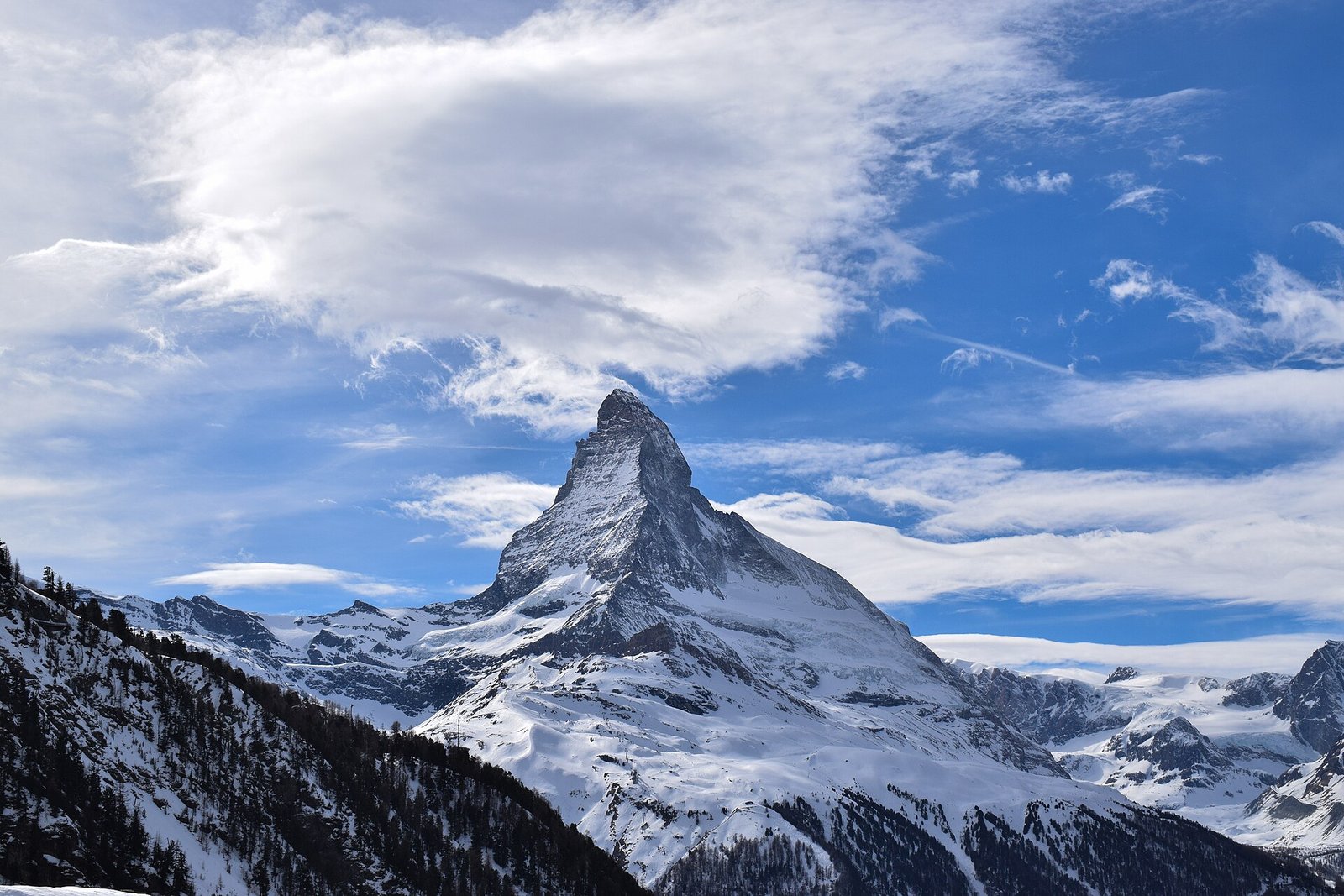
Beyond the places reviewed on ExpedReview, the Alps are full of classic climbs. The Matterhorn (4,478 m), on the Swiss–Italian border above Zermatt and Breuil-Cervinia, is the most famous mountain in the range. Its first ascent, on 14 July 1865 by Edward Whymper's party, ended in tragedy when four of the seven climbers fell to their deaths on the descent. Today, the Hörnli Ridge is a long, exposed rock climb that demands speed and fitness. The Eiger (3,967 m), above Grindelwald, is known for its north face, first climbed in 1938, though its Mittellegi Ridge is the more common guided route. The Dom (4,545 m) is the highest mountain entirely in Switzerland, and the Grossglockner (3,798 m) is the highest in Austria. Further east, Triglav (2,864 m) is Slovenia's national symbol, and the Zugspitze (2,962 m) is Germany's highest mountain.
Europe beyond the Alps
Europe's mountains do not end with the Alps. The Pyrenees, between France and Spain, rise to Aneto at 3,404 m and offer quieter climbing and trekking. Scandinavia has wild, glaciated peaks in Norway and Sweden, and Iceland's volcanic mountains and glaciers attract climbers and ski tourers. Many Alpine guides also run trips to these ranges, so ask your guide what else they offer.
Training for the Alps
Whatever your goal, fitness makes the Alps safer and more enjoyable. Alpine days often start before dawn and last eight to twelve hours, with long climbs on steep ground and descents that test tired legs. Start training at least three months before a Mont Blanc trip, with four or five sessions a week of hiking, running, cycling or stair climbing, plus strength work for legs and core and long hill days with a pack of 8–10 kg. For technical routes, climb regularly on rock, indoors and outdoors. If you can, spend a few days at altitude before your main objective, and choose a programme that includes acclimatisation climbs. See our mountaineering training guide.
Climate change and the Alps
The Alps have warmed faster than the global average, and the effects are clear on the mountains. Glaciers are shrinking, routes that were once on snow and ice are now on loose rock, and summer heatwaves have increased rockfall. Some classic routes are now best climbed earlier in the season, and some are no longer advisable in high summer. In hot years, authorities have warned climbers away from some routes, and guides have cancelled or changed plans. For climbers, this means checking conditions carefully, being flexible with plans and objectives, and choosing guides who put safety ahead of summits. Several recent ExpedReview reviews describe exactly that kind of decision.
When to go
| Season | What to do |
|---|---|
| Winter (December–February) | Skiing, ice climbing, winter mountaineering for the experienced |
| Spring (March–May) | Ski touring and ski mountaineering, including the Haute Route |
| Summer (mid-June–mid-September) | Classic mountaineering; high huts open; Mont Blanc season |
| Autumn (late September–November) | Huts closing; colder, shorter days; lower rock routes |
Summer is the main climbing season, but conditions have changed. Hotter summers have increased rockfall, opened crevasses earlier and, in some years, led authorities and guides to advise against routes such as Mont Blanc's Goûter route during heatwaves. Good guides adapt plans to conditions, as several ExpedReview reviews show.
Skills and experience
The Alps cater for every level. Beginners can join a mountaineering course and learn crampon and ice axe technique, rope work and glacier travel before climbing an easy 4,000 m peak such as Gran Paradiso or the Allalinhorn. Mont Blanc needs good fitness, basic skills and acclimatisation. Technical routes like the Matterhorn's Hörnli Ridge need fast, confident rock climbing, and many guides require a training climb first. Ski touring needs strong off-piste skills and avalanche knowledge.
A typical guided Mont Blanc week
Guided Mont Blanc programmes usually last about six days. The first days are spent on training and acclimatisation, for example a skills day on a glacier near Chamonix to practise crampon and ice axe technique and moving roped together, followed by a night at a hut and an ascent of an easier peak such as Gran Paradiso or a summit in the Monte Rosa massif. After a rest, teams head for Mont Blanc: on the Goûter route, the first day climbs from the Nid d'Aigle, crosses the Grand Couloir early in the day and climbs to the Goûter Hut at about 3,835 m. The summit day starts in the early hours, following the Dôme du Goûter and the Bosses Ridge to the top, then descends to the hut or the valley. A spare day allows for poor weather. See Mont Blanc guide.
Learning to climb in the Alps
The Alps are the best place in the world to learn mountaineering, with many short, accessible routes, good huts and cable cars that make high terrain quick to reach. A typical beginner course lasts five or six days and covers walking in crampons, ice axe use and self-arrest, roped glacier travel and crevasse rescue, basic rock climbing and abseiling, and route choice and weather. Many courses end with an ascent of a 4,000 m peak, a fitting finale to a week of learning. These skills are the foundation for bigger mountains in the Andes and Himalaya, such as Aconcagua or Denali.
How to choose a guide in the Alps
Look for guides certified by the IFMGA (UIAGM/IVBV), the international standard for professional mountain guides. Ask about guide-to-client ratios, which are usually small on technical routes: often one guide to one or two clients on Mont Blanc and the Matterhorn. Check what is included, such as hut costs, lifts and equipment, and how the guide plans acclimatisation and handles bad conditions. Read verified reviews from recent seasons, and do not judge a trip only by whether the summit was reached; the best guides turn back when conditions are unsafe. See how to choose a guide.
Huts
Alpine huts are a central part of climbing here. Most offer dormitory beds and half-board meals, and popular huts must be booked well ahead in summer. Some, like the Goûter Hut on Mont Blanc, require a booking to climb the route. Carry a sleeping bag liner, cash or a card, and respect hut rules on boots and quiet hours.
Cost
Costs in the Alps vary widely by country, route and guide ratio. Guided Mont Blanc programmes usually include several days of training and acclimatisation, hut nights and the guide's costs, and private one-to-one guiding costs more. Budget for lifts, huts, food, insurance with mountain rescue cover and equipment hire.
Insurance and rescue
Mountain rescue in the Alps is efficient, but it can be expensive in some countries. Make sure your insurance covers mountaineering at the altitudes and grades you plan, including helicopter rescue. Membership of an alpine club often includes rescue insurance.
Frequently asked questions
Which guide is ranked first in the Alps on ExpedReview?
SummitGuides, with 4.7★ from 11 verified reviews (latest October 2026), as of 23 October 2026.
When is the best time to climb in the Alps?
From about mid-June to mid-September for mountaineering, and March to May for ski touring.
What is the easiest 4,000 m peak in the Alps?
Gran Paradiso and the Allalinhorn are among the easiest, though both involve glacier travel.
Do I need a guide for Mont Blanc?
It is not required by law, but a qualified IFMGA guide is strongly recommended unless you are an experienced alpinist.
What qualifications should an Alpine guide have?
IFMGA (UIAGM/IVBV) certification is the international standard.
Can beginners learn mountaineering in the Alps?
Yes. Five to six-day beginner courses teach the basics and often end with a 4,000 m summit.
How many 4,000 m peaks are in the Alps?
82, according to the UIAA's official list.