Karakoram and Ladakh Guides: Verified Reviews for K2, Broad Peak and the K2 Base Camp Trek
By Blake Penson, Founder of ExpedReview · Everest summiter · Seven Summits climber · 20-year mountaineer · Industry expert
The Karakoram, in Pakistan's Gilgit-Baltistan, holds four of the world's fourteen 8,000 m peaks, K2 (8,611 m), Gasherbrum I, Broad Peak and Gasherbrum II, all reached by the same long trek up the Baltoro Glacier to Concordia. Expeditions run in summer, from about late June to mid-August, and the K2 Base Camp trek, the main non-climbing trip, takes about two to three weeks. These are some of the hardest and most remote mountains in the world. On ExpedReview, as of 23 October 2026, 6 operators have 19 verified client reviews in the Karakoram and Ladakh across 4 places. Ranked first is The Mountain Company (5.0★ from 5 reviews, latest June 2021), followed by Furtenbach Adventures (5.0★ from 4 reviews, latest August 2022) and Kobler & Partner (4.9★ from 4 reviews, latest December 2019). Below are the rankings, then a guide to the region.
Karakoram: key facts | | | |---|---| | Location | Gilgit-Baltistan, northern Pakistan (with parts in China and India) | | 8,000 m peaks | K2 (8,611 m), Gasherbrum I (8,080 m), Broad Peak (8,051 m), Gasherbrum II (8,035 m) | | Approach | Islamabad, Skardu, jeep to Askole, then about 7–8 days' trek up the Baltoro Glacier | | Main trek | K2 Base Camp via Concordia, optionally returning over the Gondogoro La | | Season | About late June to mid-August | | Reviewed places | K2 Base Camp trek, K2, Broad Peak, Gasherbrum I | | Operators reviewed on ExpedReview | 6, with 19 verified reviews (as of 23 Oct 2026) |
Karakoram guides ranked by verified reviews
Rankings use each operator's verified ExpedReview client reviews in the Karakoram and Ladakh: the star rating, adjusted so that one or two reviews, or only old ones, count for less than many recent ones; ties go to the operator with more reviews. Every review is checked by hand before it is published, critical reviews stay up, and operators cannot pay for a better position. Data as of 23 October 2026.
| Rank | Operator | Based in | Rating here | Reviews | Reviewed for | Latest review |
|---|---|---|---|---|---|---|
| 1 | The Mountain Company | United Kingdom | 5.0★ | 5 | K2 Base Camp trek (5) | June 2021 |
| 2 | Furtenbach Adventures | Austria | 5.0★ | 4 | Broad Peak (3), K2 (1) | August 2022 |
| 3 | Kobler & Partner | Switzerland | 4.9★ | 4 | Broad Peak (4) | December 2019 |
| 4 | Summitclimb | United States | 4.9★ | 4 | K2 Base Camp trek (3), K2 (1) | November 2023 |
| 5 | Imagine Nepal | Nepal | 3.8★ | 1 | K2 (1) | August 2024 |
| 6 | Summit Climb Germany | Germany | 1.4★ | 1 | Gasherbrum I (1) | August 2022 |
Most reviews here are a few years old, so ask operators about their recent seasons. Imagine Nepal and Summit Climb Germany have not claimed their ExpedReview profiles. Summitclimb and Summit Climb Germany are listed as separate operators.
What clients say
The K2 Base Camp trek reviews are the most enthusiastic. The Mountain Company's reviewers called Concordia "one of the most spectacular spots in the world", praised the support, food and care of the guides and crew, and recommended returning over the Gondogoro La; one wrote during the Covid lockdowns about how much the trip had meant. Summitclimb's trek reviewers described walking the Baltoro and Godwin-Austen glaciers as one of the most rewarding, difficult and otherworldly experiences of their lives, and praised the leader, Dan Mazur, the home office and the Pakistani team. A Summitclimb K2 client who had tried K2 in 2009 and 2016 with other providers said their successful 2018 expedition was "the best by far". Furtenbach Adventures' K2 and Broad Peak reviewers thanked the company and its Pakistani partner for the organisation. The two lowest ratings are more critical. Imagine Nepal's 2024 K2 reviewer (3.8) praised Mingma G's logistics and safety leadership, including stopping a small group from entering the Bottleneck while ropes were being fixed, but said the food was planned around a mainly Chinese group and protein was scarce on the walk-out. Summit Climb Germany's 2022 Gasherbrum reviewer (1.4), who paid about €16,000 for a full-service package, complained about the organisation, communication and treatment of clients, including an itinerary change that moved acclimatisation to Broad Peak, for which they had no permit, and paid services that were late or not provided.
The mountains
K2 (8,611 m)
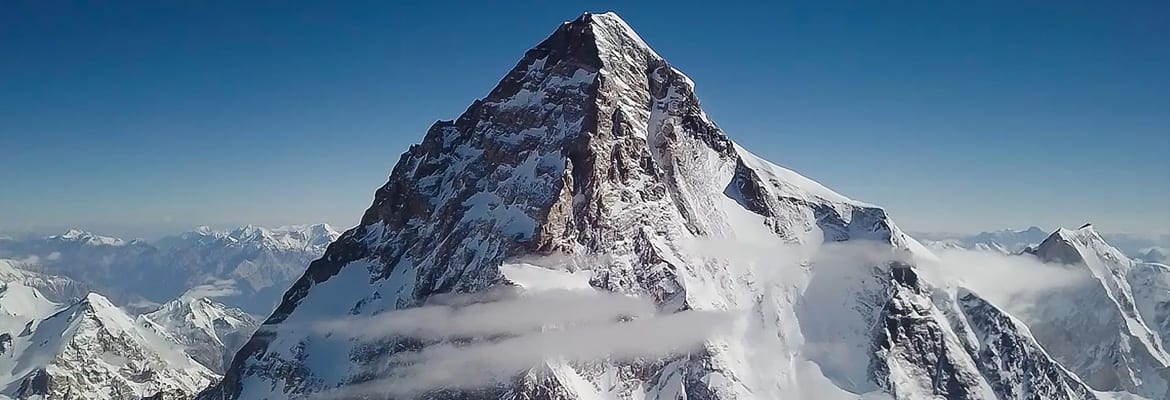
K2, the second-highest mountain in the world, is often called the hardest of the 8,000 m peaks. It was first climbed on 31 July 1954 by Lino Lacedelli and Achille Compagnoni of an Italian expedition, and first climbed in winter on 16 January 2021 by a team of ten Nepali climbers. Most expeditions use the Abruzzi Spur or the Cesen route, and both pass through the Bottleneck, a steep couloir under a huge serac high on the mountain.
Broad Peak and the Gasherbrums
Broad Peak (8,051 m) stands opposite K2 across the Godwin-Austen Glacier, and is often used as a first Karakoram 8,000er or as acclimatisation for K2. Gasherbrum I (8,080 m), also called Hidden Peak, and Gasherbrum II (8,035 m) are reached from a shared base camp further up the Baltoro, and are often climbed in one expedition.
K2 Base Camp trek
The K2 Base Camp trek follows the climbers' route up the Baltoro Glacier, past the Trango Towers and Masherbrum, to Concordia, where the Baltoro meets the Godwin-Austen Glacier and K2 comes into view. Trekkers often continue to K2 Base Camp and then return the same way or cross the Gondogoro La, a high pass of about 5,600 m, to Hushe.
Getting there
Expeditions and treks fly from Islamabad to Skardu, or drive the Karakoram Highway if flights are cancelled, then drive by jeep to Askole, the last village. From there, the trek to K2 Base Camp takes about seven to eight days, following the Braldu valley and the Baltoro Glacier past Paiju and Urdukas to Concordia. Flights to Skardu depend on the weather and are often delayed, so plan buffer days.
Season
The climbing and trekking season runs from about late June to mid-August, when the passes are open and the weather is most stable. Summit pushes on K2 and Broad Peak usually happen from mid-July to early August.
Permits and rules
Climbing and trekking in the Karakoram need permits from Pakistan's authorities, organised by a licensed local agency, and expeditions complete formalities and a briefing in Islamabad. Ask your operator what is included, especially permit and liaison officer fees, porter fees, oxygen and insurance. Check your government's travel advice for Gilgit-Baltistan and the Karakoram Highway before booking. Pakistan requires most visitors to get a visa in advance, usually online, and expedition members often need a letter from the local agency. Leave plenty of time for the paperwork, and keep copies of your permits with you on the trek, since there are checkpoints on the way to Askole.
A short history
The Karakoram was surveyed by the British in the 1850s, when Thomas Montgomerie of the Great Trigonometrical Survey of India gave the peaks working names from K1 to K5; K2 kept its survey name because no widely used local name was recorded. The Duke of the Abruzzi led a major Italian expedition in 1909 that explored the approaches to K2 and gave his name to the Abruzzi Spur. After several American attempts, an Italian expedition made the first ascent in 1954. The other Karakoram 8,000ers followed soon after: Broad Peak in 1957, Gasherbrum I (Hidden Peak) in 1958 by an American team, and Gasherbrum II in 1956 by an Austrian team. K2 has a long history of tragedy, including August 2008, when 11 climbers died after a serac collapse in and above the Bottleneck. Since the first winter ascent in 2021, commercial expeditions on K2 have grown, and in good seasons more than 100 people have reached the summit.
Hazards and altitude
The 8,000 m peaks of the Karakoram are serious undertakings. The main dangers are avalanches, serac falls, rockfall, extreme cold and wind, and the effects of altitude, such as high-altitude pulmonary and cerebral oedema. On K2, the Bottleneck and the traverse under the serac are especially exposed, and descending in the dark or in bad weather has caused many deaths. Broad Peak's long summit ridge has also been the scene of accidents, as climbers mistake the fore-summit for the main summit or run out of energy on the descent. On the trek, the main risks are altitude sickness, falls on the moraine and crevasses on the upper glaciers, as well as stomach illness. Because helicopter rescue in the Karakoram is organised through the Pakistani military and depends on the weather and on insurance, getting help can take time; check that your insurance covers helicopter rescue in Pakistan and that the operator has a clear plan.
Life on the trek
The K2 Base Camp trek is a camping trek: there are no lodges on the Baltoro, so each group travels with a team of cooks and porters, who carry tents, food and fuel. Many porters are Balti men from the villages around Askole and Skardu, and they are essential to every trek and expedition. Days are spent walking on rough moraine and glacier ice, with long views of some of the world's most dramatic peaks, including the Trango Towers, Masherbrum, Gasherbrum IV and finally K2. Nights at Concordia, at about 4,600 m, are cold. Reviewers often say the scenery is among the most spectacular they have seen, but also that the trek is long, rough and demanding, and that good support makes a big difference.
Ladakh
Ladakh, in the Indian Himalaya across the Line of Control from Gilgit-Baltistan, is a high desert region with a strong Buddhist culture. Its capital, Leh, at about 3,500 m, is reached by air from Delhi and is the base for treks such as the Markha Valley and for climbing trekking peaks over 6,000 m. Climbing in India needs a permit from the Indian Mountaineering Foundation, and some areas near the borders need extra permits. The season is from about June to September, when the Himalaya to the south blocks most of the monsoon. There are no Ladakh reviews on ExpedReview yet; we will add them as verified reviews come in.
Cost
Karakoram expeditions vary greatly in price. An 8,000 m expedition, especially K2, is one of the most expensive trips in mountaineering, while a K2 Base Camp trek costs much less. When comparing prices, check what is included: flights to Skardu, permits and liaison officer fees, porters, food, high-altitude support, oxygen, communications, insurance and summit bonuses. The cheapest price is not always the best value, as the critical review above shows.
Experience and fitness
For the K2 Base Camp trek, you need very good fitness and experience of multi-day treks at altitude, ideally above 4,000 m; no technical skills are needed for the standard trek, but crossing the Gondogoro La involves fixed ropes, crampons and an early start, and some operators treat it as a more serious option. For the 8,000 m peaks, operators usually expect previous expeditions to high peaks, often including at least one 8,000 m peak, or a 7,000 m peak at minimum, along with solid skills on fixed ropes, steep snow and ice, and mixed ground. K2 in particular is not a first 8,000er for most climbers; Broad Peak or Gasherbrum II are more common first steps in the Karakoram. Be honest with operators about your experience, and ask what they require.
Base camp life on an expedition
A Karakoram expedition usually lasts about six to nine weeks from Islamabad, much of it at base camp on the glacier at about 5,000 m. Teams make several rotations up the mountain to acclimatise and set up camps, then wait for a weather window for the summit push. Expeditions are longer and more isolated than on the Nepal side of the Himalaya: there are no lodges, villages or helicopter tours nearby, communications are by satellite, and supplies arrive by porter. Good food, a reliable cook team, communications and medical supplies matter a great deal over such a long time, which is why reviewers comment on them. Ask the operator how they manage these, and how they share base camp and fixed lines with other teams.
How to choose an operator
Ask about the operator's recent Karakoram seasons and summit record, the leader's experience on the mountain, the local partner agency, the Sherpa or high-altitude porter support, oxygen, food, communications, and what happens if the itinerary changes. The critical reviews above show why it pays to get the itinerary, permits and inclusions in writing.
Frequently asked questions
When is the climbing season in the Karakoram?
About late June to mid-August, with summit pushes usually from mid-July to early August.
How long is the K2 Base Camp trek?
Usually about two to three weeks from Islamabad, including about seven to eight days' trek from Askole to Concordia and K2 Base Camp.
Which 8,000 m peaks are in the Karakoram?
K2, Gasherbrum I, Broad Peak and Gasherbrum II.
Which operator is ranked first in the Karakoram on ExpedReview?
As of 23 October 2026, The Mountain Company is ranked first, with 5.0★ from 5 verified reviews, the latest from June 2021.