Mount Elbrus Climbing Guide: South and North Routes, Season, Difficulty and Verified Reviews
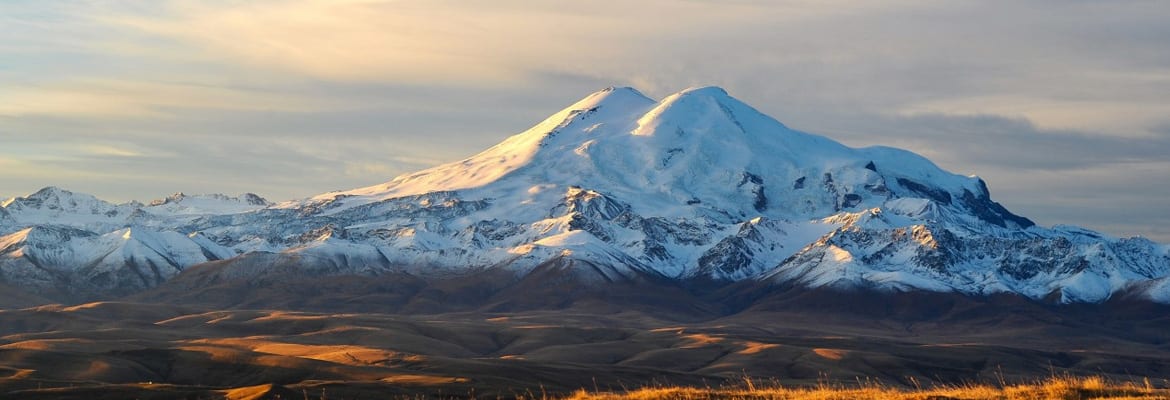
Mount Elbrus (5,642 m), a dormant volcano in the Caucasus of southern Russia, is the highest mountain in Europe and one of the Seven Summits. The standard south route, from the Azau valley, uses cable cars and snowcats to reach high huts at about 3,800 to 4,100 m, then follows a long, non-technical snow slope to the saddle between the twin summits and the west summit. The north route is more remote, with no lifts, and some teams traverse the mountain from north to south. Most guided trips take 8 to 12 days, and the season is June to September. Elbrus is technically easy but cold, windy and high, and many climbers have died there in bad weather. On ExpedReview, as of 23 October 2026, 3 operators have 10 verified client reviews for Elbrus: 360 Expeditions (4.9★ from 5 reviews, latest March 2021), Beyond Red Square (4.7★ from 3, latest September 2019) and Pilgrim Tours (4.5★ from 2, latest February 2024). Check your government's current travel advice for Russia before planning a trip. Below are the reviews, routes, season, difficulty, gear and how to choose an operator.
Mount Elbrus: key facts | | | |---|---| | Elevation | West summit 5,642 m (18,510 ft); east summit about 5,621 m | | Location | Caucasus, Kabardino-Balkaria and Karachay-Cherkessia, Russia | | Type | Dormant stratovolcano with twin summits | | First ascent | East summit 1829 (Khillar Khachirov); west summit 1874 (British party led by F. Crauford Grove) | | Main routes | South (from Azau, with lifts), north (from the Emmanuel Glade), north–south traverse | | Typical length | 8–12 days | | Season | June to September | | Operators reviewed on ExpedReview | 3, with 10 verified reviews (as of 23 Oct 2026) |
Elbrus operators with verified reviews
ExpedReview ranks operators by their verified client reviews for each place: the star rating, adjusted so one or two reviews, or only old ones, count for less than many recent ones. Every review is checked by hand before it is published, and operators cannot pay to appear or rank higher. Data as of 23 October 2026.
| Rank | Operator | Based in | Rating here | Reviews | Latest review | Guide-listed price |
|---|---|---|---|---|---|---|
| 1 | 360 Expeditions | United Kingdom | 4.9★ | 5 | March 2021 | No recent price listed |
| 2 | Beyond Red Square | United States | 4.7★ | 3 | September 2019 | No recent price listed |
| 3 | Pilgrim Tours | Not listed | 4.5★ | 2 | February 2024 | No recent price listed |
Most of these reviews describe trips before 2022. Rules, logistics and travel advice for Russia have changed a lot since then, so check current arrangements directly with any operator.
What clients say
360 Expeditions. Five reviews from February and March 2021 describe a north–south traverse. Several reviewers had travelled with the company many times before and praise the planning advice from the head office and leaders such as Rolfe and Stu S. One describes "a huge traverse summit day" with an off-road jeep drive, a night out "Russian style" and snowcats and snowmobiles on the south side. Another says the route suits "relative novices" because the summit day is "challenging but rewarding" and "isn't too technical at all". One reviewer marked the food and logistics down a little because "this isn't luxury", but says the team runs "a cost effective safe expedition".
Beyond Red Square. Three reviews from 2019 praise Andrew, who organised the trips, for being attentive and responsive. One group chose the company for "significantly better value and personal service", and saw "no difference" between its service and that of bigger companies on the mountain. Another group combined the climb with a trip to St Petersburg and Moscow, using two flights, a shuttle, a car, three gondolas, a snowmobile and a snowcat to reach the summit, then snowboarding down.
Pilgrim Tours. A February 2024 review describes "a very professional crew", "extremely knowledgeable and safety oriented", with lodgings and food as expected and "great value".
Why climb Elbrus?
Elbrus is one of the Seven Summits, and for many climbers it is the second after Kilimanjaro. It offers a real taste of a big, cold mountain, with crampons, an ice axe, high-altitude camps and a long summit day, in about a week. The south route is fast and well served by lifts, while the north route is wilder and more like an expedition. Both summits sit on a huge glaciated cone, with views over the main Caucasus ridge.
History
Local Balkar and Kabardian people have long known Elbrus. The east summit was first climbed in 1829 by Khillar Khachirov, a Kabardian guide with a Russian scientific expedition led by General Emmanuel. The higher west summit was first climbed in 1874 by a British party led by F. Crauford Grove with local guide Ahiya Sottaev. In the Soviet era, the south side was developed with cable cars and huts, including the famous Priut 11 hut, which burned down in 1998.
Routes
South route
The south route is by far the most popular. From the Azau valley (about 2,350 m), cable cars and a chairlift climb to Garabashi at about 3,800 m, where climbers stay in huts or containers known as "barrels". Snowcats can take climbers higher, to the Pastukhov Rocks at about 4,700 m, on summit day. From there, the route climbs a long, gentle slope, traverses to the saddle at about 5,400 m, then climbs the steeper final slope to the west summit. Although technically easy, the route is wide and featureless, and in a whiteout it is easy to wander onto crevassed ground. Many deaths have happened when climbers lost their way descending.
North route
The north route starts from the Emmanuel Glade, north of the mountain, reached by a long drive. Teams carry loads to a camp at about 3,800 m and a high camp at Lenz Rocks or higher, with no lifts. The summit day is longer, often 10 to 14 hours. The north route is quieter and more of an expedition, and it suits climbers wanting a bigger challenge.
Traverse
Some teams, like 360 Expeditions' groups above, climb from the north and descend to the south, getting the wilder north side and an easy exit by lift.
Sample itinerary (south route)
- Arrive in Mineralnye Vody and transfer to the Baksan valley.
- Acclimatisation hike, for example to the Cheget area.
- Take the lifts to Garabashi and settle in at the huts.
- Acclimatisation climb to about 4,700 m.
- Rest day and snow skills training.
- Summit day.
- Spare day for weather.
- Return to Mineralnye Vody.
Season
The season runs from June to September. July and August are usually the most settled. Outside summer, Elbrus is extremely cold and windy, and only experienced climbers attempt it.
How hard is Elbrus?
Elbrus is not technical, but it is a serious climb. You need to be fit for a summit day of 8 to 14 hours, comfortable walking in crampons and able to use an ice axe for self-arrest. The cold and wind can be extreme, even in summer, with temperatures of −20 °C or lower on summit day. Weather can change quickly, and whiteouts are common.
Gear
You need full mountaineering gear: insulated double boots or warm single boots, crampons, an ice axe, a harness, a down jacket, insulated mitts, goggles, a balaclava and warm layers. Some operators rent gear in the Azau valley.
Travel considerations
Many governments currently advise against all travel to Russia, and the Caucasus republics near Elbrus are covered by additional warnings in some countries' advice. Payment cards issued abroad may not work, insurance may be invalid and flights are restricted. Check your government's latest advice and your insurer's terms before booking anything.
Choosing an operator
- Check your travel insurance first. Many policies exclude Russia.
- Choose a route that matches your experience.
- Ask about guide ratios on summit day and how whiteouts are handled.
- Check acclimatisation and spare days.
- Ask what is included, such as lifts, snowcats, huts and permits.
- Read recent reviews. Most reviews here predate 2022.
For other mountains in the region, see our Caucasus guide. Kazbek in Georgia is another option; see our Kazbek guide.
Acclimatisation
Even though Elbrus is reached quickly by lift, acclimatisation is essential. A good itinerary spends several nights at or above 3,800 m before the summit day and includes at least one climb to about 4,700 m, often to the Pastukhov Rocks. Climbers who fly in and head straight up are at higher risk of acute mountain sickness and of being too weak to cope with the long, cold summit day. If you have climbed Kilimanjaro, remember that Elbrus is lower but feels much colder, with more wind and a steeper final slope.
Snowcats and summit-day choices
On the south route, many teams take a snowcat from the huts to the Pastukhov Rocks, or even higher, early on summit day. This saves two to three hours of climbing and energy and makes the summit more likely. Some climbers prefer to climb the whole way from the huts for the sense of achievement. Ask your operator whether the snowcat is included and how high it goes. On the descent, snowcats can sometimes collect tired climbers, which is a useful safety option.
Dangers on Elbrus
Elbrus has a reputation for being deceptively dangerous. The main hazards are:
- Weather. Storms can arrive quickly, bringing high winds, extreme cold and zero visibility.
- Navigation. The upper mountain is wide and featureless. In whiteouts, climbers descending from the saddle can easily drift onto crevassed glaciers to the side of the route.
- Cold injury. Frostbite is common on summit day, especially on fingers, toes and faces.
- Altitude illness, especially for climbers who ascend quickly.
- Crevasses off the main route, especially on the north side and on the traverse.
A well-run team watches the forecast closely, sets turnaround times and carries GPS devices to follow the route.
Training and experience
Elbrus suits climbers who have done some winter hill walking or a glacier course and are comfortable in crampons. A previous trekking peak or Kilimanjaro is useful but not essential. Train for long days carrying a pack, build leg strength for the steep final slope and practise ice axe self-arrest. If you plan to climb the north route, you should also be comfortable carrying heavy loads between camps.
The Baksan valley and Terskol
Climbers on the south route usually stay in Terskol or Azau in the Baksan valley, which has hotels, cafés and gear shops. The valley also offers acclimatisation hikes, such as Cheget, with excellent views of Elbrus and Donguz-Orun. Local food includes shashlik, khychin (stuffed flatbreads) and plenty of soup. The north side, by contrast, has very few facilities, and teams camp or use simple huts.
Elbrus and the Seven Summits
For many people working through the Seven Summits, Elbrus is an important step after Kilimanjaro and before bigger mountains such as Aconcagua and Denali. It introduces cold-weather mountaineering skills and lets you test your gear. Some climbers who prefer not to travel to Russia choose Mont Blanc as their European summit instead. See our Mont Blanc guide and Aconcagua guide.
The twin summits
Elbrus has two summits, separated by a saddle at about 5,400 m. The west summit (5,642 m) is the higher and is the usual goal. The east summit (about 5,621 m) is climbed less often, usually from the north route. Both are the rims of old volcanic craters, now filled with snow and ice. Elbrus last erupted roughly 2,000 years ago, and there are still hot springs and fumaroles on its flanks.
Frequently asked questions
How hard is Mount Elbrus?
It is technically easy but physically demanding, with a long summit day, high altitude and severe cold and wind.
How long does it take to climb Elbrus?
Most guided trips take 8 to 12 days.
When is the best time to climb Elbrus?
June to September, with July and August usually best.
Which route is best for Elbrus?
The south route is shorter and easier, with lifts and huts. The north route is quieter, longer and more demanding.
Which operators have verified reviews for Elbrus?
As of 23 October 2026, 360 Expeditions (4.9★ from 5), Beyond Red Square (4.7★ from 3) and Pilgrim Tours (4.5★ from 2).
Is Elbrus harder than Kilimanjaro?
Yes. Elbrus is lower but colder and windier, needs crampons and an ice axe, and has a steeper, more exposed summit day.
Do I need a snowcat on Elbrus?
No, but many teams use one on summit day to save time and energy. Ask your operator whether it is included.
Is it safe to travel to Russia to climb Elbrus?
Many governments currently advise against travel to Russia. Check your government's latest advice and your insurance before booking.
Can operators pay to rank higher on ExpedReview?
No. Operators cannot pay to appear, rank higher or have reviews removed.
Related articles
- How to choose a guide
- Best operators
- Caucasus & Iran Climbing Guides: Elbrus, Kazbek, Damavand
Guided climbing in the Caucasus and Iran: Elbrus, Kazbek and Damavand compared, with verified ExpedReview client reviews, seasons, routes, permits, travel advice and how to choose an operator.