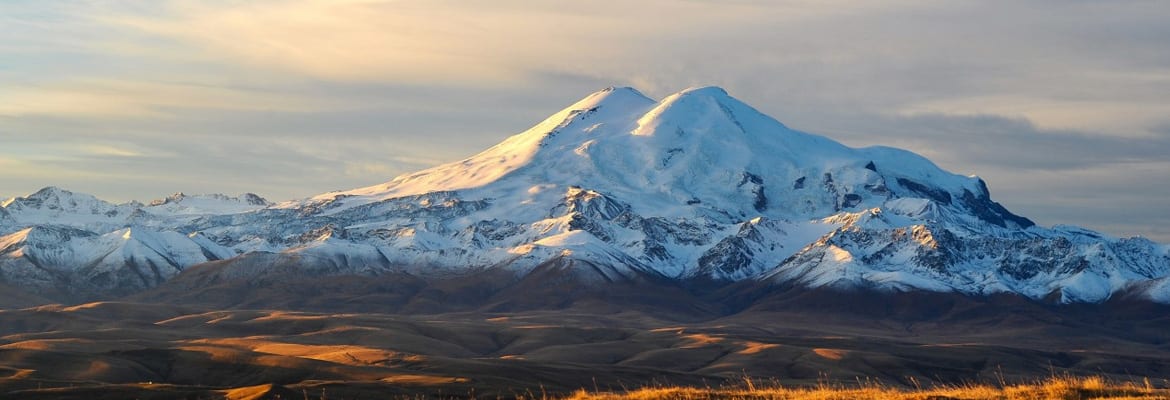
Kazbek Guides: Verified Reviews and Climbing Guide (5,054 m, Georgia)
Kazbek (Mkinvartsveri in Georgian) is a dormant volcano of about 5,054 m on Georgia's border with Russia, above the mountain town of Stepantsminda. The normal route climbs past the Gergeti Trinity Church to a hut at about 3,650 m and then crosses the crevassed Gergeti Glacier to the summit. A guided ascent usually takes six to eight days, and it is one of the best first glacier peaks above 5,000 m. On ExpedReview, as of 23 October 2026, one operator has one verified client review for Kazbek: Caucasus Quest (5.0★, April 2024). Below are the review, the route, the season and how to choose a guide.
Kazbek: key facts | | | |---|---| | Height | About 5,054 m (some sources give 5,047 m) | | Location | Greater Caucasus, Georgia–Russia border, above Stepantsminda | | Type | Dormant stratovolcano with glaciers | | First recorded ascent | 1868, Douglas Freshfield, A. W. Moore and C. C. Tucker with guide François Devouassoud | | Normal route | South side: Gergeti Glacier from Stepantsminda | | Typical guided trip | 6–8 days from Tbilisi | | Season | Mid-June to mid-September | | Operators reviewed on ExpedReview | 1, with 1 verified review (as of 23 Oct 2026) |
Kazbek guides with verified reviews
ExpedReview ranks operators by their verified client reviews for each place: the star rating, adjusted so one or two reviews, or only old ones, count for less than many recent ones. Every review is checked by hand before it is published, and operators cannot pay to appear or rank higher. Data as of 23 October 2026.
| Rank | Operator | Based in | Rating here | Reviews | Latest review |
|---|---|---|---|---|---|
| 1 | Caucasus Quest | United States (unclaimed profile) | 5.0★ | 1 | April 2024 |
What the review says. A couple who travel abroad often for outdoor trips call Caucasus Quest the most professionally run company they have dealt with. They highlight fast, clear answers to questions in the months before the trip. A single review is a useful data point, not a track record, so ask any operator for references from recent Kazbek clients.
For other peaks in the region, including Elbrus, see our Caucasus & Iran guide.
About the mountain
Kazbek stands alone above the Darial Gorge and the Georgian Military Road, the old route over the Caucasus between Tbilisi and Vladikavkaz. It is the third-highest peak in Georgia and one of the most striking volcanoes in the range, with a broad, glaciated summit cone. In Georgian legend it is the mountain where Amirani, a hero much like Prometheus in Greek myth, was chained for defying the gods, and the small Gergeti Trinity Church on a ridge below it, built in the fourteenth century, is one of the best-known images of Georgia.
The first recorded ascent was in 1868 by the British climbers Douglas Freshfield, A. W. Moore and C. C. Tucker with the Chamonix guide François Devouassoud, on the same trip on which they climbed the east summit of Elbrus. Today it is Georgia's most popular high mountain, climbed by hundreds of people each summer.
The normal route
| Day | Stage | Height |
|---|---|---|
| 1 | Tbilisi to Stepantsminda by road (about 3 hours) | About 1,750 m |
| 2 | Walk past Gergeti Trinity Church to Sabertse pass area or camp | About 3,000 m |
| 3 | Cross the Gergeti Glacier tongue to the weather station hut | About 3,650 m |
| 4 | Acclimatisation walk towards 4,000–4,400 m and skills practice | — |
| 5 | Summit day: about 1,400 m of ascent | 5,054 m |
| 6 | Reserve day for weather | — |
| 7 | Descend to Stepantsminda and drive to Tbilisi | — |
Stepantsminda to the hut. The first part is a steep walk on a good path to the Gergeti Trinity Church (about 2,170 m), then up grassy ridges with wide views of the mountain. Higher up, the trail crosses moraine and the lower Gergeti Glacier. Horses can carry loads as far as the edge of the glacier.
The weather station hut. The old meteorological station, often called the Betlemi hut, sits at about 3,650 m. It is basic, with dormitory bunks, and many teams camp nearby instead. Here you spend at least two nights to acclimatise. Water comes from snowmelt or glacier streams and should be treated or boiled. The hut area can be busy in July and August, so guided teams often bring their own tents and cook.
Summit day. Teams usually leave between 1 and 3 a.m. The route climbs the Gergeti Glacier, roped, to a broad plateau below the summit cone, then up a final steep snow and ice slope of about 40 degrees to the top. Fixed ropes are sometimes placed on the steepest part. Round trip from the hut takes 10 to 14 hours. On a clear morning the view runs along the main Caucasus range, with Elbrus far to the west.
Hazards
Crevasses. The Gergeti Glacier is crevassed, and crevasse falls are one of the main causes of accidents on Kazbek. Rope up on the glacier, even when it looks safe, especially on the descent when the snow is soft and bridges are weakest.
Weather. Storms build quickly, and in whiteout it is easy to lose the line on the plateau. Good guides carry a GPS track and turn round early.
Altitude. Summit day climbs about 1,400 m to above 5,000 m. Without proper acclimatisation, altitude sickness is common. Two nights at the hut and an acclimatisation walk are the minimum.
The final slope. The steep slope below the summit can be icy late in the season. A slip here needs to be stopped quickly, so you must be able to use an ice axe and crampons with confidence.
Rockfall. Parts of the approach pass below loose rock. Wear a helmet and move quickly through those sections.
When to climb
The main season runs from about mid-June to mid-September. July and August usually bring the most stable weather and are the busiest months. Early in the season there is more snow covering crevasses, but it is softer; by late August and September the glacier is drier, crevasses are open and the summit slope is more icy. Winter ascents are possible but are serious undertakings with severe cold, deep snow and few other climbers.
Skills and fitness
Kazbek does not require technical rock or ice climbing on the normal route, but it is a real mountaineering objective. You should:
- Be fit enough for a 10 to 14 hour summit day after several days of hiking
- Be comfortable walking in crampons and using an ice axe on slopes up to about 40 degrees
- Know how to move in a rope team on a glacier, or join a trip that includes a skills day
- Have been above about 4,000 m before, ideally
Many people climb Kazbek after Kilimanjaro or a few Alpine peaks. Six to eight weeks of training with long hill walks carrying a pack, stair climbing and steady aerobic work will make a big difference.
Permits and practicalities
Many nationalities can enter Georgia without a visa for long stays, but check current rules for your passport. The summit is on the Russian border, and climbers on Kazbek normally register their route with the Georgian border police in Stepantsminda before setting out; your guide will handle this. Georgia's national park and rescue services encourage visitors to register their plans before going into the mountains. Bring your passport on the climb, because border patrols may ask to see it.
Travel insurance must cover mountaineering to above 5,000 m and helicopter rescue. Georgia has a mountain rescue service, but evacuation from the upper glacier depends on weather.
What it costs
ExpedReview does not hold a current price for Kazbek from the reviewed operator. Local Georgian guiding companies are generally much cheaper than Western operators, which add a foreign leader and fuller support. A quote should show the guide-to-client ratio on the glacier, transport from Tbilisi, hut or tent nights, meals, horses for loads, technical equipment, border registration and reserve days. A ratio of one guide to two clients on the glacier is a good benchmark.
How to choose a guide
- Ask for the guide's qualifications. Georgian guides may hold national certifications; some hold international ones. Ask for the leader's name and experience on Kazbek.
- Ask about the ratio and rope teams. How many clients per guide on summit day?
- Ask about acclimatisation. At least two nights at the hut, an acclimatisation walk and a reserve day.
- Ask what equipment is provided. Boots, crampons, harness, helmet, ropes and tents.
- Ask about the turn-around time. A firm time protects you from coming down tired in soft snow over crevasses.
- Read reviews in full. Check what each reviewer actually climbed and when.
Gear
Most guiding companies rent technical gear in Stepantsminda or Tbilisi, but bring your own boots and break them in. A typical list:
- Mountaineering boots that take crampons, warm enough for a pre-dawn start on snow
- Crampons, ice axe, harness, helmet and a locking carabiner or two
- A warm down jacket, waterproof shell jacket and trousers, fleece and thermal layers
- Warm mitts and spare gloves, a warm hat, buff, glacier glasses and ski goggles
- A sleeping bag rated to about −10 °C or colder for the hut or tents
- Headtorch with spare batteries, two litres of water capacity and snacks for a long day
- High-factor sun cream and lip balm, because glare on the glacier is intense
Ask your operator for its own list before you buy anything, and check what is included in the price.
Kazbek or Elbrus?
The two peaks are often compared because they are the best-known summits of the Caucasus. Elbrus is about 600 m higher, and its main dangers are cold, wind and whiteout on broad, open slopes. Lifts and snowcats on the south side shorten the climb. Kazbek has no lifts, so you carry loads and walk every metre. Its glacier is more crevassed and its final slope steeper, so it asks for more mountaineering skill. Many climbers find Kazbek a better learning experience and a more beautiful approach.
There is also a practical difference. Since 2022 many governments have advised against all travel to Russia, which has made Elbrus harder to plan for many nationalities. Georgia remains open and welcoming to climbers, which is one reason Kazbek's popularity has grown.
Combining Kazbek with a trip to Georgia
Kazbek fits well into a wider trip. Tbilisi has an old town, sulphur baths and an excellent food and wine culture. The Kazbegi area itself offers good day hikes, such as the walks to the Gveleti waterfall and the Juta valley, which also make good acclimatisation before the climb. Further afield, the regions of Svaneti, with its medieval stone towers, and Tusheti offer some of the best trekking in the Caucasus. If you have time, a few days of trekking before Kazbek is the best preparation you can do.
Kazbek as a stepping stone
Kazbek is a natural step up from Kilimanjaro or Toubkal, and a good preparation for bigger glacier peaks such as Elbrus, Mont Blanc or Aconcagua. It teaches the basics of rope-team glacier travel, early starts, crampon technique on steeper snow and moving efficiently at altitude, all in a short trip. If it goes well, you will have a clear sense of whether high-altitude mountaineering is for you.
Frequently asked questions
How high is Kazbek?
About 5,054 m. Some sources give 5,047 m.
How hard is it to climb Kazbek?
It is a non-technical but serious glacier climb, with a steep final snow slope of about 40 degrees. You need fitness, crampon and ice-axe skills and good acclimatisation.
How long does it take to climb Kazbek?
A guided trip is usually six to eight days from Tbilisi, with summit day taking 10 to 14 hours from the hut.
When is the best time to climb Kazbek?
Mid-June to mid-September, with July and August the most reliable months.
Do I need a guide to climb Kazbek?
It is not legally required, but unless you are experienced in glacier travel and crevasse rescue, a guide is strongly recommended.
Is Kazbek harder than Elbrus?
Kazbek is lower but often considered more technical, with a more crevassed glacier and a steeper summit slope. Elbrus is higher, colder and more exposed to weather.
Which operators have verified reviews for Kazbek?
As of 23 October 2026, Caucasus Quest has one verified review (5.0★, April 2024).
Can operators pay to rank higher on ExpedReview?
No. Operators cannot pay to appear, rank higher or have reviews removed.
Where do you stay on Kazbek?
Most teams spend the first night in Stepantsminda, then camp or stay at the old weather station hut at about 3,650 m, which has basic dormitory bunks. Many guided groups use tents near the hut for more space and comfort.
Can beginners climb Kazbek?
Fit hikers with no mountaineering experience can climb Kazbek with a good guide and a skills day, but it is a big step. Experience on a lower glacier peak or a winter skills course first will make the climb safer and more enjoyable.
Related articles
- How to choose a guide
- Best operators
- Caucasus & Iran Climbing Guides: Elbrus, Kazbek, Damavand
Guided climbing in the Caucasus and Iran: Elbrus, Kazbek and Damavand compared, with verified ExpedReview client reviews, seasons, routes, permits, travel advice and how to choose an operator.