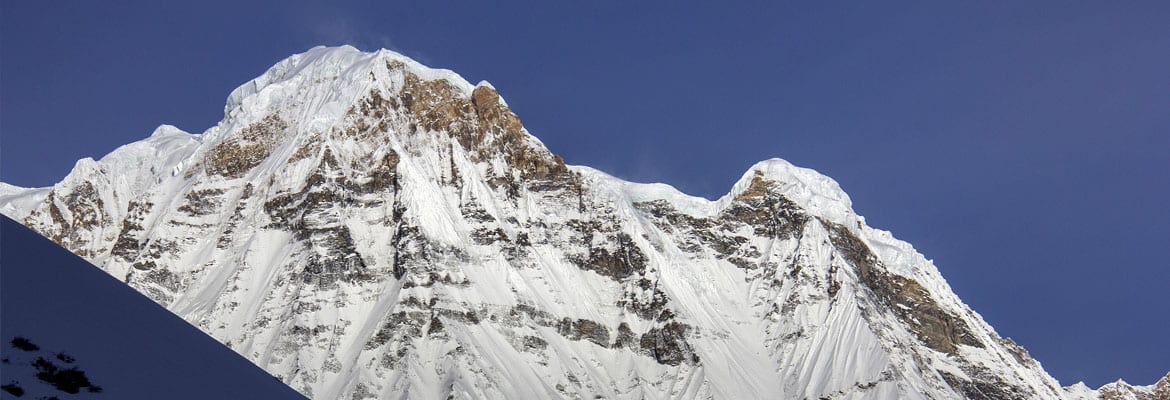
Saribung Peak Expedition: Verified Guide Reviews and Climbing Guide
Saribung is a remote snow peak of about 6,330 m close to the Nepal–Tibet border, between the Nar-Phu valleys and Upper Mustang. A Saribung expedition is a long, wild crossing rather than a single climb: three to four weeks through two restricted areas, over the Saribung La pass at a little over 6,000 m, with a short glacier climb to the summit from the pass. It suits experienced trekkers who want a first Himalayan 6,000 m peak far from the crowds. On ExpedReview, as of 23 October 2026, one operator has 3 verified client reviews for Saribung: The Mountain Company, based in the United Kingdom (5.0★ from 3 reviews, latest May 2021). Below are the reviews, the route, permits and how to choose a guide.
Saribung: key facts | | | |---|---| | Height | About 6,330 m (ExpedReview lists 6,328 m; other sources give up to 6,346 m) | | Location | Damodar Himal, Nepal–Tibet border, north of the Annapurna range | | Approach | Nar-Phu valleys in the east, Upper Mustang in the west | | Key pass | Saribung La, a little over 6,000 m | | Typical trip | 24–28 days from Kathmandu | | Season | Late April–May and late September–October | | Permits | Nar-Phu and Upper Mustang restricted-area permits, ACAP, climbing permit | | Operators reviewed on ExpedReview | 1, with 3 verified reviews (as of 23 Oct 2026) |
Saribung guides with verified reviews
ExpedReview ranks operators by their verified client reviews for each place: the star rating, adjusted so one or two reviews, or only old ones, count for less than many recent ones. Every review is checked by hand before it is published, and operators cannot pay to appear or rank higher. Data as of 23 October 2026.
| Rank | Operator | Based in | Rating here | Reviews | Latest review |
|---|---|---|---|---|---|
| 1 | The Mountain Company | United Kingdom | 5.0★ | 3 | May 2021 |
What clients say
All three reviews give five stars and were written in May 2021, so they describe trips from before then.
- Planning and contact. One client says the owner, Roland, and the guide, Jo, were in touch well before arrival to answer questions and help with planning. They call the trek and climb outstanding and value the solitude of the remote Nepal Himalaya, and say the staff and porters went beyond what was expected.
- The route. A second client describes the walk up the Naar Khola valley to the village of Phu, with time to explore, before the route climbs into remote mountains with plenty of snow and ice.
- For experienced trekkers. A third, who has trekked in Nepal for many years, says it becomes hard to find new challenges once you have done the usual treks, and that the company keeps finding new ones.
Three reviews from one month are a small sample. Ask the company how many Saribung trips it has run since 2021 and how many reached the summit.
Where Saribung is
Saribung sits in the Damodar Himal, a cluster of peaks north of the main Annapurna range, on the Nepal–Tibet border. To the east lie the Nar and Phu valleys, reached from the Annapurna Circuit near Koto. To the west lies Upper Mustang, the old kingdom of Lo, with its walled capital Lo Manthang. The whole area sits in the rain shadow of the Annapurnas and Dhaulagiri, so it is dry, high and stark, more like Tibet than the green valleys to the south.
The region was closed to foreigners for decades. Upper Mustang opened to trekkers in 1992 and Nar-Phu in the early 2000s, both as restricted areas that need special permits and a licensed guide. Saribung itself has only been climbed regularly since the 2000s, and it still sees just a handful of expeditions a year. That is the main appeal: on most days you will meet no other foreign trekkers at all, only herders, traders and the occasional pilgrim heading for Damodar Kunda. It also means there is little help nearby if things go wrong, so the quality of your operator and crew matters more than it would on a busy route.
The route
Most expeditions run east to west, starting in Nar-Phu and finishing in Upper Mustang. Some operators run it the other way.
| Stage | Route | Highest sleeping height |
|---|---|---|
| Kathmandu to Koto | Drive via Besisahar and up the Marsyangdi valley | About 2,600 m |
| Nar-Phu valleys | Koto to Meta, Phu and Nar, with acclimatisation days | About 4,100 m |
| Approach to base camp | Up remote valleys to Saribung base camp | About 4,900–5,000 m |
| Climb | High camp, then the Saribung La and the summit | About 5,700 m |
| Descent west | Down glaciers and moraine to Damodar Kunda lakes | About 4,900 m |
| Upper Mustang | Through Luri Gompa and villages to Lo Manthang or Ghemi | About 3,800 m |
| Exit | Walk or drive to Jomsom, fly or drive to Pokhara | — |
Phu and Nar. Phu is a medieval-looking village of stone houses at about 4,080 m, with Tashi Lhakhang monastery above it. Nar, on the other side of the valley, has fields, chortens and a strong Tibetan Buddhist culture. Both are good places for rest days, and both still have very few lodges, so most groups camp.
The Saribung La and summit. From high camp you climb glaciated slopes to the Saribung La, a little over 6,000 m. The summit climb branches off near the pass and takes a few hours on snow and ice of moderate angle, roped up and on fixed line where needed. Then you cross the pass and descend a long glacier to the west. Summit day, including the descent to a camp beyond the pass, can take ten hours or more, and snow conditions on the far side vary a lot from year to year.
Damodar Kunda. These sacred lakes at about 4,900 m are a Hindu pilgrimage site, linked to Muktinath. It is one of the most remote camps of the trip.
Upper Mustang. The final days pass through red cliffs, cave dwellings and old monasteries such as Luri Gompa, with its centuries-old wall paintings. Some trips finish at Lo Manthang; others go straight down towards Ghemi and Jomsom.
Skills and fitness
Saribung is not technically hard by Himalayan standards, but it is long, high and remote. You should have:
- Several high-altitude treks behind you, ideally above 5,000 m
- Experience of walking in crampons and using an ice axe; many operators include a skills day at base camp
- The fitness for many consecutive days of walking, often six to eight hours, at altitude
- The resilience for three or four weeks of camping in cold, dry conditions
Peaks such as Island Peak, Mera Peak or Lobuche East are good preparation. See our Mera Peak guide and Island Peak guide.
Altitude and acclimatisation
The climb itself is only a few days of a long trip, and the long approach through Nar-Phu is what makes it possible. A good plan spends several nights between 3,500 m and 4,500 m, with rest days in Phu or Nar, before base camp. Above 3,000 m, standard medical advice is to raise your sleeping height by no more than about 500 m a day, with an extra night for every 1,000 m gained. Ask your operator for every night's sleeping height. Remote camps here are days from a road, so the leader should carry a full medical kit, supplementary oxygen or a hyperbaric bag, and a satellite phone.
Permits
This trip passes through two restricted areas and needs several permits. Your operator applies for them, and you must travel with a licensed guide in a group of at least two foreign trekkers.
- Nar-Phu restricted-area permit: charged per week, with a higher rate in the autumn season.
- Upper Mustang restricted-area permit: US$50 per person per day under the current Nepal Tourism Board rules.
- Annapurna Conservation Area Permit (ACAP): NPR 3,000 for foreigners.
- Climbing permit for Saribung: ask your operator which authority issues it and whether it is included in the price.
Check current fees with your operator, as they change. Upper Mustang days are the biggest permit cost, so the itinerary's time inside Upper Mustang has a direct effect on price.
When to go
The Damodar Himal lies in the rain shadow, so the monsoon is weaker here than elsewhere in Nepal, but the pass and summit are best in the drier, more stable months:
- Late April to May: warming weather, more snow on the pass, longer days.
- Late September to October: clear skies and settled weather after the monsoon, colder nights.
- Winter: too cold and snowy for the pass; trips do not usually run.
What it costs
ExpedReview does not hold a current price for Saribung. Because of restricted-area permits, long camping logistics and small groups, it costs much more than a standard tea-house trek of the same length. A quote should show all permits, transport at both ends, camping crew, food, climbing gear and the guide-to-client ratio on the climb.
How to choose an operator
- Ask how many Saribung trips they have run. This is a niche route, and real experience of the pass matters.
- Ask who leads. Get the leader's name and climbing qualifications, and the ratio of climbing guides to clients on summit day.
- Ask about the acclimatisation plan. Look for rest days in Phu or Nar and at least one spare day for the climb.
- Ask about rescue. How would a casualty be evacuated from base camp or the far side of the pass?
- Ask about the crew. How are porters and camp staff equipped and insured for a 6,000 m pass?
- Read reviews closely. Check the dates and what each reviewer actually did.
Is Saribung a good first 6,000 m peak?
For the right person, yes. If you have already done one or two of the big Nepal treks, such as the Annapurna Circuit, Everest Base Camp or Manaslu, and you want your first summit above 6,000 m without the crowds of the Khumbu, Saribung is one of the most rewarding choices in the country. The climbing on the summit day is not much harder than Island Peak or Mera Peak, and the long approach gives excellent acclimatisation.
It is a poor choice if you are short on time, if you have never camped for more than a few nights, or if you want the comfort of tea houses. It is also a poor choice as your first trip at altitude. If something goes wrong on the far side of the Saribung La, you are several days from a road, and evacuation depends on weather and helicopter availability. Do a shorter peak first, learn how you respond to altitude, and then come here.
Culture and responsible travel
Nar, Phu and Upper Mustang are some of the last places in Nepal where Tibetan Buddhist village life continues much as it has for centuries. The restricted-area permit fees were set partly to limit numbers and protect that culture. Visitors are guests, so:
- Walk clockwise round chortens, mani walls and monasteries, and ask before entering a gompa
- Ask before photographing people, and respect a refusal
- Dress modestly and avoid public displays of affection in villages
- Carry out all rubbish, including batteries and plastic, because there is no collection in these valleys
- Buy local where you can, from lodges, shops and craft sellers
Damodar Kunda is sacred to Hindus, and pilgrims bathe there. Keep camps and toilets well away from the water.
Gear
Your operator should provide group camping and climbing gear: tents, kitchen, ropes and fixed lines. Bring and know your own:
- Mountaineering boots that take crampons, plus trekking boots or shoes for the approach
- Crampons, ice axe, harness, helmet, ascender and belay device, unless rented
- A four-season sleeping bag rated to about −20 °C
- Down jacket, insulated trousers, mitts and liner gloves
- Glacier glasses, high-factor sun cream and lip balm, because the light and dry air here are harsh
- A personal first-aid kit and enough of any regular medicines for the whole trip
Ask what can be rented in Kathmandu and what must come from home.
Frequently asked questions
How high is Saribung?
About 6,330 m. ExpedReview lists 6,328 m; other sources give up to 6,346 m. The Saribung La pass is a little over 6,000 m.
How hard is Saribung?
It is a non-technical to moderately technical snow climb, but the remoteness, length and altitude make it a serious trip. You should have high-altitude trekking experience and basic crampon and ice-axe skills.
How long does a Saribung expedition take?
Usually 24 to 28 days from Kathmandu, including the drive in, the Nar-Phu approach, the climb and the walk out through Upper Mustang.
What permits do I need for Saribung?
Restricted-area permits for Nar-Phu and Upper Mustang, the Annapurna Conservation Area Permit and a climbing permit. A licensed guide is required.
When is the best time to climb Saribung?
Late April to May and late September to October.
Which operators have verified reviews for Saribung?
As of 23 October 2026, The Mountain Company has 3 verified reviews (5.0★, latest May 2021).
Can operators pay to rank higher on ExpedReview?
No. Operators cannot pay to appear, rank higher or have reviews removed.
Related articles
- How to choose a guide
- Best operators
- Annapurna and Mustang Trekking and Climbing Guides: Verified Reviews
Treks and climbs in Nepal's Annapurna and Mustang region: operators ranked by verified ExpedReview client reviews, plus a guide to the Annapurna Circuit, Annapurna Base Camp, Poon Hill, Mardi Himal, Upper Mustang, Annapurna I and nearby peaks, with permits, guide rules, seasons and how to choose.