Annapurna and Mustang Trekking and Climbing Guides: Verified Reviews
By Blake Penson, Founder of ExpedReview · Everest summiter · Seven Summits climber · 20-year mountaineer · Industry expert
The Annapurna region of central Nepal, north of Pokhara, is the country's most popular trekking area after the Everest region, with treks for every level, from the four-day Poon Hill trek to the Annapurna Circuit over the Thorong La (5,416 m), the Annapurna Base Camp trek into the Annapurna Sanctuary, and the restricted, culturally Tibetan Upper Mustang. It also has big climbs, including Annapurna I (8,091 m), the first 8,000-metre peak ever climbed and one of the most dangerous, and 7,000-metre peaks such as Himlung Himal. On ExpedReview, as of 23 October 2026, 6 operators have 22 verified client reviews in Annapurna and Mustang across 10 places. Ranked first is The Mountain Company (4.8★ from 11 reviews, latest September 2021), followed by Ace the Himalaya (5.0★ from 4 reviews, latest September 2026) and Dream Himalaya Adventures (5.0★ from 3 reviews, latest March 2026). Below are the ranking and reviews, then a guide to the region.
Annapurna and Mustang: key facts | | | |---|---| | Location | Central Nepal, north of Pokhara, from the Annapurna range to the Tibetan border | | Highest peak | Annapurna I, 8,091 m (10th highest in the world) | | Protected area | Annapurna Conservation Area, Nepal's largest, established 1986 | | Popular treks | Annapurna Circuit, Annapurna Base Camp, Poon Hill, Mardi Himal, Khopra Ridge, Upper Mustang | | Highest trekking pass | Thorong La, 5,416 m | | Gateways | Pokhara, Besisahar, Jomsom | | Seasons | Spring (March–May) and autumn (October–November); Mustang also in summer | | Operators reviewed on ExpedReview | 6, with 22 verified reviews across 10 places (as of 23 Oct 2026) |
Annapurna guides ranked by verified reviews
Rankings use each operator's verified ExpedReview client reviews across the Annapurna and Mustang region: the star rating, adjusted so that one or two reviews, or only old ones, count for less than many recent ones. That is why The Mountain Company, with 4.8★ from 11 reviews, ranks above operators with 5.0★ from fewer reviews. Every review is checked by hand before it is published, critical reviews stay up, and operators cannot pay for a better position. Data as of 23 October 2026.
| Rank | Operator | Based in | Rating here | Reviews | Latest review | Reviewed for |
|---|---|---|---|---|---|---|
| 1 | The Mountain Company | United Kingdom | 4.8★ | 11 | September 2021 | Saribung (3), Upper Mustang (2), Annapurna Base Camp (2), Khopra Ridge (2), Lamjung Himal Base Camp (1), Mardi Himal (1) |
| 2 | Ace the Himalaya | Nepal | 5.0★ | 4 | September 2026 | Annapurna Base Camp (2), Annapurna Circuit (2) |
| 3 | Dream Himalaya Adventures | Nepal | 5.0★ | 3 | March 2026 | Mardi Himal (1), Poon Hill (1), Himlung Himal (1) |
| 4 | Yam adventure and treks | Nepal | 5.0★ | 2 | August 2026 | Annapurna I (1), Annapurna Circuit (1) |
| 5 | Himalaya Hub Adventure | Nepal | 5.0★ | 1 | September 2026 | Annapurna Base Camp (1) |
| 6 | Sherpa Expedition And Trekking | Nepal | 1.8★ | 1 | June 2025 | Annapurna Circuit (1) |
Sherpa Expedition And Trekking has not claimed its ExpedReview profile. The Mountain Company's reviews are all from 2021 or earlier, so ask about current arrangements.
What clients say
The Mountain Company's reviewers scored it highly for safety, value, team spirit and camps, with food slightly lower; its reviews cover more unusual routes, such as Saribung, Khopra Ridge and the Nar–Mustang trek, and describe well-run, top-end trips. Ace the Himalaya's four reviews, all from September 2026, praise its guides: two Annapurna Base Camp trekkers thanked their guide, Milan, and porter, Ting Ting, for a relaxed pace, warmth and good company, and noted that they were sometimes the only guests in the teahouses; two Annapurna Circuit trekkers praised their guide, Madan Kandel, for his experience at altitude, and one saw him give first aid to hikers from other groups. Dream Himalaya Adventures' reviewers praised a guide, Dawa, for detailed preparation, including an in-person briefing and gear check before a Poon Hill trek, and for help when a client's luggage went missing. Yam adventure and treks' reviewers, one writing in French about an Annapurna Circuit trek in May 2026, praised its flexibility in adjusting the itinerary, including an acclimatisation day at Ice Lake; they noted that a 30% deposit was paid by bank transfer and the balance in cash in Nepal. Himalaya Hub Adventure's reviewer praised their guide, Krishna, for patience and positive energy.
The one critical review, from June 2025, rated Sherpa Expedition And Trekking 1.8★ and warned solo travellers, especially solo women, that the reviewer felt "let down, misjudged, and ultimately unsafe" on their trek; it gave low scores for safety, value and team spirit.
The region
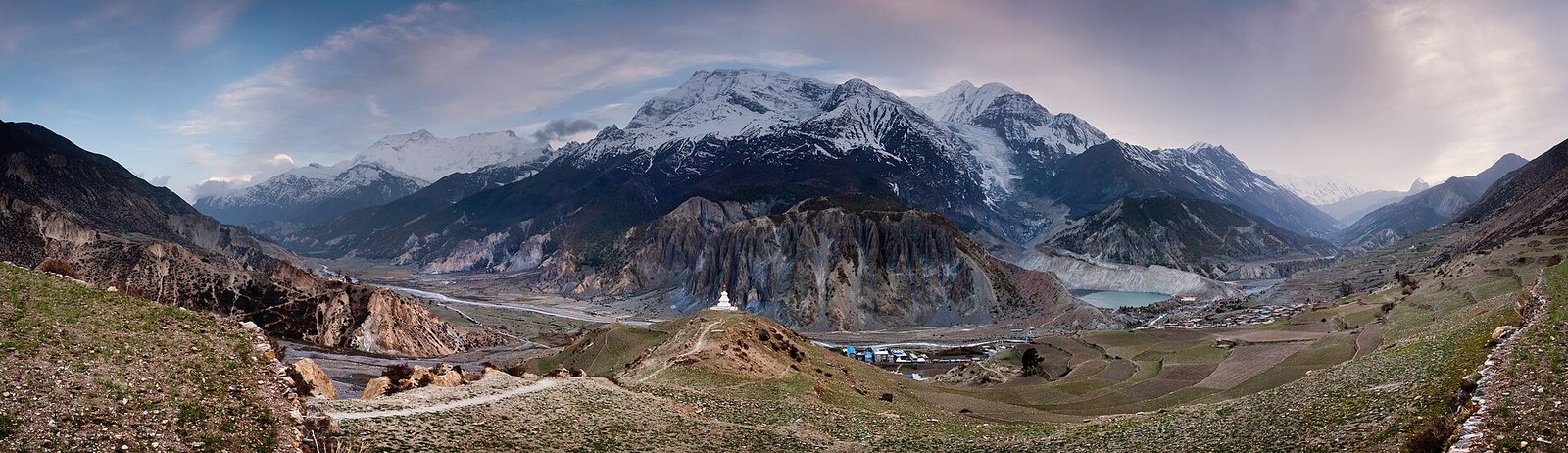
The Annapurna massif is a 55-km-long chain of peaks, including Annapurna I, II, III and IV, Gangapurna, Annapurna South and the sacred, unclimbed Machapuchare (6,993 m), the "Fishtail" peak above Pokhara. To the west, the Kali Gandaki river cuts one of the deepest gorges in the world between Annapurna I and Dhaulagiri I, and north of the range lie the dry, high valleys of Manang and Mustang, in the rain shadow of the Himalaya. The southern slopes are green and terraced, with Gurung and Magar villages, rhododendron forests and rice fields, while the north has a Tibetan Buddhist culture. Most of the area is in the Annapurna Conservation Area, Nepal's largest protected area, set up in 1986 and managed with local communities. Pokhara, a lakeside city about 200 km west of Kathmandu, is the main gateway.
Treks
Annapurna Circuit
The Annapurna Circuit is one of the world's classic long-distance treks, circling the Annapurna massif through the Marsyangdi valley, Manang, the Thorong La pass (5,416 m) and down to Muktinath and the Kali Gandaki valley. It traditionally took about three weeks, but roads now reach far up both sides, and most treks today take 12 to 18 days, using alternative trails to avoid the road where possible. Highlights include Manang, with acclimatisation hikes to Ice Lake and Tilicho Lake, and the long crossing of the Thorong La. See our Annapurna Circuit page.
Annapurna Base Camp
The Annapurna Base Camp trek, also called the Annapurna Sanctuary trek, goes north from near Pokhara through Gurung villages such as Ghandruk and Chhomrong, then up the narrow Modi Khola gorge into the Annapurna Sanctuary, a glacial basin surrounded by peaks, to Annapurna Base Camp at about 4,130 m. It usually takes 7 to 12 days and is one of the most popular treks in Nepal. See our Annapurna Base Camp page.
Poon Hill, Mardi Himal and Khopra Ridge
The Poon Hill trek is a short trek of about four days from near Pokhara to Ghorepani, with a sunrise climb to Poon Hill (3,210 m) for views of Dhaulagiri and the Annapurnas. It is good for beginners, families and travellers with limited time; see our Poon Hill page. The Mardi Himal trek follows a ridge to a high camp and viewpoint below Machapuchare, usually in five to seven days, and is quieter than Annapurna Base Camp; see our Mardi Himal page. The Khopra Ridge trek, west of Poon Hill, uses community lodges on a ridge facing Dhaulagiri and Annapurna South and is quieter still; see our Khopra Ridge page.
Upper Mustang and Nar–Phu
Upper Mustang, north of Jomsom, is a restricted area with a Tibetan culture, the walled town of Lo Manthang, and dramatic eroded landscapes. Trekkers need a special permit, now US$50 per person per day according to the Nepal Tourism Board, and must travel with a licensed guide through a registered agency. See our Upper Mustang page. The Nar and Phu valleys, north of Manang, are another restricted area, often combined with the Annapurna Circuit or with Mustang over high passes.
Climbs
Annapurna I
Annapurna I, at 8,091 m, was the first 8,000-metre peak ever climbed, by Maurice Herzog and Louis Lachenal of a French expedition on 3 June 1950, three years before Everest. It is notorious for avalanche danger, and historically has had one of the highest ratios of deaths to summits of any 8,000-metre peak, although commercial expeditions in recent years have had better success. It is climbed mainly in spring, from a base camp on the north side, and is only for very experienced high-altitude climbers.
Himlung Himal and Saribung
Himlung Himal, at about 7,126 m, near the Tibetan border north of Manang, is a popular first 7,000-metre peak, approached through the Nar–Phu valley. Saribung, a remote peak of over 6,000 m between Mustang and Nar–Phu, is usually climbed as part of a long expedition-style trek over the Saribung pass. Other climbs in the region include Chulu East and West, Pisang Peak and Tharpu Chuli (Tent Peak) in the Annapurna Sanctuary.
Lamjung Himal
Lamjung Himal Base Camp, on the eastern side of the massif, is a quiet, off-the-beaten-track trek to the foot of Lamjung Himal, reviewed on ExpedReview by a client of The Mountain Company.
Permits and the guide rule
Trekkers in the Annapurna region need an Annapurna Conservation Area Project (ACAP) permit, and those going to Upper Mustang, Nar–Phu or other restricted areas also need a restricted area permit from the Department of Immigration, arranged through a registered agency. Since 2023, the Nepal Tourism Board has required foreign trekkers in national parks and conservation areas, including the Annapurna Conservation Area, to trek with a licensed guide, though enforcement has varied and rules may change; check the current situation before you go. In restricted areas, trekkers must have a licensed guide and an agency, and since March 2026 solo trekkers have been allowed under those conditions, with a limit of seven trekkers per guide (The Kathmandu Post). Climbers need a climbing permit for the peak, issued through an agency.
When to go
The best seasons are autumn, from October to November, with clear skies after the monsoon, and spring, from March to May, when the rhododendrons bloom, though haze and afternoon cloud are more common. Winter, from December to February, is cold, and the Thorong La can be closed by snow; lower treks such as Poon Hill are still possible. The monsoon, from June to September, brings heavy rain, leeches and landslides to the southern treks, but Upper Mustang and the upper Manang valley are in the rain shadow and can be trekked in summer.
Safety
The main risks in the region are altitude sickness, especially on the Annapurna Circuit, where trekkers cross the Thorong La at 5,416 m; avalanches, which have hit the Annapurna Base Camp trail in the Modi Khola gorge; landslides in the monsoon; and road accidents. In October 2014, a sudden blizzard caused by the remnants of Cyclone Hudhud killed more than 40 people, including trekkers, guides and porters, in the Thorong La area, one of the worst trekking disasters in Nepal's history. Acclimatise gradually, follow your guide's advice on weather, avoid crossing the pass in bad conditions, and carry good insurance covering helicopter evacuation. Choose an operator that looks after its staff and porters, with proper equipment and insurance.
Teahouses, roads and getting there
Most treks in the region use teahouses, family-run lodges with simple rooms and dining rooms serving Nepali and international food. Standards vary from basic to comfortable, and some lower villages now have hot showers, wifi and charging. Camping is needed only on remote routes, such as Saribung, and on climbs. Roads have spread across the region in the past two decades, especially on the Annapurna Circuit and in Mustang, and jeeps can shorten treks, though many trekkers prefer the trails. Pokhara is reached from Kathmandu by a short flight or a long drive, and Jomsom by a flight from Pokhara.
Cost
No operator lists a current price for the region on ExpedReview, so ask each one directly. Prices for treks vary with the length of the trek, group size, the standard of accommodation, and whether you hire a guide only or a guide and porters. Restricted areas such as Upper Mustang cost more because of permit fees. When comparing prices, check what is included: permits, transport, hotels in Kathmandu and Pokhara, meals on the trek, guide and porter wages and insurance, and any flights. As one reviewer noted, some local operators ask for a deposit by bank transfer and the balance in cash in Nepal, so ask how and when you will pay.
How to choose an operator
Ask about the guide's licence and experience on your route, the itinerary and acclimatisation days, the group size, how the operator handles altitude sickness and emergencies, and what happens if the Thorong La or another pass is closed. Ask how they care for porters, including loads, equipment and insurance. Read the reviews above: recent reviews of Ace the Himalaya, Dream Himalaya Adventures, Yam adventure and treks and Himalaya Hub Adventure describe individual guides by name, which can help you request one. For climbs, ask about the expedition leader's experience on the peak and the safety record. Solo trekkers, especially women, may want to ask operators directly about how they look after solo clients, given the concerns raised in the critical review above. Our how-to-choose guide has more questions to ask.
Frequently asked questions
Which is the best trek in the Annapurna region?
It depends on your time and experience. Poon Hill is a short, easy introduction; Annapurna Base Camp takes about 7 to 12 days into a spectacular mountain basin; the Annapurna Circuit is a longer, higher trek over the Thorong La; and Upper Mustang offers a different, cultural experience in a restricted area.
Do I need a guide in the Annapurna region?
Rules introduced in 2023 require foreign trekkers in conservation areas to hire a licensed guide, though enforcement has varied. In restricted areas such as Upper Mustang, a licensed guide and a registered agency are always required.
When is the best time to trek in the Annapurna region?
October to November and March to May. Upper Mustang can also be trekked in summer.
Was Annapurna I the first 8,000-metre peak climbed?
Yes. Maurice Herzog and Louis Lachenal reached the summit on 3 June 1950.
Which operator is ranked first in Annapurna and Mustang on ExpedReview?
As of 23 October 2026, The Mountain Company, with 4.8★ from 11 verified reviews, the latest from September 2021.