Should Everest Base Camp Be Moved? The Debate, the Science and Where It Stands Now
By Blake Penson · December 19, 2022
Category: expedition-news
6 min read
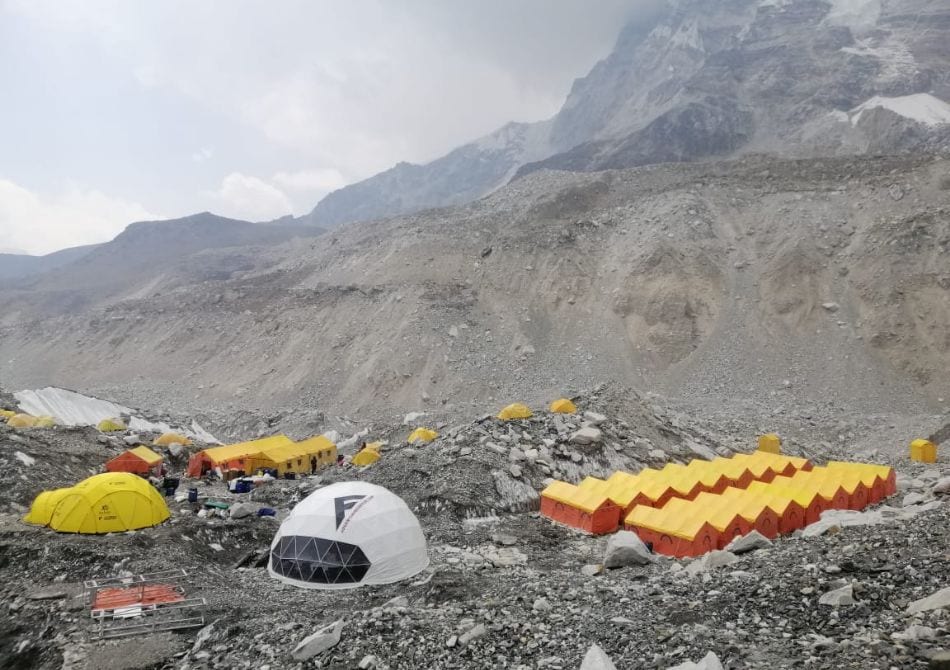
Everest Base Camp has not moved. In June 2022, Nepal's tourism department said it would study moving the camp, which sits at about 5,364 m on the thinning Khumbu Glacier, to a site 200–400 m lower. After strong opposition from the Sherpa community and the climbing industry, the BBC reported in May 2023 that the plan had been shelved, though officials said a study was continuing. In December 2025, the idea came back: Nepal's first five-year Everest Cleaning Action Plan (2025–2029) includes a feasibility study into relocating Base Camp, alongside measures on waste, fixed ropes and the mountain's carrying capacity. No new site has been chosen or approved. For climbers and trekkers, the camp, the trek and the route through the Khumbu Icefall remain as they are for now. This article, first published in December 2022 and updated in October 2026, explains both sides of the debate.
| Current location | Khumbu Glacier, about 5,364 m |
| Original proposal | June 2022: study a move 200–400 m lower, off the glacier |
| Industry response | More than 95% of attendees rejected the idea at a 2023 consultation (BBC) |
| Status May 2023 | Shelved, with a study said to be continuing |
| Status December 2025 | Feasibility study included in the Everest Cleaning Action Plan 2025–2029 |
| Site chosen? | No |
| Glacier thinning near Base Camp | About 1 m per year (2018 Leeds University study, reported by the BBC) |
Why Nepal proposed moving Base Camp
Everest Base Camp on the Nepal side sits on the Khumbu Glacier, a river of ice covered in rock and debris. Scientists have found that the glacier is thinning quickly: a 2018 study by researchers from the University of Leeds found that the section near Base Camp was thinning by about a metre a year. As the ice melts, ponds form on the surface and join up, streams run through the camp, and crevasses open in places where tents once stood.
Field studies have also shown that the ponds and lakes on the glacier are growing and joining up. Professor Bryn Hubbard of Aberystwyth University, who led a three-year project on the glacier's ice, told the BBC that as the ice melts beneath the debris, the surface becomes more uneven, encouraging ponds that gradually merge into large lakes.
At the same time, Base Camp has grown into a seasonal tent city. During the spring season, hundreds of climbers and many more support staff live there for weeks, with kitchen tents, generators, heaters and, at some camps, luxury facilities. Officials argued that moving Base Camp to stable ground off the glacier would improve safety and reduce pollution.
"We are now preparing for the relocation, and we will soon begin consultation with all stakeholders," Taranath Adhikari, then director general of Nepal's tourism department, told the BBC in 2022. "It is basically about adapting to the changes we are seeing at the base camp, and it has become essential for the sustainability of the mountaineering business itself."
Officials looked at two sites 200–400 m lower. Either would add a long walk on the way to the Khumbu Icefall, where climbers first need crampons. Officials also said they would not move the camp before the 2024 season.
The case against moving
Base Camp is still the safest place to sleep
Dawa Steven Sherpa, chief executive of Asian Trekking and a member of the committee studying the move, told ExplorersWeb that the idea was forward-looking rather than a response to an emergency. "Base Camp and the Khumbu Glacier on which it sits is no more unstable than in the past," he said. "There certainly are no cavities under the ice that could swallow up Base Camp or pose a threat to anyone's life. Also, no crevasses are suddenly ripping open overnight to devour tents." He added that the current site is still the place best shielded from avalanches.
No good alternative site
Kami Rita Sherpa, who holds the record for the most Everest summits, told The Third Pole that moving Base Camp would create chaos. "If you move Base Camp lower, say to Gorak Shep (5,150 metres/17,000 feet), then it will just be a stopover before the current base camp, as it's nearly impossible to hike from the moved Base Camp to Camp I," he said. "And you can't stay anywhere in between, as there isn't any suitable spot except the current base camp. It will be just an added camp, not an alternative."
The Icefall timing problem
Sherpa climbers cross the Khumbu Icefall early in the morning, before the sun warms the ice and increases the risk of collapsing seracs, avalanches and rockfall. Mingma Sherpa, chair of the Khumbu Pasang Lhamu Rural Municipality, told the BBC that a lower camp would add nearly three hours of walking and delay the start of the Icefall crossing. Teams would then simply set up an advanced camp at the old site, defeating the purpose of the move.
An operator's view
Lukas Furtenbach, founder of Furtenbach Adventures, told ExpedReview in 2022 that he did not see an immediate need to move Base Camp. "I don't see an immediate problem with the increased melting on the Khumbu glacier, except that the campsites (platforms) need more maintenance work during the season," he said. "In the past, we have seen that not all of the area where modern basecamp stretches is safe. Some areas are exposed to gravitational mass movement and avalanches from surrounding terrain."
He added that, with more than 2,000 people living in the area for over two months every year, he would order a risk analysis by international experts if he were the responsible official in the Nepalese government. He said he was not aware of any assessment by a recognised expert so far, so "any decision taken without that would be a gut decision."
He agreed that operators would likely keep a camp at the current site. "The climb to C1 will be longer, depending on where they plan the new EBC location," he said. "For some people, maybe too long. These people will need an interim camp. And where could that be? Definitely not in the Khumbu Icefall. At the site of the original EBC."
The 2023 consultation and the shelving of the plan
In May 2023, the BBC reported that the plan had been shelved after widespread opposition. Tourism ministry officials and the Nepal Mountaineering Association said more than 95% of attendees at a consultation with the mountaineering industry rejected the idea. "I have come across not even a single person in our community who supports the idea of moving the Everest base camp," Mingma Sherpa told the BBC. Ang Norbu Sherpa, president of the Nepal National Mountain Guides Association, asked where the study on a viable alternative was. Nepal's tourism minister at the time said the issue was not urgent, though officials maintained that a study was continuing.
Not everyone opposed the idea. Adrian Ballinger, founder of Alpenglow Expeditions, told the BBC the plan made sense because the camp would face more avalanches, ice and rockfall in the future. And almost everyone agreed that Base Camp had grown too crowded. Nepal issued a record 478 Everest permits in spring 2023, according to the BBC, meaning more than 1,500 people on the mountain including support staff. See our report on the record 2023 season.
What critics wanted instead
Many critics argued that moving Base Camp would do less good than other measures, including:
- Minimum qualifications for climbers and guides, so fewer inexperienced people go high.
- Limits on permits, based on the mountain's capacity.
- Removing all human waste from the camps on the mountain.
- Electrifying Base Camp, which Kami Rita Sherpa said would replace cooking gas and reduce warming in the valley.
- Semi-permanent toilets at Base Camp, replacing the blue barrels that porters now carry down to disposal sites.
- Regulating the size and services of camps, a concern raised by the Expedition Operators' Association Nepal about "deluxe" facilities.
Other ideas: helicopters and a new route
Two ideas have been suggested to avoid an advanced camp at the old Base Camp site. The first is using helicopters to carry loads to Camp 2, which would lighten the long walk from a lower Base Camp but would add cost, noise and emissions. The second is a new route avoiding the Khumbu Icefall, proposed by the French mountaineer Marc Batard, which many experienced climbers argued would be more technical and more exposed to avalanches than the existing route.
Kami Rita Sherpa warned that making the Nepal side longer and more expensive could push climbers to Tibet's Northeast Ridge. Furtenbach doubted this, because China strictly limits permits and operators. See Everest South Col vs Northeast Ridge.
The 2025–2029 Everest Cleaning Action Plan
In December 2025, Nepal's Ministry of Culture, Tourism and Civil Aviation released its first five-year Everest Cleaning Action Plan, following a Supreme Court order. According to the Kathmandu Post, it includes:
- A feasibility study into relocating Base Camp, which a Department of Tourism director described as "overcrowded and fragile".
- Carrying capacity: new laws to define how many climbers the mountain can take, and to regulate climbing timelines.
- Fixed ropes and ladders: rope-fixing teams must report what they use, and expeditions must bring back what they install.
- A garbage collection point at Camp 2, with climbers bringing down a set amount of old rubbish from above.
- Inventories of goods at the start and end of every expedition.
- Biodegradable flags and banners above Base Camp.
- Mountain rangers to monitor waste management.
- A proposal to turn the US$4,000 garbage deposit, in place since 2014, into a non-refundable fee for a mountain welfare fund.
The plan also sits alongside a rise in the spring royalty for foreign climbers on the South Col route from US$11,000 to US$15,000 from 1 September 2025, and compulsory poop bags above Base Camp since 2024. See our guide to the Everest permit fee.
What it means for climbers and trekkers
For now, nothing changes on the ground. Climbing teams still use the current Base Camp, and trekkers still walk from Gorak Shep to the camp's edge. If a move is ever approved, it would probably come with years of consultation and a transition period, and operators expect that some form of camp at the current site would remain for the Icefall.
What has changed is the rules on waste and equipment, and the cost of permits. If you are planning an Everest climb, check that your operator follows the new waste and rope rules and builds them into its plans. If you are trekking, choose operators that carry out rubbish, use proper toilets and avoid single-use plastic.
Where the debate goes next
The underlying problem has not gone away: the glacier is still thinning, and the camp is still crowded. Dawa Steven Sherpa has suggested that Everest may be at a turning point, between further commercialisation and greater accessibility for less experienced climbers, and a mountain climbed on its own terms by those with the skills to do so. Whether the answer is a new Base Camp, better regulation, or both, the debate is likely to continue for years.
Planning a trip to Base Camp
Base Camp treks and climbs are still running. Compare operators by verified client reviews on our Everest Base Camp trek page, see how to choose an EBC trek operator and read our trek cost guide. For climbers, see how to choose an Everest operator.
Frequently asked questions
Has Everest Base Camp been moved?
No. As of October 2026, Base Camp is still on the Khumbu Glacier at about 5,364 m, and no new site has been chosen.
Why did Nepal want to move Everest Base Camp?
Because the Khumbu Glacier is thinning and becoming less stable, and because the camp has become crowded and polluted.
Why did Sherpas oppose the move?
They said there was no suitable site, that the current camp is the safest place to sleep, and that a lower camp would delay early crossings of the Khumbu Icefall.
What is the Everest Cleaning Action Plan?
A five-year plan (2025–2029) released by Nepal in December 2025, covering waste, fixed ropes, carrying capacity and a feasibility study on relocating Base Camp.
How fast is the Khumbu Glacier melting?
A 2018 University of Leeds study found the section near Base Camp was thinning by about 1 m a year.
Would moving Base Camp affect trekkers?
Possibly, but no plan has been approved, so the trek is unchanged for now.
Tags: everest-base-camp, khumbu-glacier, nepal, climate-change, relocation