Annapurna Base Camp Trek Guide (2026): Itinerary, Permits, Altitude, Difficulty and Best Time
By Blake Penson · June 9, 2022
Category: destination-guides
7 min read
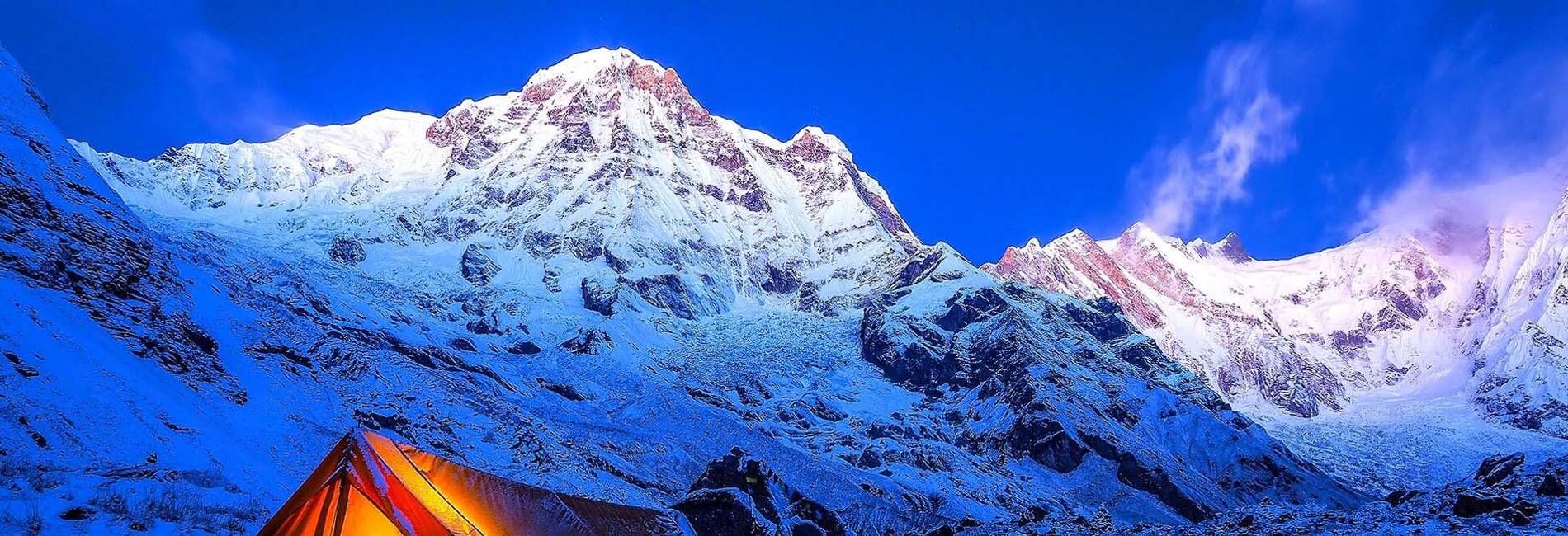
The Annapurna Base Camp (ABC) trek is a moderate teahouse trek in central Nepal that climbs from the Pokhara area into the Annapurna Sanctuary, a high glacial basin ringed by peaks including Annapurna I (8,091 m) and Machapuchare (6,993 m). Annapurna Base Camp sits at about 4,130 m (13,550 ft). Most itineraries take 7 to 12 days from Pokhara, depending on the start point and whether you add Poon Hill or the Jhinu hot springs. Since 1 April 2023, foreign trekkers must hire a licensed guide and need an Annapurna Conservation Area Permit (ACAP, NPR 3,000) and a TIMS card. The best months are October to November and March to May. The trek suits fit beginners with good preparation; there is no technical climbing, but there are thousands of stone steps and a real risk of altitude sickness and, in winter and spring, avalanches in the gorge.
| Fact | Detail |
|---|---|
| Location | Annapurna Conservation Area, Kaski District, Gandaki Province, Nepal |
| Highest point | Annapurna Base Camp, about 4,130 m (13,550 ft) |
| Other key point | Machapuchare Base Camp (MBC), about 3,700 m |
| Start/finish | Pokhara (by road to Nayapul, Kimche, Ghandruk or Siwai) |
| Duration | Typically 7–12 days from Pokhara |
| Difficulty | Moderate; long stair sections; altitude above 3,000 m |
| Accommodation | Teahouses (lodges) throughout |
| Permits | ACAP (NPR 3,000; SAARC nationals NPR 1,000) and TIMS card |
| Guide | Mandatory for foreign trekkers since 1 April 2023 |
| Best seasons | Autumn (October–November) and spring (March–May) |
Where is Annapurna Base Camp?
Annapurna Base Camp is in Nepal, in the Annapurna Conservation Area north of Pokhara, Nepal's second-largest tourist city. It lies at the head of the Modi Khola valley, inside the Annapurna Sanctuary, a high amphitheatre surrounded by peaks. The only way in is through a narrow gorge between Hiunchuli and Machapuchare.
Annapurna I, at 8,091 m, was the first 8,000 m peak to be climbed, by a French expedition led by Maurice Herzog in 1950. It is also one of the deadliest. The south face, which towers above ABC, is one of the great walls of the Himalaya.
Machapuchare, the "Fish Tail" mountain, is sacred to local people and closed to climbing. Its distinctive double summit dominates the view on much of the trek.
How to reach Annapurna Base Camp
- Fly or drive to Pokhara. Flights from Kathmandu take about 25 minutes. Pokhara International Airport opened in January 2023. Tourist buses and private vehicles take most of a day on the road.
- Drive from Pokhara to the trailhead. Common starts are Nayapul, Kimche (for Ghandruk), and Siwai or Jhinu (for a shorter route). Road extensions have shortened the walk-in in recent years.
- Trek up the Modi Khola valley via Chhomrong, Bamboo, Dovan, Himalaya and Deurali to Machapuchare Base Camp and then ABC.
- Return the same way, often via the Jhinu hot springs.
Pokhara: the gateway town
Pokhara sits beside Phewa Lake, with the Annapurna range and Machapuchare rising to the north. It is Nepal's main base for treks in the Annapurna region, with plenty of hotels, restaurants and gear shops where you can buy or rent trekking equipment. Most trekkers spend a night or two in Pokhara before and after the trek to meet their guide, collect permits and rest.
Popular activities before or after the trek include boating on Phewa Lake, visiting the World Peace Pagoda, sunrise at Sarangkot and paragliding. Pokhara is also a good place to recover if weather delays your plans.
Typical day on the trail
A typical trekking day starts with breakfast at around 7 am, then a morning's walk of three to four hours to a lunch stop. After lunch, most groups walk another two to three hours to reach the next teahouse by mid-afternoon, before the afternoon cloud and rain that are common in many seasons. Evenings are spent in the dining room around a stove, eating dinner, playing cards and talking with other trekkers. Most people are in bed by 8 or 9 pm, ready for an early start.
Annapurna Base Camp trek itinerary
The itinerary below is a typical 10-day trip from Pokhara including Poon Hill. Altitudes are approximate and vary between sources.
| Day | Route | Approximate altitude at night |
|---|---|---|
| 1 | Drive Pokhara to Nayapul/Ulleri area; trek to Tikhedhunga or Ulleri | 1,500–2,000 m |
| 2 | Trek to Ghorepani | about 2,860 m |
| 3 | Dawn hike to Poon Hill (3,210 m); trek to Tadapani | about 2,600 m |
| 4 | Trek to Chhomrong | about 2,170 m |
| 5 | Trek to Bamboo or Dovan | 2,300–2,600 m |
| 6 | Trek to Deurali | about 3,200 m |
| 7 | Trek via MBC to Annapurna Base Camp | about 4,130 m |
| 8 | Sunrise at ABC; descend to Bamboo | about 2,300 m |
| 9 | Descend to Jhinu Danda (hot springs) | about 1,780 m |
| 10 | Trek out and drive to Pokhara | about 820 m |
Shorter options
Itineraries of 5 to 7 days are possible by driving closer to Chhomrong and skipping Poon Hill. A four-day "ABC" trip is very rushed. It skips acclimatisation and is only for very fit, experienced trekkers. Shorter itineraries increase the risk of altitude sickness and leave no spare days for bad weather.
Longer options
Many trekkers add days for rest, side trips or a slower ascent. The ABC route can also be combined with the Mardi Himal trek or, for experienced trekkers, with the Annapurna Circuit as part of a longer journey.
Day-by-day trail notes
Pokhara to Ghorepani
Most treks begin with a drive from Pokhara along the Baglung road to Nayapul, then up the Bhurungdi Khola valley. Jeeps now continue further up the valley, so many trekkers start walking near Tikhedhunga. The climb from Tikhedhunga to Ulleri is one of the most famous staircases in Nepal, with thousands of stone steps rising steeply through the village. Above Ulleri, the trail enters rhododendron and oak forest to Ghorepani, a large village of lodges on a ridge.
Poon Hill and Tadapani
Poon Hill (3,210 m) is a pre-dawn hike of about an hour from Ghorepani. On clear mornings it gives a sweeping view of Dhaulagiri, Annapurna South, Hiunchuli, Machapuchare and the Annapurna range. It is one of the most popular viewpoints in Nepal and gets crowded in peak season. The trail then follows forested ridges to Deurali pass and drops to Tadapani, a small settlement with views of Annapurna South and Machapuchare.
Chhomrong: gateway to the sanctuary
Chhomrong is a large Gurung village on a steep hillside, and the last major settlement before the sanctuary. It is a good place to buy last supplies, use an ATM if one is working, or rest. Above Chhomrong, the trail drops on a long staircase to a suspension bridge over the Chhomrong Khola and then climbs again. Many trekkers find this the toughest section of the trek, especially on the return.
Bamboo, Dovan and Himalaya
Beyond Chhomrong, the trail enters the Modi Khola gorge through bamboo and rhododendron forest. Settlements here are small clusters of lodges rather than villages. The forest is damp and can be slippery, and in spring the rhododendrons flower in red, pink and white. Langurs and other wildlife may be seen.
Deurali to Machapuchare Base Camp
Above Deurali, the valley narrows and the trees give way to grass and scrub. This is the avalanche-prone section of the route, especially in winter and spring. The trail climbs gradually beside the river and moraine to Machapuchare Base Camp, a cluster of lodges beneath the Fish Tail.
Machapuchare Base Camp to ABC
The final section climbs gently across open meadows into the heart of the sanctuary. ABC sits on a ridge beside the Annapurna South Glacier, with 360-degree views of Annapurna I, Annapurna South, Hiunchuli, Gangapurna, Annapurna III, Machapuchare and other peaks. A memorial area at ABC remembers climbers who died on Annapurna. Sunrise, when the first light turns the summits gold, is the highlight of the trek for many visitors.
The return and the Jhinu hot springs
Most trekkers descend the same way to Chhomrong and then drop to Jhinu Danda, where natural hot springs beside the Modi Khola are a welcome treat for tired legs. From Jhinu, a short walk and drive return you to Pokhara.
Training for the Annapurna Base Camp trek
You do not need to be an athlete, but training makes the trek more enjoyable and safer.
- Start 8–12 weeks before your trip.
- Walk regularly with a loaded rucksack, building up to 5–6 hour days.
- Train on stairs or steep hills. ABC's stone steps punish weak legs, especially on descents.
- Add strength training for legs and core, such as squats, lunges and step-ups.
- Build cardiovascular fitness with running, cycling or swimming.
- Do back-to-back training days to simulate consecutive trekking days.
Altitude sickness on the Annapurna Base Camp trek
ABC is lower than many famous Himalayan treks, but altitude sickness is still common, especially on fast itineraries that climb from below 2,500 m to 4,130 m in two days.
| Condition | Main symptoms | What to do |
|---|---|---|
| AMS | Headache, nausea, fatigue, poor sleep, dizziness | Rest; do not go higher until better; descend if worse |
| HAPE | Breathlessness at rest, cough, weakness | Descend immediately; seek medical help |
| HACE | Confusion, loss of coordination, severe headache | Descend immediately; seek medical help |
Ways to reduce the risk:
- Choose an itinerary with gradual ascent, including Poon Hill or extra days.
- Stay hydrated and eat well.
- Avoid alcohol at higher altitudes.
- Tell your guide about any symptoms.
- Discuss medication such as acetazolamide with a doctor before travel.
Weather on the trek
Temperatures vary enormously between the warm valleys and the high sanctuary. In autumn and spring, days at lower altitudes are often warm, while nights at ABC can be well below freezing. Afternoon cloud is common in spring, and the monsoon brings daily rain from June to September. Winter brings snow to the upper trail and can close the route after heavy falls. Always pack for cold conditions at the top, whatever the season.
Mobile coverage, charging and money
Many lodges offer Wi-Fi and phone charging for a fee, and mobile coverage is available on parts of the route. Coverage can be patchy in the gorge. Carry enough Nepali rupees in cash for the whole trek, as card payments and ATMs are unreliable beyond the larger villages.
Annapurna Base Camp altitude and height
| Place | Altitude (m) | Altitude (ft) |
|---|---|---|
| Pokhara | about 820 | about 2,700 |
| Ghandruk | about 1,940 | about 6,360 |
| Chhomrong | about 2,170 | about 7,120 |
| Deurali | about 3,200 | about 10,500 |
| Machapuchare Base Camp | about 3,700 | about 12,140 |
| Annapurna Base Camp | about 4,130 | about 13,550 |
| Poon Hill (side trip) | 3,210 | about 10,530 |
ABC is lower than Everest Base Camp, which sits at around 5,364 m, but it is still high enough to cause altitude sickness. Ascend gradually, drink plenty of water and know the symptoms of acute mountain sickness (AMS), high-altitude pulmonary oedema (HAPE) and high-altitude cerebral oedema (HACE). Descend if symptoms worsen.
Permits and rules for 2026
| Requirement | Detail |
|---|---|
| ACAP permit | NPR 3,000 for foreign nationals; NPR 1,000 for SAARC nationals |
| TIMS card | NPR 2,000 for foreign trekkers, usually arranged by your agency |
| Licensed guide | Mandatory for foreign trekkers since 1 April 2023 |
| Where to get permits | Through a registered trekking agency, the Nepal Tourism Board offices in Kathmandu or Pokhara, or as arranged by your guide |
Check the latest rules before you go, because fees and procedures change.
Can you trek Annapurna Base Camp solo?
Not as an independent foreign trekker. Since 1 April 2023, the Nepal Tourism Board has required foreign trekkers in national parks and conservation areas to trek with a licensed guide arranged through a registered agency. You can still trek as a "solo" client with your own private guide, which is a popular and affordable option. Nepali citizens are not affected by the rule.
How difficult is the Annapurna Base Camp trek?
ABC is usually rated moderate. There is no technical climbing, but the trek is physically demanding:
- Stone steps: the route is famous for its long staircases, especially around Chhomrong, Ulleri and the descent to and climb out of the Chhomrong Khola. Thousands of steps are typical over the trek.
- Daily distances: most days involve 5 to 7 hours of walking.
- Altitude: the last two days take you above 3,000 m and to about 4,130 m.
- Weather: rain, snow and cold are possible, especially outside the main seasons.
Most reasonably fit people who train for a few months can complete the trek. Read training for mountaineering for a preparation plan.
Best time to trek to Annapurna Base Camp
| Season | Months | Conditions |
|---|---|---|
| Autumn | October–November | Clear skies, stable weather, busiest season |
| Winter | December–February | Cold, fewer trekkers; snow and avalanche risk in the upper gorge |
| Spring | March–May | Warmer, rhododendrons in bloom; haze later in spring; avalanche risk early in the season |
| Monsoon | June–September | Heavy rain, leeches, landslides and cloud; quiet trails |
Annapurna Base Camp in April
April is one of the most popular months. Rhododendron forests bloom on the lower trail and temperatures are pleasant at lower altitudes. Mornings are usually clearest, with cloud building in the afternoon. Snow can still lie in the upper gorge, so check conditions with your guide.
Avalanche danger in the Annapurna Sanctuary gorge
The section between Deurali and Machapuchare Base Camp, and between Himalaya and Deurali, passes beneath steep slopes. After heavy snow, avalanches can sweep across the trail. In January 2020, an avalanche between Deurali and Himalaya hit a group of Korean trekkers and their Nepali guides. Local authorities sometimes close the upper trail after heavy snowfall. Always follow guidance from your guide, lodge owners and local authorities, and be ready to wait or turn back.
Annapurna Base Camp trek cost
The total cost depends on how you travel:
| Cost | Notes |
|---|---|
| Permits | ACAP NPR 3,000 + TIMS NPR 2,000 |
| Guide | Mandatory; a daily rate plus insurance, food and accommodation |
| Porter (optional) | Carries up to an agreed load; daily rate |
| Teahouse rooms | Often cheap if you eat at the lodge |
| Food and drink | The main daily cost; prices rise with altitude |
| Transport | Flights or buses to Pokhara; jeep or taxi to the trailhead |
| Tips | Customary for guides and porters at the end of the trek |
Package treks from registered agencies typically include permits, guide, accommodation and sometimes meals. Compare exactly what is included before booking. Read mountaineering on a budget for ways to save.
Accommodation and food on the trail
Teahouses line the route. Rooms are basic twin rooms with shared bathrooms, and higher lodges get colder and simpler. In peak season, ABC and MBC lodges fill up, so guides often book ahead. Food menus are surprisingly varied, but dal bhat is the best value and fuel for trekking. Upper Annapurna Sanctuary lodges follow local rules restricting some foods; for example, meat is traditionally not taken into the sanctuary out of respect for the sacred mountain.
Annapurna Base Camp vs Everest Base Camp
| Annapurna Base Camp | Everest Base Camp | |
|---|---|---|
| Altitude | about 4,130 m | around 5,364 m |
| Typical duration | 7–12 days | 12–14 days |
| Access | Road from Pokhara | Flight to Lukla (weather-dependent) |
| Difficulty | Moderate; many steps | Moderate to challenging; higher altitude |
| Scenery | Inside a ring of peaks; forests and villages | Glaciers, Everest, Lhotse, Ama Dablam |
| Crowds | Busy in peak season | Very busy in peak season |
Both are classic Nepal treks. ABC is shorter, lower and easier to reach; EBC is higher and has the Everest connection. Read our Everest Base Camp trek guide.
Annapurna Sanctuary trek vs Annapurna Circuit
The Annapurna Sanctuary trek is another name for the ABC trek: it goes into the sanctuary basin to Annapurna Base Camp. The Annapurna Circuit circles the whole Annapurna massif, crossing the Thorong La pass at about 5,416 m. The circuit is longer and higher, with more varied landscapes, but road building has changed parts of the route.
What to pack for Annapurna Base Camp
| Category | Items |
|---|---|
| Clothing | Base layers, fleece, insulated jacket, waterproof shell, trekking trousers, warm hat, gloves |
| Footwear | Broken-in trekking boots, camp shoes, good socks |
| Sleeping | Sleeping bag rated for below-freezing temperatures (many lodges also provide blankets) |
| Gear | Daypack or rucksack, trekking poles, headtorch, water bottles and purification, sunglasses, sun cream |
| Health | First-aid kit, blister care, personal medications; discuss altitude medication with a doctor |
| Documents | Passport, permits, insurance details, cash in Nepali rupees |
Microspikes are useful in winter and early spring. See mountaineering backpack essentials.
Safety and insurance
Most ABC treks pass without serious incident, but the trek reaches high altitude in remote country, and evacuation can take time. Prepare for the worst while expecting the best.
- Buy travel insurance that covers trekking up to at least 4,200 m and helicopter evacuation.
- Acclimatise properly and descend if symptoms worsen.
- Respect avalanche closures and local advice.
- Treat water or use refill stations to avoid illness and plastic waste.
- Watch for landslides in the monsoon and after heavy rain.
Responsible trekking
The Annapurna Sanctuary is a fragile high-mountain environment and a sacred place for local communities. Small choices by thousands of trekkers each year add up.
- Use refill stations instead of buying plastic bottles.
- Carry out your own rubbish.
- Respect local customs, including those around sacred Machapuchare.
- Pay and tip guides and porters fairly, and make sure porters have proper clothing and insurance.
People and culture of the Annapurna region
The lower part of the ABC trek passes through villages of the Gurung and Magar communities, among others. Ghandruk and Chhomrong are traditional Gurung villages with stone houses, slate roofs and terraced fields of rice, millet and potatoes. Many Gurung men have served in the British and Indian Army Gurkha regiments, and the region's history and wealth are closely tied to that service. Ghandruk has a small museum of Gurung culture.
Trekking tourism is now a major source of income. Many teahouses are family-run, and the Annapurna Conservation Area Project, managed by the National Trust for Nature Conservation, uses permit fees to support conservation, community development and tourism management. Respect local customs: ask before photographing people, dress modestly, walk clockwise around stupas and mani walls, and remove shoes when entering homes or religious sites.
Wildlife and nature
The ABC trek climbs through several ecological zones in a short distance, from subtropical farmland near Pokhara, through oak, rhododendron and bamboo forest, to alpine meadows and glacial moraine. The Annapurna Conservation Area is home to many bird species, as well as langur monkeys, Himalayan tahr and other mammals. Spring brings flowering rhododendrons, Nepal's national flower, which colour whole hillsides red and pink.
Combining ABC with other treks
| Trek | How it combines with ABC |
|---|---|
| Poon Hill | Classic add-on at the start for a famous sunrise viewpoint |
| Mardi Himal | A quieter ridge trek nearby; can be linked or done separately |
| Khopra Ridge | Less-visited ridge with big views of Dhaulagiri and Annapurna South |
| Annapurna Circuit | Separate long trek around the massif; some trekkers do both in one trip |
ExpedReview has pages for Poon Hill, Mardi Himal, Khopra Ridge and the Annapurna Circuit.
Who is the trek suitable for?
- First-time Himalayan trekkers with good fitness and preparation.
- Families with older children who are used to long walks, provided they take a slow itinerary.
- Older trekkers who are fit and healthy; check with a doctor first, especially about altitude.
- Solo travellers who are happy to trek with a private guide.
It is less suitable for anyone with knee problems that make long staircases painful, or with medical conditions affected by altitude. Talk to your doctor before booking.
Choosing a trekking agency
Because a licensed guide is mandatory, choosing a good agency is one of the most important decisions you will make. Check that the agency is registered with Nepal's Department of Tourism, that guides are licensed and insured, and that porters carry fair loads and are properly equipped. Read verified reviews and ask exactly what the price includes: permits, transport, accommodation, meals, guide and porter costs, and any extras such as hot showers or Wi-Fi.
Is Annapurna Base Camp worth it?
For most trekkers, yes. Few treks reach such a dramatic high-mountain setting in so few days. Waking at ABC to see the sun hit the south face of Annapurna, with Machapuchare, Hiunchuli and Annapurna South around you, is one of Nepal's great experiences. The trek also passes through Gurung villages, terraced fields and rhododendron forests.
Top-rated Annapurna Base Camp operators on ExpedReview
These operators have the highest average ratings from verified ExpedReview client reviews for Annapurna Base Camp (minimum two reviews; data as of 22 October 2026).
| Operator | ER average rating | Verified reviews |
|---|---|---|
| Ace the Himalaya | 5.0 / 5 | 2 |
| The Mountain Company | 4.7 / 5 | 2 |
See all reviews on ExpedReview's Annapurna Base Camp page.
Frequently asked questions
Where is Annapurna Base Camp?
In the Annapurna Sanctuary in central Nepal, north of Pokhara, inside the Annapurna Conservation Area.
Which country is Annapurna Base Camp in?
Nepal.
What is Annapurna Base Camp?
The base camp for climbing the south face of Annapurna I, and the destination of one of Nepal's most popular treks. It sits in a glacial basin surrounded by high peaks.
What is the altitude of Annapurna Base Camp?
About 4,130 m above sea level.
How high is Annapurna Base Camp in feet?
About 13,550 ft.
How long is the Annapurna Base Camp trek?
Most itineraries take 7–12 days from Pokhara, depending on the start point and side trips.
Can you do the Annapurna Base Camp trek in 4 days?
It is possible from a road end close to the trail, but very rushed, with little acclimatisation. A minimum of 6–7 days is more sensible for most trekkers.
How do I get to Annapurna Base Camp?
Fly or drive to Pokhara, then drive to a trailhead such as Nayapul, Kimche or Siwai, and trek via Chhomrong, Bamboo, Deurali and Machapuchare Base Camp.
Can I trek Annapurna Base Camp solo?
Not independently. Since 1 April 2023, foreign trekkers must hire a licensed guide. You can trek as a single client with a private guide.
Do I need a guide for Annapurna Base Camp?
Yes. A licensed guide has been mandatory for foreign trekkers since 1 April 2023.
What permits do I need for Annapurna Base Camp?
An Annapurna Conservation Area Permit (NPR 3,000 for foreigners; NPR 1,000 for SAARC nationals) and a TIMS card.
How difficult is the Annapurna Base Camp trek?
Moderate. There is no technical climbing, but there are long stair sections, 5 to 7 hours of walking most days and altitude up to about 4,130 m.
How many stairs are there on the Annapurna Base Camp trek?
There is no official count, but the trek involves thousands of stone steps, especially around Ulleri and Chhomrong.
What is the best time for Annapurna Base Camp?
October to November and March to May.
Is April a good time to trek to Annapurna Base Camp?
Yes. April brings rhododendron blooms and mild temperatures, though afternoons can be cloudy and snow may remain in the upper gorge.
Is the Annapurna Base Camp trek dangerous?
It is generally safe with a guide in the main seasons. The main risks are altitude sickness, avalanches in the upper gorge after heavy snow, and landslides in the monsoon.
What is the Annapurna Sanctuary trek?
Another name for the Annapurna Base Camp trek, which enters the high basin known as the Annapurna Sanctuary.
Is Annapurna Base Camp harder than Everest Base Camp?
Generally no. ABC is lower and shorter, although its steps make some days tough. EBC is higher and longer.
Can you see Annapurna from Annapurna Base Camp?
Yes. ABC lies beneath the south face of Annapurna I, with Annapurna South, Hiunchuli and Machapuchare also in view.
What is the Annapurna Base Camp trek like in Nepal for beginners?
It is one of the best first Himalayan treks for fit beginners, thanks to teahouses, a moderate maximum altitude and road access from Pokhara.
Sources
Data gathered by ExpedReview from operator websites and official sources, written in our own words:
- Nepal Tourism Board (guide requirement from 1 April 2023; TIMS).
- National Trust for Nature Conservation – Annapurna Conservation Area Project (ACAP permit).
- January 2020 avalanche: The Kathmandu Post.
- Annapurna I first ascent: Himalayan Database.
Tags: annapurna-base-camp, nepal, trekking, itinerary