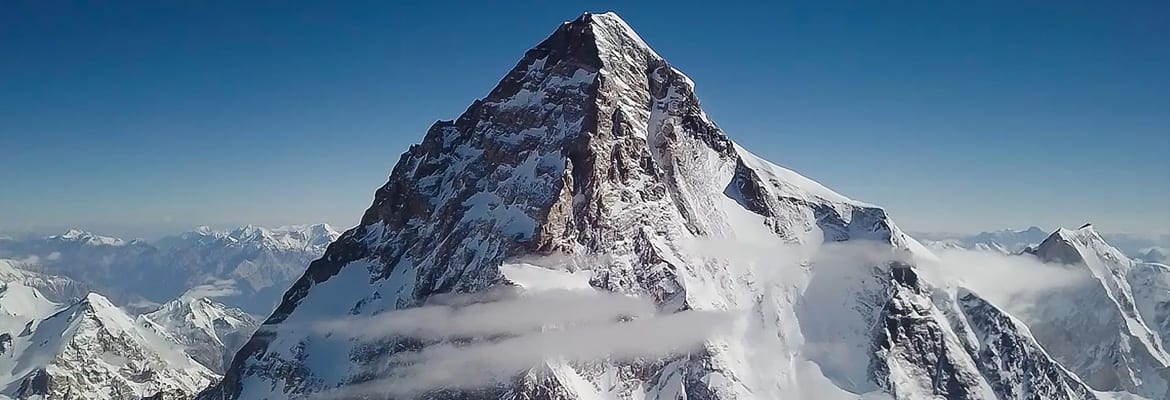
Gasherbrum I Expedition Guide and Verified Reviews (8,080 m)
Gasherbrum I, also called Hidden Peak or K5, is the eleventh-highest mountain in the world at 8,080 m, standing at the head of the Baltoro Glacier in Pakistan's Karakoram. It is a serious, remote 8,000 m peak reached by a week-long trek past K2, usually climbed in July by the Japanese Couloir on its north-west face, and often combined with neighbouring Gasherbrum II. On ExpedReview, as of 23 October 2026, one operator has one verified client review for Gasherbrum I: Summit Climb Germany (1.4★, August 2022), a detailed negative review. Below are the review, the route, the season and how to choose an operator.
Gasherbrum I: key facts | | | |---|---| | Height | 8,080 m (11th highest in the world) | | Other names | Hidden Peak, K5 | | Location | Gasherbrum group, Baltoro Muztagh, Gilgit-Baltistan, Pakistan (on the China border) | | First ascent | 5 July 1958, Pete Schoening and Andy Kauffman (American expedition led by Nicholas Clinch) | | Normal route | North-west face via the Japanese Couloir | | Base camp | About 5,000 m on the Gasherbrum Glacier (shared with Gasherbrum II) | | Season | Mid-June to early August | | Typical expedition | 7–8 weeks from Islamabad | | Operators reviewed on ExpedReview | 1, with 1 verified review (as of 23 Oct 2026) |
Gasherbrum I operators with verified reviews
ExpedReview ranks operators by their verified client reviews for each place: the star rating, adjusted so one or two reviews, or only old ones, count for less than many recent ones. Every review is checked by hand before it is published, critical reviews stay up, and operators cannot pay to appear or rank higher. Data as of 23 October 2026.
| Rank | Operator | Based in | Rating here | Reviews | Latest review |
|---|---|---|---|---|---|
| 1 | Summit Climb Germany | Germany (unclaimed profile) | 1.4★ | 1 | August 2022 |
What the review says. The client, writing in German, booked a full-service Gasherbrum I and II expedition for about €16,000. They report problems with organisation, communication and client care, including:
- The acclimatisation plan was changed from the Gasherbrums to Broad Peak, for which the client had no permit. After moving to Gasherbrum base camp, they say they waited nearly a week alone without a mess tent or their luggage.
- Services they had paid for, such as a satellite phone, shower tent, medical kit and luggage transport to base camp, were not provided or came late.
- On the summit push, as a storm arrived, the client turned back with the high-altitude porters while the leader continued, and could not reach the leader by radio for hours. The client says they were the leader's only client.
- The reviewer notes that the leader was an experienced professional mountaineer but not a state-certified mountain guide, and that the high-altitude porters had little formal training and little English.
The reviewer concludes that they received a basic service with high-altitude porters and that booking a local Pakistani operator directly would have been cheaper. This is one client's account; the company has not claimed its ExpedReview profile. It is a useful checklist of the questions to ask any Gasherbrum operator.
Summitclimb, a separate US-based company, also lists Gasherbrum I on ExpedReview but has no verified reviews for it yet. Do not confuse the two.
About the mountain
Gasherbrum I is the highest of the Gasherbrum group, a ring of peaks at the head of the Baltoro and Abruzzi glaciers. The name is often said to come from Balti words meaning "beautiful mountain". The British surveyor Thomas George Montgomerie gave it the label K5 in 1856, and the American climber William Martin Conway later called it Hidden Peak because it is hard to see from the Baltoro until you are close.
The first ascent came on 5 July 1958, when Pete Schoening and Andy Kauffman reached the top from the south, up a long ridge first explored by a 1934 international expedition, on a small American expedition led by Nicholas Clinch. In 1975 Reinhold Messner and Peter Habeler climbed a new route on the north-west face in alpine style, without fixed camps, high-altitude porters or supplementary oxygen, a landmark in Himalayan climbing. The peak has since been climbed by several routes, and its first winter ascent was made in March 2012 by the Polish climbers Adam Bielecki and Janusz Gołąb.
The approach
Like K2, Broad Peak and Gasherbrum II, Gasherbrum I is reached on foot up the Baltoro Glacier.
- Islamabad to Skardu. Fly about an hour, weather permitting, or drive for one to two days on the Karakoram Highway.
- Skardu to Askole. A rough jeep road of six to eight hours to the last village.
- Askole to Concordia. About six to seven days of trekking up the Braldu valley and the Baltoro Glacier, past the Trango Towers and Masherbrum, to Concordia, where K2, Broad Peak and the Gasherbrums come into view together.
- Concordia to base camp. One to two days up the Abruzzi Glacier to Gasherbrum base camp at about 5,000 m.
Porters carry loads to base camp. The trek is itself a big undertaking, with glacier walking, river crossings and long days at altitude, and gives useful early acclimatisation. It also passes some of the finest mountain scenery on Earth.
The climbing route
Most commercial teams climb the north-west face by the Japanese Couloir, sharing the lower mountain with Gasherbrum II:
- Base camp to Camp 1 (about 5,900 m). Through the Gasherbrum icefall, a maze of crevasses and seracs that changes every season, to the high basin known as the Gasherbrum cirque.
- Camp 1 to Camp 2 (about 6,400 m). Across the cirque to the foot of the north-west face, where routes to Gasherbrum I and II divide.
- Camp 2 to Camp 3 (about 7,000 m). Up steep snow and ice into the Japanese Couloir, with fixed ropes.
- Camp 3 to the summit. Up the upper couloir and the summit slopes, a long and exposed day that usually starts before midnight.
Heights vary from year to year with conditions. The icefall, avalanche risk in the cirque after snowfall, and the steep, icy couloir are the main hazards. Gasherbrum I is generally considered harder and more serious than Gasherbrum II.
When to climb
The Karakoram season is the northern summer. Most expeditions arrive at base camp in mid to late June and try for the summit in July or early August. The Karakoram is far less affected by the monsoon than the Nepal Himalaya, but it has its own storms, and summit windows can be short and few.
Permits and practicalities
Climbing permits for peaks in Gilgit-Baltistan are issued through the regional government, and the Central Karakoram National Park charges an entry fee. Expeditions must use a registered Pakistani agency, and a liaison officer may be required. Your operator will handle permits, porters and trekking logistics. Check visa rules for your nationality and current government travel advice for Pakistan, especially for the overland journey.
Travel insurance must cover climbing to 8,080 m and helicopter rescue. In Pakistan, helicopter rescue is run by a military-linked service and needs a pre-arranged guarantee, usually a deposit through your agency. Ask your operator exactly how this is set up before you leave.
Skills and experience
Gasherbrum I is not a first 8,000 m peak. You should have:
- At least one 8,000 m summit, or strong experience on 7,000 m peaks
- Confident skills on fixed ropes, steep snow and ice, and in icefall terrain
- The fitness and patience for seven to eight weeks away and long waits for weather
- Experience of rope-team glacier travel and crevasse rescue
Many climbers start with Gasherbrum II, Manaslu or Cho Oyu, then come to Gasherbrum I.
What it costs
The only price on ExpedReview for this peak comes from the review above, where the client says they paid about €16,000 for a combined Gasherbrum I and II package in 2022. That is one client's figure, not a current price. Costs vary widely depending on whether you book a Western-led expedition or a local Pakistani agency, the number of climbing Sherpas or high-altitude porters, oxygen and the base camp services included. Ask for a full written list of what is and is not included.
How to choose an operator
The review above is a good list of things to check:
- Get the itinerary in writing, including where you will acclimatise, and check that you have permits for every mountain you are expected to climb.
- Ask who leads and what qualifications they hold. Is the leader an IFMGA or nationally certified mountain guide, or an experienced climber? Both can be fine, but you should know.
- Ask about high-altitude support. How many porters or Sherpas per client, what training they have, and whether they speak your language.
- Ask about communication. Who carries radios and satellite phones, and what happens if the team splits on summit day?
- Ask what base camp services are included, such as mess tent, shower tent, medical kit, satellite internet and luggage transport.
- Ask about rescue. How is helicopter rescue guaranteed, and who pays?
- Talk to past clients. For a peak like this, references matter more than star ratings.
Climbing Gasherbrum I and II on one trip
Because the two peaks share a base camp, an icefall and Camp 1, many expeditions offer them together. The usual plan is to acclimatise on the lower slopes of both, climb Gasherbrum II first, rest at base camp, and then go for Gasherbrum I if time and weather allow. In theory it is efficient: one approach, one set of permits for the area and one long period of acclimatisation. In practice, climbing two 8,000 m peaks in one season takes great fitness and luck with the weather, and many climbers who plan both summit only one.
If you book a combined trip, ask how the schedule works if the first summit takes longer than expected, what happens to the second permit if you stop after one peak, and whether the support team, oxygen and fixed ropes are planned for both. The review above shows what can go wrong when plans change mid-expedition: if the acclimatisation or summit order changes, make sure you have the permits and support to match.
Life at base camp
Gasherbrum base camp sits on rubble-covered ice beside the glacier at about 5,000 m, and you may spend five or six weeks there. A good camp has a heated mess tent, a kitchen with cooks who know how to keep climbers eating at altitude, a toilet and shower tent, solar power, a satellite internet or phone link, and a proper medical kit. These things matter more than they sound. Eating well, staying healthy and keeping in touch with home make the long waits for weather easier and improve your chances on summit day.
Ask your operator for a written list of base camp services, and whether you share facilities with other teams or with clients bound for other peaks.
Risk
Gasherbrum I has a higher death rate than the most commercial 8,000 m peaks such as Cho Oyu and Manaslu. The main dangers are avalanches in the cirque after fresh snow, falls in the steep couloir, crevasses and seracs in the icefall, and the effects of extreme altitude: high-altitude cerebral and pulmonary oedema, frostbite and exhaustion. Remoteness adds to the risk, because rescue from the upper mountain is very difficult and helicopters cannot always fly.
The best protection is experience, good acclimatisation, a conservative turn-around time and a team that stays together on summit day.
Frequently asked questions
How high is Gasherbrum I?
8,080 m, the eleventh-highest mountain in the world.
Why is Gasherbrum I called Hidden Peak?
Because it is hidden behind other peaks and hard to see from most of the Baltoro Glacier. The name was given by William Martin Conway in 1892.
Who first climbed Gasherbrum I?
Pete Schoening and Andy Kauffman, on 5 July 1958, as part of an American expedition led by Nicholas Clinch.
Is Gasherbrum I harder than Gasherbrum II?
Yes, in general. Gasherbrum I is higher, and its Japanese Couloir route is steeper and more serious than the normal route on Gasherbrum II.
When is the best time to climb Gasherbrum I?
July and early August, with expeditions arriving at base camp from mid-June.
Which operators have verified reviews for Gasherbrum I?
As of 23 October 2026, Summit Climb Germany has one verified review (1.4★, August 2022).
Can operators pay to remove bad reviews on ExpedReview?
No. Operators cannot pay to appear, rank higher or have reviews removed, and critical reviews stay up.
Related articles
- How to choose a guide
- Best operators
- Karakoram and Ladakh Guides: Verified Reviews for K2, Broad Peak and the K2 Base Camp Trek
Climbing and trekking in Pakistan's Karakoram and Ladakh: operators ranked by verified ExpedReview client reviews for K2, Broad Peak, Gasherbrum I and the K2 Base Camp trek, the Baltoro approach, season, permits, safety, cost and how to choose an operator.