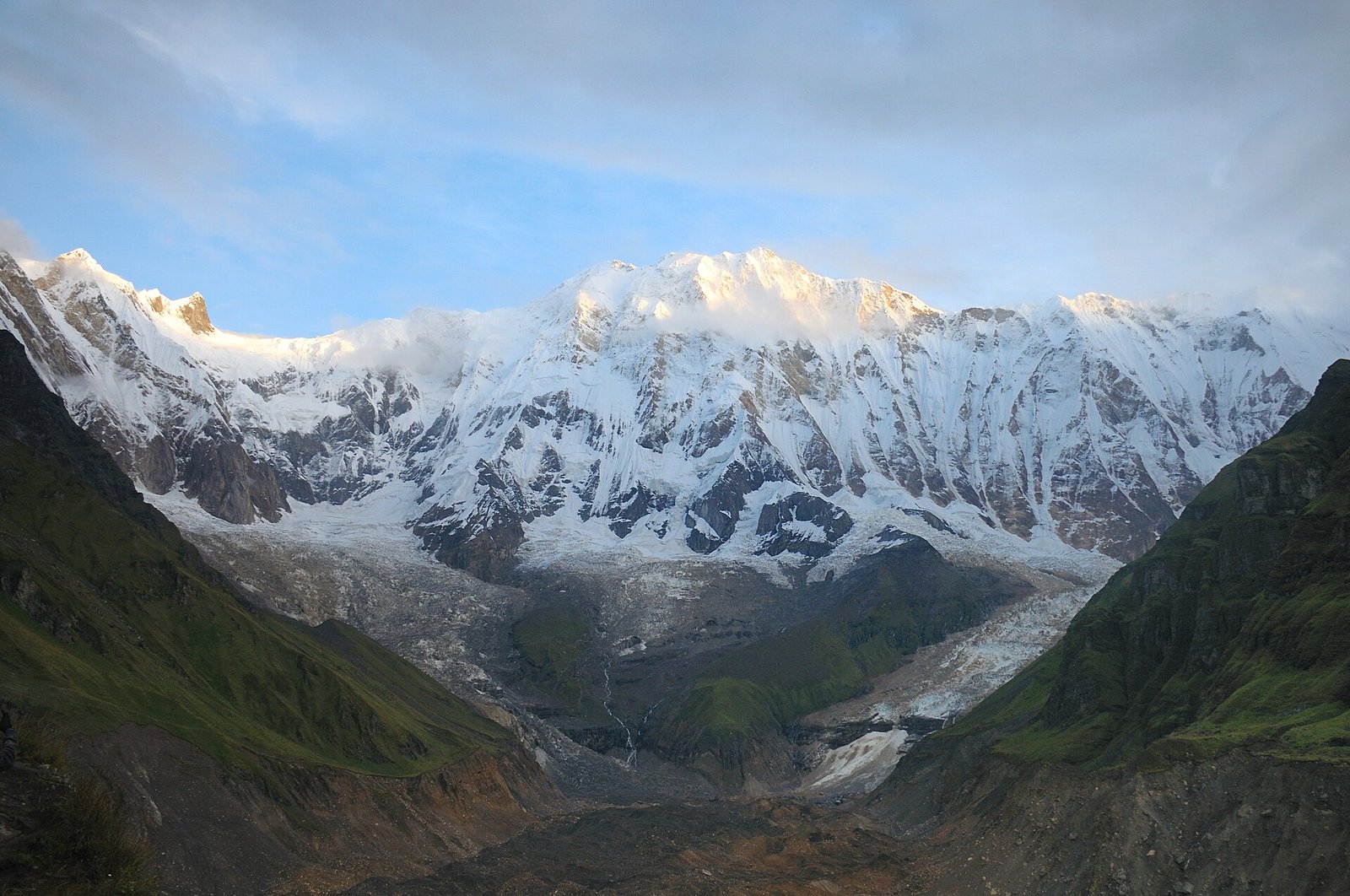
Annapurna I Expedition Guides and Climbing Guide
Annapurna I (8,091 m, 26,545 ft), in central Nepal, is the tenth-highest mountain in the world and the first 8,000-metre peak ever climbed, by Maurice Herzog and Louis Lachenal in 1950. It is also one of the most dangerous: for decades it had the highest ratio of deaths to summits of any 8,000-metre peak, mainly because of avalanches and serac falls on the north-side normal route. Commercial expeditions now climb it most springs, using helicopters to reach base camp, fixed ropes and supplementary oxygen, but it is only for climbers with substantial 8,000-metre experience. On ExpedReview, as of 23 October 2026, 1 operator has 1 verified client review filed under Annapurna I: Yam adventure and treks (5.0★, August 2026), although the review itself describes treks, not an Annapurna I climb. Alpine Ramble and Bold Himalaya also list trips here. Below are the listings and reviews, then a guide to the mountain.
Annapurna I: key facts | | | |---|---| | Height | 8,091 m (26,545 ft); 10th highest in the world | | Location | Annapurna massif, Gandaki Province, central Nepal | | First ascent | 3 June 1950, Maurice Herzog and Louis Lachenal (France), north face | | First winter ascent | 3 February 1987, Jerzy Kukuczka and Artur Hajzer (Poland) | | Normal route | North face, from a base camp at about 4,200 m | | Main hazard | Avalanches and serac falls | | Season | Mainly spring (April–May) | | Operators on ExpedReview | 1 with 1 verified review (a trek review); 2 more list trips (as of 23 Oct 2026) |
Annapurna I operators on ExpedReview
Rankings use each operator's verified ExpedReview client reviews for the mountain: the star rating, adjusted so that one or two reviews, or only old ones, count for less than many recent ones. Every review is checked by hand before it is published, and operators cannot pay for a better position. Data as of 23 October 2026.
| Rank | Operator | Based in | Rating here | Reviews | Latest review |
|---|---|---|---|---|---|
| 1 | Yam adventure and treks | Nepal | 5.0★ | 1 | August 2026 |
Alpine Ramble and Bold Himalaya also list trips here but have no reviews for Annapurna I yet. No operator lists a current price on ExpedReview.
What clients say
The one review filed under Annapurna I, from August 2026, is not about a climb of the mountain. The reviewer describes a Mardi Himal trek, their first trek in Nepal, and a later Langtang Valley trek with their mother and brother, both with Yam adventure and treks. They praise the organisation of hotels, homestays and transport, the chance to meet local people and see ceremonies and a school, and the guide's kindness and knowledge, and describe a visit to his home village, Laprak, badly affected by the 2015 earthquake. It is a strong review of a trekking guide, but it tells you nothing about an 8,000-metre expedition. For Annapurna I, ask operators for references from past expedition clients and read their reviews on other 8,000-metre peaks.
The mountain
Annapurna I is the highest peak of the Annapurna massif, a long chain of peaks north of Pokhara, bounded to the west by the Kali Gandaki gorge, which separates it from Dhaulagiri I. Its name comes from Sanskrit and is usually translated as "full of food", after the Hindu goddess of food and nourishment. The mountain has a summit ridge several kilometres long with three main summits, the main (west) summit, the central summit and the east summit, all above 8,000 m. Its north side rises from a glaciated basin reached from the Miristi Khola valley, and its south face, above the Annapurna Sanctuary, is one of the biggest walls in the Himalaya, about 3,000 m high.
History
In 1950, a French expedition led by Maurice Herzog set out to climb Dhaulagiri or Annapurna, with only poor maps to guide them. After weeks spent finding a way to the mountain, Herzog and Lachenal reached the summit of Annapurna on 3 June 1950, the first ascent of any 8,000-metre peak. The descent became an epic of survival: both men suffered severe frostbite and lost toes, and Herzog also lost fingers. Herzog's book Annapurna became one of the best-selling mountaineering books of all time. In 1970, a British expedition led by Chris Bonington climbed the steep south face, with Dougal Haston and Don Whillans reaching the summit, a landmark in big-wall Himalayan climbing. Jerzy Kukuczka and Artur Hajzer made the first winter ascent in 1987. In 2013, the Swiss climber Ueli Steck climbed the south face solo, a feat that was widely celebrated but also debated because he lost his camera and had no summit photograph.
The normal route
Most commercial expeditions climb the north face, the side of the first ascent. Teams usually fly by helicopter from Pokhara to base camp, at about 4,200 m, on the glacier below the north face, because the trek in through the Miristi Khola is long and difficult; some trek in from the Kali Gandaki valley over high passes. From base camp, the route climbs to Camp 1, at about 5,000–5,100 m, then through a heavily crevassed glacier and under seracs to Camp 2, at about 5,600–5,700 m. The section between Camp 2 and Camp 3, at about 6,400–6,500 m, crosses or climbs near slopes exposed to avalanches and falling ice from the hanging glaciers above, and is the most dangerous part of the route. Many routes use a rib, often called the Dutch Rib, to reduce exposure, but the line changes from year to year with conditions. Camp 4, at about 7,000–7,100 m, is the launch point for the summit push, which climbs a long, steep snow slope and a rocky band to the summit ridge, a long day of up to 15 hours or more. Most commercial climbers use supplementary oxygen from Camp 3 or Camp 4, and Sherpa teams fix rope along most of the route.
Why Annapurna is so dangerous
Annapurna's reputation comes from its statistics. For many years, it had a ratio of roughly one death for every three successful summits, the highest of any 8,000-metre peak, according to analyses of the Himalayan Database. The main cause is avalanches and serac falls on the north face, which can sweep large areas of the route with little warning. Bad weather, frostbite and altitude illness add to the risk. In recent years, larger commercial teams, helicopter access and better forecasting have increased the number of summits each spring and improved the ratio, but deaths and serious accidents still happen most years, including falls into crevasses. Climbers should be under no illusion: much of the risk on Annapurna is objective, and no level of skill can remove it. The best defences are a well-chosen line, fewer trips through the danger zone and the discipline to wait or turn back.
Experience needed
Most operators require clients to have climbed at least one 8,000-metre peak, often Manaslu, Cho Oyu or Everest, and to have experience on steep snow and ice, fixed ropes, glacier travel and crevasse rescue at high altitude. Climbers should be comfortable moving quickly through dangerous terrain, since speed reduces time under seracs, and should be prepared to turn back when conditions are poor. Annapurna is often climbed by those working on all fourteen 8,000-metre peaks, and by Nepali guides and climbers building their records.
Other routes
Besides the north face, Annapurna has several harder routes that are rarely guided. The south face, first climbed in 1970, is a huge, steep wall of rock and ice above the Annapurna Sanctuary, and has seen a number of hard alpine-style ascents since. The east ridge, a long, high traverse from the east summit, was climbed by a Swiss pair, Erhard Loretan and Norbert Joos, in 1984. Other routes on the north-west and south-west sides have been climbed by strong expeditions. These routes demand top-level alpine skills and are outside the scope of commercial expeditions, which concentrate on the north face, where Sherpa teams can fix ropes and establish camps.
Season
Annapurna is climbed mainly in spring, from about April to May, when the weather window and conditions on the north face are usually most favourable. Autumn ascents are less common, because of heavy snow after the monsoon and higher avalanche risk. Winter ascents are rare and extreme.
Permits and logistics
Climbers need a Nepal climbing permit for Annapurna I, issued through a registered Nepali agency, plus an Annapurna Conservation Area permit. Nepal revised its climbing royalties in 2025, so check the current fee with your operator. The government also requires expeditions to employ Nepali guides and to manage waste on the mountain. Because base camp is reached mainly by helicopter, weather delays in Pokhara can affect schedules, and rescue from the higher camps is also by helicopter, sometimes using long-line techniques. Insurance covering helicopter rescue at high altitude, and expedition cancellation, is essential.
A typical expedition
Annapurna I expeditions usually last about five to six weeks from Kathmandu. A typical itinerary includes several days in Kathmandu for permits and briefings, travel to Pokhara and a helicopter flight to base camp, a period of acclimatisation, sometimes including a trek or a climb of a lower peak before arriving, rotations to the higher camps while the route is fixed, a wait for a summit window, the summit push from Camp 4, and a helicopter flight out. Some operators reduce time on the mountain by having clients pre-acclimatise on another peak or in a hypoxic tent at home, and then fly straight to base camp. Ask how the operator limits the number of trips through the most dangerous section.
Cost
No operator lists a price for Annapurna I on ExpedReview, so ask each one directly. Expeditions to Annapurna cost more than most 7,000-metre climbs because of the 8,000-metre permit, helicopter access, supplementary oxygen, Sherpa support and the larger rescue reserves needed. Prices vary widely between operators, depending on the ratio of Sherpas to clients, the amount of oxygen, the standard of base camp and whether helicopter flights are included. Check what is included, and what happens if the expedition is cancelled or the route is judged too dangerous to climb. See our Everest cost guide for a broader view of 8,000-metre expedition costs.
Gear
Climbers need full 8,000-metre equipment: high-altitude boots, a down suit, down mittens and gloves, a sleeping bag rated to about -40°C, crampons, an ice axe, a harness, a jumar, a rappel device, a helmet, and an oxygen mask and regulator, usually supplied by the operator with the oxygen. Operators usually provide tents, ropes, cooking equipment and group gear. Test all your gear on earlier high-altitude climbs.
Training
Prepare for many months, building endurance, strength and cardiovascular fitness, with long days carrying heavy loads and steep ascents. Practise moving quickly on fixed ropes and steep snow in full high-altitude gear. Above all, build experience on lower 8,000-metre peaks, so that you know how your body responds at extreme altitude and can move efficiently through hazardous ground.
How to choose an operator
Choosing an operator for Annapurna is mainly about risk management. Ask about the expedition leader's and the Sherpa team's experience on Annapurna, how many times they have climbed it, their safety record, how they choose the line through the avalanche zone, how many rotations clients make through it, the Sherpa-to-client ratio on summit day, the amount of oxygen, and their rescue plans. Ask for references from past Annapurna clients. Because the one review here is about trekking, read operators' reviews on other 8,000-metre peaks and our how-to-choose guide. For the wider region, see our Annapurna page.
Frequently asked questions
Why is Annapurna I so dangerous?
Mainly because of avalanches and serac falls on the north-side normal route. For decades it had the highest ratio of deaths to summits of any 8,000-metre peak, though the ratio has improved in recent years.
Who first climbed Annapurna I?
Maurice Herzog and Louis Lachenal of a French expedition, on 3 June 1950. It was the first ascent of any 8,000-metre peak.
What experience do I need to climb Annapurna?
Most operators require at least one previous 8,000-metre summit and solid experience on steep snow and ice and fixed ropes.
When is Annapurna I climbed?
Mainly in spring, from about April to May.
Are there verified reviews of Annapurna I expeditions on ExpedReview?
Not yet of a climb. As of 23 October 2026, the one review filed under Annapurna I, for Yam adventure and treks, describes Mardi Himal and Langtang treks. Alpine Ramble and Bold Himalaya also list trips.
Related articles
- How to choose a guide
- Best operators
- Annapurna and Mustang Trekking and Climbing Guides: Verified Reviews
Treks and climbs in Nepal's Annapurna and Mustang region: operators ranked by verified ExpedReview client reviews, plus a guide to the Annapurna Circuit, Annapurna Base Camp, Poon Hill, Mardi Himal, Upper Mustang, Annapurna I and nearby peaks, with permits, guide rules, seasons and how to choose.