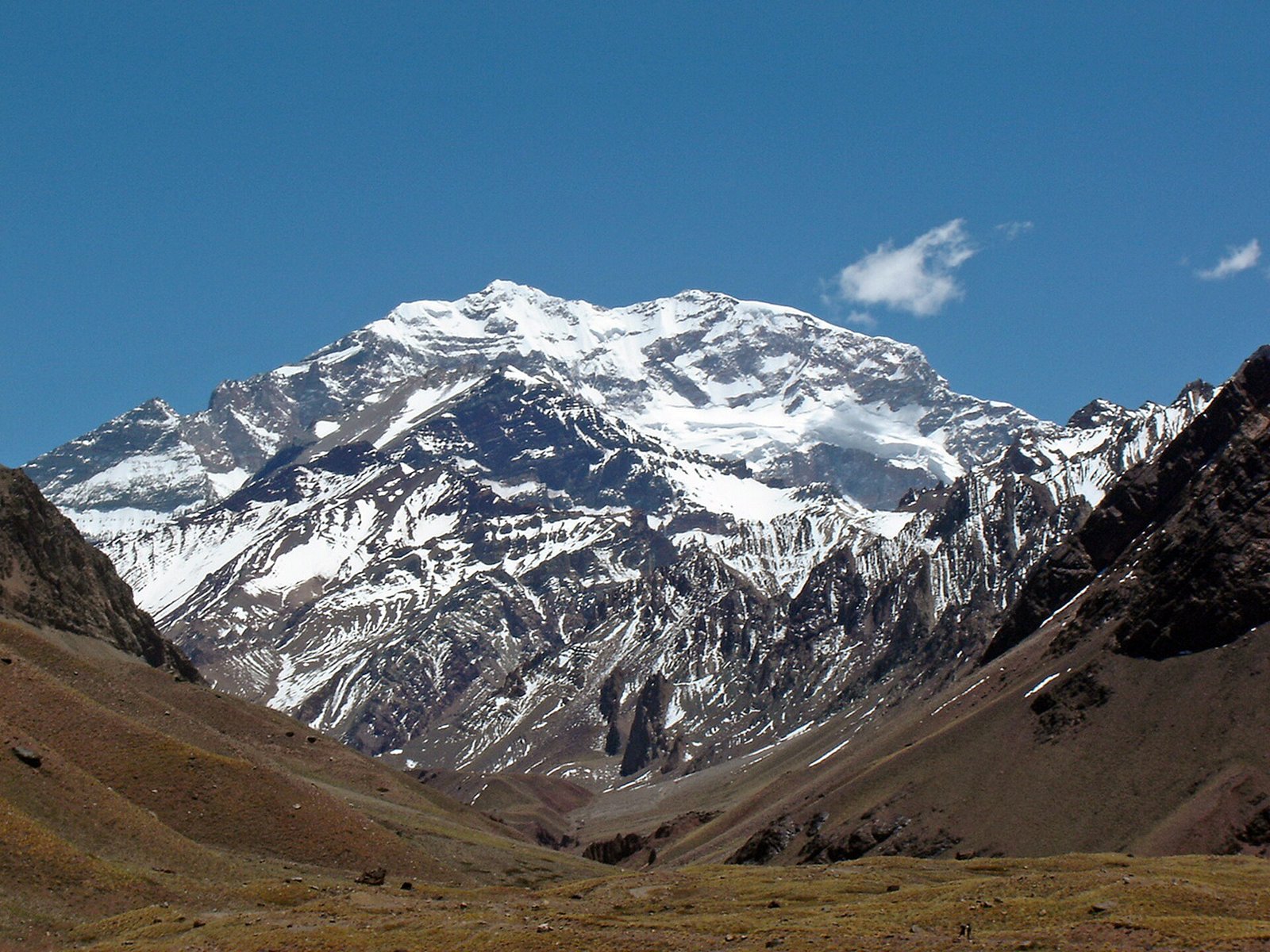
Climbing Aconcagua (2026): Routes, Permit Fees, Best Time, Difficulty and Itinerary
Aconcagua is the highest mountain in South America and the highest outside Asia, at 6,961 m (22,838 ft), in Aconcagua Provincial Park in Mendoza, Argentina. Most climbers take the non-technical Normal Route from the Horcones Valley via Plaza de Mulas, or the longer Vacas Valley approach to the Polish Glacier Traverse ("360") route. Expeditions take about 18 to 21 days, and the climbing season runs from mid-November to the end of February, with December to February the main window. For the 2025-26 season, a foreign (non-Latin American) climber paid US$1,170 for an assisted ascent permit via Horcones, or US$1,640 without a registered service provider, according to the Mendoza provincial government. The climb needs no technical skills on the Normal Route, but the altitude, cold and wind make it one of the toughest of the Seven Summits.
Aconcagua at a glance | Fact | Detail | |---|---| | Height | 6,961 m (22,838 ft) | | Location | Aconcagua Provincial Park, Mendoza Province, Argentina | | Range | Principal Cordillera of the Andes | | Gateway city | Mendoza | | Main routes | Normal Route (Horcones/Plaza de Mulas); Polish Glacier Traverse (Vacas/Plaza Argentina) | | Expedition length | About 18–21 days door to door | | Season | Mid-November to February (park summer season 1 Nov–30 Apr) | | Difficulty | Non-technical on standard routes; extreme altitude, cold and wind | | 2025-26 ascent permit (foreigner, Horcones) | US$1,170 assisted; US$1,640 unassisted | | Seven Summits | Yes, South America's highest peak |
Where is Aconcagua?
Aconcagua stands in the Andes of western Argentina, in Mendoza Province, about 15 km from the Chilean border. It lies within Aconcagua Provincial Park, which is managed by Mendoza's Dirección de Áreas Protegidas. The nearest city is Mendoza, about three hours' drive away, and the park entrance at Horcones is close to the international road between Mendoza and Santiago de Chile.
Although Aconcagua is heavily glaciated on its south and east sides, its northwest flanks are dry and rocky. This is why the Normal Route is mostly a long walk on scree, rock and snow patches, rather than a glacier climb.
Why climb Aconcagua?
- It is one of the Seven Summits. For many climbers, Aconcagua is the second or third of the seven, often after Kilimanjaro and Elbrus.
- It is the highest peak you can reach without technical climbing. The Normal Route is non-technical in good conditions.
- It is a real high-altitude test. At almost 7,000 m, it is a stepping stone toward 8,000 m peaks.
- It has well-organised infrastructure. Base camps have services run by registered providers, and the park has rangers and medical checks.
Aconcagua routes compared
| Route | Approach | Style | Difficulty | Notes |
|---|---|---|---|---|
| Normal Route (Northwest) | Horcones Valley to Plaza de Mulas | Non-technical; scree, snow and rock | Moderate technically; very demanding at altitude | Most popular and busiest |
| Polish Glacier Traverse ("360" or Vacas Valley) | Vacas Valley to Plaza Argentina, then traverse to the Normal Route high on the mountain | Non-technical in most conditions; crampons often needed | Similar to the Normal Route, longer and quieter | Popular with guided groups; more scenic |
| Polish Glacier Direct | Vacas Valley | Technical snow and ice climbing up to about 40–50° | Technical | Conditions vary; less often guided |
| South Face | Horcones Valley to Plaza Francia | Big-wall alpine climbing | Extremely technical | Requires special permission |
The Normal Route
The Normal Route starts at Horcones (about 2,950 m) and follows the Horcones Valley to the base camp at Plaza de Mulas (about 4,300 m). Above base camp, climbers move up to high camps at Plaza Canadá (about 5,050 m), Nido de Cóndores (about 5,560 m) and Colera or Berlin (about 5,850 to 6,000 m). The summit day climbs via the Independencia hut area and the Portezuelo del Viento to the long traverse and the infamous Canaleta, a steep scree gully, before reaching the summit ridge.
The Polish Glacier Traverse
The Vacas Valley approach starts at Punta de Vacas and takes three days of trekking to Plaza Argentina (about 4,200 m). From there, climbers move up to Camp 1, Camp 2 and a high camp before traversing across to join the Normal Route near Colera for the summit push. The longer approach helps acclimatisation, and the valley is quieter and more scenic.
Aconcagua permit fees for 2025-26
Climbing permits are set each season by decree of the Mendoza provincial government. The 2025-26 rules (Decree 2322) covered the summer season from 1 November 2025 to 30 April 2026. Fees vary by valley, by your residence and by whether you use a registered service provider ("con asistencia"). US dollar fees are paid in Argentine pesos at the Banco de la Nación exchange rate.
| Permit (foreigner, non-Latin American) | Assisted (with registered provider) | Unassisted |
|---|---|---|
| Ascent via Horcones (Normal Route) | US$1,170 | US$1,640 |
| Ascent via Vacas (Polish Glacier routes) | US$1,450 | US$2,000 |
Latin American visitors paid US$910 for an assisted Horcones ascent. Argentine and Mendoza residents pay in pesos. Anyone doing an ascent or long trek must carry medical and evacuation insurance. Rules and fees for the 2026-27 season may differ, so check the park's official website before you book.
Data gathered by ExpedReview from official sources: the Mendoza provincial government press office and the published 2025-26 decree.
How much does it cost to climb Aconcagua?
The total cost depends on the style of expedition you choose. Your budget will include the permit, the expedition package (guides, camps, meals, mules or porters), flights to Mendoza, gear, insurance and tips. Local Argentine operators usually cost less than international guiding companies, while private trips and small groups cost more. Ask exactly what is included, particularly porter carries to high camp, mule loads, base camp services and evacuation support.
For a full breakdown of operator prices, see ExpedReview's Aconcagua cost guide.
When is the best time to climb Aconcagua?
The main climbing season is from mid-November to the end of February, during the Southern Hemisphere summer.
| Period | Conditions |
|---|---|
| Mid-November to early December | Colder, more snow on the route, fewer people |
| Mid-December to January | Warmest and most stable; busiest period |
| February | Generally stable early on; drier, often more ice on the upper route; numbers fall |
| March to October | Winter conditions; extremely cold and windy; for experienced climbers only |
Even in summer, temperatures at high camp can fall well below -20°C at night, and the wind can be ferocious. A weather window with lower winds is often the deciding factor on summit day.
A typical Aconcagua itinerary (Normal Route)
| Day | Plan |
|---|---|
| 1 | Arrive in Mendoza |
| 2 | Gear check, permits; drive to Penitentes or Horcones |
| 3 | Trek from Horcones to Confluencia (about 3,400 m) |
| 4 | Acclimatisation hike toward Plaza Francia; medical check |
| 5 | Trek to Plaza de Mulas base camp (about 4,300 m) |
| 6 | Rest day at base camp; medical check |
| 7 | Acclimatisation hike |
| 8 | Carry to Plaza Canadá; return to base camp |
| 9 | Move to Plaza Canadá |
| 10 | Carry to Nido de Cóndores |
| 11 | Move to Nido de Cóndores |
| 12 | Rest and acclimatise |
| 13 | Move to Colera or Berlin high camp |
| 14 | Summit day |
| 15–17 | Spare weather days |
| 18 | Descend to Plaza de Mulas |
| 19 | Trek out to Horcones; drive to Mendoza |
| 20 | Depart |
Most reputable operators build in several spare days, because high winds frequently delay summit attempts.
How hard is Aconcagua?
Technically, the Normal Route is not difficult. There are no ropes or ladders, and in good conditions crampons may only be needed near the summit. Physically and mentally, though, it is a big undertaking.
- Altitude: Aconcagua is high enough to cause acute mountain sickness, high-altitude pulmonary oedema (HAPE) and high-altitude cerebral oedema (HACE).
- Summit day: Typically 10 to 14 hours round trip from high camp, with a gain of about 1,000 m.
- Cold and wind: The "Viento Blanco" storms can bring dangerous winds and very low temperatures.
- Load carrying: Unless you hire porters, you carry heavy loads between camps.
Most climbers attempt Aconcagua after a peak like Kilimanjaro or Elbrus, plus some experience of cold-weather camping.
Training for Aconcagua
Begin a structured plan at least four to six months before your trip. Focus on:
- Aerobic endurance: long hikes, running, cycling and stair training.
- Strength training: legs, core and back, to carry 15 to 25 kg loads.
- Back-to-back days: consecutive long days with a weighted pack.
- Altitude experience: a previous climb above 5,000 m helps you understand your own response to altitude.
Altitude sickness and safety on Aconcagua
Park rangers and doctors at Confluencia and base camp carry out medical checks, and climbers who fail them may be required to descend. Follow your guide's acclimatisation plan, drink plenty of water and report any symptoms.
Know the signs of serious altitude illness: severe headache that does not respond to medication, confusion, loss of coordination, breathlessness at rest or a persistent wet cough. Descend immediately if you see these signs in yourself or a teammate.
Waste management is also strict. Climbers must carry human waste bags on the upper mountain and return them to base camp, and every expedition must bring its rubbish back.
Gear for Aconcagua
| Category | Key items |
|---|---|
| Footwear | Double mountaineering boots for summit day; trekking shoes for the approach |
| Clothing | Base layers, insulating layers, down jacket, waterproof shell |
| Hands and head | Liner gloves, insulated gloves, expedition mittens, warm hat, buff, glacier glasses |
| Sleeping | Sleeping bag rated to about -30°C; insulated sleeping mat |
| Technical | Crampons, ice axe, trekking poles, harness if required by your operator |
| Other | Large backpack, duffel bag, headtorch, water bottles, insulated flask, sunscreen and lip balm |
ExpedReview has a full Aconcagua equipment list.
Choosing an Aconcagua operator
Look for registered park service providers with experienced guides, low guide-to-client ratios, a clear summit-day turnaround policy and solid evacuation procedures. Compare what is included and read verified client reviews.
| Operator | ER average rating | Verified reviews |
|---|---|---|
| Climbing The Seven Summits | 4.9 / 5 | 7 |
| 360 Expeditions | 4.5 / 5 | 7 |
| Furtenbach Adventures | 5.0 / 5 | 2 |
Ratings are from verified ExpedReview client reviews for Aconcagua (minimum two reviews; data as of 22 October 2026). See all operators on ExpedReview's Aconcagua rankings, the Aconcagua region page and the guide on how to choose an Aconcagua operator.
Aconcagua guides ranked by verified reviews
Rankings use each operator's verified ExpedReview client reviews in this region: the star rating, adjusted so that one or two reviews, or only old ones, count for less than many recent ones. Every review is checked by hand before it is published, and operators cannot pay for a better position. Data as of 23 October 2026.
| Rank | Operator | Based in | Rating here | Reviews | Latest review |
|---|---|---|---|---|---|
| 1 | Climbing The Seven Summits | United States | 4.9★ | 7 | January 2025 |
| 2 | 360 Expeditions | United Kingdom | 4.5★ | 7 | May 2022 |
| 3 | Furtenbach Adventures | Austria | 5.0★ | 2 | January 2023 |
| 4 | Nafika Tours | Tanzania | 5.0★ | 1 | June 2026 |
| 5 | Adventure Consultants | New Zealand | 5.0★ | 1 | May 2026 |
| 6 | Adventure Peaks | – | 5.0★ | 1 | February 2023 |
| 7 | Acomara | – | 4.6★ | 1 | January 2020 |
| 8 | Summitclimb | United States | 2.4★ | 1 | March 2024 |
One further operator, with two reviews from 2019, is not listed here.
What clients say
Climbing The Seven Summits leads on both rating and recent volume. Its reviewers describe repeat trips with the company, a strong guiding team and a feeling of safety throughout, and one wrote about a private custom climb with a guide they had climbed with before. 360 Expeditions has as many reviews, but the latest is from 2022, so its position reflects older trips. Adventure Consultants has a single recent review, from a climber who chose the company for its reputation after climbing Kilimanjaro.
The one critical review is a 2.4★ rating of a Summitclimb trip in March 2024. The reviewer said the package was not delivered as described, in particular the nationality and qualifications of the lead guide. That is a useful reminder to ask every operator, in writing, who will lead your team and what certification they hold. The Nafika Tours review filed under Aconcagua describes a Kilimanjaro trek, so do not read it as evidence about Aconcagua.
Across the region's 23 reviews, safety comes up in 13 and food in 12, nearly all in positive reviews. Summit is mentioned in 5, two of them in lower-rated reviews. Only 4 of the 23 reviews were published in the last 24 months, so ask any operator you shortlist for recent client references.
Skills you need
- Walking in crampons and using an ice axe for balance.
- Using layering effectively in extreme cold and wind.
- Setting up and living in a tent in harsh conditions.
- Pacing yourself at altitude.
- Recognising signs of altitude illness in yourself and others.
Read skills you need before a mountaineering trip.
Summit day on the Normal Route
Summit day is the crux of any Aconcagua climb. Teams usually leave high camp in the dark, often between 3 and 5 a.m., wearing their warmest layers. The route climbs steadily to the ruins of the Independencia hut at around 6,350 m, then crosses the exposed Portezuelo del Viento, where strong wind is common. A long rising traverse leads to the base of the Canaleta, a steep gully of loose rock and scree below the summit ridge.
The Canaleta is where many climbers struggle. Every step takes effort at this altitude, and loose ground can make footing tiring. Guides set a slow, steady pace and keep a close eye on turnaround times. The summit itself is a broad, rocky top with views across the Andes and, on clear days, toward the Pacific.
The descent is just as important. Many accidents happen when tired climbers descend late in the day. Saving energy for the descent and turning around on time are essential.
Life at base camp
Plaza de Mulas and Plaza Argentina are busy, well-organised base camps during the season. Operators set up dining tents, kitchen tents and toilets, and park rangers and medical staff are present. Climbers usually spend several days at base camp, resting, acclimatising and preparing gear between rotations. Expect cold nights, dusty days and a lively social atmosphere.
Mules carry gear from the trailhead to base camp, so you only carry a day pack on the approach trek. Above base camp, you or porters carry loads to the higher camps.
Getting there
Most climbers fly to Mendoza, Argentina, via Buenos Aires or Santiago. Mendoza is a pleasant city known for its wine, and it is where expeditions organise permits, gear checks and supplies. From Mendoza, a drive of several hours through the Andes leads to the Penitentes area and the Horcones or Vacas trailheads.
Why climbers fail on Aconcagua
Many climbers do not reach the summit. The most common reasons are:
- Poor acclimatisation, often from ascending too fast.
- Weather, especially strong wind and cold on summit day.
- Exhaustion, from a lack of fitness or from carrying heavy loads.
- Illness, including stomach problems and respiratory infections at base camp.
- Frostbite risk, when guides turn clients around to protect their fingers and toes.
Building in spare days, training well and choosing an experienced operator all improve your chances.
Aconcagua as a step toward bigger peaks
For many climbers, Aconcagua is the step between peaks such as Kilimanjaro and the Himalaya. It teaches expedition skills, cold-weather living and how your body handles altitude close to 7,000 m. After Aconcagua, many climbers move on to Denali, a technical 6,000 m peak such as Ama Dablam, or a first 8,000 m peak such as Manaslu. See what to climb before Everest.
Guided or independent?
Most climbers join guided expeditions, which handle permits, logistics, mules, food, base camp services and safety. Experienced climbers can go independently using base camp service providers. Either way, you need a permit and must follow park rules.
Beyond Aconcagua: the Southern Andes
Aconcagua is the reason most climbers come to this part of the Andes, but it is not the only objective. Ojos del Salado, on the Chile–Argentina border further north, is the highest volcano in the world at about 6,893 m, and Mercedario, Tupungato and the other high peaks of the Mendoza Andes offer quieter expeditions. Further south, Patagonia is a very different kind of climbing, with steep granite towers and ice caps rather than high-altitude walking. At present our verified reviews in this region are all for Aconcagua.
Aconcagua history
Aconcagua was first climbed in 1897 by the Swiss guide Matthias Zurbriggen, a member of an expedition led by Edward FitzGerald. Members of the same expedition reached the summit a few weeks later. The name is thought to come from either the Quechua or Mapuche language, although the exact meaning is debated.
Frequently asked questions
How high is Aconcagua?
6,961 m (22,838 ft) above sea level.
Where is Aconcagua?
In Aconcagua Provincial Park, Mendoza Province, western Argentina, near the border with Chile.
Is Aconcagua the highest mountain outside Asia?
Yes. Aconcagua is the highest mountain in both the Western and Southern Hemispheres.
How long does it take to climb Aconcagua?
Most expeditions take 18 to 21 days, including travel, acclimatisation and spare weather days.
Is Aconcagua a technical climb?
Not by the Normal Route or the Polish Glacier Traverse in normal conditions. The Polish Glacier Direct and South Face are technical.
How much is the Aconcagua permit?
For 2025-26, foreigners from outside Latin America paid US$1,170 for an assisted Horcones ascent and US$1,640 unassisted. Vacas Valley permits cost US$1,450 assisted and US$2,000 unassisted.
When is the best time to climb Aconcagua?
Mid-December to February, during the Southern Hemisphere summer.
Can a beginner climb Aconcagua?
A fit beginner with some trekking and altitude experience can attempt the Normal Route with a guide, but it is best to climb a smaller peak such as Kilimanjaro or Elbrus first.
What is the success rate on Aconcagua?
Success rates vary widely by season, route and operator. Ask operators for their own recent figures and how they define success.
Do I need a guide for Aconcagua?
No, but you will pay a higher permit fee without a registered service provider, and you must be self-sufficient at altitude.
What is the Canaleta on Aconcagua?
A steep scree gully near the top of the Normal Route that leads to the summit ridge. It is one of the hardest parts of summit day.
Who first climbed Aconcagua?
Matthias Zurbriggen, a Swiss guide, in 1897.