Peru and Bolivia Climbing Guides: Verified Reviews for Alpamayo and the Andes
By Blake Penson, Founder of ExpedReview · Everest summiter · Seven Summits climber · 20-year mountaineer · Industry expert
The Andes of Peru and Bolivia have the greatest concentration of high, glaciated tropical peaks in the world, and some of the most beautiful mountains anywhere. Peru's Cordillera Blanca, above the town of Huaraz, holds Huascarán (6,768 m), the country's highest peak, and Alpamayo (5,947 m), whose fluted south-west face is one of the most famous ice climbs in the world. Bolivia's Cordillera Real, near La Paz, offers accessible 6,000 m peaks such as Huayna Potosí (6,088 m) and Illimani (6,438 m). The main climbing season is the dry season, from May to September. On ExpedReview, as of 23 October 2026, 2 operators have 3 verified client reviews in the region, all for Alpamayo: Exped Tribe is ranked first (5.0★ from 2 reviews, latest December 2025), followed by Adventure Consultants (5.0★ from 1 review, February 2026). Below are the rankings, then a guide to climbing in Peru and Bolivia.
Peru and Bolivia: key facts | | | |---|---| | Main ranges | Cordillera Blanca (Peru), Cordillera Real (Bolivia) | | Highest peak in Peru | Huascarán Sur, 6,768 m | | Highest peak in Bolivia | Sajama, 6,542 m | | Bases | Huaraz, about 3,050 m (Peru); La Paz, about 3,600 m (Bolivia) | | Season | Dry season, May to September | | Classic objectives | Alpamayo, Chopicalqui, Huascarán, Pisco, Huayna Potosí, Illimani | | Operators reviewed on ExpedReview | 2, with 3 verified reviews (as of 23 Oct 2026) |
Peru and Bolivia guides ranked by verified reviews
Rankings use each operator's verified ExpedReview client reviews in the region: the star rating, adjusted so that one or two reviews, or only old ones, count for less than many recent ones; ties go to the operator with more reviews. Every review is checked by hand before it is published, and operators cannot pay for a better position. Data as of 23 October 2026.
| Rank | Operator | Based in | Rating here | Reviews | Latest review | Reviewed for |
|---|---|---|---|---|---|---|
| 1 | Exped Tribe | Switzerland | 5.0★ | 2 | December 2025 | Alpamayo (2) |
| 2 | Adventure Consultants | New Zealand | 5.0★ | 1 | February 2026 | Alpamayo (1) |
Neither operator lists a recent price on ExpedReview. With only three reviews, the ranking is a starting point; see our Alpamayo guide for more on the climb.
What clients say
Both Exped Tribe reviewers climbed Alpamayo and Chopicalqui on a combined expedition. One said they felt safe throughout and that the whole team summited Alpamayo, which they understood was not often the case; the other praised the service, the guides' efforts to get them to the summit, and the porters and chefs. The Adventure Consultants reviewer, writing under the title "Fast and Light", described an excellent rope team of guide and clients, fairly advanced logistics for such a technical mountain and an acclimatisation schedule that worked well; they rated value lower, at 3.0, than the other categories.
Why climb in Peru and Bolivia?
The tropical Andes combine high altitude with relatively short approaches. In the Cordillera Blanca, many 5,000 and 6,000 m peaks are within a day or two's walk of a road, and Huaraz is a lively base with guides, gear shops and hotels. The mountains are steep and heavily glaciated, with fluted snow faces, cornices and seracs, so they suit climbers who want to move on from glacier walks to steeper snow and ice. In Bolivia, La Paz sits at over 3,600 m, and Huayna Potosí can be climbed in two or three days from the city, which makes it one of the most accessible 6,000 m peaks in the world. For climbers preparing for the Himalaya, these ranges are excellent places to gain experience above 6,000 m.
Alpamayo
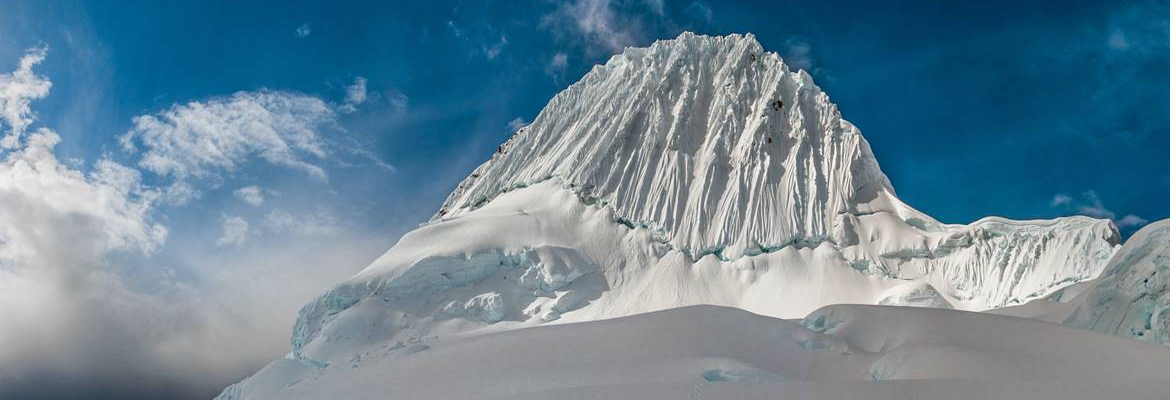
Alpamayo, at 5,947 m in the northern Cordillera Blanca, is famous for its steep, fluted south-west face, which looks like a perfect pyramid from the Santa Cruz valley. It is often called the most beautiful mountain in the world, after a 1966 poll in a German mountaineering magazine. The usual route, the French Direct (or Ferrari route) on the south-west face, climbs about 400 m of steep snow and ice, often around 60 degrees, in runnels between the flutings, with abseils on the descent. It is a serious technical climb, usually done after acclimatising on lower peaks, and conditions vary greatly from year to year. Our Alpamayo page covers it in detail.
Chopicalqui and Huascarán
Chopicalqui, at about 6,354 m, is a popular glaciated peak in the central Cordillera Blanca, often combined with Alpamayo on one expedition, as both Exped Tribe reviewers did. Its normal route on the south-west ridge is a steep glacier climb with crevasses, seracs and a final ridge, more demanding than a walk-up but less technical than Alpamayo. Huascarán Sur, at 6,768 m, is the highest mountain in Peru and in the tropics. Its normal route goes up the Garganta, the col between its north and south summits, past heavily crevassed glaciers and seracs. It is a long, serious climb, often taking about a week.
Acclimatisation peaks
Most expeditions in the Cordillera Blanca start with acclimatisation hikes from Huaraz, then a climb of a lower peak such as Pisco (about 5,750 m), Ishinca (about 5,530 m) or Urus, before attempting Alpamayo, Chopicalqui or Huascarán. A typical Alpamayo expedition lasts about two weeks, including acclimatisation; combined expeditions take longer.
Bolivia's Cordillera Real
The Cordillera Real runs along the eastern edge of the Altiplano near La Paz. Huayna Potosí, at about 6,088 m, is the most climbed peak; its normal route is a glacier climb with a steep final ridge, reached from a refuge at about 4,800 m and a high camp at about 5,130 m. Illimani, at about 6,438 m, towers above La Paz and is a longer, harder climb. Sajama, at 6,542 m, Bolivia's highest peak, is a remote volcano in the west. Bolivia is generally cheaper than Peru, but has fewer guiding services and more basic infrastructure in the mountains.
Season and weather
The dry season, from May to September, is the main climbing season in both countries, with June to August the most settled. The wet season, from December to March, brings heavy snow and cloud to the mountains, and few climbs are attempted. Even in the dry season, afternoon cloud and snow are common, and nights at high camps are cold. In recent years, warmer temperatures have caused glaciers to retreat and some routes to become more dangerous, with more rockfall and unstable seracs.
Altitude
Huaraz is at about 3,050 m and La Paz at about 3,600 m, so climbers arriving from sea level need several days to acclimatise before going higher. Spend time on day hikes, drink plenty of water, and learn the symptoms of acute mountain sickness. Good itineraries build in plenty of acclimatisation before attempting a 6,000 m peak.
Skills and experience
The Andean peaks vary from glacier walks to serious ice climbs. For Huayna Potosí or Pisco, you need fitness and basic crampon and ice-axe skills, which guides can teach. For Chopicalqui and Huascarán, you need solid glacier experience and fitness for long, high days. For Alpamayo, you should be confident on steep ice of 55 to 65 degrees, using two ice tools, and comfortable abseiling. Climbs such as Mount Baker, the Alps or the volcanoes of Ecuador make good preparation.
Cost
Neither reviewed operator has a recent price on ExpedReview. International operators charge more than local agencies in Huaraz or La Paz, but usually provide more experienced guides, lower client-to-guide ratios and more support. Check whether prices include park fees, transport from Lima or La Paz, donkeys and porters to base camp, camp staff and food, and the guide-to-client ratio on summit day.
Getting there
For the Cordillera Blanca, fly to Lima, then take a bus of about eight hours, or a short flight to Huaraz's nearby airport when flights operate. For Bolivia, fly to El Alto International Airport, above La Paz. Many international expeditions meet in Lima or La Paz. Allow buffer days at both ends of your trip: road travel to Huaraz can be delayed by roadworks or protests, and flights in and out of El Alto, one of the highest international airports in the world at over 4,000 m, are sometimes affected by weather. Arriving a few days early also gives you time to acclimatise, sort out gear rental and meet your guide before heading to the mountains. Check your government's travel advice for both countries, as road blockades and strikes occasionally disrupt travel, particularly in Bolivia.
How to choose an operator
Choose an operator with long experience in the Cordillera Blanca or Cordillera Real, and ask about the guides' qualifications, the guide-to-client ratio on technical sections, the acclimatisation plan, and how they assess route conditions, which change from year to year. Ask how evacuation would work from the high camps, and check that your insurance covers mountaineering at the altitudes you plan to reach. Read the reviews above, and our Alpamayo guide.
A short history
Andean peoples crossed high passes and made offerings on some summits long before European climbers arrived, and Inca ritual sites have been found on several high peaks in the southern Andes. In the Cordillera Blanca, the American climber Annie Peck reached the north summit of Huascarán in 1908, and a German–Austrian expedition made the first ascent of the higher south summit in 1932. Alpamayo was first attempted by a Franco-Belgian team in 1951, who reached a point on the ridge they believed to be the summit, and a German expedition led by Günter Hauser reached the true summit in 1957. The famous south-west face route was climbed in 1975. Since then, Huaraz has grown into one of the world's great climbing towns. In Bolivia, Illimani was first climbed in 1898, and Huayna Potosí in 1919.
The 1970 earthquake
On 31 May 1970, a major earthquake off the coast of Peru triggered a vast rock and ice avalanche from the north face of Huascarán. It buried the town of Yungay, at the foot of the mountain, and much of nearby Ranrahirca, and the earthquake killed tens of thousands of people across the region. The site of old Yungay is now a memorial, and a reminder of the scale of the hazards in these mountains, from glacier lakes as well as avalanches. Retreating glaciers have since created new lakes, and the risk of outburst floods is closely monitored.
Treks in the region
Not everyone comes to climb. The Santa Cruz trek, a four-day trek through the Cordillera Blanca, passes beneath Alpamayo's famous face and crosses the Punta Unión pass, at about 4,750 m. The Huayhuash circuit, south of the Cordillera Blanca, is one of the finest high treks in the world, with about ten days of camping around a compact, dramatic range. In Bolivia, treks along the Cordillera Real link remote valleys and lakes. Many climbers combine a trek with their expedition, as it is an excellent way to acclimatise.
Safety and rescue
Rescue capacity in the Cordillera Blanca is limited compared with the Alps, and helicopter rescue is not always available, so teams must be ready to manage accidents themselves. Avalanches, serac falls, crevasses and cornices are the main hazards, and conditions on the steeper faces change from year to year and even from week to week. Choose guides who are certified (for example, by the Peruvian Mountain Guides Association, a member of the IFMGA), carry insurance that covers mountain rescue, and listen to your guide's assessment of conditions.
Responsible climbing
Huascarán National Park protects most of the Cordillera Blanca and charges an entry fee. Carry out all your rubbish and human waste where required, use established camps, and hire local porters, arrieros (donkey drivers) and cooks through reputable agencies that pay and equip them fairly. Our guide to responsible climbing has more advice that applies in the Andes too.
Frequently asked questions
When is the best time to climb in Peru and Bolivia?
The dry season, from May to September, with June to August the most settled months.
Which is the easiest 6,000 m peak in the region?
Huayna Potosí, near La Paz, is one of the most accessible, with a glacier route that can be climbed in two or three days with a guide.
How hard is Alpamayo?
It is a serious technical climb, with about 400 m of steep snow and ice, often around 60 degrees, on its south-west face, plus abseils on the descent.
How long does an Alpamayo expedition take?
Usually about two weeks, including acclimatisation and a lower peak first.
Which operator is ranked first in Peru and Bolivia on ExpedReview?
As of 23 October 2026, Exped Tribe is ranked first, with 5.0★ from 2 verified reviews, the latest from December 2025.