Mount Kosciuszko Guides: Verified Reviews and Climbing Guide
Mount Kosciuszko (2,228 m) is the highest mountain in mainland Australia and one of the Seven Summits on the original Bass list. In summer it is an easy walk of about 13 km return from the top of the Kosciuszko Express chairlift at Thredbo, or a longer walk from Charlotte Pass; in winter, from about June to early October, the Main Range is snow-covered and becomes a place for ski touring, snowshoeing and introductory mountaineering courses. On ExpedReview, as of 23 October 2026, 1 operator has 11 verified client reviews for Kosciuszko: Climbing The Seven Summits (5.0★ from 11 reviews, latest August 2024), which lists its winter course and climb from US$1,995 (updated March 2026). Below are the ranking and reviews, then a guide to the mountain.
Mount Kosciuszko: key facts | | | |---|---| | Height | 2,228 m (7,310 ft) | | Location | Main Range, Snowy Mountains, Kosciuszko National Park, New South Wales, Australia | | Rank | Highest in mainland Australia; Seven Summits (Bass list) | | Named | 1840, by Paweł Strzelecki, after Tadeusz Kościuszko | | Summer route | About 13 km return from the top of the Thredbo chairlift | | Other routes | Summit walk and Main Range Track from Charlotte Pass | | Winter | Snow from about June to early October | | Nearest towns | Thredbo and Jindabyne | | Operators reviewed on ExpedReview | 1, with 11 verified reviews (as of 23 Oct 2026) |
Kosciuszko guides ranked by verified reviews
Rankings use each operator's verified ExpedReview client reviews for Kosciuszko: the star rating, adjusted so that one or two reviews, or only old ones, count for less than many recent ones. Every review is checked by hand before it is published, and operators cannot pay for a better position. Data as of 23 October 2026.
| Rank | Operator | Based in | Rating here | Reviews | Latest review | From price |
|---|---|---|---|---|---|---|
| 1 | Climbing The Seven Summits | United States | 5.0★ | 11 | August 2024 | US$1,995 (updated March 2026) |
Climbing The Seven Summits is the only operator with reviews here. Its trips are winter courses, not summer walks, which most people do without a guide.
What clients say
The eleven reviews, from 2022 to 2024, are consistently enthusiastic about the company's winter programme, which it calls the Australian Alpine Academy, an introduction to mountaineering combined with a Kosciuszko climb. One reviewer called it "the perfect beginner's introduction", covering ice-axe and crampon technique, abseiling, snow camping, alpine safety and the ethics of mountaineering. Another said the course was the ideal place to learn the basics, from snowshoeing upwards. Reviewers repeatedly named the lead guide, Rob, and his assistant guides, praising them as knowledgeable, organised, encouraging and fun, and one group said that despite "horrendous weather" the guides packed in as many technical skills as they safely could. Several mentioned the food and the comfort of camp, including, to one reviewer's surprise, the toilet. Others used it as preparation: one said it built confidence for an upcoming Nepal expedition, and another that they were "ready for my next expedition". The most recent reviewer, in August 2024, said wellbeing and safety were at the heart of the programme, with detailed gear checks and close guidance.
The mountain
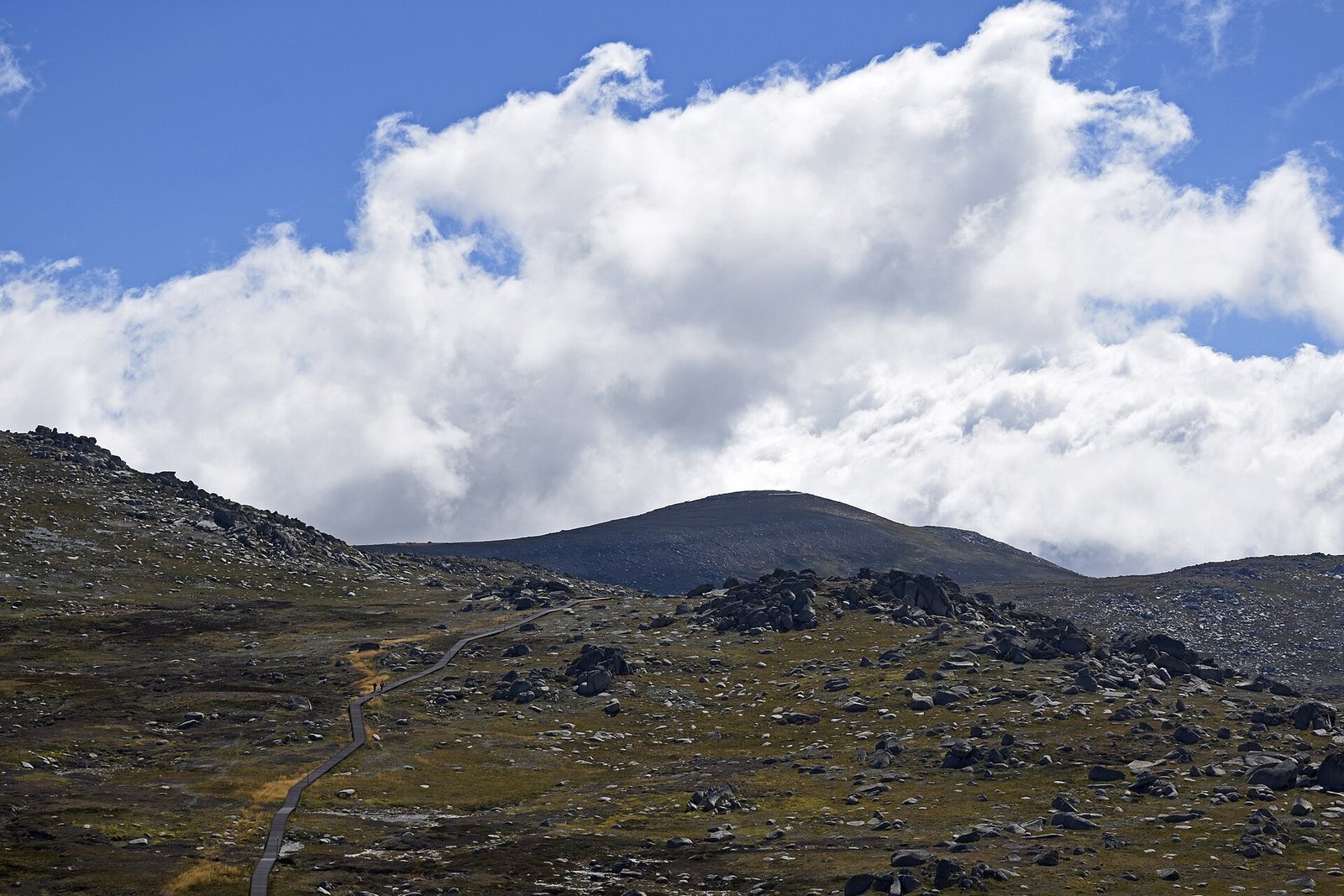
Kosciuszko is a rounded summit on the Main Range of the Snowy Mountains, part of the Great Dividing Range, in Kosciuszko National Park, the largest national park in New South Wales. It is not dramatic: it rises only a little above the surrounding high plateau, and the second-highest peak, Mount Townsend (2,209 m), looks more impressive from some angles. But the Main Range is Australia's only true alpine area, with glacial lakes such as Blue Lake, Lake Cootapatamba and Club Lake, formed by small glaciers during the last ice age, and fragile alpine herb fields and snow gums. The area is the traditional country of Aboriginal peoples, including the Ngarigo, who travelled to the high country for millennia.
History
In 1840, the Polish explorer Paweł Strzelecki climbed in the Main Range and named the highest peak after Tadeusz Kościuszko, the Polish-Lithuanian patriot who fought in the American War of Independence. Later surveys found that the peak Strzelecki named may have been the one now called Mount Townsend, and the names were swapped so that Kosciuszko stayed on the highest point. The name's spelling in Australia was officially changed from "Kosciusko" to "Kosciuszko" in 1997. In 1985, the American businessman Dick Bass became the first person to climb the highest peak on each continent, using Kosciuszko for Australia, which made it a Seven Summit.
Summer routes
From Thredbo
The most popular route starts with the Kosciuszko Express chairlift from Thredbo village to Eagles Nest at about 1,930 m. From there, a raised steel-mesh walkway protects the alpine vegetation and leads gently across the plateau, past Lake Cootapatamba lookout, to Rawson Pass, then up the final zigzag track to the summit. It is about 6.5 km each way, or about 13 km return, and takes about four to five hours. There is a toilet at Rawson Pass, often called the highest public toilet in Australia.
From Charlotte Pass
From Charlotte Pass, at the end of the Kosciuszko Road, the summit walk follows the old summit road, now closed to traffic, to Rawson Pass and the summit, about 9 km each way. The Main Range Track is a longer, more scenic loop of about 22 km, crossing the Snowy River and passing Blue Lake, Club Lake and Lake Albina before reaching the summit, and is one of the best day walks in Australia.
Winter on Kosciuszko
From about June to early October, snow covers the Main Range, and the summit becomes a winter objective. The weather can be severe: strong winds, blizzards and whiteouts are common, temperatures with wind chill can fall well below freezing, and walkers and skiers have died in the area. Winter visitors need snowshoes or skis, navigation skills, and the equipment to camp or shelter in a storm. This is why guided courses are popular. They teach the basics of winter mountaineering, including cramponing, ice-axe self-arrest, roped travel, snow anchors and building snow shelters, in an accessible place close to roads and towns.
A typical guided winter course
Guided winter programmes usually last four to six days. On the first day, the group meets in Jindabyne or Thredbo for a gear check and briefing, then travels onto the Main Range on snowshoes or skis, often using the Thredbo lifts to gain height. Camp is set up on the snow, sometimes with snow walls or shelters for protection from the wind. The following days are spent learning skills: walking in crampons on hard snow and ice, using an ice axe for balance and self-arrest, roped travel, building snow anchors, abseiling, navigation in poor visibility, and camp routines such as melting snow for water. A summit day to Kosciuszko is usually included when the weather allows, and some programmes also climb other peaks on the range, such as Mount Townsend. Reviewers here mention all of these, as well as the evenings in camp and the teamwork. Because the weather can be severe, guides adjust the plan daily.
When to go
For a summer walk, the best time is from about December to March, when the snow has gone, the wildflowers are out and the chairlift runs every day. November and April can also be good, but snow may linger and the weather can be cold. For winter courses and ski touring, the best snow is usually from July to September. Weather on the Main Range changes quickly in any season, and summer thunderstorms, cold fronts and even snow are possible, so carry warm, waterproof layers whenever you go.
Where to stay
Thredbo has hotels, lodges and apartments within walking distance of the chairlift, and Jindabyne, about 35 km away on the shore of Lake Jindabyne, has more choice and lower prices, as well as shops and outdoor gear rental. Perisher and Charlotte Pass have accommodation mainly in winter. Camping is possible at several campgrounds in the national park, such as Thredbo Diggings and Island Bend, and bush camping is allowed in parts of the park outside the restricted areas. In the ski season, accommodation fills quickly, especially at weekends and in school holidays, so book early. Most guided winter courses meet in Jindabyne and spend most nights camping on the snow, so you may need only a night or two before and after.
What summit day is like in winter
In winter, the summit is a long day from a camp on the range. The group usually sets out early to make the most of the daylight and better snow, crossing open, rolling terrain on snowshoes or skis, often in strong wind. The summit itself can be icy, and crampons and ice axes are sometimes needed on the final slopes. In clear weather, the views extend across the snow-covered range; in poor weather, navigation is the main challenge, since the landscape has few landmarks and the walkway markers can be buried.
Gear
For a summer walk, you need comfortable walking shoes or boots, a waterproof jacket, a warm layer, a hat, sun protection, water and food. For a winter course, operators usually provide the technical equipment, such as crampons, ice axes, snowshoes, harnesses and tents, and give you a kit list. You will need warm, windproof and waterproof clothing, insulated boots or mountaineering boots, gloves and mittens, goggles and a warm sleeping bag. Ask the operator what they provide and what you need to bring or rent.
Getting there
Thredbo and Jindabyne are about five to six hours' drive from Sydney, about two to three hours from Canberra, and about six to seven hours from Melbourne. Canberra has the nearest major airport, and there are seasonal flights to Cooma. In winter, cars must carry snow chains on the park's roads, and the road to Charlotte Pass closes beyond Perisher, so access is by oversnow transport or on skis. Park entry fees apply for vehicles in Kosciuszko National Park.
Kosciuszko and the Seven Summits
For Seven Summits climbers, Kosciuszko is the easiest of the list in summer. Many climbers who follow the Messner list, which uses Carstensz Pyramid instead, also walk up Kosciuszko to complete both versions. A winter climb is a different matter: it is a good place to learn and test the skills needed for bigger mountains, which is why several reviewers here took the course before expeditions to Nepal or other ranges. Our Oceania page covers both Seven Summits options.
Safety and environment
On a summer walk, stay on the track or walkway, carry water, and watch the weather; people have been caught out by sudden storms and cold. In winter, tell someone your plans, carry a map, compass or GPS and a personal locator beacon, and turn back if the weather worsens. The alpine area is fragile and protected: do not pick plants, take all rubbish home, use the toilet at Rawson Pass, and camp only where allowed. Camping is not permitted in the catchments of the glacial lakes. The national park rules change from time to time, so check the NSW National Parks and Wildlife Service website before you go.
Cost
Walking to the summit in summer costs only the park entry fee, the chairlift ticket if you use it, and your travel. Climbing The Seven Summits lists its winter course and Kosciuszko climb from US$1,995 (updated March 2026). Check what the price includes, such as equipment, food, transport from Jindabyne and lift tickets.
How to choose a guide
For a winter course, ask about the guides' qualifications and experience, the guide-to-client ratio, what skills the course teaches, how the operator handles bad weather, and what equipment is provided. If you are using the course to prepare for a particular expedition, tell the operator, since some courses focus on skills such as rope work and snow camping. Read the reviews above.
Frequently asked questions
How long does it take to walk up Mount Kosciuszko?
From the top of the Thredbo chairlift, about 13 km return, usually four to five hours.
Do I need a guide to climb Kosciuszko?
Not in summer. In winter, a guide or a course is recommended unless you have winter mountain experience.
When is the best time to climb Kosciuszko?
From about December to March for a summer walk, and from July to September for winter courses.
Is Kosciuszko one of the Seven Summits?
Yes, on the Bass list. The Messner list uses Carstensz Pyramid instead.
Which operator is ranked first for Kosciuszko on ExpedReview?
As of 23 October 2026, Climbing The Seven Summits is the only ranked operator, with 5.0★ from 11 verified reviews, the latest from August 2024.
Related articles
- How to choose a guide
- Best operators
- Carstensz Pyramid and Oceania Guides: Verified Reviews for Carstensz and Kosciuszko
Climbing in Oceania: operators ranked by verified ExpedReview client reviews for Carstensz Pyramid and Mount Kosciuszko, the two "Seven Summits" of Oceania, access, permits, season, skills, cost and how to choose an operator.