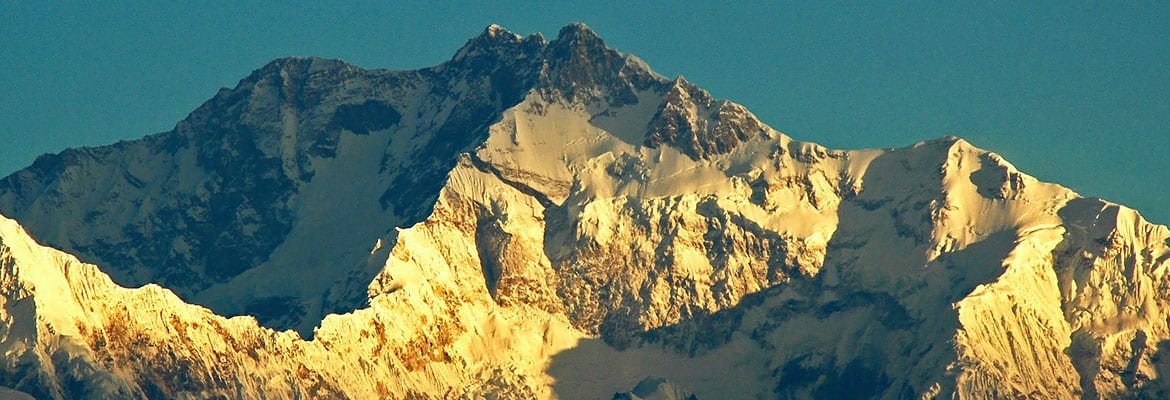
Kangchenjunga & Makalu Guides: Expeditions, Treks and Verified Reviews
By Blake Penson, Founder of ExpedReview · Everest summiter · Seven Summits climber · 20-year mountaineer · Industry expert
Eastern Nepal holds two of the world's five highest mountains: Kangchenjunga (8,586 m, third-highest) on the Sikkim border, and Makalu (8,485 m, fifth-highest) just south-east of Everest. Both are serious, remote 8,000 m expeditions for experienced climbers, and both have quiet, wild base camp treks. On ExpedReview, as of 23 October 2026, 2 operators have 2 verified client reviews in this region: Dream Himalaya Adventures, based in Nepal (5.0★ from 1 review for Makalu, October 2026), and Pioneer Adventure, based in Nepal (5.0★ from 1 review for Kangchenjunga, July 2022). Below are the reviews, the two mountains, the treks, seasons and permits, and how to choose an operator.
Kangchenjunga & Makalu: key facts | | | |---|---| | Kangchenjunga | 8,586 m, third-highest; first climbed 25 May 1955 (British) | | Makalu | 8,485 m, fifth-highest; first climbed 15 May 1955 (French) | | Protected areas | Kangchenjunga Conservation Area; Makalu Barun National Park | | Expedition season | Mainly spring (April–May); some autumn attempts | | Trekking seasons | Spring (March–May) and autumn (late September–November) | | Gateways | Taplejung (Kangchenjunga); Tumlingtar (Makalu) | | Operators reviewed on ExpedReview | 2, with 2 verified reviews (as of 23 Oct 2026) |
Operators with verified reviews
ExpedReview ranks operators by their verified client reviews in each region: the star rating, adjusted so one or two reviews, or only old ones, count for less than many recent ones. Every review is checked by hand before it is published, and operators cannot pay to appear or rank higher. Data as of 23 October 2026.
| Rank | Operator | Based in | Rating here | Reviews | Reviewed for | Latest review |
|---|---|---|---|---|---|---|
| 1 | Dream Himalaya Adventures | Nepal | 5.0★ | 1 | Makalu | October 2026 |
| 2 | Pioneer Adventure | Nepal | 5.0★ | 1 | Kangchenjunga | July 2022 |
What clients say
Dream Himalaya Adventures. A client reviewing a Makalu trip in October 2026 describes a "great experience with Dawa", praising efficient, friendly service.
Pioneer Adventure. A July 2022 Kangchenjunga review praises the "amazing sherpas and amazing team" and congratulates "Shanu dai" (Sanu Sherpa) on becoming the first person to climb all fourteen 8,000 m peaks twice, a feat he completed that month.
Both reviews are short, and there is only one review per operator. Ask for detailed references from recent clients on the same mountain before booking an expedition here.
Kangchenjunga
Kangchenjunga is the third-highest mountain in the world and the highest in India. Its name is usually translated as "five treasures of the snow", referring to its five summits. A British expedition led by Charles Evans made the first ascent on 25 May 1955, when Joe Brown and George Band reached the top via the Yalung face. They stopped just short of the true summit to respect the beliefs of the people of Sikkim, a tradition many climbers still follow.
Today, most expeditions climb the south-west face from a base camp of about 5,500 m on the Yalung Glacier, in spring, over about 45 to 55 days. The mountain is long, remote and exposed to avalanches, and is not a first 8,000 m peak. For the route, season, permits and preparation, see our Kangchenjunga expedition guide.
Makalu
Makalu, at 8,485 m, is the fifth-highest mountain in the world, about 19 km south-east of Everest. Its striking four-sided pyramid shape makes it one of the most recognisable peaks in the Himalaya. A French expedition led by Jean Franco made the first ascent: Lionel Terray and Jean Couzy reached the summit on 15 May 1955, followed by the rest of the team over the next two days.
Most commercial expeditions climb the north-west ridge (the French route) from the Nepal side. Base camp is at about 5,700 m (advanced base camp), above the Barun valley, reached by a trek of around a week or more from Tumlingtar, or by helicopter. The route crosses the Makalu La, a high col at about 7,400 m, before a final section of steep snow, ice and rock to a narrow summit. Makalu is technically harder than many 8,000 m peaks, especially high on the mountain, and it is regarded as a serious objective for climbers with previous 8,000 m experience. Expeditions usually take around 45 to 55 days.
Treks in the region
Kanchenjunga Base Camp trek
This trek visits the north base camp at Pangpema (about 5,140 m), the south base camp at Oktang, or both, crossing passes such as the Sele La. It takes around three to four weeks, passes through Limbu and Sherpa villages, forests, high pastures and glaciers, and gives close views of the world's third-highest mountain. It is one of the quietest and most rewarding long treks in Nepal.
Makalu Base Camp trek
The Makalu Base Camp trek starts at Tumlingtar and follows the Arun and Barun valleys through Makalu Barun National Park, with rich forests, waterfalls and wildlife, before reaching a base camp at around 4,870 m beneath Makalu's south face. It takes around two to three weeks. Lodges are basic and there are long sections without villages, so many groups camp or use simple teahouses.
The Great Himalaya Trail
Both treks form part of the Great Himalaya Trail, a network of routes across Nepal's high mountains. Experienced trekkers sometimes link Makalu and the Everest region via high passes such as Sherpani Col and West Col, but these are mountaineering routes that need glacier skills, climbing equipment and a strong team.
Seasons
- Expeditions: Spring (April–May) is the main season for both Kangchenjunga and Makalu, with summit windows usually in mid to late May. Autumn attempts are made but are less successful.
- Treks: Spring (March–May), when rhododendrons bloom in the lower forests, and autumn (late September–November), with clear skies after the monsoon. Winter is very cold at high camps and passes; the monsoon (June–September) brings rain, leeches and landslides on the lower trails.
Permits and rules
Both mountains need a Nepal Department of Tourism expedition permit (royalty) for the season, plus park or conservation area fees. Kangchenjunga requires a restricted area permit and a Kangchenjunga Conservation Area permit; Makalu requires a Makalu Barun National Park permit. Since 1 April 2023, foreign trekkers in Nepal's national parks and conservation areas outside the Khumbu must hire a licensed guide. Restricted area permits must be arranged through a registered Nepali agency. Royalty and fee rates change, so ask your operator for current figures.
Choosing an operator
- Look for direct experience on the mountain. Ask how many times the operator and its lead Sherpas have climbed Kangchenjunga or Makalu, with dates and results.
- Check the Sherpa ratio and oxygen plan. Ask about rope fixing, climbing Sherpa-to-client ratios, oxygen quantities and reserves.
- Ask about rescue and medical support. Both mountains are remote. Ask about helicopter evacuation, satellite communications and medical staff.
- Ask about the approach. Trekking in helps acclimatisation; helicopter access saves time but costs more.
- Get a written breakdown of inclusions. Royalties, park fees, oxygen, helicopter flights, equipment and insurance for staff all affect price.
- Read detailed reviews and references. With few reviews in this region, ask for contact details of recent clients.
Getting there
Both areas are a long way from Kathmandu. For Kangchenjunga, most teams fly to Bhadrapur or Biratnagar in the south-east lowlands, then drive for a day or more to Taplejung, where the trek begins. For Makalu, teams fly to Tumlingtar, in the Arun valley, then drive to Num or beyond before walking. Flights in eastern Nepal are often delayed by cloud, and roads can be blocked by landslides, especially near the monsoon, so allow spare days. Many expeditions now use helicopters to reach or leave base camp, saving a week or more, at significant extra cost and with the loss of natural acclimatisation from trekking.
People, culture and wildlife
The lower valleys of eastern Nepal are home to Limbu and Rai communities, with Sherpa and Tibetan-influenced villages higher up. Kangchenjunga is sacred to the people of Sikkim and to many Limbu, and you will see prayer flags, chortens and monasteries along the trails. Respect local customs: walk clockwise around chortens and mani walls, ask before photographing people and dress modestly in villages.
Both protected areas are rich in wildlife. The Kangchenjunga Conservation Area, managed with local communities, protects snow leopards, red pandas, Himalayan black bears and blue sheep. Makalu Barun National Park, established in 1992, spans an extraordinary range of altitudes, from subtropical forest in the Arun valley at under 1,000 m to the summit of Makalu, and is known for its orchids, rhododendrons and rare birds. Choose operators who manage waste carefully and employ local staff.
Dangers and how to manage them
The main risks on both expeditions are avalanches and serac fall, crevasses, falls on steep ground, extreme cold and frostbite, high-altitude illness (including high-altitude pulmonary and cerebral oedema) and exhaustion on long summit days. On the treks, altitude sickness, river crossings, landslides and remoteness are the biggest concerns.
Good operators manage these risks with careful acclimatisation, conservative turnaround times, reliable weather forecasts, enough oxygen and climbing Sherpas, satellite communications and a clear rescue plan. Clients reduce risk by being fit, experienced and honest about how they feel, and by turning back when the leader decides to.
Preparing for an expedition here
Both mountains suit experienced high-altitude climbers. A sensible progression might include a 6,000 m trekking peak such as Island Peak or Mera Peak, then a 7,000 m peak or Ama Dablam, then an 8,000 m peak such as Manaslu or Cho Oyu, before tackling Makalu or Kangchenjunga. Train for months with long days carrying a heavy pack, build strength and practise fixed-rope techniques. Make sure your insurance covers climbing above 8,000 m and helicopter rescue at high altitude.
Costs
Expeditions to Kangchenjunga and Makalu cost more than most 8,000 m peaks because of the remote access, small teams and long seasons. Major cost factors include the guide-to-climber ratio, number of oxygen bottles, Western or Nepali leadership, helicopter use and base camp services. No prices are listed for these operators in this region on ExpedReview, so ask for written quotes with full inclusions and compare them line by line.
Life on a Makalu expedition
Makalu expeditions usually set up base camp and advanced base camp on the moraine above the Barun Glacier. After acclimatisation rotations, climbers move up to Camp 1, Camp 2 and Camp 3 at the Makalu La, where the views stretch across Tibet to Everest and Lhotse. The summit push crosses the broad plateau beyond the col and climbs steep snow, ice and rock to a tiny, exposed summit. Strong winds are common, and teams often wait at base camp for weeks for the right window. The Barun valley is wild and beautiful, and much quieter than the Everest base camps.
Who these mountains suit
Kangchenjunga and Makalu suit climbers who have already climbed at least one 8,000 m peak and want a quieter, more serious expedition than Everest. They also suit strong trekkers who want remote, uncrowded routes with huge views, basic lodges or camping and real wilderness. If you want comfort, short days or frequent flights, the Everest and Annapurna regions are better choices.
Frequently asked questions
Which is harder, Kangchenjunga or Makalu?
Both are serious. Kangchenjunga is longer and more remote, with significant avalanche risk; Makalu has steeper, more technical climbing near the top. Neither is a first 8,000 m peak.
How long are the Kangchenjunga and Makalu expeditions?
Usually about 45 to 55 days from Kathmandu, depending on the approach and weather.
Can I trek to Kangchenjunga or Makalu base camp?
Yes. The Kanchenjunga Base Camp trek takes about three to four weeks, and the Makalu Base Camp trek about two to three weeks. Both need a licensed guide and permits.
Which operators have verified reviews in this region?
As of 23 October 2026, Dream Himalaya Adventures (5.0★, Makalu, October 2026) and Pioneer Adventure (5.0★, Kangchenjunga, July 2022).
Can operators pay to rank higher on ExpedReview?
No. Operators cannot pay to appear, rank higher or have reviews removed.
When was Makalu first climbed?
On 15 May 1955, by Lionel Terray and Jean Couzy of a French expedition led by Jean Franco.
Do I need a guide to trek in the Kangchenjunga or Makalu areas?
Yes. Since 1 April 2023, foreign trekkers need a licensed guide in national parks and conservation areas outside the Khumbu, and Kangchenjunga also requires a restricted area permit.
When is the best time to trek to Makalu Base Camp?
Spring (March–May) and autumn (late September–November), when the weather is usually most settled.