Kangchenjunga Expedition Guide: Routes, Season, Risks and Verified Reviews (8,586 m)
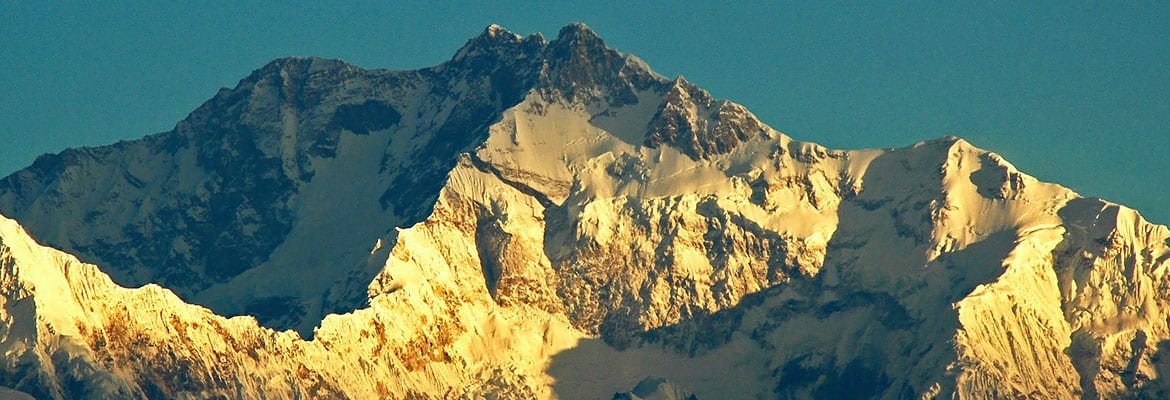
Kangchenjunga, at 8,586 m, is the third-highest mountain in the world, on the border between Nepal and the Indian state of Sikkim. It is one of the most serious 8,000 m peaks: remote, long, exposed to avalanches and far less climbed than Everest, Manaslu or Cho Oyu. Most expeditions climb the south-west face from the Yalung Glacier in Nepal in spring, over about 45 to 55 days. On ExpedReview, as of 23 October 2026, one operator has one verified client review for Kangchenjunga: Pioneer Adventure, based in Nepal (5.0★, July 2022). High Himalayan Climbing and Expeditions also lists Kangchenjunga but has no reviews here yet. Below are the review, the routes, the season, the risks and how to choose an operator.
| Height | 8,586 m (28,169 ft), third-highest in the world |
| Location | Nepal–Sikkim (India) border, eastern Himalaya |
| First ascent | 25 May 1955, Joe Brown and George Band (British expedition led by Charles Evans) |
| Normal route | South-west face from the Yalung Glacier, Nepal |
| Main season | Spring (April–May) |
| Typical expedition length | About 45–55 days from Kathmandu |
| Operators reviewed on ExpedReview | 1, with 1 verified review (as of 23 Oct 2026) |
Operators with verified reviews
ExpedReview ranks operators by their verified client reviews for each place: the star rating, adjusted so one or two reviews, or only old ones, count for less than many recent ones. Every review is checked by hand before it is published, and operators cannot pay to appear or rank higher. Data as of 23 October 2026.
| Rank | Operator | Based in | Rating here | Reviews | Latest review | Price |
|---|---|---|---|---|---|---|
| 1 | Pioneer Adventure | Nepal | 5.0★ | 1 | July 2022 | No recent price listed |
| – | High Himalayan Climbing and Expeditions | – | No reviews yet | 0 | – | – |
What the client says
The single review, from July 2022, praises Pioneer Adventure's "amazing sherpas and amazing team", and congratulates "Shanu dai" on becoming the first person to climb all fourteen 8,000 m peaks twice. That refers to Sanu Sherpa, who completed his second round of the fourteen in July 2022. It is a short review and does not describe the expedition itself, so ask the operator for detailed references from recent Kangchenjunga clients.
Why Kangchenjunga is different
Kangchenjunga is often ranked with Annapurna and K2 as one of the hardest and most dangerous 8,000 m peaks. Reasons include:
- Remoteness. The base camps are a week or more's trek from the nearest road, and helicopter rescue is weather-dependent.
- Length. The route is long, with high camps spread over a big face and a summit push of more than 1,000 m from the top camp.
- Avalanche and serac danger. Parts of the south-west face are exposed to falling ice and avalanches, especially after heavy snow.
- Altitude. At 8,586 m, it is only a few hundred metres lower than Everest, and the time spent above 7,500 m is long.
- Fewer climbers. With fewer teams than on Everest, there is less shared rope-fixing work, and less help nearby if things go wrong.
Kangchenjunga is not a first 8,000 m peak. Most operators expect clients to have climbed at least one, and preferably two, 8,000 m peaks, often including Manaslu, Cho Oyu or Everest.
History
The name is usually translated as "five treasures of the snow", referring to its five summits. It was thought to be the highest mountain in the world until surveys in the 1840s and 1850s showed Everest was higher. Early attempts included Aleister Crowley's disastrous 1905 expedition and a large German effort in 1929 and 1931 on the north-east spur.
On 25 May 1955, Joe Brown and George Band of a British expedition led by Charles Evans made the first ascent via the Yalung face, followed the next day by Norman Hardie and Tony Streather. Respecting a promise to the Chogyal (ruler) of Sikkim, who held the mountain sacred, they stopped a few metres short of the true summit. Many climbers still follow this tradition.
The first woman to reach the summit was the British climber Ginette Harrison, in 1998. The Polish climber Wanda Rutkiewicz, one of the greatest Himalayan mountaineers, disappeared on the mountain in 1992.
Routes
South-west face (Yalung side, Nepal)
This is the normal route today. It starts from a base camp of about 5,500 m on the Yalung Glacier, reached by a trek of around 10 to 14 days from Taplejung. The route climbs the face through four high camps, crossing glaciers, snow slopes and a rocky section near the top called the Gangway, before the final ridge to the summit. Teams fix ropes on much of the route, and most clients use supplementary oxygen above the high camps.
North side (Nepal)
The north face is climbed from the North Base Camp, near Pangpema (about 5,140 m). This route, used by some teams, includes the north col and the long north ridge. It is less commonly used commercially.
Sikkim (India)
Sikkim's side of the mountain is sacred and has been closed to climbing since 2000, except for very rare permitted expeditions.
Season and itinerary
Most commercial expeditions climb in spring, from April to late May, when the jet stream eases and summit weather windows usually arrive in mid-May. Some teams attempt it in autumn, but summits are less common.
A typical itinerary looks like this:
- Arrival and preparation in Kathmandu (3–4 days): permits, briefings, gear checks.
- Fly and drive to the trailhead: usually a flight to Bhadrapur or Biratnagar, then a long drive to Taplejung, or a helicopter to base camp.
- Trek to base camp (around 10–14 days on foot): through the Kangchenjunga Conservation Area, acclimatising on the way.
- Acclimatisation rotations (about 3 weeks): climbing to the higher camps and back to base camp.
- Summit push and descent (around 7–10 days, depending on the weather window).
- Return trek or helicopter flight and return to Kathmandu.
Many operators now use helicopters for the approach or return to cut the expedition length, at extra cost.
Permits and regulations
Climbing Kangchenjunga requires a Nepal Department of Tourism expedition permit (royalty) for the season, a permit to enter the Kangchenjunga Conservation Area and a restricted area permit. The restricted area permit is only issued through a registered Nepali agency, and trekkers must travel with a licensed guide. Nepal requires a liaison officer and has rules on garbage deposits, insurance for Nepali staff and the return of waste. Royalty rates change, so ask your operator for the current figures and what they include.
Costs
Kangchenjunga expeditions are expensive because of the remote approach, the long season, the oxygen and Sherpa support needed and the small number of teams. Prices vary widely between operators depending on the guide-to-climber ratio, the number of oxygen bottles, Western leadership and whether helicopters are used. Pioneer Adventure's ExpedReview profile shows no recent listed price, so ask any operator for a written quote listing what is included.
Choosing an operator
- Check their Kangchenjunga record. Ask how many times they have run the mountain, how many clients summited and whether anyone died or was seriously injured.
- Ask about the Sherpa team. Who leads the rope fixing, how experienced are they, and what is the climbing Sherpa-to-client ratio?
- Ask about oxygen. How many bottles per client, from which camp, what flow rate, and what reserves are held?
- Ask about rescue. What is the plan if you are injured or ill above base camp? What are the helicopter limits?
- Ask about weather forecasting. Kangchenjunga demands well-timed summit pushes.
- Ask for detailed references. One short review is not enough.
The trek to base camp
The approach is one of the best parts of a Kangchenjunga expedition. From Taplejung, the trail climbs through terraced farmland, rhododendron and oak forest, and villages of Limbu, Rai and Sherpa people, before reaching high pastures and moraine below the south-west face. The Yalung side passes through Ramche and Oktang, with superb views of the face. The trek gives climbers a gradual, natural acclimatisation and a chance to get fit before the climb.
Trekkers who are not climbing can do the Kanchenjunga Base Camp trek, visiting the North Base Camp at Pangpema, the South Base Camp at Oktang, or both via the Sele La and Mirgin La passes, in about three to four weeks. A licensed guide and restricted area permit are required, and lodges are basic. It is one of the quietest major treks in Nepal.
Preparation and training
Prepare for Kangchenjunga as you would for Everest, but with extra emphasis on endurance and self-reliance. Most climbers need:
- Prior 8,000 m experience, ideally including at least one ascent with supplementary oxygen, so you know how you respond to extreme altitude.
- Technical skills on fixed ropes: ascending with a jumar, abseiling, passing anchors and moving efficiently with crampons on steep snow, ice and mixed rock.
- Long-term fitness training of six months or more, with long days carrying a loaded pack, hill and stair work, and strength training for legs and core.
- Mental resilience to cope with weeks of waiting at base camp, cold, poor sleep and the decision to turn back.
A good operator will ask for your climbing CV and decline applicants without enough experience. Treat that as a good sign.
Oxygen, gear and base camp
Most commercial climbers use supplementary oxygen from about Camp 3 or Camp 4, with Sherpas carrying bottles to the high camps. Ask whether your operator uses modern regulators and masks, how many bottles each client gets, and what happens if someone needs extra oxygen on the descent.
Your gear will be similar to an Everest kit: an 8,000 m down suit, high-altitude boots, insulated mitts, crampons, harness, ascender, helmet and a warm sleeping bag rated to around −30 °C or lower. Base camp on the Yalung side is remote, so check what the operator provides for food, heated dining tents, communications, power and medical support, including a doctor or medical kit and a hyperbaric chamber.
Climate change and conditions
Like many Himalayan peaks, Kangchenjunga has seen changes in snow cover and glacier conditions. Drier seasons can expose more rock and increase rockfall, while heavy snow raises avalanche danger. These changes make up-to-date local knowledge more valuable, so ask operators what conditions they found in recent seasons and how they adapted their route and camps.
For the wider region, including Makalu, see our Kangchenjunga & Makalu guide.
Life on the expedition
Expect around six to seven weeks away from home. Much of the time is spent at base camp, resting between rotations, eating, reading and waiting for weather. Rotations to the higher camps are hard work and sleep at altitude is poor. Good operators keep morale up with good food, comfortable tents, reliable communications and clear decisions from the leader. The summit push itself usually takes several days, with a very long summit day leaving the top camp late at night and returning, if all goes well, the following afternoon. Allow spare days for bad weather.
Frequently asked questions
How high is Kangchenjunga?
8,586 m (28,169 ft), making it the third-highest mountain in the world after Everest and K2.
How long does a Kangchenjunga expedition take?
About 45 to 55 days from Kathmandu, depending on the approach, helicopter use and weather.
When was Kangchenjunga first climbed?
On 25 May 1955, by Joe Brown and George Band of a British expedition led by Charles Evans.
Is Kangchenjunga harder than Everest?
It is generally considered more serious, because of its remoteness, avalanche risk, length and fewer teams, although both demand high-altitude experience.
Which operators have verified reviews for Kangchenjunga?
As of 23 October 2026, Pioneer Adventure has 1 verified review (5.0★, July 2022).
Can operators pay to rank higher on ExpedReview?
No. Operators cannot pay to appear, rank higher or have reviews removed.
Do I need oxygen to climb Kangchenjunga?
Most commercial climbers use supplementary oxygen high on the mountain. A few elite climbers summit without it, but this greatly increases the risk.
Can I trek to Kangchenjunga base camp without climbing?
Yes. The Kanchenjunga Base Camp trek visits the north base camp, the south base camp or both, in about three to four weeks. A licensed guide and a restricted area permit are required.
What experience do I need for Kangchenjunga?
Most operators expect at least one previous 8,000 m ascent, solid fixed-rope skills and excellent fitness. It is not a first 8,000 m peak.
What does the name Kangchenjunga mean?
It is usually translated as "five treasures of the snow", after its five summits.
Related articles
- How to choose a guide
- Best operators
- Kangchenjunga & Makalu Guides: Expeditions, Treks and Verified Reviews
Expeditions and treks in eastern Nepal's Kangchenjunga and Makalu region: the third- and fifth-highest mountains in the world, base camp treks, seasons, permits, and verified ExpedReview reviews of operators.