Japan & Kamchatka Guides: Mount Fuji, Japanese Alps and Kamchatka Volcanoes
By Blake Penson, Founder of ExpedReview · Everest summiter · Seven Summits climber · 20-year mountaineer · Industry expert
Japan and Russia's Kamchatka peninsula sit on the Pacific "Ring of Fire", and their mountains are mostly volcanoes. Japan's best-known climb is Mount Fuji (3,776 m), an easy but crowded summer hike that becomes a serious winter mountaineering objective. Kamchatka has more than 300 volcanoes, about 29 of them active, and is a remote destination for volcano ascents and ski touring. On ExpedReview, as of 23 October 2026, 2 operators have 4 verified client reviews in this region: Feeding The Rat Expeditions, based in Australia (5.0★ from 3 reviews filed under Mount Fuji, latest February 2022), and Hohenbergsteigen, based in Germany (4.4★ from 1 review for Kamchatka ski touring, February 2020). Below are the reviews, the main objectives and how to choose an operator.
Japan & Kamchatka: key facts | | | |---|---| | Highest peak in Japan | Mount Fuji, 3,776 m | | Highest peak in Kamchatka | Klyuchevskaya Sopka, about 4,750 m (height varies with eruptions) | | Main activities | Fuji ascents, Japanese Alps hut treks, Hokkaido ski touring, Kamchatka volcano climbs and ski touring | | Fuji summer season | Early July to about 10 September (official trail opening) | | Kamchatka seasons | Ski touring in late winter and spring; volcano climbs in summer | | Operators reviewed on ExpedReview | 2, with 4 verified reviews (as of 23 Oct 2026) |
Operators with verified reviews
ExpedReview ranks operators by their verified client reviews in each region: the star rating, adjusted so one or two reviews, or only old ones, count for less than many recent ones. Every review is checked by hand before it is published, and operators cannot pay to appear or rank higher. Data as of 23 October 2026.
| Rank | Operator | Based in | Rating here | Reviews | Reviewed for | Latest review |
|---|---|---|---|---|---|---|
| 1 | Feeding The Rat Expeditions | Australia | 5.0★ | 3 | Mount Fuji | February 2022 |
| 2 | Hohenbergsteigen | Germany | 4.4★ | 1 | Kamchatka volcanoes | February 2020 |
What clients say
Feeding The Rat Expeditions. One client climbed Fuji with the company several times in 2021, saying they were unprepared for the difficulty the first time, but improved with the guide's advice. They describe the guide as very knowledgeable about climbing. Another, training for 8,000 m peaks, booked a custom winter Fuji programme, noting that you need someone who has climbed Fuji in winter many times "as there is little room for error". The third review, although filed under Mount Fuji, describes a self-supported ten-day trip over a mountain and down canyons and a river to the ocean by packraft, so it reflects a different kind of trip.
Hohenbergsteigen. One client describes volcanic ski touring in Kamchatka as "simply unforgettable", praising the preparation, the guiding, steep descents on the volcanoes, food cooked by a local chef and a constant focus on safety in a very remote region.
All four reviews are several years old. Ask each operator what it runs now, who would guide you and how recent its experience is.
Mount Fuji
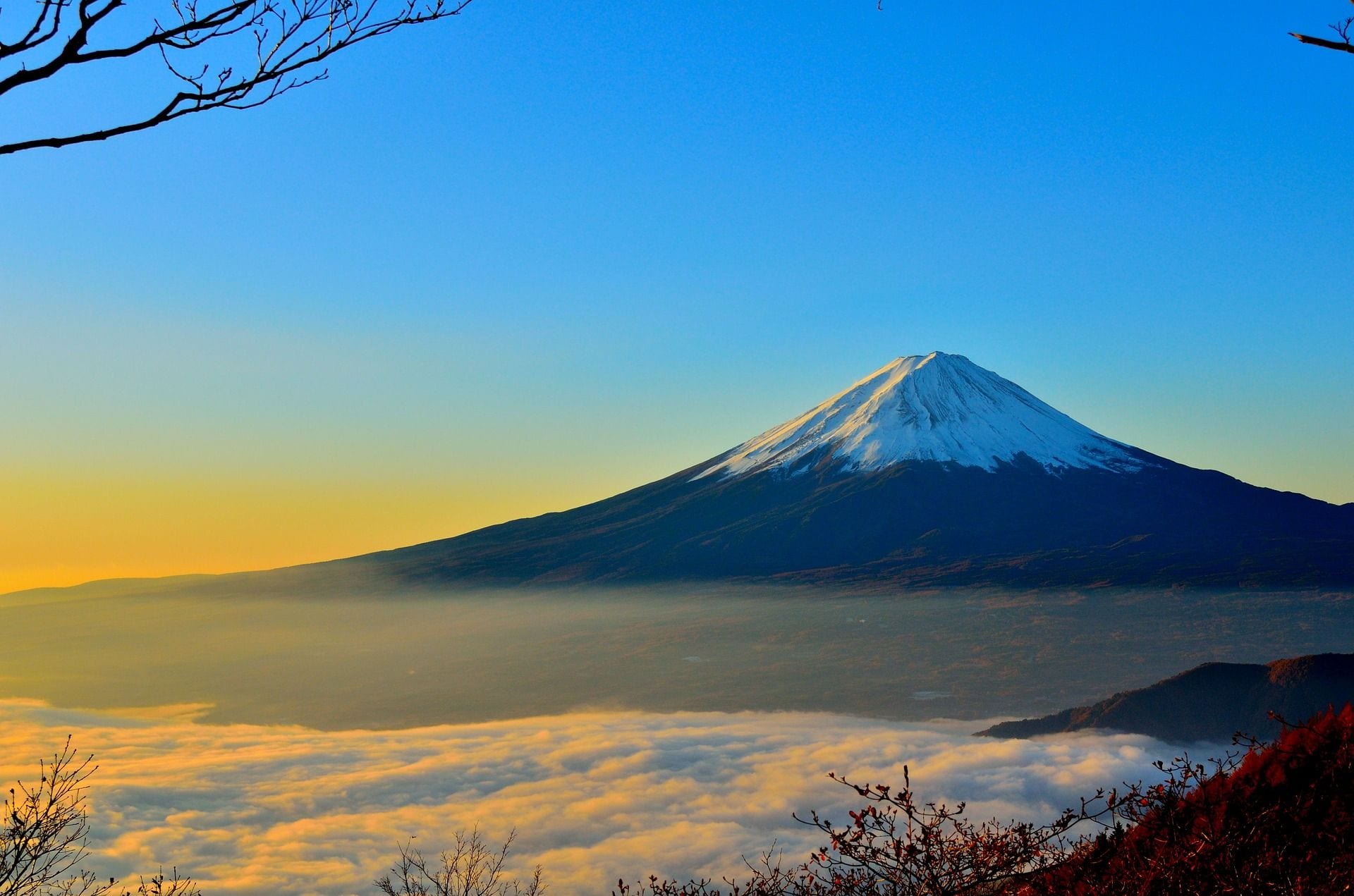
At 3,776 m, Fuji is Japan's highest mountain and a sacred site, listed by UNESCO in 2013 as a cultural World Heritage site, "Fujisan, sacred place and source of artistic inspiration". It is a dormant stratovolcano that last erupted in 1707.
Climbing Fuji in summer
During the official season, roughly early July to 10 September, four main trails lead to the summit: Yoshida (the most popular, from the Fuji Subaru Line 5th Station in Yamanashi), Subashiri, Gotemba and Fujinomiya (all in Shizuoka). Mountain huts on the trails offer food and beds. Most people climb in the afternoon, sleep in a hut and set off in the small hours to see sunrise from the summit, a tradition called goraiko.
The climb is a long, steep walk on loose volcanic scree, with no technical difficulty, but it is not trivial. Climbers gain around 1,400 m from the 5th Stations, and altitude sickness, cold and wind at the top, and crowds are all common. Both prefectures now charge an entry fee, have daily limits on some trails and set times after which climbers cannot start without a hut booking. Rules have changed several times since 2024, so check the current fee, booking and time rules on the official prefectural sites before you go.
Climbing Fuji in winter
Outside the official season, the huts close, the trails are not maintained and Fuji becomes a serious winter climb. Hard, wind-blasted ice, very strong winds, extreme cold and long sliding falls make it dangerous, and accidents happen every year. Authorities strongly discourage climbing outside the season and ask climbers to submit a climbing plan. Winter Fuji is a training climb for experienced mountaineers with crampons, ice axe and self-arrest skills, ideally with a guide who has climbed it in winter many times, as one of the reviews above points out.
The Japanese Alps
The Hida, Kiso and Akaishi ranges of central Honshu, known together as the Japanese Alps, contain most of Japan's peaks above 3,000 m, including Kita-dake (3,193 m), the second-highest mountain in Japan, and Okuhotaka-dake (3,190 m). Many have well-marked trails and staffed huts in summer. Some routes, such as the traverse from Yari-ga-take to Hotaka, include chains, ladders and exposed scrambling. In winter, these peaks receive very heavy snow and become serious alpine objectives.
Hokkaido and Japanese powder
Japan's northern island, Hokkaido, and the mountains of northern Honshu are famous for very heavy, light snowfall caused by cold winds crossing the Sea of Japan. This "Japow" makes Japan one of the world's top ski touring and backcountry destinations. Popular areas include Niseko and the Shiretoko and Daisetsuzan volcanoes in Hokkaido, and Hakuba in the Northern Alps. The main hazards are avalanches, tree wells and fast-changing weather. Guided touring with avalanche equipment is the safest way to explore.
Kamchatka
Kamchatka is a peninsula about 1,250 km long in Russia's Far East, between the Sea of Okhotsk and the Pacific. The "Volcanoes of Kamchatka" were listed by UNESCO as a natural World Heritage site in 1996. Highlights include:
- Klyuchevskaya Sopka, about 4,750 m, the highest active volcano in Eurasia, which erupts frequently.
- Avachinsky (about 2,741 m) and Koryaksky (about 3,456 m), close to the regional capital Petropavlovsk-Kamchatsky. Avachinsky is the most-climbed volcano in Kamchatka, a long non-technical ascent in summer.
- Mutnovsky and Gorely, known for fumaroles, crater lakes and steaming ground.
For ski touring, operators run trips in late winter and spring, often using snowmobiles or helicopters to reach long descents on volcanic slopes down to the sea. See our Kamchatka volcanoes guide for details.
Travel to Kamchatka
Kamchatka is part of Russia, and many governments currently advise against all travel to Russia. Most international operators have suspended trips, and getting there, paying for services and getting help in an emergency are all harder than before. Check your government's travel advice and your insurance before considering a trip.
Choosing an operator
- Match the operator to the objective. A summer Fuji guide, a winter Fuji guide, a Japan backcountry ski guide and a Kamchatka volcano expedition need very different skills.
- Check qualifications. For winter climbing and ski touring, look for internationally qualified guides (IFMGA) or nationally certified guides, and ask about avalanche training.
- Ask about group size and ratios. On winter Fuji and in avalanche terrain, small groups are much safer.
- Ask about rescue and insurance. Helicopter rescue in Japan may be charged to the climber, and Kamchatka is very remote.
- Ask what is included. Huts, transport, lift passes, snowmobiles, permits and meals vary widely.
- Read recent reviews. Reviews here are older than 2022, so ask for recent references.
A typical summer Fuji ascent
Most climbers take a bus from Tokyo or Shinjuku to the Fuji Subaru Line 5th Station, at about 2,300 m, on the Yoshida trail. A common plan is:
- Day 1, afternoon: Spend an hour or so at the 5th Station to acclimatise, then climb for 3 to 5 hours to a hut around the 7th or 8th Station. Eat dinner and sleep for a few hours.
- Day 2, small hours: Leave the hut around 1 to 3 am with a headlamp to reach the summit crater rim for sunrise. If you have time and energy, walk around the crater (ohachi-meguri) to Kengamine, the true summit at 3,776 m.
- Day 2, morning: Descend by the zigzag descent trail to the 5th Station, which takes 3 to 5 hours and is hard on the knees.
Pack warm layers, a waterproof jacket, gloves and a hat, as temperatures at the summit can be near freezing even in August. Carry cash, a headlamp, water and snacks, and wear sturdy boots. Hut beds are basic and crowded, and must be booked in advance during the busy season. Avoid the mid-August Obon holidays and weekends if you can.
Volcanic hazards
Almost every major peak in this region is a volcano, which adds a hazard most alpine climbers do not face. On 27 September 2014, Mount Ontake in central Japan erupted without warning on a busy autumn day, killing 58 people, with 5 more still missing. It was Japan's deadliest volcanic disaster in decades. The Japan Meteorological Agency issues alert levels for active volcanoes, and some summits and trails close when activity increases. In Kamchatka, several volcanoes erupt regularly, and ash, gas and lava flows can affect routes. Check the current alert levels and listen to local guides.
Other Japanese mountains
Japanese hikers have a long tradition of mountain walking, and many aim to climb the Nihon Hyakumeizan, the "100 famous mountains of Japan", a list chosen by the writer and mountaineer Kyūya Fukada in his 1964 book. They range from Fuji and the 3,000 m peaks of the Alps to volcanoes in Kyushu and Hokkaido. Popular multi-day routes include the Yari–Hotaka traverse, the Tateyama–Tsurugi area, with its famous chains and ladders on Tsurugi-dake, and Hokkaido's Daisetsuzan traverse, where brown bears live.
Japanese huts are generally well run, with dinner and breakfast, but are often very full in peak season. Japan has excellent public transport, so many trailheads can be reached by train and bus.
Kamchatka ski touring
Kamchatka is famous among ski tourers for long descents from volcano summits, sometimes to the Pacific shoreline. Trips usually run in late winter and spring, when days are longer and the snowpack is often more stable. The terrain varies from broad, gentle slopes to steep couloirs and crater rims, and weather can change quickly. Typical trips use a base in or near Petropavlovsk-Kamchatsky, with access by snowmobile, tracked vehicle or helicopter, and camping or simple lodges. Skiers need solid off-piste skills, avalanche training and the fitness to climb 1,000 to 1,500 m a day. The review above, from February 2020, predates current travel restrictions.
Best time to go
- Fuji (summer hike): July and early September, avoiding the Obon holidays.
- Fuji (winter climb): From about November to May, for experienced climbers only, with the most stable weather often in late spring.
- Japanese Alps: July to October, with autumn colours from late September.
- Japan ski touring: January and February for deep powder; March and April for spring touring on the volcanoes.
- Kamchatka: Late winter and spring for ski touring; July to September for volcano climbs and trekking.
Frequently asked questions
How hard is it to climb Mount Fuji?
In summer, Fuji is a long, steep, non-technical walk that most fit people can complete. Allow 5 to 7 hours up and 3 to 5 down from the 5th Stations. In winter, it is a serious mountaineering climb that needs crampons, an ice axe and experience.
When is the official Fuji climbing season?
From about early July to 10 September, depending on the trail and the year. Check the official prefectural sites for exact dates.
Do I need a guide to climb Mount Fuji?
Not in summer, when the trails and huts are open. A guide is strongly recommended for winter ascents or if you are new to mountains.
What is the highest volcano in Kamchatka?
Klyuchevskaya Sopka, at about 4,750 m, which is also the highest active volcano in Eurasia. Its height changes with eruptions.
Which operators have verified reviews in Japan & Kamchatka?
As of 23 October 2026, Feeding The Rat Expeditions (5.0★ from 3 reviews, Mount Fuji) and Hohenbergsteigen (4.4★ from 1 review, Kamchatka).
Can operators pay to rank higher on ExpedReview?
No. Operators cannot pay to appear, rank higher or have reviews removed.
Can I still travel to Kamchatka?
Kamchatka is in Russia, and many governments currently advise against all travel there. Most international operators have suspended trips. Check your government's advice and your insurance first.
Is Fuji a good training climb for higher mountains?
In winter, it can be. Its cold, wind and hard ice make it a demanding place to practise crampon and ice axe skills, but only with a guide experienced in winter conditions.