Pamir, Kunlun and Mongolia Expedition Guides: Verified Reviews
By Blake Penson, Founder of ExpedReview · Everest summiter · Seven Summits climber · 20-year mountaineer · Industry expert
Central Asia's high mountains, from the Pamirs of Kyrgyzstan and Tajikistan to the eastern Pamir and Kunlun of China's Xinjiang and the Altai of western Mongolia, offer some of the most accessible 7,000-metre peaks in the world. The two most popular are Lenin Peak (7,134 m), on the Kyrgyzstan–Tajikistan border, and Muztagh Ata (7,546 m), in Xinjiang, both long, mostly non-technical snow climbs that are classic first 7,000ers, climbed in summer, usually in July and August. On ExpedReview, as of 23 October 2026, 2 operators have 2 verified client reviews in the region across 2 places: Adventure Consultants (5.0★ from 1 review, Lenin Peak, August 2026) is ranked first, followed by Exped Tribe (5.0★ from 1 review, Muztagh Ata, July 2026). Below are the ranking and reviews, then a guide to the region.
Pamir, Kunlun and Mongolia: key facts | | | |---|---| | Countries | Kyrgyzstan, Tajikistan, China (Xinjiang), Mongolia | | Popular peaks | Lenin Peak (7,134 m), Muztagh Ata (7,546 m) | | Other objectives | Ismoil Somoni (7,495 m), Korzhenevskaya (7,105 m), Khan Tengri (about 7,010 m), Khuiten Peak (4,374 m, Mongolia) | | Gateways | Osh (Kyrgyzstan), Kashgar (China), Ulaanbaatar (Mongolia) | | Main season | July to August | | Typical 7,000 m expedition | About 3–4 weeks | | Operators reviewed on ExpedReview | 2, with 2 verified reviews across 2 places (as of 23 Oct 2026) |
Central Asia guides ranked by verified reviews
Rankings use each operator's verified ExpedReview client reviews across the region: the star rating, adjusted so that one or two reviews, or only old ones, count for less than many recent ones; ties go to the operator with more reviews. Every review is checked by hand before it is published, and operators cannot pay for a better position. Data as of 23 October 2026.
| Rank | Operator | Based in | Rating here | Reviews | Latest review | Reviewed for |
|---|---|---|---|---|---|---|
| 1 | Adventure Consultants | New Zealand | 5.0★ | 1 | August 2026 | Lenin Peak |
| 2 | Exped Tribe | Switzerland | 5.0★ | 1 | July 2026 | Muztagh Ata |
No operator lists a current price for the region on ExpedReview, so ask each one directly. Two reviews are a thin basis for comparison, so read operators' reviews on other high peaks too.
What clients say
The Lenin Peak review, from August 2026, came from a team of three friends attempting their first 7,000-metre peak, who chose Adventure Consultants for its reputation for professionalism. They described thorough pre-trip information and gear lists, and smooth logistics in the country, from airport and bus transfers to hotels, internal flights and tents on the mountain. The standout was their guide, Rob, who they said was calm and smart about rotations, kept them rested, avoided bad weather and gave great training, leading to "a perfect (albeit challenging) summit day". They said they saw many teams failing on the mountain because of poor decisions and inexperience, and that while Adventure Consultants may cost more than some local operators, "paying a little bit extra for experience means you are more likely to get there". The Muztagh Ata review, from July 2026, described a successful ski ascent with Exped Tribe and said the reviewer was "very positively surprised" by the logistics and organisation.
The region
The Pamir is a high mountain knot where the Himalaya, Karakoram, Hindu Kush, Kunlun and Tian Shan ranges meet, often called the "roof of the world". Its highest peaks are in Tajikistan, including Ismoil Somoni (7,495 m), formerly Communism Peak, and in the Trans-Alay range on the Kyrgyzstan–Tajikistan border, including Lenin Peak. East of the border, in China's Xinjiang, the eastern Pamir includes Muztagh Ata and Kongur Tagh (7,649 m), at the western end of the Kunlun system. To the north, the Tian Shan of Kyrgyzstan and Kazakhstan has Khan Tengri and Jengish Chokusu (Pobeda Peak, 7,439 m). Far to the north-east, the Altai mountains on Mongolia's borders with China and Russia rise to Khuiten Peak (4,374 m), Mongolia's highest. The climate is continental and dry, with cold, stormy weather possible at any time on the high peaks.
Lenin Peak
Lenin Peak, at 7,134 m, is one of the most-climbed 7,000-metre peaks in the world, partly because it is relatively cheap and accessible. Most expeditions fly to Osh in southern Kyrgyzstan, drive about eight to ten hours to base camp at Achik Tash, at about 3,600 m, then move to advanced base camp at about 4,400 m. The standard route crosses a crevassed glacier, including a basin often called the Frying Pan, to Camp 2 at about 5,300 m, then climbs steep slopes exposed to avalanches to Camp 3 at about 6,100 m, with some teams placing a further camp at about 6,400 m, before a very long summit day along a ridge and plateau. The climb is not technical, but its length, altitude, weather and avalanche risk make it serious. In July 1990, an avalanche triggered by an earthquake hit a camp on the route and killed 43 climbers, one of the worst disasters in mountaineering history. The mountain is busy in July and August, with large camps run by local companies, and, as the review above notes, many teams turn back. Lenin Peak is one of the peaks of the former Soviet "Snow Leopard" award for climbing the 7,000-metre peaks of the former USSR.
Muztagh Ata
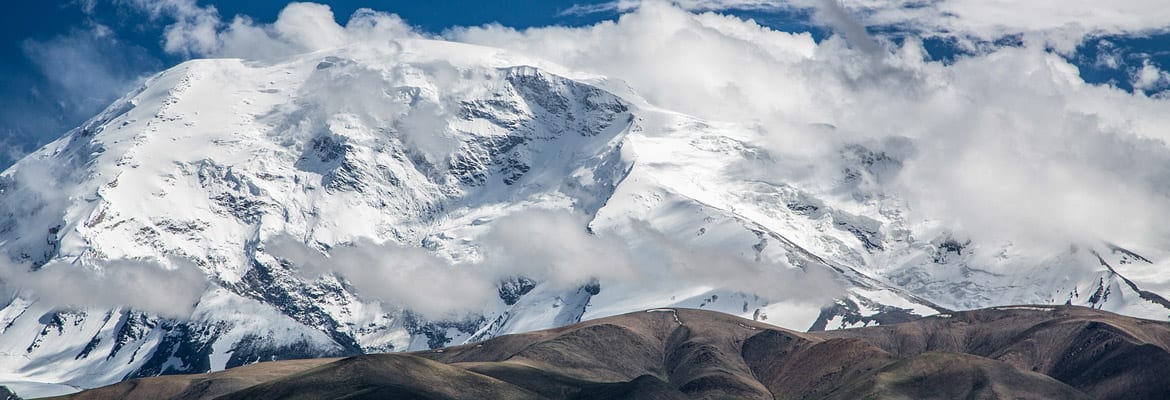
Muztagh Ata, at 7,546 m, stands above Karakul Lake and the Karakoram Highway, about four to five hours by road from Kashgar in Xinjiang. Its standard West Ridge route is a long, broad snow slope, with crevasses but little steep ground, which makes it one of the most accessible 7,000-metre peaks and a favourite for ski ascents, as in the Exped Tribe review above. It was first climbed in 1956 by a joint Chinese–Soviet expedition. Expeditions usually take about three to four weeks, with three camps above base camp. Access depends on Chinese permits for Xinjiang, which have sometimes been restricted, so check the current situation with your operator.
Other peaks
The other 7,000-metre peaks of the former Soviet Union, Ismoil Somoni, Korzhenevskaya (7,105 m), Jengish Chokusu and Khan Tengri, are more serious and remote expeditions. Korzhenevskaya and Ismoil Somoni are usually climbed from a base camp on the Moskvina Glacier in Tajikistan, reached by helicopter. Khan Tengri, in the central Tian Shan, is a striking marble pyramid, climbed from base camps on the North or South Inylchek Glacier, with steep fixed-rope climbing and a high objective risk. In Mongolia, Khuiten Peak, in Altai Tavan Bogd National Park, is a glaciated peak of 4,374 m, usually climbed in an expedition of about two weeks, with a long drive or flight from Ulaanbaatar to Ölgii and a trek or camel-supported approach over the Potanin Glacier.
When to go
The main climbing season for the Pamir and Tian Shan peaks is July and August, with some expeditions in late June and early September. Muztagh Ata is climbed from about June to August. In Mongolia's Altai, the season is from about June to August. Outside summer, the high peaks are very cold and stormy, and access is difficult. Weather in summer is generally more stable than in the Himalaya, without a monsoon, but storms, high winds and heavy snowfall can still last several days.
Getting there
For Lenin Peak, international flights reach Bishkek, Kyrgyzstan's capital, with connections to Osh, the gateway to the southern mountains; some flights also go direct to Osh via Istanbul, Moscow or other hubs. For Muztagh Ata, climbers fly to Kashgar via Ürümqi or other Chinese cities, or cross overland from Kyrgyzstan through the Irkeshtam or Torugart passes. For the Tajik peaks, climbers usually fly to Dushanbe or reach the mountains from Kyrgyzstan. For Mongolia's Altai, climbers fly to Ulaanbaatar and then to Ölgii in the far west. Allow spare days for flights and border crossings, which can be slow, and check opening times for land borders.
Permits and access
Permits and visas differ by country. Kyrgyzstan offers visa-free entry for many nationalities, and Lenin Peak requires a border zone permit and a climbing registration, usually arranged by the local operator. Tajikistan requires an e-visa and a permit for the Gorno-Badakhshan region, plus climbing permits. China requires a visa, a climbing permit from the Xinjiang Mountaineering Association and special arrangements for travel in Xinjiang, which have changed several times in recent years. Mongolia requires border zone permits for the Altai, arranged in Ölgii. In all cases, the local operator usually handles the paperwork, but you should check the requirements for your nationality well in advance.
Cost
No operator lists a price for the region on ExpedReview, so ask each one directly. Lenin Peak is one of the cheapest 7,000-metre expeditions, especially with local operators that provide base camp services and leave clients to climb independently, while fully guided trips with international operators cost more, as the Adventure Consultants reviewer noted. Muztagh Ata costs more, because of Chinese permits and logistics. When comparing prices, check what is included: guiding ratios above base camp, high-camp tents and food, permits, transfers, hotels, and rescue cover.
Safety
The main risks are avalanches, especially on Lenin Peak's slopes between the lower and upper camps; crevasses; altitude illness on long summit days; frostbite in high winds; and the remoteness of some areas, where helicopter rescue is limited or slow. On busy peaks such as Lenin Peak, many independent climbers and small teams share the route, and some are inexperienced, which adds risk. Choose an operator with a conservative acclimatisation plan, experienced guides, good communication and clear rules on turnaround times. Insurance covering rescue at high altitude in the specific country is essential, since not all policies cover Central Asia.
Experience needed
Lenin Peak and Muztagh Ata are often a climber's first 7,000-metre peak. Operators usually ask for experience on glaciers and at altitude, such as a 6,000-metre peak in Nepal or the Andes, or a climb of Aconcagua or Denali, and competence with crampons, an ice axe and roped glacier travel. Fitness and endurance matter more than technical skill, because summit days are long, often 12 hours or more. For Muztagh Ata on skis, you need to be a competent ski tourer, able to ski variable snow with a pack at high altitude. Khan Tengri and the Tajik peaks require more technical skill and previous 7,000-metre experience.
A typical expedition
A Lenin Peak expedition usually takes about three weeks from Osh: a day of travel to base camp, several days of acclimatisation at base camp and advanced base camp, including hikes to nearby peaks, two rotations to the higher camps, a wait for a summit window, the summit push and the return. Muztagh Ata usually takes three to four weeks, from Kashgar, with a similar pattern of rotations. Many climbers combine Lenin Peak with another peak, such as Korzhenevskaya or Khan Tengri, or with travel in Central Asia.
How to choose an operator
Ask each operator about the experience of the guides on your peak, the guide-to-client ratio above base camp, the acclimatisation plan and number of rotations, how they choose summit days, and what happens if a client needs to descend. Ask whether you will be climbing with a guided team or using base camp services only, since many cheaper Lenin Peak trips leave clients to climb independently. Ask about the quality of high-camp food and tents, communication, and rescue arrangements, and check what is included in the price. The Lenin Peak review above shows why experienced guiding matters: the reviewer credited their guide's decisions on rotations and weather for their success when many other teams failed. Read operators' reviews on other high peaks and our how-to-choose guide.
Frequently asked questions
Which is easier, Lenin Peak or Muztagh Ata?
Both are non-technical 7,000-metre snow climbs. Muztagh Ata is higher but has gentler slopes and is popular with skiers; Lenin Peak has more avalanche-prone terrain and a long summit day, but is cheaper and easier to reach.
When is the best time to climb in the Pamirs?
July and August, with some expeditions in late June and early September.
Is Lenin Peak a good first 7,000-metre peak?
Yes, for climbers with previous glacier and high-altitude experience, though its avalanche risk and long summit day should not be underestimated.
Can I ski Muztagh Ata?
Yes. Its long, gentle slopes make it one of the most popular 7,000-metre ski ascents.
Which operator is ranked first in Pamir, Kunlun and Mongolia on ExpedReview?
As of 23 October 2026, Adventure Consultants, with 5.0★ from 1 verified review for Lenin Peak, from August 2026.